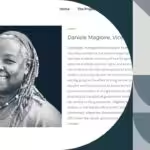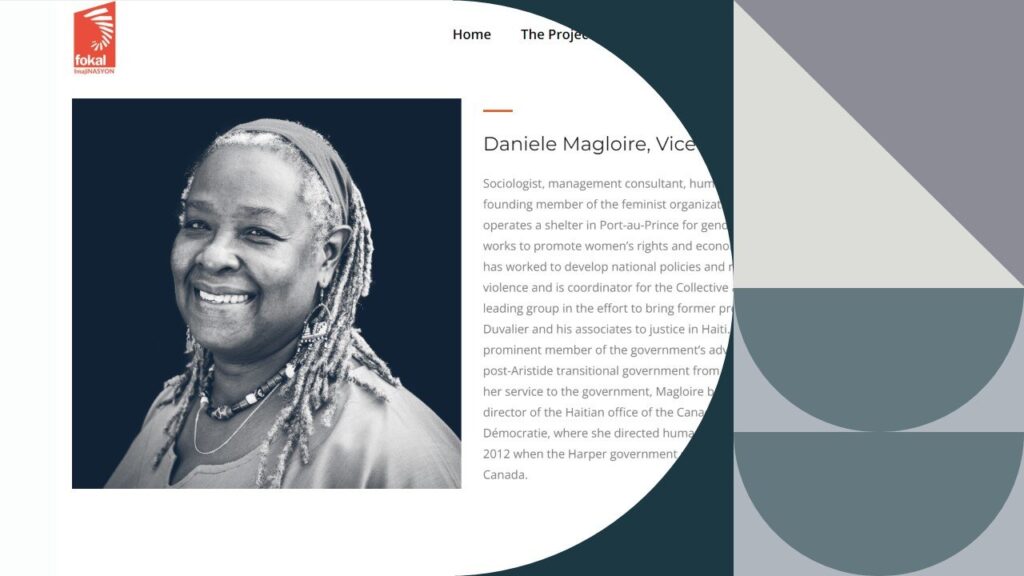
Daniele Magloire's profile on FOKAL's website. Photo: The Canada Files.
Daniele Magloire's profile on FOKAL's website. Photo: The Canada Files.
By Travis Ross – Nov 7, 2024
The Canadian government is coordinating with the United Nations to implement programs in Haiti intended to influence governance and elevate key actors into positions of leadership. Meanwhile, the Canadian government, along with private foundations like the Open Societies Foundation, funds feminist organizations inside Haiti led by the next generation of imperialist feminists. These feminist leaders have worked to manufacture consent for the unpopular Transitional Presidential Council and the armed intervention force, the Multinational Security Support Mission.
Some of the imperialist feminists follow the steps of key political figures in Haiti like Montana Accord spokesperson Magali Comeau Denis.
Magali Comeau Denis’s role in Haitian politics over the past 21 years exemplifies the nexus of imperialist power and influence in Haiti’s liberal bourgeois feminist movement.
Comeau Denis was selected by the “Council of the Wise” to be the Minister of Culture in the Latortue/Boniface coup regime. Among the seven members of the “Council of the Wise” were Danièle Magloire and Dr. Ariel Henry.
Comeau Denis’ unelected position was due, in part, to her participation in the propaganda campaign against Aristide’s democratically elected government. Comeau Denis was the leader of the Collectif Non, a collective of elite artists, educators, and writers. Comeau Denis co-wrote a letter in September 2003 signed by dozens of Haiti’s elite, calling Aristide’s government a “tyrannical power” experiencing “totalitarian drift.”
The letter was also signed by several elite writers, academics, and artists including Danièle Magloire, Yanick Lahens, and director Raoul Peck.
Once she had taken office, Comeau Denis led the campaign to jail popular Lavalas leader Father Gérard Jean-Juste.
Following her time in the coup regime, Comeau Denis returned to her career as an stage actress, while maintaining advisory roles for elected officials. But in 2021, she reappeared in a leadership role in Haitian politics.
Comeau Denis was one of the founders of the Haitian Civil Society Forum (Forum Société Civile Haitienne or FSCH). The FSCH proposed the creation of the Commission to Research a Haitian Solution to the Crisis (Commission pour la Recherche d’une Solution Haïtienne à la Crise, CRSHC) in January 2021, in response to the crisis caused by then President Jovenel Moïse’s refusal to step down from the presidency on February 7, 2021, when many legal experts and Haitian judicial institutions said his term had ended. The CRSHC was launched a few months later in May 2021.
The CRSHC resulted in the Montana Accord, announced on August 30, 2021.
The coalition behind the Montana Accord quickly became the main rival to PM Ariel Henry’s coalition. Montana’s two main spokespeople were Comeau Denis and economist Jacques Ted Saint-Dic.
Montana’s leadership’s strategy for attaining power in Haiti was centered on appealing to Washington for legitimacy and control of a transitional government. Montana representatives met over and over again with American diplomats and government officials. The strategy of appealing to Washington for legitimacy as a path to install a Montana-led transitional government eroded their support inside Haiti.
Speaking on the ”Panel Magik” show a year after the Montana Accord was announced, Saint-Dic revealed the plot. In response to a question about his desire to gain the support of the leaders in Haiti’s private sector, Saint-Dic argued that “with a united bloc they [the leaders in the private sector] will have greater influence on the political and social fronts.” This would facilitate Montana leadership’s mission “to lay the foundations for the reconstruction of a national bourgeoisie.”
Saint-Dic, like his fellow Montana Spokesperson Comeau Denis, see themselves as Haiti’s rightful heirs to power, a national liberal bourgeoisie that must be restored.
This is what the Montana Accord now represents: a front for Haiti’s liberal bourgeoisie who back neoliberal reforms.
The rise of Michel Martelly and the neo-duvalierist movement in 2010, culminating in the election of the Haitian Tèt Kale Party (PHTK) in 2011, simultaneously pushed the liberal bourgeoisie out of political power in Haiti. They had lost the favor of Washington.
The PHTK have maintained their grip on power since then with the support of Washington and the CORE group who interfered in the (s)elections in 2010 and 2017 to ensure PHTK victories.
Haitians largely did not participate in these sham elections. Only 20 per cent of Haiti’s voters showed up to vote in the election that brought Jovenel Moise to power.
In an article for Jacobin, Jake Johnston pointed to four critical factors for the apparent loss of faith in electoral democracy among Haitians generally:
“The impact of foreign intervention, the crushing constraints of neoliberalism, and the prioritization of economic stability over democracy,” followed by the “disappointments and betrayals of left-leaning political leaders, put into office by Haiti’s once-powerful popular movements, only add to this sense of apathy.”
The sidelining of the liberal bourgeoisie after Martelly’s election has continued up until the present day and is reflected in the make-up of the Transitional Presidential Council (TPC). Four of the seven voting members of the TPC are associated in some way to the PHTK. The Montana Accord, which has transformed into a civil society front for the liberal bourgeoisie, represented by Fritz Jean, has one seat on the TPC.
The remaining members are Leslie Voltaire, who represents the Fanmi Lavalas party, and Laurent Saint-Cyr, who represents the elite business sector in Haiti’s capital, Port-au-Prince (the oligarchs). Saint-Cyr has occupied various leadership positions in the American Chamber of Commerce in Haiti and the Chambre de Commerce & d’Industrie d’Haïti.
Washington and the CORE group forced these two sectors to assemble and form the TPC. Membership of the TPC was determined by Washington and their proxies at CARICOM. Members were obliged to accept the Multinational Security Support Mission (MSS) as a precondition to enter into negotiations for a seat on the TPC.
Having accepted their role in facilitating another armed intervention while Washington regains colonial control of Haiti, Comeau Denis and Saint-Dic have played key roles in this violation of Haiti’s sovereignty.
Imperialist feminists manufacture consent for the Washington-imposed TPC
Predictably, the imperial feminists have fallen in line with Washington and CORE group policy.
One of their roles is to manufacture consent for Washington’s plan for Haiti by tacitly supporting the TPC and Conille’s government. Their critique focuses on whether the members of Conille’s government are properly vetted by their organizations, and whether there are enough women within. These kinds of complaints about the TPC and Conille’s interim government fall within acceptable boundaries of political discourse from the perspective of the Canadian and American governments.
For example, writing on behalf of Kay Fanm, Daniele Magloire released a statement on June 25, 2024, questioning the selection of Marie Françoise Suzan for the position of Minister for the Status of Women and Women’s Rights (MCFDF).
Magloire opposed the nomination for two reasons: First, her credentials were not made available so that Haitian feminist groups could scrutinize her background. Second, Suzan proposed renaming the Ministry the “Ministry for the Status of Women, Women’s Rights and the Family,” adding supporting families to the dossier the Suzan would oversee.
Magloire claimed that with the inclusion of “family” in the dossier of the Ministry, Suzan “demonstrates unacceptable sexism which supports the system of oppression of women.”
Suzan’s selection had already received criticism from other feminists. Ultimately, these critiques are based on Suzan’s proximity to the PHTK.
Suzan expressed a desire to create “gender parity” in Haiti at a symposium held on August 27, 2024. Organized by the MCFDF and the UN, the symposium was titled “the place of women in the transition.” Suzan promised 50 million gourdes (approximately 524 thousand CAD) would be allocated to “help women in detention regain their dignity and maintain hope.”
A few days earlier, Suzan visited the Centre for the Rehabilitation of Minors in Conflict with the Law (CERMICOL). CERMICOL is seriously overcrowded, holding 152 detainees (140 women and 12 minors). In a speech delivered there, Suzan acknowledged that many of the detainees have experienced “prolonged preventive detention without having been heard by a judge for several years” and promised to “examine the grievances of the detainees, take into account the reasons for their incarceration, and give priority to those who deserve it.”
Two days after the symposium, Suzan visited a former women’s prison in Pétion-Ville in order to begin renovations. This would presumably mitigate overcrowding in other women’s prisons.
Maintaining the acceptable bounds of political discourse from the imperialist perspective, Magloire doesn’t critique the TPC’s legitimacy. Nor does she challenge the legitimacy of the MSS.
Haitian imperialist feminists’ main focus is the number of women in Conille’s interim government and other political bodies associated with the transition to elections in 2026, which CARICOM has offered to supervise.
In early June, a joint statement from several organizations was released demanding that “one half of all ministry posts in the forthcoming government and at least one third of all positions related to the transition” go to women. The media contacts for the joint statement are Pascale Solages, founder of the Haitian feminist organization Négés Mawon; Rosy Ducema of the National Human Rights Defense Network (RNDDH); Mario Joseph of the Bureau des Avocats Internationaux (BAI); and Brian Concannon and Sasha Filippova of the BAI’s partner organization the Institute for Justice & Democracy in Haiti (IJDH).
The TPC only has one member who is a woman, and she maintains observer status and cannot vote.
Once Conille selected his cabinet, women held four out of 14 positions, just under 30% of the total. Writing for Stabroek News, Sasha Filippova explained that these four women “have six Ministerial mandates among them.” Filippova notes that these Ministries include “powerful ones like the Ministry of Foreign Affairs and the Ministry of Finance.”
The selection of these four women ministers “meet the Constitution’s 30% quota.” Thirty percent is not, however, the parity the organizations in the joint statement were demanding.
For comparison, only two countries in Latin America and the Caribbean have achieved gender parity in their parliaments: Cuba (56%) and Nicaragua (54%). While women hold, on average, 36% of parliamentary seats in Latin America and the Caribbean, and make up 33% of parliamentarians in Europe and North America.
If Haiti were to have an equal number of men and women in Parliament, it would be the seventh nation on the planet to achieve this.
The joint statement goes on to explain that “the exclusion of women from the TPC is a giant step backward from decades of hard-won progress towards equality.”
The statement then quotes Rosy Ducema from the RNDDH, who said “in this pivotal moment in Haiti’s democracy,” women “are being given nothing but a chance to watch men make decisions from the observer seat.”
The irony is lost on Ducema.
The RNDDH played a key role in the coup d’etat that forced President Jean-Bertrand Aristide from power in 2004. The RNDDH is generally understood to be a political organization beneath the facade of a human rights group.
Human rights lawyer Mario Joseph, the managing attorney at the Bureau des Avocats Internationaux (BAI), once referred to RNDDH (then named NCHR-Haiti) as an “injustice machine” that was invented using Canadian government funding. He argued that the RNDDH’s accusations against Fanmi Lavalas leaders were political and resulted in “more than a hundred Fanmi Lavalas grassroots activists” being “arrested and detained with no charge, and no trial.”
Joseph’s current collaboration with the RNDDH, an organization he clearly loathed in the past, will be explored in a forthcoming article.
Indeed, virtually every Haitian has an “observer seat” in governing Haiti, as Washington fundamentally controls the TPC, interim government, and will inevitably guide eventual (s)elections towards a government compliant to US interests.
This tacit acceptance of US hegemony while demanding greater representation for women has a historical precedence. Following the 2004 coup, CONAP released a statement recommending that Gérard Latortue respect the constitution and ensure one third of the interim government are women.
At the time, CONAP was led by Daniele Magloire, who also sat on the “Council of the Wise.”
CONAP’s recommendation was met. Danielle Saint-Lot, Josette Bijoux, Adeline Magloire Chancy, and Magali Comeau Denis were selected for key ministerial positions in the unconstitutional coup government.
NGO leader backed by Haitian women advocacy and feminist organizations for interim government position
Once Ariel Henry resigned following his forced exile by Viv Ansamn in late February 2024, several women’s advocacy groups in Haiti threw their support behind Novia Augustin as a candidate for the TPC. On March 20, 2024, Mapou News Haiti reported that Augustin, a lawyer, had backing from a “broad range of organizations representing various sectors of Haitian society” including “support from women’s organizations across the country.”
Augustin is the head of Refuge Des Femmes D’Haïti (Ref-Haiti) a UN-partnered NGO that promotes women’s rights and women’s health. In contrast to the imperialist feminist groups and leaders discussed in the article, Augustin doesn’t seem to speak publicly on affairs outside advocacy for women’s rights.
Augustin is also vice president of the Fédération des Organisations de Femmes pour l’Égalité des Droits Humains (Federation of Women’s Organizations for Human Rights and Equality – FEDOFEDH). Founded in March 2021, Augustin claims FEDOFEDH represents “more than 300 organizations, platforms and other women’s federations across the country’s 146 municipalities.” FEDOFEDH supports gender parity in government.
Augustin’s role as leader of Ref-Haiti and VP of FEDOFEDH has facilitated the UN’s move to connect to many of the women’s advocacy groups who make up its membership.
She remarked in an interview that “we work closely with UN Agencies to support women”, while a UN report explained “technical support from UN Women” has allowed Ref-Haiti “to have full coverage in the Metropolitan Region and even to expand to other departments” where “dozens of women’s organizations, members of FEDOFEDH” are located.
Augustin’s bid for a seat on the TPC was ultimately ignored. She did, however, receive an award for her work in women’s advocacy from the Ministère à la Condition féminine et aux Droits des femmes—a government ministry—on May 30, 2021, three days before Garry Conille was sworn into office.
Augustin does not seem to have any direct relationships with the Canadian and American governments. Nor do the organizations she represents seem to take funding from private foundations like OSF and AJWS.
Her proximity to the UN, one of the international actors that has had a key role in destroying Haiti’s democracy and sovereignty, follows a pattern among Haiti’s feminist leaders. A pattern of tacit or open support for American foreign policy in Haiti.
The CORE group is chaired by the UN special representative to Haiti. It has long been recognized that UN policy in Haiti follows Washington’s lead.
The Canadian government funds the next generation of imperialist feminists in Haiti
Before founding Négés Mawon (Maroon Women), Pascale Solages served in the cabinets of two ministers of women’s affairs and women’s rights, Marie Denise Claude and Eunide Innocent.
Claude was brought into ministerial positions from Réné Préval’s INITE party. Eunide Innocent led Haiti’s Ministry for the Status of Women beginning in 2017. Both Innocent and Claude served under PHTK governments.
Innocent also heads the Plateforme des Organisations de Femmes Haitiennes pour le Developpement (Platform for Haitian Women’s Organizations for Development – POFHAD). POFHAD is partnered with the UN through the UN Women’s Peace & Humanitarian Fund and the French Embassy in Haiti. Innocent also led the Coalition Haïtienne des Femmes Leaders (COHFEL), a USAID initiative.
Solages, who currently lives in the US, is also a co-founder and spokesperson for Nou Pap Domi (“We are not Sleeping”—NPD). The activists who make up NPD came from the Petrochallenger movement that led massive protests inside Haiti in 2017 and 2018 against then-President Jovenel Moïse’s government.
NPD is also a founding organization of the coalition behind the Montana Accord.
Solages, like other members of NPD, see Magali Comeau Denis as a mentor, and they clearly share a fondness for each other.

Solages also collaborates with the older generation of imperialist feminists, like Magloire. They have spoken on panels at various conferences and presentations together.
For example, Solages joined Danièle Magloire and the Montana Accord Spokesperson Monique Clesca for a conference organized by the Canadian Embassy in Haiti in March 2021.
Solages, like others from NPD, founded an organization with funding from the same governments and foundations which provided funding for organizations like CONAP, Kay Fanm, SOFA, and others.
For example, Emmanuela Douyon, another prominent NPD spokeswoman and avowed feminist, previously worked for the NDI, an arm of the National Endowment for Democracy (NED), a CIA cut-out. Later, she received an NED grant and funding from AJWS to found a “think tank” named Policité.
Douyon offered support for Washington’s Global Fragility Act (GFA) at a December 15, 2022, Alliance for Peacebuilding conference. She attended this conference with fellow NPD member Jeffsky Poincy. Poincy said he was “glad Haiti is part of the GFA.” Poincy is a program manager at Partners Global, a consultancy firm funded by the US State Department, the Canadian government, the Open Society Foundation, and USAID.
In the words of Guyanese educator and activist Gerald A. Perreira, many of the NPD spokespeople have been “NGO-ized.”
Their career trajectories are comparable to imperialist feminists like Danièle Magloire and Michèle Pierre-Louis.
The Canadian government helped to launch Négés Mawon. The organization was founded in 2015, in part through funding from the Canadian government and the Open Societies Foundation. Négés Mawon continues to receive funding from the Canadian government, and now includes AJWS, FOKAL, and the UN Women’s Peace & Humanitarian Fund amongst its partners.
Some of Négés Mawon’s members also have direct links to the 2004 coup d’etats. Négés Mawon’s Advisory Council includes Rosy Ducema of the NED and Canadian government- funded RNDDH, and Yanick Lahens, a former member of the Group of 184 and signatory to Comeau Denis’ Collectifs Non letter that condemned Aristide as a tyrant.
The US-backed Group of 184 was a group of Haitian elites who led “civil society” protests and opposition against President Aristide in the lead up to the 2004 coup d’état. According to Guy Philippe, elites within the Group of 184 financed the purchase of arms and ammunition for paramilitary forces which played a key role in the 2004 coup.
The ease with which NPD’s members fell in sync with Haiti’s liberal or “enlightened” bourgeoisie, represented by the likes of Comeau Denis, Pierre Espérance, Danièle Magloire, and Michèle Pierre-Louis is largely a consequence of their mutual class interests.
NPD, rooted in the Petrochallenger movement, was led by its middle-class spokespeople. Nearly all of the Petrochallengers spokespeople who moved on to form NPD eventually partnered with foreign governments (Canada, US, and France) or private foundations like OSF and AJWS to found various organizations. If not, they work for large companies like Digicel who have direct ties to USAID.
The emergence of the Petrochallenger movement marked a significant change in the class dynamics of the protest movement in Haiti, which had seen, up until then, massive influence from Haiti’s poor masses.The Petrochallengers organized and led two massive protests on October 17, 2018 and November 18, 2018.
At the time, the Petrochallengers were keenly aware of this. In one interview, NPD member Vélina Charlier said “Nou Pap Dòmi is a collective of rebels who dare to go against this system,” while Emmanuela Douyon clarified that NPD was not revolutionary: “I’m afraid of the word,” she said. “It’s too big.”
Indeed, Professor Robert Fatton deemed NPD “neutral in terms of politics.” While Haitian human rights advocate Jocelyn Mccalla said that NPD needed to be “more politically engaged.”
Kim Ives explained that the Petrochallengers were “unofficially headed by Réné Préval’s protégé and foiled presidential candidate Jacky Lumarque, Quisqueya University’s rector.” In his team, Ives explains, are familiar figures such as “Préval’s former prime minister Michèle Duvivier Pierre-Louis, and bourgeois businessmen like Reginald Boulos and Dimitri Vorbe.”
The destiny of NPD members to be absorbed into the network of NGOs partnered with foreign governments and private foundations seems to be a foregone conclusion in hindsight. The governments of the United States and Canada are actively seeking Haitians, particularly Haitian women, to partner with and provide funding to.
The Canadian government’s Women’s Voices in Leadership project has provided funding for 36 local women’s rights organizations in Haiti. Its overall budget was $8.3 million between the years of 2018 and 2023.
The Canadian government recently announced that it is renewing funding for its Women’s Voice and Leadership program, totaling over 200 million CAD in new funding over five years.
It is unclear how much of this new funding will be devoted to Haiti.
According to the announcement, the initiative is aimed at “the management and sustainability of more than 20 grassroots women’s organizations and up to six women’s umbrella organizations in Haiti”. The initiative also aims to improve the “effectiveness of six advocacy groups who are trying to influence the development of gender-sensitive laws and policies [author’s emphasis].”
In coordination with UN Femmes Haiti (United Nations Women—Haiti), the initiative has brought together several small, local women’s advocacy groups from across Haiti concerned with issues related to women under the banner of the Platformes Politiques pour des organizations de Femmes (Political Platform for Women’s Organizations). The focus has been on “promoting women leaders” to “expand dialogue and participate in advocacy and mobilization to ensure the respect of the rights and the representation of women in spaces of dialogue and decision-making in Haiti.”
This initiative between ONU Femmes and the Canadian government included “three days of training for 40 women at the Montana Hotel in May of 2022” where candidates received a certificate for the three days of training at the Académie de Leadership Politique Féminin (ALPF). Criteria for candidacy included being fluent in spoken and written French and having at least two years in a recognized organization promoting women’s rights. Virtually guaranteeing that these candidates would be drawn from the same organizations already connected in some way to the UN or the Canadian or American governments.
Efforts by the UN and the Canadian government to cultivate a new generation of women leaders are far-ranging. According to a Canadian government report, the Appui à une gouvernance locale et inclusive en Haïti program “prepared” 79 women civil society leaders to “actively participate in consultations on reforms related to territorial governance project.” The project lasted six years—from 2018 to 2024. Its budget was over $15 million CAD.
Who Canada funds, and who it wants suppressed
This effort by the UN and the Canadian government to influence governance structures of various local women’s advocacy groups and network them into large federations represents yet another threat to Haitian sovereignty. Ottawa has already demonstrated its willingness to fund and elevate imperialist feminists like Magloire who actively participated in undermining Haitian sovereignty and democracy.
The UN and the Canadian government’s attempts to meddle in Haitian society through so-called feminist policies are not the only threat to Haiti’s sovereignty. Other organizations tied to the 2004 coup—USAID and the Haitian Democracy Project—have also reframed their interventionist policies with the same rhetoric used by the UN and Canadian government purporting to support women’s leadership and feminism.
Imperialist governments do not fund organizations and leaders who fundamentally challenge their foreign policy. Therefore, one can presume that Haitians selected to participate in these programs are compliant with the framework of the foreign policy imposed by the UN, Washington, and Ottawa, which sees Haiti as a colony of the United States.

Travis Ross is a teacher based in Montreal, Québec. He is also the co-editor of the Canada-Haiti Information Project at canada-haiti.ca. Travis has written for Haiti Liberté, Black Agenda Report, TruthOut, and Rabble.ca. He can be reached on Twitter.