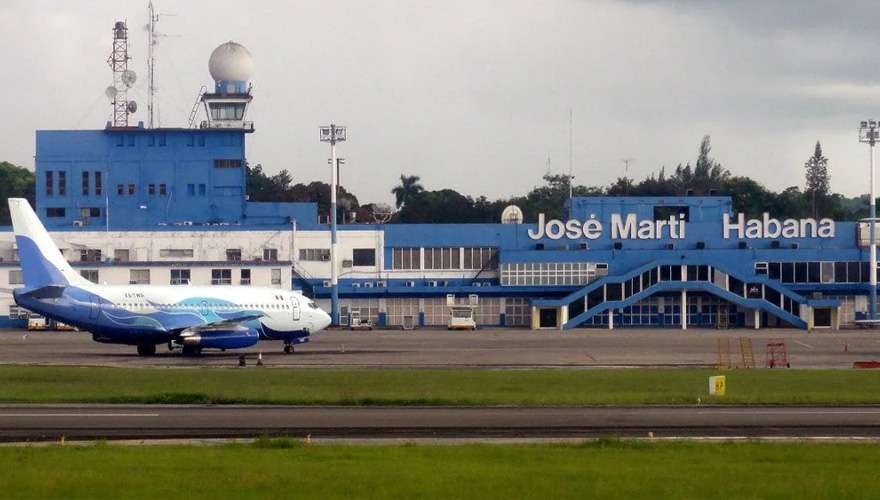
José Martí International Airport in Havana, Cuba. Photo: Getty Images.
José Martí International Airport in Havana, Cuba. Photo: Getty Images.
The energy blockade imposed by the United States continues to cause great damage to the people of Cuba.
The Cuban government has issued a critical alert to international airlines over the imminent depletion of aviation fuel reserves. This situation, confirmed by various sources to the EFE news agency, is the direct consequence of the total oil siege imposed by the United States.
As of this Monday, air operations on the island are left at the mercy of a pressure policy that seeks to definitively isolate the Cuban people from the rest of the world.
Affected companies, with key routes from Spain, Mexico, Panama, and the United States itself, have not yet detailed how they will overcome this logistical obstacle. The shortage threatens to disrupt flight frequencies and immediately alter the schedules of thousands of passengers.
The measure not only hits the state economy but also strips citizens of their right to mobility and connection with the outside world. The oil blockade constitutes yet another violation of human rights and international law by the United States’ imperialist regime.
Although the island has faced similar crises in the past, particularly during the Special Period following the fall of the USSR, the current severity marks a breaking point. On previous occasions, airlines managed to mitigate the impact through technical stopovers in neighboring countries to refuel. However, the extreme tightening of current sanctions complicates any logistical survival alternative for the Cuban aviation sector.
Trump’s presidential order: a war against subsistence
The energy stranglehold was launched through a presidential order by US President Trump that uses trade as a weapon of war. By threatening tariffs on third countries that supply oil to Cuba, Washington has established a siege that goes beyond bilateral borders.
Under the unproven pretext of alleged national security concerns and an attempt to portray Cuba as a threat to the United States, a policy of collective punishment has been put in place that ignores the basic needs of the civilian population.
This escalation began at the start of the year with the interruption of Venezuelan supply of oil to Cuba. Since the election of Hugo Chávez in 1998, Venezuela has maintained a consistent supply of energy for Cuba. By closing this vital tap, the US regime has left Cuba in an extremely vulnerable positing, forcing it into negotiations under coercion. While the Cuban government remains open to dialogue, pressure from the White House is attempting to force a political surrender through hunger and lack of fuel.
Cuba’s dependence on imported crude oil is the Achilles’ heel that Washington has chosen to attack with mathematical coldness. Given that the country produces only one third of what it consumes, the cut in supplies from Venezuela, Mexico, and Russia creates great disorder in the daily life of Cubans. The impact extends far beyond airplanes: the lack of fuel translates into darkness spreading through all strata of Cuban society.
An emergency plan in the face of the people’s extreme vulnerability
Faced with the impossibility of importing petroleum or derivatives, Havana has been forced to implement a subsistence plan bordering on the agonizing. Measures include the suspension of diesel sales and drastic cuts in sensitive sectors such as health and public administration.
The closure of hotel infrastructure and the reduction of hospital services highlight the human dimension of this criminal blockade.
Cuba is facing this onslaught at its moment of greatest economic fragility in recent decades. After six years of deep crisis, characterized by runaway inflation and shortages of basic goods, the population is exhausted. Prolonged power outages and medicine shortages were already part of daily life before the oil siege intensified.
The lack of aviation fuel is the latest link in a chain of measures designed to collapse Cuban resistance.
(Últimas Noticias) by Randolph Borges
Translation: Orinoco Tribune
OT/CB/SL

Cameron Baillie is an award-winning journalist, editor, and researcher. He won and was shortlisted for awards across Britain and Ireland. He is Editor-in-Chief of New Sociological Perspectives graduate journal and Commissioning Editor at The Student Intifada newsletter. He spent the first half of 2025 living, working, and writing in Ecuador. He does news translation and proofreading work with The Orinoco Tribune.