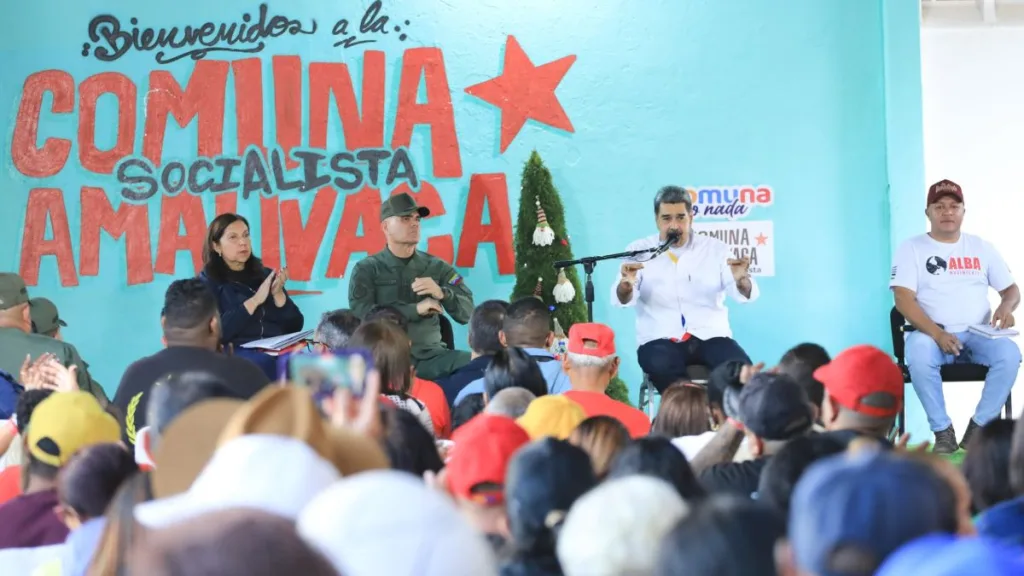
Venezuelan President Nicolás Maduro at an official event at the Amalivaca Commune in Caracas. Photo: Telegram/SputnikMundo.

Orinoco Tribune – News and opinion pieces about Venezuela and beyond
From Venezuela and made by Venezuelan Chavistas
Venezuelan President Nicolás Maduro at an official event at the Amalivaca Commune in Caracas. Photo: Telegram/SputnikMundo.
Venezuelan President Nicolás Maduro recently highlighted the role of the National Council for Productive Economy in driving the growth of a new, self-sustaining economy.
During a meeting on Friday, December 13, which brought together the government, the banking sector, and representatives of the country’s main business chambers, he presented the year-end gross domestic product (GDP) growth forecast of 9%, surpassing the Economic Commission for Latin America and the Caribbean (ECLAC) projections and marking 18 consecutive quarters of sustained economic growth.
The president emphasized the urgency of “fine-tuning the complete substitution of imports” as a path toward exchange rate stabilization and the construction of an autonomous economic model.
“We must accelerate the transition to an autonomous model that generates its own products, its own wealth, and has the necessary foreign exchange for perfect stability of the exchange rate system,” he underscored.
In this context of evaluation and projection, Sputnik spoke with Venezuelan economist Katiuska López, who analyzed the scope of this council, the evolution of the Venezuelan national economic model, and the recent geopolitical challenges.
Tangible results
According to López, the mere convening of the council and the results presented are, in themselves, “wonderful news.” She emphasized that the presence and active participation of the national private sector lends incontestable legitimacy to the shared data.
“No one can come and say that the data is biased or that it only comes from the government or the state, that the figures are doctored or made up,” the economist said.
This diagnosis of synergy and productive unity was endorsed during the council by Vice President Delcy Rodríguez, who declared that “there is not a single productive sector in Venezuela that is not showing growth today.”
Rodríguez congratulated business owners and workers for their “great effort of cohesion and national unity” to overcome the effects of the economic blockade.
But how did this come about? López pointed out that there has been a structural paradigm shift in the Venezuelan economy. In her view, the main achievement of the process has been the transition from a rentier economy dependent on imports to one focused on domestic production.
“Having gone from importing 85% of what we consumed to producing 90% of what we consume domestically already gives us, in a way, a total shift in the functioning of the economic structure,” she explained.
This figure, in her view, constitutes one of the “great medals” won by the Venezuelan people and government because it breaks with the historical logic of dependence.
President Maduro framed this transformation within the Bolivarian Economic Agenda and its 14 engines, a model that, in his words, is “admired around the world” for demonstrating how a country under “economic warfare, blockade, and sanctions” found its path to development.
This new pattern not only covers domestic demand. López highlighted that non-oil exports have increased by 14% this year, with shipments abroad of products such as rice, flour, cocoa, and coffee. “That represents a significant shift in Venezuela’s economic engagement with the world,” she said.
Venezuela Defied Blockade With Economic Growth in 2025 (+Statistics)
Productive reconciliation
One noteworthy aspect is the committed participation of business chambers, which have historically been opposed to the economic policies of the Bolivarian Revolution. According to the economist, this adjustment is the result of an evolution on both sides.
On the one hand, she pointed out that the business sector “has had to acknowledge that, indeed, public policy and the path set by the Bolivarian Revolution does lead to the development of society.”
On the other hand, the government has worked to simplify procedures for production and export, generating greater confidence among investors.
“We are pursuing societal development along the same path,” she added. At the same time, there are tangible improvements in areas such as security, which, in her view, has created a virtuous synergy with the potential for businesses to expand.
Resilience amid new economic aggressions
Sputnik’s interview with the expert took place against the backdrop of escalating US pressure, following the recent hijacking of an oil tanker from near the Venezuelan coast by the United States.
López said that these bellicose actions are aimed at halting the progress of the Venezuelan economy. However, “now it is not the same as how we would have been impacted in 2014 or 2015, when we still depended entirely on oil revenues and imports … We have overcome that dependence,” she added.
She used a metaphor to illustrate the current resilience of the national economy.
“We have to consider the economy as a living organism. Earlier it has been stopped, and we cannot expect it to take off running right now, of course, but it is not at its worst,” she said.
A unique model for the present
The economist considered that the Venezuelan economy is undergoing an accelerated transition, having been able to internalize its production and consumption chains, diversify its exports, and build bridges with domestic economic sectors that were previously adversaries.
The data presented by the government—the projected 9% GDP growth, the 18 consecutive quarters of growth, and the increase in non-traditional exports—serve as the basis for its argument about a sui generis model forged under the pressure of sanctions.
This model, according to López, is not a theoretical recipe imported from abroad, but one that has been adapted to the idiosyncrasies of a “consumer society” that now produces what it consumes.
The immediate challenge, as pointed out by President Maduro himself at the council, is to deepen the “radical import substitution” in order to safeguard exchange rate stability and consolidate autonomy.
(Sputnik) by José Negrón Valera
Translation: Orinoco Tribune
OT/SC/DZ