Elite UK Military Unit Secretly Trained by Leftist Regime-Change Advocate Gilbert Achcar and Other Academics

Orinoco Tribune – News and opinion pieces about Venezuela and beyond
From Venezuela and made by Venezuelan Chavistas
Government documents show scholar Gilbert Achcar and other pro-regime change academics have given training sessions to UK Ministry of Defense soldiers, helping the British military enhance its counter-insurgency tactics.
By Ben Norton
Declassified British government documents obtained by The Grayzone show that prominent regime-change activists who work in academia and market themselves as leftists have been quietly teaching training sessions for the United Kingdom’s Ministry of Defense.
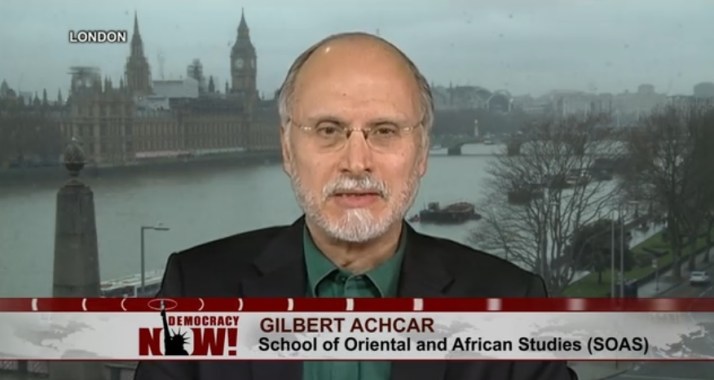
Among these UK military collaborators is the scholar Gilbert Achcar, a frequent contributor to Jacobin Magazine and Democracy Now who teaches international relations at the University of London’s School of Oriental and African Studies.
Achcar has publicly identified himself as a Marxist while vehemently advocating for the overthrow of independent post-colonial governments in Libya and Syria.
Achcar defended foreign intervention in Libya in 2011, insisting “no one can reasonably oppose” the so-called no-fly zone, which was used to violently overthrow the government. And in 2018 he signed an open letter calling for foreign intervention in Syria, citing the “responsibility to protect” doctrine in order to “forcibly stop” the war.
At the same time, Achcar has repeatedly attacked the anti-imperialist left, without ever publicly disclosing his work with the British military.
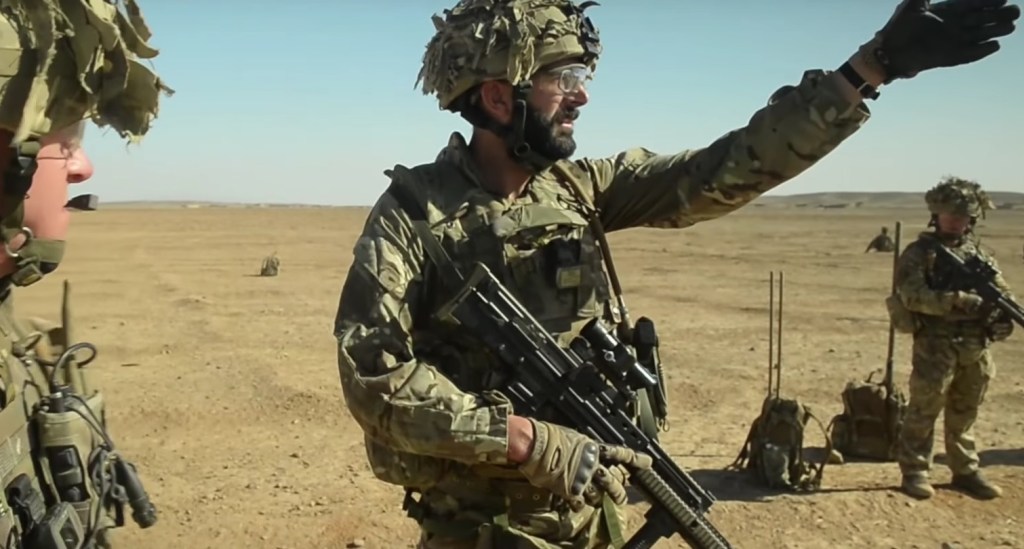
The regular educational sessions led by Achcar and other top academics were organized to train the Defense Cultural Specialist Unit. This wing of the British military is staffed by senior officers who wear full uniform and are embedded with other soldiers on the battlefield.
The unit’s cultural specialists have played a key role in the British war on Afghanistan, and have advised the military on how to operate in other countries, including several nations that were previously colonized by Britain.
Many of the academics involved in these training sessions also teach at the School of Oriental and African Studies, which is known for hiring and producing post-modernist scholars who are progressive but staunchly anti-communist, and often supportive of NATO-backed regime-change efforts and Islamism.
Some of the other scholars involved in the British military program include prominent Yemen expert Helen Lackner, the popular pundit Lina Khatib, and the former director of the BBC’s Arabic and Turkish services.
Like Achcar, Lackner is a regular contributor to left-wing news outlets such as Jacobin Magazine, which this July co-sponsored a socialism-themed conference that featured numerous regime-change activists from US government-funded organizations.
Jacobin has continued publishing articles by Achcar even after his involvement with the British military was first exposed in July by the UK’s Morning Star newspaper and its reporter Phil Miller.
To be sure, the Ministry of Defense (MOD) trainings were not just innocuous educational sessions that equipped soldiers with historical and cultural background. Declassified schedules obtained by The Grayzone show some of the educational sessions focused explicitly on “implications for UK military mission,” providing “key takeaways for MOD personnel.”
The School of Oriental and African Studies and its staff claim otherwise, and have defended their collaboration with the British military.
The Grayzone has gotten access to the declassified British government files and published them in full. For the first time, the public can see for itself how the British military establishment has penetrated ostensibly progressive academic circles.
Training sessions for the UK’s ‘Defense Cultural Specialist Unit’
On July 26, following an explosive report in the Morning Star newspaper, London’s School of Oriental and African Studies (SOAS) published a statement on its website confirming that its faculty trains and advises “government bodies.” It added, “We reject any suggestion that, in undertaking such work, we are perpetuating a colonial approach to between the UK and other nations.”
SOAS also attached a three-page open letter from Gilbert Achcar (also first reported on by Morning Star’s Phil Miller). In the missive, the scholar acknowledged that he provided trainings for the British military.
But Achcar stood by the decision, wondering, “Should we prefer that the military and security personnel of this country be solely exposed to right-wing education?” He drew a false parallel between a school receiving public funding for education and a school taking money from the Ministry of Defense to provide training to the military, maintaining that it is important for self-declared leftists to try training the troops.
Achcar insisted that renowned intellectual Noam Chomsky had “convinced me that it is important to let critical voices be heard even among the military,” noting that Chomsky gave a lecture to the US Military Academy in 2006. (Chomsky collaborated with Achcar on a book on the Middle East.)
The move to expose the role of SOAS academics like Achcar in a military training program began this January when a student at the school filed a Freedom of Information request for government documents related to the UK’s Defense Cultural Specialist Unit and its collaboration with his university.
The student was part of the Decolonising Our Minds Society, a SOAS group that says it “seeks to challenge the political, intellectual and structural legacies of colonialism and racism both within and outside the university.”
The student asked the ministry how much the Defense Cultural Specialist Unit paid for “briefing, training, consultancy, analysis or research, to the School of Oriental and African Studies.”
On April 5, 2019, the Army Secretariat of the UK Ministry of Defense replied with an email containing several files.
These documents — which have been published by The Grayzone and are embedded at the bottom of this article — reveal that the UK’s Defence Cultural Specialist Unit holds what it calls Regional Studies Weeks, “which are designed and delivered on our behalf by SOAS.”
A key component of British counterinsurgency that is ‘essential to equipping the military’
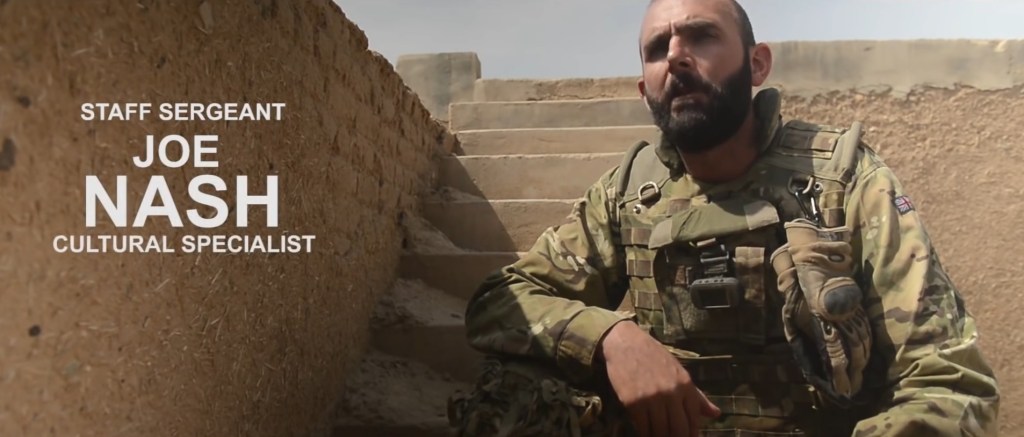
The Defence Cultural Specialist Unit (DCSU) is not just a cultural group; it is a key part of the British military’s counter-insurgency operations.
The unit was formed in 2010, soon after the UK withdrew from the war in Iraq, and while it was still bogged down in Afghanistan. The Ministry of Defense said in a news report announcing the unit’s creation that it was deploying “military specialists in Afghan culture and language to advise commanders on the ground.” Most of these specialists were themselves uniformed “senior military officers.”
The UK’s assistant chief of the defense staff, Andy Pulford, said the “unit is essential to equipping the military with a better understanding and appreciation of the region, its people and how to do business there.” The Defense Ministry added that the “immediate focus for the DCSU is supporting operations in Afghanistan but it will evolve alongside operational requirements to fit the needs of the military in future conflicts.”
Defense Cultural Specialist Unit forces are frequently deployed side-by-side with soldiers in Afghanistan, according to publicly available postings on the UK government’s official website. In Kenya, they have also deployed with the Psychological Operations Group, as well as in Bosnia and Herzegovina.
A recruitment video for the unit that was published on YouTube in 2016 showed some of these “cultural specialists” dressed in full military uniform and, to an untrained eye, indistinguishable from soldiers. Many had spent years embedded with the military in war zones.
The recruitment video explained that the DCSU “really came out of the experience in Afghanistan.” When it was first formed in 2010, “the sole focus, the whole point of the unit, was for Afghanistan.”
By 2016, a DCSU officer said the mission had shifted: “It’s completely different now. It’s a lot broader; it’s a lot wider.”
The DCSU is today active in Bosnia and Herzegovina, which had previously been part of Yugoslavia until it was balkanized in the 1990s in UK-backed NATO wars.
One of the unit’s longest-serving members, Rachel Phillips, lives in Sarajevo and says, “I can give piece of advice to a soldier about a situation in Sarajevo: Don’t do this, or don’t do that, or it’d be better if you did it this way.”
The unit is also active in Jordan, which was a major base of operations for the Western war on Syria, where the CIA and other foreign intelligence services trained and armed Islamist militants in the bid to overthrow the government of Bashar al-Assad.
A cultural specialist deployed in Jordan revealed that the DCSU also has forces active in Libya, Algeria, Tunisia, and Saudi Arabia.
The recruitment video shows DCSU forces are active as well in Kenya, a former British colony.
An officer explained that the unit’s goal was to “work with [cultural] differences so that we can sort of smooth the way for defense.”
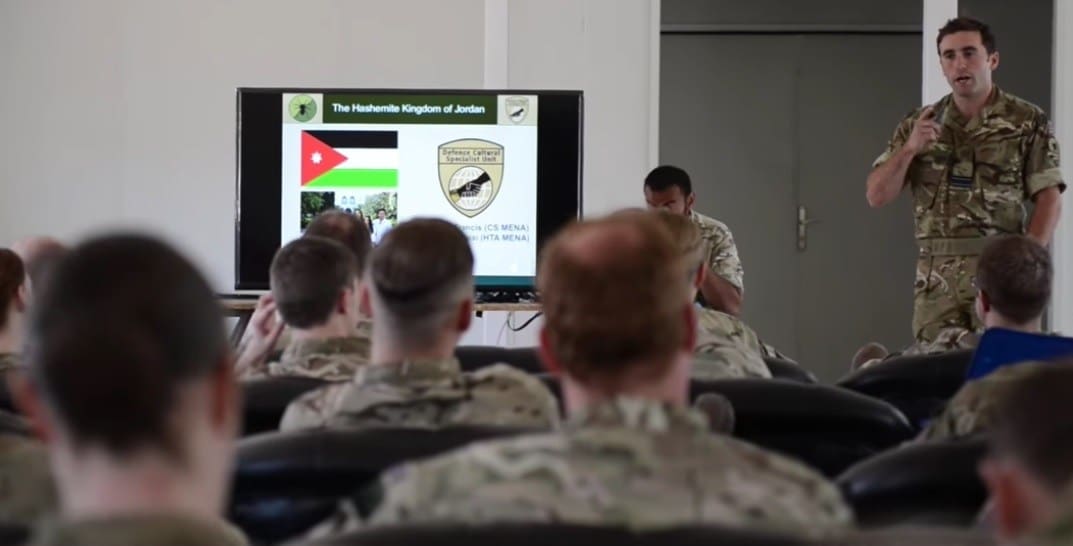
According to the Defense Ministry documents released to the SOAS student, London’s School for Oriental and African Studies designs and delivers these training programs for the DCSU in three different regional groupings: the Middle East and North Africa; Russia, Eastern Europe, and Central Asia; and Sub-Saharan Africa.
The Defense Ministry provided information on payments going back only to May 2017. But the documents revealed that there were SOAS training sessions in May 2017, October 2017, February 2018, July 2018, November 2018, December 2018, and February 2019, with each costing roughly £50,000 or more.
The British military released the schedules for only two of these training sessions, showing that they were held over several days in February 2018 and February 2019. These materials unequivocally demonstrate that leading scholars have been enthusiastically collaborating with the UK’s military.
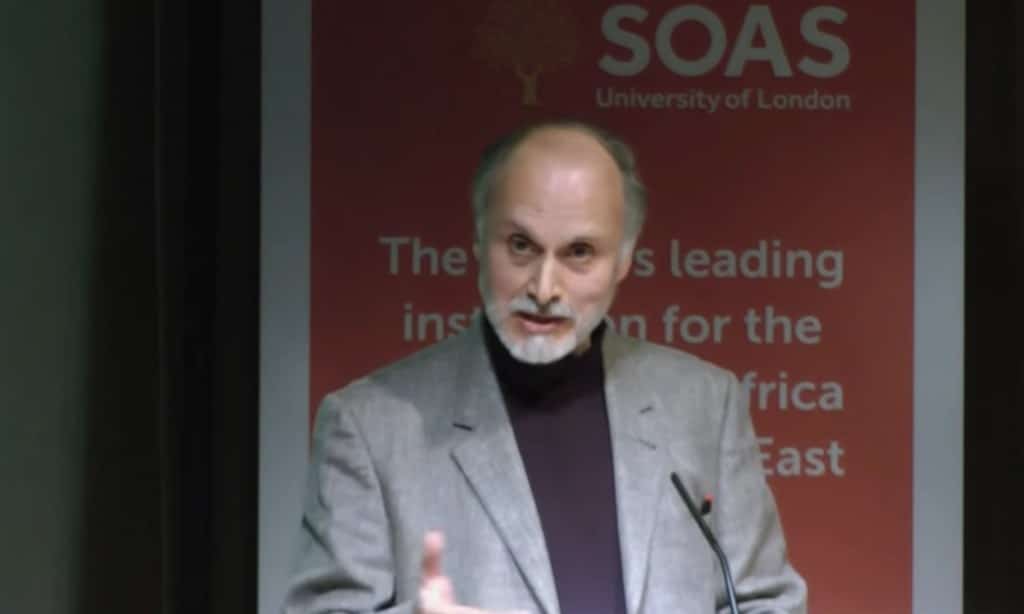
Gilbert Achcar’s training for the UK military
One of the most prominent scholars involved in the British military training sessions is Gilbert Achcar.
Achcar has been a strong supporter of overthrowing the governments of Libya and Syria, portraying the NATO-backed regime-change efforts as “revolutions.”
Achcar kicked off the Ministry of Defense’s five-day Middle East and North Africa Training Program in 2018 with two full days of lessons taught entirely by himself. Indeed, he was more actively engaged in the program than any other scholar.
One of the schedules from 2018 (but mistakenly labelled 2017 in the declassified document), shows that Achcar gave two day-long training sessions to the Ministry of Defense on February 19 and 20.
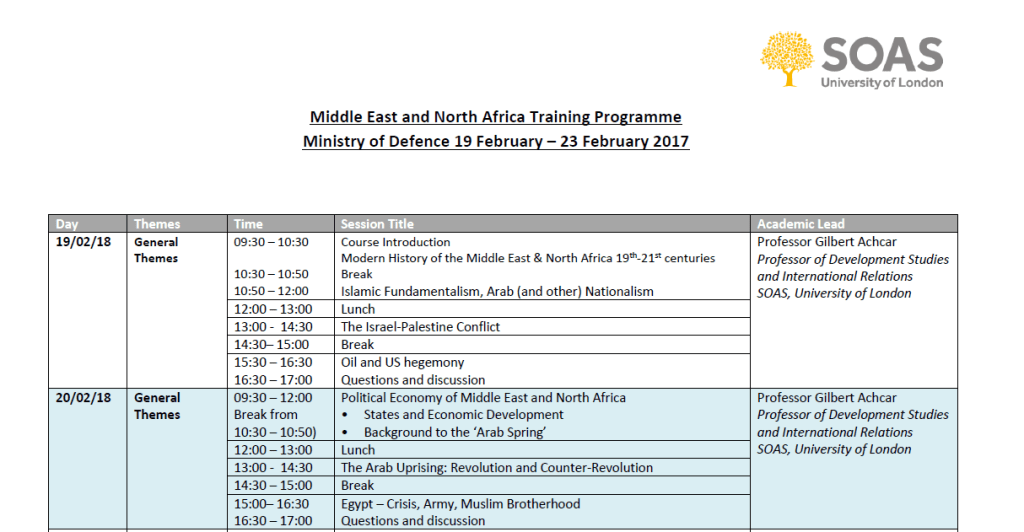
Achcar taught subjects including the so-called Arab Spring, Arab nationalism, Israel-Palestine, the Muslim Brotherhood, and Islamic fundamentalism.
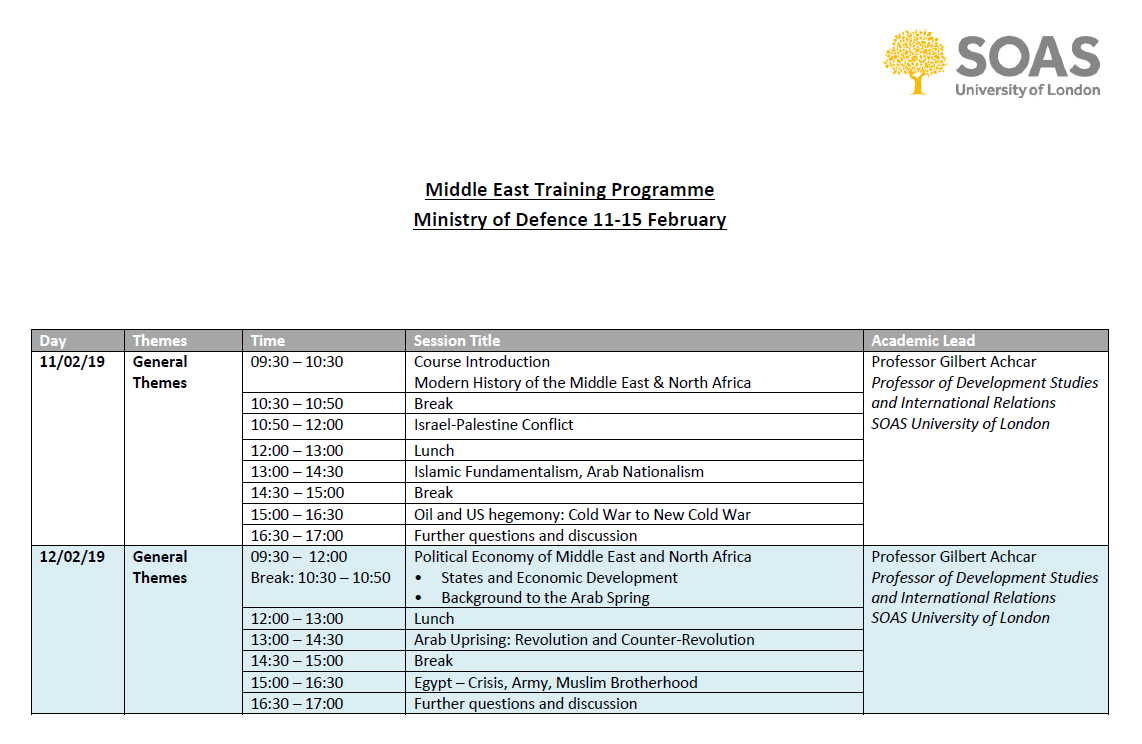
One of Achcar’s sessions was titled “The Arab Uprising: Revolution and Counter-Revolution.” Another was titled “Oil and US hegemony.”
Achcar once again opened up the MOD’s Middle East and North Africa Training Program in 2019, repeating these two full days of sessions on February 11 and 12.
Regime change-supporting ‘Marxist’
Gilbert Achcar’s role in training this important British military unit might come as a surprise to those familiar with the SOAS scholar’s self-portrayal as an anti-war socialist.
Over the years, he has cultivated a reputation as a man of the left by, for instance, co-authoring a book with Noam Chomsky and publishing volumes with titles like “Marxism, Orientalism, Cosmopolitanism.”
But Achcar has also spent years attacking the anti-imperialist left, while lobbying for regime change against the top targets of NATO.
Haymarket Books, the publishing arm of the Trotskyite International Socialist Organization, released a volume in 2018 titled “Indefensible: Democracy, Counterrevolution, and the Rhetoric of Anti-Imperialism.” Authored by Rohini Hensman, the tract was a several hundred pages-long tirade against the anti-imperialist left that featured full-throated support for virtually every regime-change war the West has waged since the 1990s.
The book featured a prominent blurb from Achcar, who praised Hensman for “brushing off all sorts of dogmatic beliefs.” Achcar was apparently so enthused by the book’s contents that he introduced and chaired Hensman’s official launch event, which was held at SOAS.
Almost nothing Achcar says challenges American and British foreign-policy designs in the Middle East, save for his criticism of Israel.
This might explain why a soi-disant “Marxist” scholar linked to numerous Trotskyite groups enjoys positive book reviews in mainstream pro-NATO newspapers like The Guardian.
‘No one can reasonably oppose’ regime change in Libya
In recent years, Achcar has eagerly performed the role of the corporate media’s go-to “socialist” voice, lending credibility to regime-change campaigns against independent post-colonial governments.
In 2011, Achcar was a vocal supporter of regime change in Libya. While claiming to oppose to NATO intervention, the academic strongly cheered on NATO-backed “rebel” groups, many of whom were dominated by extremist Salafi-jihadists who committed egregious war crimes and racist atrocities.
Numerous critics have thoroughly documented Achcar’s public support for regime change in Libya.
In an interview published on the day NATO military intervention began in Libya in March 2011, Achcar acknowledged that the opposition “very heterogeneous,” but insisted that what “unites all the disparate forces is a rejection of the dictatorship and a longing for democracy and human rights.” Critics pointed out that Achcar made this claim while reports circulated about NATO-backed “rebels” ethnically cleansing Black Libyans.
Achcar strongly supported UN Security Council resolution 1973, which imposed a so-called “no-fly zone” over Libya and opened the door for NATO military intervention, leading to the murder of Muammar Qadhafi and the eventual destruction of the Libyan state.
Achcar condemned anti-war skeptics who warned that the Security Council resolution would be used to justify a war of regime change, claiming, “Given the urgency of preventing the massacre that would have inevitably resulted from an assault on Benghazi by Gaddafi’s forces, and the absence of any alternative means of achieving the protection goal, no one can reasonably oppose it.”
He added, “I believe that from an anti-imperialist perspective one cannot and should not oppose the no-fly zone, given that there is no plausible alternative for protecting the endangered population.”
The UK House of Commons’ bipartisan Foreign Affairs Committee later published a report admitting that there was no basis whatsoever for the myth spread by Achcar and the Western government-backed opposition that Qadhafi had planned to massacre civilians in Benghazi.
Like many anti-anti-imperialist leftists, Achcar insisted that he opposed foreign military intervention, even while he actively called for regime change and lobbied on behalf of Western-backed militants. A week into the NATO military intervention, Achcar wrote, “if there is no clarity about what a post-Gaddafi Libya might look like … it can’t be worse than Gaddafi’s regime.”
Today, it is difficult to overstate how wrong he was. Libya went from one of the most prosperous and equitable countries in Africa to a failed state that is still the site of a bloody civil war between multiple competing governments, a huge ISIS threat, and open-air slave markets.
During the NATO war on Libya, Achcar smeared actual anti-imperialists and anti-war skeptics as supporters of a “dictator.” Meanwhile, the scholar Micah Zenko employed the military alliance’s own materials to demonstrate how the war was always about regime change and never related to the protection of civilians in any sincere way.
While NATO was bombing the independent North African nation, Achcar adamantly maintained, “The idea that Western powers are intervening in Libya because they want to topple a regime hostile to their interests is just preposterous. Equally preposterous is the idea that what they are after is laying their hands on Libyan oil.” Both of these actually preposterous claims were proven to be completely wrong.
Lobbying for regime change in Syria
Gilbert Achcar would go on to use the same smear tactics against opponents of regime change in Syria.
Since the war began in the country in 2011, the US, UK, Saudi Arabia, Qatar, and Turkey have spent billions upon billions of dollars to arm, train, and fund a violent insurgency that is dominated primarily by sectarian Salafi-jihadist extremists.
But instead of blaming these foreign governments for needlessly prolonging the regime-change war on Syria, Achcar has put the blame squarely on their enemies, claiming, “If the war is dragging and carrying on, it is because of Russian and Iranian support to Bashar al-Assad. The main responsibility in that regard falls on Moscow and Tehran.”
Achcar adopted the ultra-hardline position of the Syrian opposition in exile, maintaining that Syrian President Bashar al-Assad bears all of the responsibility for the war, and that there is no way to end it without his overthrow.
“The key point again, the stumbling block is Assad,” Achcar maintained. “Assad and his clan. This ruling clan which is controlling Syria for several decades now. This is the point. And this is the source of the whole explosion. And there is no peace coming to Syria as long as they are at the end. That’s out of the question.”
For Achcar, there was only one solution to the war: “What is needed is to get rid of Assad, or to force Assad to step down. Go to Moscow in exile, if you want, or to Tehran. And let this country go into some transition.” He added, “it is just impossible for the war to end in Syria as long as he is in power.”
Borrowing rhetoric familiar to neoconservatives, Achcar was careful to point out that, “when I say ‘regime,’ I am actually referring to the Russia-Iran-Assad axis.”
While attacking what he described as “campist ‘anti-imperialism’ (which by the way is exclusively anti-American, and often even pro-Russian),” Achcar has even defended US military intervention in Syria.
“There are in fact cases,” Achcar claimed in a 2018 interview with a Trotskyite publication, “where the United States supports, as in Syria today, a progressive force in its fight against a reactionary enemy.”
That same year, Achcar joined a who’s who of regime-change activists in signing an open letter published in the New York Review of Books that demanded that the “The World Must Act Now on Syria.”
This open letter explicitly cited the imperialist “responsibility to protect” doctrine, and called on foreign nations to “forcibly stop” the war and provide “immediate protection for all Syrian lives.”
The letter blamed the international proxy war entirely on the Syrian government and its allies Russia and Iran, and insisted that “every member state has nevertheless adopted and pledged to uphold the Responsibility to Protect (R2P) doctrine,” adding that the war “can now only be ended by the elected and appointed members of democratic bodies if they fulfill their obligations under R2P to protect Syria’s endangered population.”
The invocation of R2P — which had previously been used to justify bombing Yugoslavia and Libya — was an obvious call for foreign military intervention. The Achcar-endorsed letter stopped just short of openly demanding military intervention by Western governments, but it was very strongly implied.
“For the agony of the people of Syria to come to an end, this must be forcibly stopped,” the letter continued. “The perpetrators of these colossal crimes against humanity must be halted, once and for all.”
Peddling regime-change conspiracies
While whitewashing and in some cases even defending Western intervention, Achcar also for years adamantly advanced the conspiracy theory that the US government was never truly committed to regime change in Libya and Syria.
In Achcar’s eyes, only the administration of George W. Bush was trying to overthrow independent governments in the Middle East.
As he put it in an interview with Jacobin magazine, “after Bush, the Obama administration was no longer in the business of regime change.”
According to Achcar’s bizarre theory, the United States and Russia were secretly conspiring to preserve the Syrian government, even while they supported opposing sides in the war that were killing each other. “They agreed from the beginning on that,” he claimed.
While burnishing the so-called “Arab Spring” protests with a radical leftist veneer by analyzing them “through Marxist lenses as a classic case of social revolution,” Achcar argued that the US supposedly only wanted to remove the leaders of Syria, Libya, and beyond; while he on the other hand wanted to go a step further, implementing complete regime change that dismantled the governing “regime” as a whole.
As he clamored for the dismantlement of entire state structures, Achcar grossly downplayed the billions of dollars worth of foreign military support Syria’s armed opposition received.
RELATED CONTENT: Jacobin Stabs Venezuela in the Front
“Whatever you want to say, there is no comparison between the support that whoever has received in the opposition has received and the support given to the Assad regime,” he maintained.
Achcar continued drawing false equivalences, arguing that “both the United States of America and Russia are imperialist countries, and [Russian] imperialism is no better than US imperialism.”
Demonizing Iran
Gilbert Achcar has also relentlessly demonized Iran, blaming its post-revolutionary government for many of the problems in the Middle East.
In Jacobin magazine, Achcar dismissed Iran’s republican government as a “mullarchy,” while condemning what he called “neo-tsarist Russia.”
While even Larry Wilkerson, the conservative ex-chief of staff to George Bush’s Secretary of State Colin Powell, has acknowledged that Iran is “the most democratic country in the Persian Gulf region,” self-declared “Marxist” Achcar has branded the independent nation as a “regime” that is supposedly “motivated by a sectarian political agenda” and supports “Islamic fundamentalist forces.
Curiously, Achcar avoids this heated rhetoric when describing Western allies.
In an interview with the ISO’s newspaper, Achcar blamed Iran for the spread of sectarianism in the region. He failed to note that the Takfiri sectarianism spread by US- and UK-backed Gulf regimes like the Wahhabi monarchy in Saudi Arabia has promoted the extermination of Muslim minorities, whereas the supposed sectarianism spread by Shia Iran has done nothing of the sort.
Achcar claimed the “expansionism of the Iranian regime is at the same time a threat to the populations of the region,” adding that Tehran’s supposed “exploitation of the religious factor is making the societies of the region explode.”
He even went so far as to portray Iran as “much more aggressive and expansionist” than the Saudi regime, writing, “Tehran’s offensive policy of expansion contrasts with the conservatism of the Saudis. We do not see them building local armed tentacles as Iran does.”
Given Achcar’s vehemently stated views on Iran and the region, it is not surprising that he enjoys so much support in elite Western circles, and is presented with opportunities to train a top-line British military unit.
Rather than providing a forceful challenge to the British and US foreign policy consensus, the self-styled Marxist helps round it out with a left-wing voice.
And Achcar is far from alone.
Yemen expert and Jacobin contributor Helen Lackner
Joining Gilbert Achcar in teaching UK Ministry of Defense personnel was the prominent Yemen expert Helen Lackner, who also associates with the socialist left.
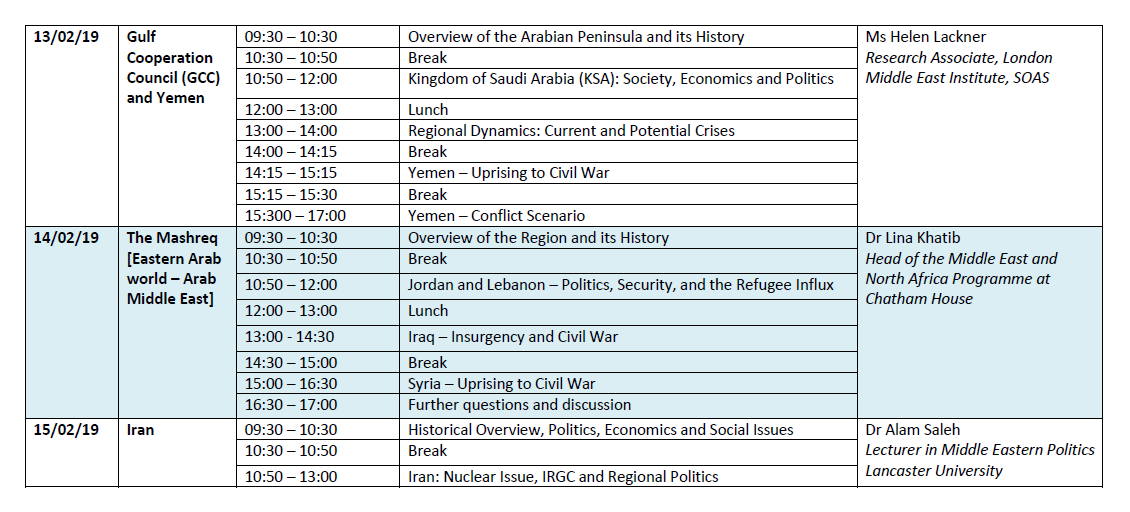
Lackner held an all-day training session on February 23, 2018 on Yemen, Saudi Arabia, and the Gulf monarchies.
On February 13, 2019, she conducted another session on the same topics, focusing largely on the ongoing UK-backed Saudi war on Yemen.
Like Achcar, Helen Lackner has repeatedly contributed to Jacobin, and has been the magazine’s go-to expert on the Yemen war.
In 2017, she published an article in Jacobin attacking the revolutionary anti-imperialist armed group Ansarallah (known informally as the Houthis) as a reactionary “familial, fundamental Zaydist movement.”
Lackner took a liberal “plague on both your houses” stance — a common tactic of the anti-anti-imperialist left — and wrote, “The first thing any socialist, of whatever hue, needs to understand about the war in Yemen is that none of the leaders of any of the many factions involved has objectives worthy of support.”
She expanded her “plague on both your houses” analysis into an entire book, titled “Yemen in Crisis: The Road to War,” which was published by Verso this April.
Left out of Lackner’s analysis is Ansarallah leaders’ statements of inspiration from Venezuela’s Hugo Chávez, as well as their modeling of resistance tactics after the Vietnamese national liberation front and those of Hezbollah.
The Houthis have even insisted that the attempt to portray them as Iranian proxies is part of a strategy to, in their words, “turn the struggle in this country and the region into a sectarian one, based on the American and Zionist agenda.”
Western military officials recognize the challenge this movement presents. When the UAE announced that it was partially withdrawing from the Yemen war in July, the New York Times reported: “Mike Hindmarsh, a retired Australian major general who commands the Emirati presidential guard, recently told Western visitors that Yemen had become a quagmire where the Houthis were the ‘Yemeni Viet Cong.’”
But Jacobin Magazine, the self-declared “leading voice of the American left,” insists otherwise, relying on the expertise of scholars like Helen Lackner — who was photographed attending the 2018 security summit of the pro-NATO group Friends of Europe.
In addition to training the British military, Lackner likewise published an extensive report on Yemen for the International Institute for Democracy and Electoral Assistance, a soft-power organization that works on projects backed by Western governments and the European Union to advance Western foreign-policy interests in the Global South.
Former BBC manager and other scholars
Another SOAS colleague who gave training sessions to the Ministry of Defense was Gamon McLellan, a teaching fellow in Turkish studies at the school.
McLellan’s biography on the SOAS website notes that he previously ran the Turkish Service for the BBC, a UK public broadcaster.
He later became the head of the BBC Arabic Service, directing its output during the 2003 Iraq war, which the British military fought in alliance with the US.
Just before the invasion of Iraq in 2003, BBC’s Arabic Service fired two Arab producers, who accused the pro-war media organization of bias and character assassination. In a press conference following their dismissal, one of the sacked producers singled out Gamon McLellan, noting his Arabic-language skills were so weak he could not even understand the programs he was overseeing.
“The fact that the Arabic Service is headed by someone who doesn’t speak the language speaks for itself,” the fired Arab BBC producer said.
In 2018, McLellan gave a half-day training session to the British military titled “Turkey & the Kurdish question.”

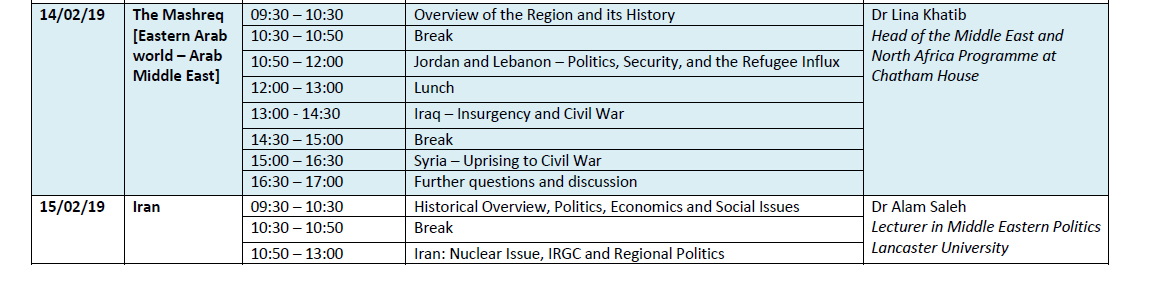
Popular pundit Lina Khatib also gave full-day training sessions to the Ministry of Defence in 2018 and 2019.
Khatib is a research associate at SOAS and head of the Middle East and North Africa program at the British think Chatham House, which receives funding from the UK government.
Khatib primarily focuses on Syria, where she frequently pushes for regime change. She is a frequent contributor to The Guardian, where she has praised Western bombing of the Syrian government and called for Washington to more directly intervene to prevent fighting between Israel and Iran.
Lancaster University scholar Alam Saleh filled the second half of the day with lectures on Iran. Saleh’s politics follow the established pattern. One of his articles is headlined “Iran’s cynical pandering to its ethnic minorities will do it no good.”
Other MOD training programs with British academics
While the UK Ministry of Defence held these Middle East-related trainings in February 2018, it also convened parallel sessions on other regions of the world.
In its Eastern Europe and Central Asia Training Programme on the same dates, the Ministry of Defence hosted the London School of Economics scholar Janet Hartley and University of St Andrews lecturer Filippo Costa Buranelli.
Another professor involved in the training was King’s College London’s James Gow, whose name appeared on a mailing list of the UK government-funded Integrity Initiative.
Gow taught about “Post-Soviet political and military integration with the West” and “Russian influence in” the Balkans.
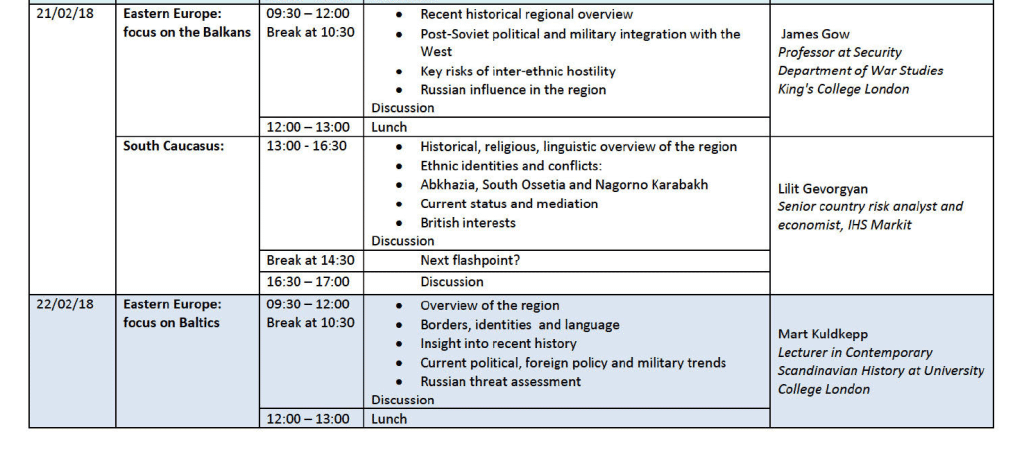
University College London academic Mart Kuldkepp spoke about “Current political, foreign policy and military trends” in the Baltics and gave a “Russian threat assessment.”
Economist Lilit Gevorgyan taught many sessions on Russia, focusing on its foreign policy, economy, and history.
In both 2018 and 2019, Gevorgyan lectured on the “Implications for UK military mission,” discussing “Global scenarios on Russian foreign policy and direct implications for MOD mission” and providing “key takeaways for MOD personnel.”
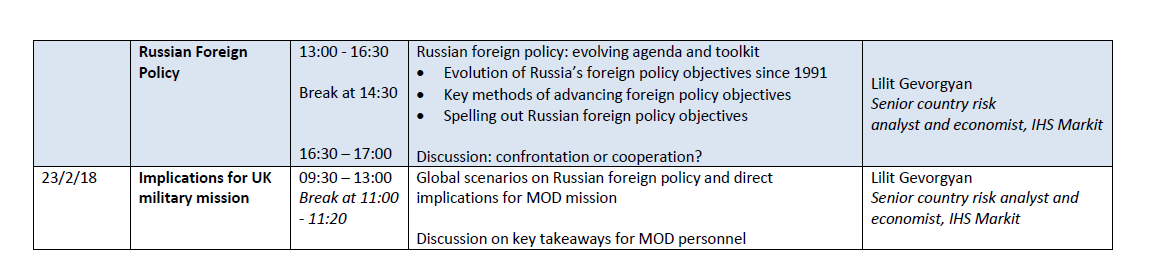
In February 2019, MOD brought back many of the same experts, along with De Montfort University and London School of Economics scholar Kenneth Morrison.
The roster for the Ministry of Defense’s Sub Saharan Africa Training Program almost entirely consisted of SOAS scholars, including Alastair Fraser, Matteo Rizzo, Chege Githoria, Jeremy Keenan, Friederike Luepke, Laura Hammond, and Tom Young.
The only other academic featured in the Sub Saharan Africa Training Program was Cambridge University professor Christopher Clapham, who taught a session called, “So what does it mean for the military?,” which provided “Practical Exercises involving issues likely to be encountered by MOD staff.”
This session made it abundantly clear that these trainings were not just designed to equip Ministry of Defense personnel with background knowledge and education. Their express, targeted purpose was to enhance the British military’s counter-insurgency prowess.
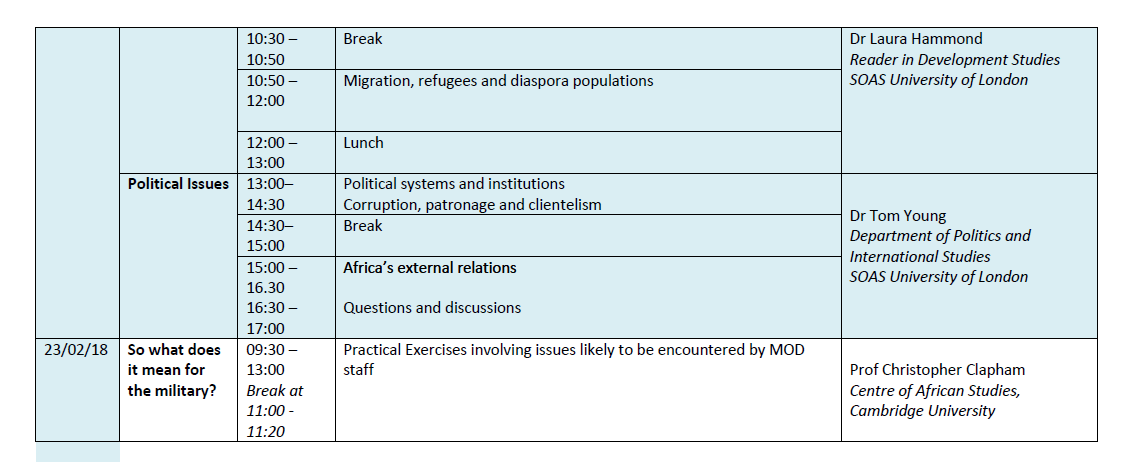
Below you can find the full tranche of British government documents, which were published under the UK’s Freedom of Information Act:
SOAS Ministry of Defence tr… by The Grayzone on Scribd

Benjamin Norton is the founder and editor of the independent news website Multipolarista, where he does original reporting in both English and Spanish. Benjamin has reported from numerous countries, including Venezuela, Nicaragua, Bolivia, Ecuador, Honduras, Colombia, and more. His journalistic work has been published in dozens of media outlets, and he has done interviews on Sky News, Al Jazeera, Democracy Now, El Financiero Bloomberg, Al Mayadeen teleSUR, RT, TRT World, CGTN, Press TV, HispanTV, Sin Censura, and various TV channels in Mexico, Nicaragua, Venezuela, Ecuador, and Bolivia. Benjamin writes a regular column for Al Mayadeen (in English and Spanish). He was formerly a reporter with the investigative journalism website The Grayzone, and previously produced the political podcast and video show Moderate Rebels. His personal website is BenNorton.com, and he tweets at @BenjaminNorton.