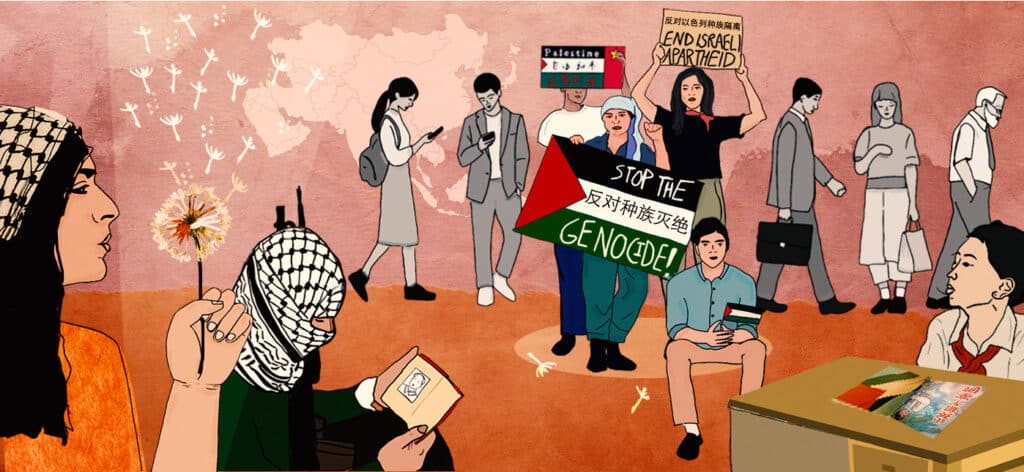
Illustration by Fourate Chahal El Rekaby.
Illustration by Fourate Chahal El Rekaby.
By Zhang Sheng – Mar 12, 2025
Frontier of global anti-imperialist struggle: China’s perceptions of the Palestinian struggle from 1955 to 1976
China is probably one of few states which flipped its diplomatic stance on the “Palestinian-Israeli conflict” in the most dramatic manner from the 1950s to 1970s. In only 20 years, the People’s Republic of China (PRC)’s official foreign policy dramatically changed from almost establishing diplomatic relations with Israel in 1950 to denying any legitimacy of the Israeli state in the 1960s to 1970s. As I aim to demonstrate in this article, the Maoist era, especially from 1955 to 1976, established the foundation of China’s diplomatic support for the Palestinian liberation movement, and this legacy is still one of the main factors guiding China’s official stance on Palestine today.
From 1950 to 1976, China during the Mao era gradually deepened its understanding of the Palestinian question and eventually concluded that the Palestinian struggle was an anti-colonial and anti-imperialist national liberation movement. Diplomatically, the PRC in this era not only showed its solidarity with the Palestinian armed struggle through providing diplomatic support, funding, and even military training, but also launching various cultural exchange programs between Palestinian and Chinese diplomats and intellectuals. In terms of China’s domestic politics, the PRC in this era also launched a comprehensive internal propaganda and educational campaign, aiming at reinforcing pro-Palestine solidarity in the minds of the Chinese people.
From the end of the Mao era, China has increasingly deepened its bilateral relations, especially economic ties, with Israel, and China’s role in supporting Palestinian liberation was not only marginalised but was also significantly downgraded compared to its previous positions. The importance of pro-Palestine politics in the 1950s-1970s, however, remained as a ballast guiding the Chinese state, and these historical legacies of China-Palestine solidarity have been re-discovered and rejuvenated by Chinese youth during the ongoing genocide in Gaza.
Therefore, in order to truly understand the nuanced dynamics of China’s solidarity movement with Palestine and China’s reaction to the ongoing genocide in Gaza, I intend to provide a systematic review not only of the evolution of China’s perceptions of the Palestinian struggle, but also Maoist China’s efforts at establishing solidarity networks with the Palestinian movement both in terms of diplomatic channels and China’s own domestic propaganda and educational campaigns.
Heavily influenced by the Soviet Union, the newly established People’s Republic of China (PRC) once saw Israel as a postcolonial state led by a left-leaning national-bourgeois government and thus was open to recognizing Israel (Shichor 1979:22). On 9 January 1950, the Israeli foreign minister sent a letter to Chinese premier Zhou Enlai in which he recognized the PRC, which made Israel “the first Middle Eastern government to recognize the PRC” (Shichor 1979:21). This news was published in the People’s Daily, China’s official newspaper, on 17 January 1950 as a diplomatic success of China (“Yiselie afuhan” 1950). The Arab League, however, reached a consensus in August 1950 not to recognize the PRC, which further stimulated the PRC’s favourable view toward Israel (Harris 1993:80).
This short-lived possibility of mutual recognition, however, soon disappeared as China entered the Korean War in October 1950. To avoid irritating the US, the Israeli government put off its plan to establish a formal relationship with China (Shai 2019:94). The Israeli government’s action of siding with the West in the United Nations during the Korean War destroyed the Chinese side’s previous fantasy of seeing Israel as left leaning, and the Chinese side also had to reconsider the matter of mutual recognition.
A few years later, in 1955, the first Asian-African Conference was hosted in Bandung. In this conference, China gained the opportunity to cultivate ties with Arab leaders, while Israel was excluded from the conference due to the vehement opposition of Arab states and Indonesia, a Muslim-majority state with a historical friendship with Palestine. Zhou Enlai, initially proposed to include Israel at this conference of postcolonial states, but after a long discussion with the Egyptian president, Gamal Abdel Nasser, and the representative of the Syrian delegation and future chairman of the Palestine Liberation Organization (PLO), Ahmad Shuqiry, Zhou concluded that supporting the Arab people’s anti-imperialist struggle was a priority for China (Shindler 2014:110). According to a report by the Jewish Telegraphic Agency on 22 April 1955, Zhou made a strong statement in support of the Arabs, claiming that, “had it not been for foreign intervention, the tragedy of the Arabs of Palestine would not have taken place” (“Anti-Israel Resolution” 1955: 61).
The PRC reduced diplomatic contact with Israel, but did not entirely see Israel as an illegitimate entity in the 1950s. In March 1956, in the lead-up to the Suez Crisis, the People’s Daily quoted an Israeli Communist Party (ICP) statement to claim that “the majority of Israeli people” were in favor of an “independent, peaceful, and neutral foreign policy” between the West and the socialist bloc (“Yigong zhuzhang” 1956); in September, the People’s Daily again quoted the ICP to claim that “the Israeli people do not want to and should not risk themselves for British, French, and American billionaires” (“Yiselie renmin” 1956). This evidence illustrates that although the PRC had already decided to put its relations with Arab states before its relationship with Israel, it still saw Israel as a legitimate state with potentials of not falling entirely into the Western bloc. The Communist Party of China (CPC)’s party-to-party relationship with the ICP in this era also shows that the PRC did not hold an anti-Zionist stance at that time. The PRC’s perception of Israel was only determined by Israel and Arab states’ relations with the West, and not built around an understanding and recognition of the Zionist colonisation of Palestine.
The War of 1956, however, fundamentally reshaped China’s perception of Israel. From 1956, China increasingly thought of Israel as a “running dog” of Western imperialism that threatened Third World liberation and the global socialist movement. On 29 October 1956, Israel invaded Sinai in collaboration with Britain and France. Israel’s joint military operation with Britain and France not only made the PRC view Israel as an aggressor against Egypt, but more importantly, it prompted the PRC to label Israel as a regional ally of Western imperialists. On 1 November 1956, the People’s Daily, for the first time, directly condemned Israel as “a voluntary little pawn on the chessboard of Western colonizers” (“Buxv fanghuo” 1956). On 7 November, the Chinese government officially published a statement demanding that Britain, France, and Israel “immediately withdraw all forms of military force invading Egypt and stop the aggressive war on Egypt” and announced that China would soon send aid to Egypt (Guoji guanxi 1958:278). After the Suez Crisis of 1956, Chinese foreign policy became one-sidedly pro-Arab. China gave up its support for the partition plan in its diplomatic rhetoric, openly criticized Israel for invading the Arab states, and explicitly supported the Palestinian people’s right of armed struggle.
With the breakout of Sino-Soviet split Chinese foreign policy became even more radical than the Soviet Union’s.(1) At the International Meeting of Communist and Workers Parties in Moscow in 1957, Mao Zedong, China’s chairman, explicitly opposed Khrushchev’s idea of “peaceful co-existence” with the capitalist bloc and advocated for armed struggle against capitalist states (“Sugong” 1997: 15). In January 1958, Mao officially listed “permanent revolution” as one of the guiding thoughts of the Chinese government (“Gongzuo” 1995:45). Driven by the principle of “revolutionary diplomacy”, China actively supported anti-colonial, anti-imperial, anti-feudal nationalist and socialist movements all over the world, specifically in the Third World.
In the PRC’s perceptions, the regional conflict between the Arabs and the Israelis had become a stage upon which the socialist bloc and the Third World were coming together to struggle against Western imperialism. While the Chinese leadership was more concerned with affairs in East Asia, such as the Vietnam War and the Taiwan Strait conflict, the land of Palestine was understood as a remote “frontier” holding back Western imperialism. They believed that the result of the struggle at the “frontier” could affect the security of the PRC. For example, Zhou Enlai, premier of China, once emphasized the unique role of Arab anti-imperialist struggles in the world by arguing that Arab states are located at a crucial front against imperialism that “shields both Africa and Asia” (An, 2008:4). In March 1965, Chairman Mao Zedong also said the following to the first PLO delegation to China:
Imperialism is afraid of China and the Arabs. Israel and Formosa [Taiwan] are bases of imperialism in Asia. You are the front gate, and we are the rear. They created Israel for you and Formosa for us. The West does not like us, and we must understand this fact. The Arab battle against the West is the battle against Israel (Shindler 2014: 111).(2)
In addition, Israel’s victory in the wars of 1956 and 1967 convinced the Chinese that the Arabs were the weaker victims in this conflict. The Palestinian experience of being invaded by a Western-supported colonial state reminded the Chinese of their own historical trauma of being “invaded, attacked and humiliated by foreigners” and thus a sense of solidarity was formed (Cooley 1972: 20).
Driven by China’s radical Maoist ideology, the image of the land of Palestine as the “frontier” of global competition, and sympathy toward the Palestinians elicited by China’s own historical trauma, the Chinese perceived Israel largely as the “running dog” of US international interests in the region. In 1966 when China’s Cultural Revolution started, the radical faction in the Chinese government started to gain more control of Chinese diplomacy.(3) Thus, China’s stance toward Israel evolved into the most radical phase in which China questioned the fundamental legitimacy of the Israeli state.
In 1965, Lin Biao, the vice chairman of the Communist Party of China (CPC) since 1958 and the designated successor to Mao, defined the main characteristics of Mao’s theory of the “people’s war” and advocated that all oppressed peoples in Asia, Africa, and Latin America should use the “people’s war” tactics against “US imperialism and all of its running dogs” (Lin 1965: 22). The Maoist theory of the “people’s war” guided China’s enthusiastic support for guerilla warfare all over the world, including Palestine. Palestinian guerilla forces became an ideal model of the “people’s war.” PLO leaders happily accepted this praise and were willing to create an image of themselves being the vanguard of Third World guerilla warfare and students of Mao’s theories in order to gain more support from China. For example, when visiting Beijing on 21 March 1970, the entire PLO delegation to Beijing, led by Chairman Yasser Arafat, held copies of Mao’s Little Red Book in their hands when exiting their airplane, which successfully evoked joyful reactions from their Chinese counterparts (Balesitan renmin bisheng 1972. Film. 20:01).
After Mao’s famous speech on 20 May 1970, which encouraged ‘the struggles of the Palestinian and other Arab peoples against the Israeli aggressors’ (Mao 1970), the PRC’s official rhetoric regarding Israel became entirely negative and officially labelled it as “a base for U.S. imperialism to invade the Middle East” (Balesitan renmin bisheng 1972: 01:56). Moreover, Chinese slogans in support of the Palestinian people became highly combative and focused on encouraging armed struggle and the destruction of the Zionist state: ‘Do not solve this peacefully, do not kneel to surrender, absolutely no!’ (Balesitan renmin bisheng 1972: 23:38). Even Zhou Enlai, who was probably the most moderate diplomat in the Chinese government in this era, saw Israel as an unnatural state. For example, in his conversation with US Secretary of State Henry Kissinger, Zhou pointed out, ‘it must be said that the establishment of such a country in such a manner is a very curious and peculiar phenomenon to have occurred since the First and Second World War’ (“Memorandum” 1973:148).
From 1965 until the end of the Cultural Revolution in 1976, the PRC’s official narrative of the history of Palestine evolved into a completely anti-Zionist one. Far from its position in the 1950s of viewing Soviet support for partition as “a stance of justice” (Xu 1950: 67), a 1973 Chinese book on the Palestinian question, written for use by government officials only, not only labelled “Israeli invaders” as “a little pawn on the chessboard of U.S. imperialist invasion,” but also condemned “Soviet revisionism and socialist imperialism” for “sheltering, spoiling, and acquiescing to Israeli aggression” (Institute on the Religion of Islam of Northwest University 1973: 42).
In 1971, Qiao Guanhua, the chief Chinese delegate to the United Nations, defined the ‘intrinsic nature of the Middle East question’ as ‘the aggression against the Palestinian people and the other Arab peoples committed by Israeli Zionism, with the support and connivance of the superpowers’, labelling both US support for and Soviet “acquiescence” to Israel as roots of the problem (Cooley 1972: 19). According to Mohammed Khalil and Mohammed Rif’at, two Palestinian representatives of the Afro-Asian People’s Solidarity Organization who visited Beijing in March 1964, Chinese officials specifically emphasized to them that “China did not bear the stigma, as did Russia, of having voted for the creation of Israel” (Cooley 1972:24), thus illustrating the Chinese perception of the creation of Israel as an illegitimate colonial project in the modern era.
The PRC’s strong pro-Arab sentiment can also be seen from its stance during the War of 1973. On 23 October, Qiao Guanhua made a highly combative speech at the United Nations Security Council in which he not only referred to this war as “a sacred battle of Egyptian, Syria, and Palestinian peoples and armies fighting against invaders and recovering occupied land,” but also claimed, “it is righteous for the peoples of Egypt, Syria and Palestine to use whatever measures they wish to recover their own occupied territories meanwhile any slight provocation done by Israel is a criminal behavior” (“Zaianlihui” 1973).
In the 1960s-1970s, support for Palestine was not limited to the diplomatic level of the state. Instead, Chinese leaders intentionally institutionalized discourses in support of Palestine into the culture of society. The first and most direct way was to encourage mass demonstration. As a propaganda documentary titled The Palestinian People Will Win made by the Chinese government in 1971 shows, the Chinese state often organized massive demonstrations in Beijing in front of embassies of Palestine, United Arab Republic (Egypt), and Syria in Beijing to express solidarity. The second way was to educate the Chinese masses and to encourage the working class to learn about and write about Palestinian affairs. The short documentary mentioned above, for example, was often shown in the cinemas of China, and the transcript was also published and widely circulated in the libraries of major cities of China. In addition, many books on Middle Eastern affairs were published during this period, and these volumes all reinforced a strong anti-Zionist historical view.(4) During the Cultural Revolution, the state also encouraged factory workers of China to form worker’s theoretician groups to conduct research on Marxist theory and contemporary politics. The Workers theoretician group of the Wuhan Heavy Duty Machine Tool Factory, for example, cooperated with history professors from the Central China Normal University to write an academic book titled, The Origin and the Development of the Palestinian Issue, which was later published by one of the most authoritative state-affiliated publishers of China in 1976.(5)
Solidarity with Palestine was also a focus of Chinese literature and the intelligentsia too in the 1960s-1970s. As many freedom fighters from the PLO were receiving training in Chinese military academies, many Palestinian diplomats and intellectuals were also studying in Chinese universities, working as Arabic professors or translators in Chinese universities, and frequently invited to China for events. Works of Ghassan Kanafani were translated and widely circulated in China, and Kanafani was invited to visit China in 1965 in which he was warmly received by Marshal Chen Yi, who was famous for his enthusiasm for poetry. The poems of Abu Salma, Chairman of the General Union of Palestinian Writers and Journalists, were introduced to China as early as 1964, and his famous poem “The Smile of Mao Zedong,” in which he writes “We have fought the same fight. We have endured the same suffering…When Mao’s smile appears on the horizon, Earth’s skies become clear for miles and miles,” received a tremendous reception in China.(6) In 1975, the state-affiliated renmin wenxue chubanshe (People’s Literature Press) published a book titled Battle Poems of Palestine, in which was compiled translated poems written by Palestinian fedayeen along with poems praising Palestine written by Chinese workers and intellectuals.(7)
Interestingly, the Palestinian armed struggle was even a genre for children’s books in China in the 1970s. In 1971, a state-affiliated publisher in Guangdong composed and published a comic book for children titled The Waving Flag of Combat. Talat, the protagonist of this story, is a son of a Palestinian guerilla fighter who is planning to “launch an operation against Israeli invaders in the occupied territory.” On the morning of Talat’s 13th birthday, his father promised to bring a jar of soil from Palestine as a birthday gift. Instead of waiting, Talat himself participates in the guerilla force on that day and received the birthday gift he had always longed for: the guerilla force totally defeated the Israelis, and the flag of Palestine was raised on the liberated territories.(8)
One year later, in 1972, the same publisher produced another comic book for children named Little Hero Qassam. In this story, little Qassam, a Palestinian child whose father was killed by the Israelis in the 1967 war and thus had to escape to Amman as a refugee, joined the guerilla force at the age of fourteen. Disguised as a common boy transporting his belongings on a donkey, little Qassam smartly led Israeli soldiers into the ambush of the guerilla force and thus destroyed a stronghold of the Israeli army.(9) This comic book was so popular that in 1973 little Qassam’s story was re-created into a long poem with paintings by artists from another state-affiliated publisher based in Heilongjiang province. (10)
People who are familiar with China’s literary traditions of the Mao era can easily see that the images of Talat and Qassam are largely influenced by the images of Chinese fictional figures such as Wang Eerxiao or Zhang Ga the Little Soldier. Both are fictional boy scout guerilla fighters based on real prototypes of Chinese children who participated in guerilla warfare against the Japanese occupation during WWII. Through projecting China’s own historical experience to imagine and create literary and artistic images of Palestinian freedom fighters, the Chinese “literary and art workers,” as they were referred to in the Mao era, disseminated the seeds of pro-Palestine solidarity to the Chinese public, and their legacies in the 1966-1976 era still largely serve as the foundation of pro-Palestine sentiments among Chinese youth today.
Between the revolutionary past and the trade-centric present: China’s foreign policy on Palestine from 1980s to the present
When Mao passed away in 1976, the Cultural Revolution was put to an end with a coup in which the old-guard, moderate faction within the CPC forcefully addressed leaders of the radical-Leftist faction, who later was given the derogatory name of the “gang of four.” Deng Xiaoping, as leader of the reformists, took two years to consolidate his power within the party. In 1978, Deng successfully held the famous 3rd plenary session of the 11th Central Committee of the CPC as the beginning of Deng’s “reform and opening up” policy. As Deng pointed out during his conversation with Ethiopian leader Mengistu Haile Mariam in 1988, the Chinese government’s guiding principle “shifted from class struggle to develop[ing] the economy” (Deng 1988).
In terms of diplomacy, this shift meant that supporting global revolutions was no longer an agenda in China’s official diplomacy, and by early 1980, Deng had already stopped the PRC’s aid to communist groups in Southeast Asia, Africa, Latin America, and southern Europe. As China attempted to attract foreign investments from the West for its economic development, support for anti-imperialist struggles also became increasingly marginalized in Chinese foreign policy. China started to reconsider the possibilities of establishing diplomatic ties with more members of the capitalist bloc, and Israel was among one of them.
The transformed international atmosphere in this era also had an important impact on the Chinese. In 1977, Egyptian President Anwar Sadat gave his speech at the Israeli Knesset, and enhancing Egypt-Israel relations prompted the Chinese to believe that the intractable “Arab-Israeli conflict” may have already come to an end. Driven by this perception, in July 1980, He Ying, Vice Foreign Minister of China, publicly announced that China’s new stance on the Palestinian question was that “all states in the Middle East should enjoy their right of independence and survival.” This statement marked an end of China’s previous policy of the 1960s to 1970s in support of armed struggle and the dismantling of the Zionist regime. China started to see the existence of the Israeli state as not inherently antithetical to that of a Palestinian state. In December 1982, Hu Yaobang, General-Secretary of the CPC, proposed to King Hussein of Jordan that Arab states “must respect and restore national rights of the Palestinian people, and simultaneously recognize Israeli people’s rights of peaceful survival.” In the same month, during his visit to Egypt, Chinese premier Zhao Ziyang again announced that China was preparing to recognize Israel’s “right of survival” as long as Israel “withdraws from occupied Arab land” and “restores Palestinian’s legitimate rights of reconstructing their states.”
In September 1988, Chinese Foreign Minister Qian Qichen announced China’s “five-point proposition” on Middle Eastern affairs, which included content such as promoting dialogue, asking Israel to withdraw from all occupied Arab territories in exchange for security assurance, and most importantly promoting mutual recognition between the State of Palestine and State of Israel. Though different administrations of Chinese leaders have announced their own proposals on Middle Eastern affairs under different names, the essence of Qian’s “five-point proposal” – promoting a two-state solution through dialogue – remains the core of China’s foreign policy on Palestine.
Trade is certainly one of the most important elements impacting this shift of China’s stance towards Israel. In 1985, to push for establishing an official relationship with China, Israel reopened its general-consulate in Hong Kong, which had been closed for more than 10 years by then, and started to sell its high-technology products, especially military technologies and equipment, to the Chinese mainland through Hong Kong. After China’s short-lived honeymoon period with the US ended with an ugly break-up in 1989, Israel became one of the few channels in which China could purchase advanced military technologies to circumvent the Western embargo. Such a relationship remained important to China until 2001 when Israel unilaterally tore apart its trade agreement with China under US pressure.
Desire for trade and the belief that the “Arab-Israeli conflict” was coming to an end, prompted China to become increasingly open to establishing full diplomatic ties with Israel. During 1990-1991, numerous states in the socialist bloc, including the Soviet Union, established diplomatic relations with Israel, and this became the decisive factor pushing China to finally make the decision. In January 1992, China established diplomatic relations with Israel.
As a result, China welcomed the Oslo Accords in 1993. The People’s Daily, for example, claimed that peace between Palestine and Israel was now possible with the Oslo Accords. Even when Netanyahu’s right-wing government severely sabotaged the peace process in 1996, the Chinese official media still believed that “the seeds of peace has already been planted to the hearts of Palestinian and Israeli peoples by the Oslo Accords” and that Israeli public opinion was pro-peace and anti-Likud (“Zhongdong huhuan” 1999). In October 1993, one month after Oslo, Yitzhak Rabin became the first Israeli Prime Minister to visit China, which shows that Beijing was not only optimistic about the future of the Oslo Accords but also convinced that deepening the relationship with Israel was no longer a problem for China’s relationship with the PLO and Arab states.
Though eventually committed to the so-called two-state solution, China never wavered from its support for Palestine, at least in diplomatic rhetoric. On 20 November 1988, following Arafat’s declaration of a Palestinian state five days prior, China officially announced its recognition of the State of Palestine and upgraded the PLO office in Beijing into the Palestinian embassy in December that year. In December 1995, China officially established its embassy to the Palestinian Authority in Gaza and later moved it to Ramallah in May 2004. Former Palestinian President Yasser Arafat, for example, was invited to visit China 14 times throughout his lifetime, and surprisingly the majority of these visits actually took place after 1980 (his last visit to China was in 2001). Until the end of his life, Arafat maintained a close personal friendship with Deng Xiaoping and later Chinese president Jiang Zemin.
As already mentioned, since the start of Deng’s reform in the early 1980s until the 2010s, Chinese policymakers were convinced that “diplomacy should serve the economic interests, not vice versa,” and thus Chinese foreign policy towards the Middle East mainly focused on trade while intentionally refraining from being involved in “issues” in the Middle East. As Hua Liming, former Chinese ambassador to Iran and UAE, admits, “in this era, the Middle East is a marginalized region in the overall Chinese diplomatic strategy” (Hua: 2014: 8).
Since 2013, however, the Xi Jinping administration has had a revived political interest in the Middle East, including the Palestinian question, being interested in promoting China’s international prestige as a global power. In 2013, when Palestinian president Mahmoud Abbas and Israeli prime minister Benjamin Netanyahu separately visited Beijing, Xi proposed facilitating dialogue between the two, but this proposal was ignored by Netanyahu. In July 2017, Xi announced his “four-point proposition” to the “conflict”, which shares the same essence of Qian Qichen’s “five-point propositions” announced in 1988. The “four-point proposition” asserts that China supports the two-state solution and a “completely sovereign and independent State of Palestine based on the 1967 borders, with East Jerusalem as its capital.” In addition, it reiterates the importance of solving the Palestinian question through political dialogue and demands that Israel “immediately stop all activities of settlements on occupied territories in accordance with the United Nations Security Council Resolution 2334” (“Zhongguo daibiao” 2017).
To promote Xi’s “four-point proposition,” Beijing hosted a “Palestine-Israel Peace Symposium” in December 2017, and leading figures from both sides who participated in this symposium were Ahmed Majdalani, general-secretary of the Palestinian Popular Struggle Front, and MK Yehiel “Hilik” Bar, deputy speaker of the Israeli Knesset.
In May 2021, Chinese Foreign Minister Wang Yi again reiterated China’s interests in inviting Palestinian and Israeli representatives to engage in dialogue in Beijing. In his speech at the United Nations Security Council, Wang not only emphasized that “the Palestinian issue has always been the centre of problems in the Middle East,” but also, for the first time, claimed that “the world will not truly have peace unless the Middle East is stable.” Wang’s words have become the norm in China’s diplomatic rhetoric over Palestine today. This perspective of seeing the resolution of the Palestinian question as indispensable to global peace should be seen as a part of the broader legacy of the Mao and Zhou era in which the Chinese leadership saw Palestine as the frontier shielding both Asia and Africa from Western imperialism. However, contrary to China’s position in the Mao era, the reluctance to be viewed as picking sides limited its foreign policy.
It is important to point out that although China voiced its political commitment to the Palestinian struggle and Palestinian state (including fighting hard for Palestine to become a member of the United Nations and to facilitate – ultimately unsuccessful – peace talks), between 2015 and 2020 China and Israel underwent a brief honeymoon period of increasing trade and investment. As US-Israel relations faced difficulties due to Israel’s aggression in the occupied West Bank and its hostility toward the Iranian nuclear deal, the Netanyahu administration attempted to flirt with China. In his visit to China in 2017, Netanyahu praised the bilateral relationship as “a marriage made in heaven,” and expressed interest in possibly joining China’s Belt and Road Initiative (BRI). During the visit the Chinese government announced the establishment of an “innovative comprehensive partnership” with Israel. Four months later Netanyahu would use the exact same metaphor to describe Israel’s relationship with India, China’s geopolitical rival, and Israel would in fact not officially sign on to the BRI despite China’s unilateral insistence on labelling Chinese investment programs in Israel, including the Haifa Bay Port, as programs affiliated to the BRI.
Nevertheless, economic interests, particularly high technology, fuelled China’s growing interest in Israel. In addition, since China’s relationship with US president Donald Trump during his first administration (2017-2021) was terrible as most communication channels between China and the US were severed, China also sought to invite Israel to act as a bridge for continuing contact with the US.
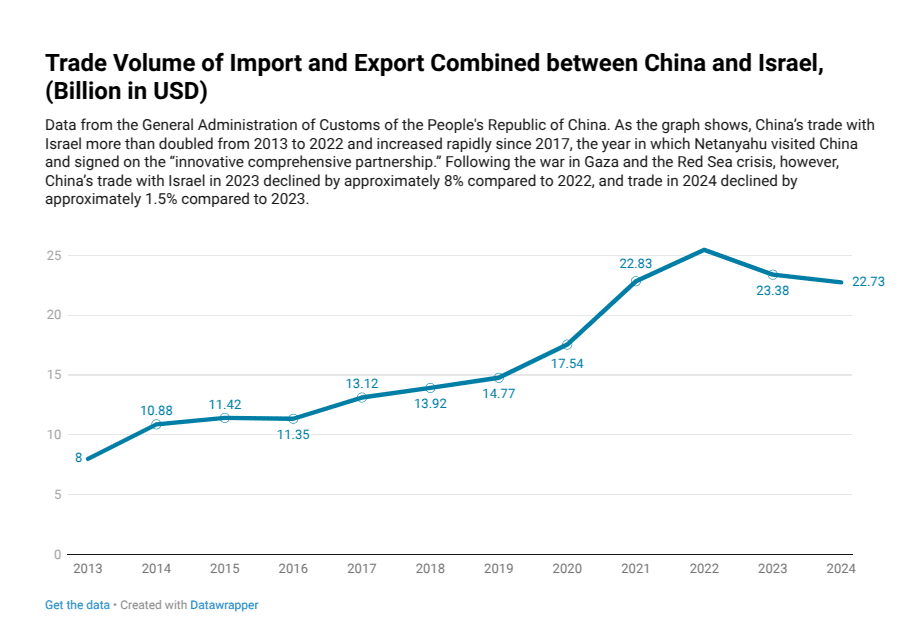
The largest flagship Chinese investment in Israel during this era was the Haifa Bay Port, or new Haifa port. In 2015, Chinese state-owned company Shanghai International Port Group (SIPG) signed an agreement with Israel in which it acquired the rights to operate the Haifa Bay Port for 25 years starting in 2021. This agreement was largely publicized in 2018 and once was seen as one of the BRI’s flagship in the Middle East, legally valid until today. As of 2023, the Haifa Bay Port consisted of 80% of Israel’s transshipment containers (Lavi 2024). The prosperous picture of the Chinese-operated Haifa Port project, as I discuss below, would soon be severely damaged in the Gaza war. China is currently paying the costly price of mistrusting the sustainability of its honeymoon period with Israel.
Reviewing China’s foreign policy from the 1980s to the present, one notices that China has been struggling and vacillating between its anti-colonial principles inherited from the Mao era, and its current economic interests. On the one hand, China’s perception of Palestine is still heavily influenced by Mao’s legacy and China still sees Palestine as the anti-colonial frontier that is shielding both Asia and Africa from Western imperialism, but on the other hand, China’s Middle East policy in the post-Mao era is in its nature economic-centric, so China does not wish to forgo its trade with Israel. Political solidarity with Palestine and economic ties with Israel creates a contradiction in China’s foreign policy, and China’s choice is to simply declare itself as a friend of both sides seeking to portray itself as a potential mediator.
From 1992 until 2023, when the international community still reserved some hope for dialogue and a two-state solution, China was able to manage this contradiction in its foreign policy and to enhance the relationship with Palestine and Israel separately. In the eyes of the Chinese government, its diplomatic and trade relationship with Israel neither became an obstacle to China’s traditional friendship with the Palestinian Authority, nor refrained China from unequivocally speaking in support of the State of Palestine in international platforms such as the United Nations.
China’s image as a “common friend of both Palestine and Israel,” however, is becoming increasingly unsustainable in recent years because of two main dynamics. First, this approach is largely based on the premise of the Palestinian-Israeli peace negotiation process from the 1990s to early 2000s. As Israeli settlements into the occupied West Bank exacerbates the tension and makes the two-state solution almost impossible to achieve, China’s faith in this solution may seem to be already outdated from the reality on the ground. Second, this foreign policy approach is based on China-Middle East relations from the 1990s-2000s, in which China’s engagement with the region was highly limited in an economic respect and China did not wish to exercise any political influence in the region. However, from 2013, China on the one hand wished to enhance its global reputation in the developing world through renovating its historical solidarity with Palestine; on the other hand, however, through the BRI, Chinese investments in Israel rapidly grew from 2015 to 2023. Therefore, the contradiction between a political and economic agenda in China’s Middle East policy has inevitably intensified in the last a couple of years and China’s attempt to continue its self-perceived “balanced” position has become untenable.
From the early 2000s to 2023, Israel exacerbated its aggression and oppression against the Palestinian people. Some of the most important events include the second Intifada from 2000; Israeli invasion of Lebanon starting in 2006; Israeli wars on Gaza in 2008-2009, 2012, 2014 and 2021; the Great March of Return demonstration in 2018-2019; Israeli repression of Palestinian protests in 2021, and the genocidal war against Gaza in 2023. In each of these events, China did release several diplomatic statements criticizing Israel’s actions, but none of the atrocities committed by Israel has had any impact on China’s trade with Israel. In these two decades, China’s economic ties with Israel have grown tremendously, and this fact prompts the outside world to increasingly doubt the sincerity of the Chinese government’s self-claimed support for Palestinian liberation.
This contradiction within China’s Middle East policy is destined to push the country to reconsider its unsustainable approach. The increasingly dire reality on the occupied land of Palestine will eventually burst the bubble of the illusional fantasy inherited from the short-lived peace process of 1990s-2000s and force China to abandon its unrealistic goal of fraternizing with both sides. Since Israel’s genocide in Gaza, this contradiction in Chinese foreign policy has exacerbated into an unprecedented degree as Israel has threatened to harm Chinese investment if China continues its diplomatic support to Palestine.
Diplomatic conflict, Israeli propaganda, and organic construction of Chinese popular opinion: How China reacts to the Gaza genocide
The seemingly promising bilateral relationship between China and Israel from 2015 to 2020, once created some voices, both within Chinese and Israeli society, calling for a deeper strategic cooperation between the two states. Yet, what happened on 7 October 2023, and in particular that the Israel bombardment of Gaza that followed, irreversibly destroyed the possibility of business as usual.
Right after 7 October, the Israeli government demanded China condemn Operation Al-Aqsa Flood and to list Hamas as a terrorist organization, but unsurprisingly, China refused this demand. The Chinese government does not accept the Western-Israeli narrative that portrays 7 October as the start of history. Instead, China sees it as one of the many tragedies of the prolonged “Arab-Israeli conflict” inherited from British colonial rule. The PRC, as a regime that emerged out of Mao’s strategy of “people’s war,” guerrilla warfare, and anti-colonial armed struggle, remains inherently sympathetic toward other guerrilla forces of the Global South. Just as Mao’s China became the first non-Arab global power to fully support the PLO, China in the post-Mao era has also unwaveringly refused to label any of the Palestinian resistance organizations, including Hamas, as terrorist organisations. Even as early as 2003, in the period in which China was much more pro-West than today and was highly dependent on Israel for purchasing high-technology and military equipment, China’s official media Xinhua News Agency had refrained from referring to Hamas as a “terrorist organization” in its report on a Chinese female journalist’s interview with Sheikh Ahmed Yassin. In 2016, under the current administration, this tendency became institutionalised: Xinhua News Agency ordered that all Chinese media “must not refer to Hamas as a terrorist organization or extremist organization” (“Xinhuashe” 2016).
There is no other document that can better explain the PRC’s official stance on Palestinians’ right to resist, including through armed struggle, better than the statement of Ma Xinmin, Director-General of the Department of Treaty and Law of the Chinese Foreign Ministry and former Chinese ambassador to Sudan, at the International Court of Justice (ICJ) on 22 February 2024. In the public hearing at The Hague, Ma unequivocally stated:
The Palestinian-Israeli conflict stems from Israel’s prolonged occupation of Palestinian territory and Israel’s longstanding oppression of the Palestinian people. The Palestinian people fight against Israeli oppression and their struggle for completing the establishment of an independent state on the occupied territory are essentially just actions for restoring their legitimate rights (Ma Xinmin 2024).
Citing numerous articles of international laws, Ma claims that “the struggle waged by peoples for their liberation, right to self-determination, including armed struggle against colonialism, occupation, aggression, domination against foreign forces should not be considered terror acts” and that “armed struggle in this context is distinguished from acts of terrorism. It is grounded in international law. This distinction is acknowledged by several international conventions.” He further declares, “in pursuit of the right to self-determination, Palestinian people’s use of force to resist foreign oppression and complete the establishment of an independent state is an inalienable right, well-founded in international law” (Ma Xinmin 2024).
Ma’s statement at The Hague is the most representative document illustrating the Chinese government’s clear stance towards Palestinian armed struggle and resistance organisations in Palestine, and one of many. Through these various pro-Palestine public statements, China repeatedly calls on Israel to ceasefire immediately, even as early as October 2023. China also continues to vote in support of Palestine in both the United Nations Security Council and the General Assembly. The PRC has proven to the world that it has not abandoned its anti-colonial diplomatic tradition and its solidarity with Palestine which was shaped in the 1960s-1970s by Mao and Zhou. Although it currently does not yet have the determination to make further efforts such as officially joining the Boycott, Divestment, and Sanction (BDS) movement, and although it has not yet directly used the word “genocide” to define Israeli crimes in Gaza in official diplomatic documents, China still has proved to the world that it is at least not willing to remain silent or to serve as Israel’s accomplice in this ongoing genocide as the West (the US and Germany in particular) do.
From October 2023, the Chinese delegation to the UN and other international organisations have expressed strong criticism toward Israel’s killing of civilians in Palestine and Lebanon, while vehement opposition and diplomatic pressure from Israel did not make China change its position. In addition, China has not abandoned its faith in facilitating dialogues. Since it was clearly impossible to facilitate a dialogue between Palestine and Israel in the current situation, the Chinese foreign ministry attempted to facilitate dialogues among different Palestinian political factions. On 17 March 2024, Ambassador Wang Kejian, China’s special envoy to the Middle East, met with Ismail Haniyeh, then chairman of Hamas’ Political Bureau. Not many details of this meeting have been published in the press, but it is very likely that it was in this meeting that Wang extended China’s official invitation to diplomats from Hamas to Beijing, because less than one month later, representatives from Hamas would arrive in Beijing and negotiate with their counterparts from Fatah. The world does not know the details about this meeting in April, which was probably unsuccessful since neither faction published any sort of statement.
Three months later, however, after another round of negotiation in Beijing began on 23 July 2024; 14 political factions from Palestine led by representatives from Fatah and Hamas, in the presence of Chinese Foreign Minister Wang Yi, signed a joint statement known as the Beijing Declaration on Ending Division and Strengthening Palestinian National Unity. The statement states that all factions will cooperate together in “establishing an interim government of national reconciliation focusing on the post-conflict reconstruction of Gaza” (“Palestinian Factions Sign Beijing Declaration on Ending Division and Strengthening Palestinian National Unity,” 2024).
Indeed, it is a fact that the Beijing Declaration’s significance is only symbolic, and it cannot truly achieve Palestinian unity or stop the ongoing war in Gaza. Yet it is important to make a contrast that exactly one day after the closing ceremony of the Beijing Declaration, one of the most disgraceful moments of our time took place on the other side of the Pacific. Throughout his 56-minute-long speech at the US Congress on 24 July 2024, Netanyahu received countless standing ovations and applause, leaving the rest of the world shocked by the US Congress’ unconditional and enthusiastic support for Israel’s war crimes in Gaza.
Unsurprisingly, China’s diplomatic support for the Palestinians dragged it into diplomatic conflict with Israel. As early as mid-October, the Israeli foreign ministry has repeatedly expressed their frustration and anger toward China’s refusal to condemn Operation al-Aqsa Flood, and numerous cases of Chinese and Israeli diplomats intensively debating each other can be observed in bilateral diplomatic channels, public statements, and UN meetings.
Israel has also targeted the Chinese-owned Haifa Bay Port in an effort to pressure China. Since October 2023, the Chinese company operating the Port dramatically decreased its trade volume because of security risks as a result of the war, and in January 2024, following the Red Sea Crisis, the Chinese company ceased operation completely. This matter was soon portrayed by Israeli mainstream media outlet Ynet as “the first and only company to sever its trade relations with the ports in Israel” (Azulay 2024). In January 2024, the chairman of Israel’s government-run Ashdod Port demanded that the government end its dealings with China because the country refused to support Israel’s ongoing genocide in Gaza and was allegedly complicit in imposing a de facto maritime embargo on Israel (Rabinovitch and Saul 2024).
Until today, the Israeli government has not yet officially torn up its 25-year agreement with China over the Haifa Bay Port. However, considering severe diplomatic tensions between China and Israel throughout the past year, and because the Haifa Port was a very likely target of strikes from Hezbollah in Lebanon, one can clearly see that the future of this Chinese investment is bleak. Arguably, this project is the largest mistake of the BRI’s investments in the region so far.
Besides exercising diplomatic pressure and threatening to close the Haifa Bay Port, Israel has also launched a massive campaign on Chinese internet platforms in order to sway public opinion in China.
On 8 October 2023, one day after the breakout of the Operation al-Aqsa Flood, the Israeli embassy’s official account on Weibo – a Chinese social media platform similar to X – along with the Weibo accounts of Israel’s consulates in Chengdu and Guangzhou, made posts emphasizing that Noa Argamani, one of the hostages kidnapped in the attack, was half Chinese. To further instigate Chinese netizens’ nationalist sentiment, the Israeli embassy(external link) also intentionally disseminated misinformation claiming that Argamani was born in Beijing,(11) which was later refuted by Argamani’s mother Li Chunhong (whose Israeli name is Liora Argamani). Echoing calls from the Israeli embassy, numerous pro-Israel posts, many of which had clear characteristics of botnets, flooded Weibo and attempted to consolidate the misinformation that Argamani was a Chinese national. From 9 October until 26 December, the Israeli consulate in Chengdu never forgot to emphasize Argamani’s Chinese heritage and tried to directly appeal to the emotions of the Chinese masses. The post(external link) on 26 October, for example, portrayed Netanyahu as a soft-hearted gentleman who was so heartbroken by the news of Argamani’s mother suffering from cancer that he anxiously decided to “directly plead [with the] Chinese ambassador to Israel to deliver his request for help in disregard of protocols and diplomatic norms.”(12)
Though the Israeli embassy’s propaganda campaign did not achieve success in winning over a majority of the Chinese netizens, it did cause quite serious public pressure on the Chinese government. Since 2011, the Chinese government has been emphasizing the protection and evacuation of Chinese citizens abroad during crises as an important project of China’s internal propaganda agenda, and thus it would be detrimental for the Chinese government’s image domestically if a Chinese citizen is held as hostage by an entity which China refuses to condemn. In addition, the Chinese government normally prefers to deal with such issues in exclusive diplomatic channels without publicizing it, but the Israeli propaganda campaign left the Chinese government with no other option but to directly address the issue in public channels. Ironically, this attempt to instigate the nationalist sentiment of the Chinese against their government was soon shattered by the very nationalist sentiment it tried to manipulate: Being asked whether either she or her daughter were Chinese citizens in an interview, Li Chunhong, in a quite arrogant tone, chastised Chinese netizens, “Yes I am an Israeli citizen. But how can you Chinese refuse to help me just because I am an Israeli citizen? Do you understand? Helping me is a duty of everyone” (Interview Li Chunhong, 2023). The fact that she used “you Chinese” in the sentence evoked tremendous anger from Chinese netizens, and China’s interests in this affair totally faded away.
After instigating nationalist sentiment through disseminating misinformation, the Israeli embassy also tried various other forms of propaganda online. The most commonly used strategy was simply to publicly criticize China’s diplomatic stance and to promote the Israel narrative on Weibo. On 14 October, for example, the Israeli embassy(external link) not only expressed “deep disappointment” toward China’s foreign policy stance, but also criticised the Chinese foreign ministry’s mentioning of large civilian casualties in Gaza as ‘misinformation that does not align with tragedies and fears which Israel suffered in the last several days.’(13) Similar posts are constantly made until today.
Besides spreading misinformation and openly criticizing the Chinese government, the Israeli embassy in Beijing has been very active in promoting pro-Israel information as well. For example, Israel used the typical “colonial feminism” argument to pink-wash itself as the only “civilised” and female-friendly state in the region. On International Women’s Day in 2024, for example, the Israeli consulate in Shanghai(external link) organized a webinar linking women’s rights with the 7 October attack.(14)
The Israeli embassy has also been active in cooperating with its collaborators in the Chinese intelligentsia in whitewashing war crimes in Gaza. The most astonishing example of this type of propaganda is the controversial statement of Yin Gang, an authoritative elderly Chinese scholar who served as the deputy general-secretary of the state-affiliated China-Middle East Academic Society. Lecturing the Chinese masses on TV that they should “look at the Middle East with apathetic eyes,” Yin blamed the Palestinians for “professionally selling tears to the world” and claimed that “according to my in-depth investigation, not even a single person died in the bombing of al-Ahli Arab Hospital.” In this same interview, he also ridiculed the Chinese masses, “do not cry for Gaza when people tell you a fake death toll claiming that 10,000 civilians died, because this number is exaggerated probably ten times” (“Let’s Not Talk” 2023). Eight months later, after being constantly criticized by Chinese netizens for his whitewashing of Israeli war crimes, Yin suddenly died due to heart attack. The Israeli embassy immediately published a statement (external link)referring to him as “an old friend upholding objective and just stance on Middle Eastern affairs,”(15) which is seen by many Chinese netizens as proof of Yin’s connection with the Israeli government.
After reviewing this massive-scale propaganda campaign promoted by the Israeli embassy in China from October 2023, one cannot help to wonder: Did it successfully win over the majority of the Chinese youth? The answer is a resolute No. Ever since 7 October, the Chinese netizens have been overwhelmingly in support of the Palestinian struggle by all means, including armed struggle. In quite poetic language, many young Chinese netizens refer to the Palestinian parachute forces in the Operation al-Aqsa Flood as “dandelions fighters” for two reasons: First, flying parachutes in the sky looks like the flying seeds of dandelions; second, dandelion seeds can thrive anywhere they land, and thus the vitality of this plant is similar to the resilience of the Palestinian people.
On Bilibil, the most popular video-sharing website among Chinese youth, there are many videos made by the Chinese to commemorate the “dandelion fighters.” Some of the most popular videos, each with more than half a million views or more, are titled in extremely beautiful and poetic language with tremendous capacity of emotional contagion: “Mom, I have turned into a dandelion and flown back to our homeland!”; “The dandelion will never die. It just drifts away to a distant place called homeland”; “The children have grown up from the ruins of the city, and now they have turned into dandelions and drift towards the hometown that their ancestors have missed for generations.”(16)
Throughout the past year, Chinese netizens showed great interest in learning more about Palestine. Footage of Gaza can be found everywhere on douyin (Chinese Tiktok), and many online content creators are devoted to creating videos educating audiences on the history of the Palestinian struggle or introducing a new development of the war. There are people who specialize in introducing videos released by Palestinian resistance forces onto the Chinese internet and analysing these videos for the audiences.(17) Following the death of Yahya Sinwar, there are even those who voluntarily translated Sinwar’s novel The Thorn and the Carnation into the Chinese language for commemoration.(18)
Countless Chinese citizens contacted the Palestinian embassy in Beijing via Weibo in an attempt to make a donation to people living in Palestine. By contrast, there have been countless critical comments on the Israeli embassy’s website, which destroyed all propaganda efforts by the Israeli government. Ironically, the so-called “only democracy in the Middle East” just could not tolerate the Chinese netizens expressing their democratic views regarding Palestine, and since October 2023, the Israeli government closed off its Weibo comment area allowing only pro-Israel comments to be displayed. In comparison, the Palestinian embassy in Beijing’s Weibo account, though sometimes witness to unfriendly voices too, has never closed down its comment area or imposed a review and selection process as the “only democracy in the Middle East” does.
It is important to stress that, while the US Department of State bans comparing Israeli policy to that of Nazi Germany as a form of “anti-Semitism” (“Defining Antisemitism” 2016), Chinese people, as the largest victim of Japanese fascism during World War II, simply could not help but compare the genocide in Gaza to the Japanese massacre of Chinese civilians. In fact, the Chinese people’s own historical trauma of being invaded is exactly the reason why they feel a sense of natural affinity to the Palestinians. Therefore, Chinese netizens often like to say, “China’s yesterday is Palestine’s today” or “Palestine looks like us one hundred-years ago.” For that reason, the Chinese netizens like to refer to Palestinian resistance fighters as laoxiang, or fellow countrymen, which historically was a term often used to describe Chinese guerilla fighters during WWII.
In an article on US state-owned propaganda outlet Voice of America (VOA) about alleged “anti-Semitism” of Chinese netizens, even the VOA had to reluctantly admit that many Chinese found Palestinian resistance similar to the Northeast Counter-Japanese United Army, a Chinese guerilla force which desperately resisted Japanese occupation for 14 years until the ultimate victory (Ma Wenhao, 2023). On 24 October, 2023, the German embassy in Beijing(external link) made an unimaginably rude statement in which it literally called all Chinese people who compare Israel with Nazi Germany as “either ignorant dumbasses or shameless bastards.” Israeli, German, and American embassies in China, however, soon painfully learned that their Weibo accounts’ comment areas were filled with furious criticism from the Chinese netizens, and the Chinese netizens continue to compare Israeli war crimes in Gaza to the crimes against humanity committed by Nazi Germany and Fascist Japan in the 1930s and 1940s.
Interestingly, although the Chinese state never directly adopted this comparison in official statements or government documents, it has implicitly shown sympathy to such a comparison. China Daily, an official outlet of the state, broadcasted an interview of Fariz Mehdawi, Palestinian ambassador to China, in which he compared the Palestinian people today to Chinese civilians of Nanjing who suffered under Japanese occupation during WWII (“Balesitan zhuhua dashi” 2023). Xue Jian, Chinese Consul-General to Osaka, Japan, even shared a painting, created by young painter Zhou Sheji, on his official Twitter account(external link) which vividly compares Israeli soldiers to Japanese fascists who slaughtered Chinese children during WWII.(19)
From historical inertia to organic solidarity: Discussion over Gaza as the hope for China-Palestine solidarity in the future
Reviewing contemporary China’s foreign policy stance towards Palestine, one can clearly see the disjunction between two different legacies: The first legacy was tempered by the revolutionary and radical spirits of the Mao era, and it is exactly this Maoist legacy that ensures that support for Palestinian liberation remains a political principle within both the Chinese government and society at large. The second legacy is the so-called “balanced approach” of the post-reform era which became institutionalized since the late 1980s, and this legacy basically prompts the Chinese government to regard its relationship with Israel as neither a threat for China-Palestine relations nor an obstacle to China’s support for the two-state solution.
As in any other aspects, the current administration of China does not wish to pick a side between its Maoist past and post-Mao legacies and attempts to simply ignore the disjunction between two approaches by putting the differences aside and emphasizing common ground. As the result, China’s responses to the ongoing genocide in Gaza tends to be mixed. On the one hand, the Chinese state has unequivocally spoken against Israel on all international platforms, and compared to the West, the Chinese state has made it crystal clear that it supports the Palestinian people to use all available means, including armed struggle, against Israeli occupation. When almost all major Western powers are busy in physically suppressing pro-Palestine voices by delegitimizing them as “anti-Semitic,” the Chinese state not only tolerates, but also largely encourages and interacts with the Chinese netizens’ genuine expression of their sense of justice for Palestine.
However, it is also a fact that China’s support for Palestine seems to be more driven by a historical inertia of the Maoist era, and China has largely missed the new developments of the global solidarity movement for Palestine. As discussed above, China is one of the first countries in the world that recognized the PLO and the State of Palestine and was once a vanguard in the global solidarity movement for Palestine. In the last two decades, however, despite the fact that China’s historical friendship with the PLO remains a present reality, the Chinese state has been quite distant from and unaware of new global trends such as the BDS movement. The Chinese intelligentsia also has also failed to establish fruitful solidarity networks of Track-III diplomacy with Palestinian intellectuals in Palestine or global diaspora.
https://OrinocoTribune.com/the-gates-of-the-great-continent-palestine-china-and-the-war-for-humanitys-future/
Lack of understanding of the situation on the ground and unwillingness to put its trade with Israel at risk, the Chinese government is not willing to accept the painful fact that the two-state solution is becoming increasingly unfeasible and China’s goal of becoming a common friend to both Palestine and Israel no longer fits a reality in which Palestinians are facing existential threats. Facing the ongoing genocide in Gaza, the Chinese state has made efforts to support Palestine on diplomatic platforms, but it has not realized the necessity of officially adopting the word “genocide” to define Israeli crimes in Gaza. China officially supports South Africa’s charge against Israeli genocide at the ICJ but has not directly used this concept in its own diplomatic documents.
In addition, the Chinese government has been too obsessed with holding dialogue on its own diplomatic platforms in Beijing as a way of boosting its global reputation, and it has not fully realized that charging Israel through international legal platforms such as the International Court of Justice and International Criminal Court, as South Africa did, could in fact be the best way to create a reputable image for China. Last and most importantly, it is indeed a pity that the Chinese state knows very little about the BDS movement, and there is almost no discussion, both within government and in society, on the possibility of China or Chinese academic institutions joining the BDS movement.
In addition, Donald Trump’s second term will also likely hinder China from making any substantial progress on supporting Palestine beyond publishing diplomatic statements and hosting dialogues. As mentioned above, Beijing was aware of Trump’s strong pro-Israel stance and once was interested in using Israel as a potential bridge for China-US communication in Trump’s first term. Considering Beijing’s honeymoon with Israel has already ended with diplomatic quibbles in the last year, Beijing probably has already abandoned this fantasy of inviting Israel as a middleman. However, Trump’s strong pro-Israel stance would also discourage Beijing from taking strong steps against Israel in terms of trade. Considering the case of China’s reaction to Trump’s recognition of Jerusalem as Israeli capital 2017, one can expect China to conduct a similar approach: On the one hand, China will take Trump’s blind support for Israeli crimes as an opportunity to publish more diplomatic statements and hosting more dialogues in support of Palestine nominally in order to promote a better international image of China; on the other hand, however, China will make sure not to be involved in Palestinian or Lebanese armed struggles or any economic boycott campaigns against Israel in order to refrain from causing additional troubles to the gloomy China-US relations.
Nevertheless, one can still remain cautiously optimistic about the future of China’s role in the solidarity movement for Palestine. At the state-level, the Israeli government’s hysteria since October 2023 has already made the Chinese government unhappy. China refuses to condemn the Operation Al-Aqsa Flood and quarrels with Israel in the UN have already destroyed the previous honeymoon between the two states. While economic ties between China and Israel may continue to deepen in the future, after the quibbles over the Haifa Bay Port, both states may be reluctant to cooperate with each other on similar large-sale projects in the future.
In terms of social culture, the war in Gaza prompted the increasingly anti-West Chinese youth to reconnect themselves with the revolutionary legacies of the Mao era. Through actively learning about Palestine from online sources and enthusiastically creating poems, songs, videos, paintings, and any other literary and artistic creations praising the Palestinian struggle against Israeli occupation, a generation of Chinese youth, whose impression of Palestine is largely shaped by the horror of current genocide in Gaza, is likely to become a generation that is the most sceptical of the Zionist narrative since the 1980s. With the young taking up more important positions in the Chinese government and society in the long-run, there is a strong hope that China will possibly (re)embrace its anti-colonial traditions in the 1960s-1970s and play a more active role in the global solidarity movement for Palestine.
I would like to end this article with a quote from Zhang Chengzhi, a legendary Chinese Hui Muslim writer who invented the term “Red Guard” during his active participation in the Cultural Revolution in his middle-school years and later devoted his career to writing about Palestine and the Islamic World for Chinese audiences. In his famous article ”The Daughter of the Japanese Red Army” in which he commemorated a group of Japanese Maoists who participated in armed struggles in Palestine in cooperation with the PFLP in the 1970s-1990s, Zhang left his prophecy in poetic language:
Persistent projects aiming at delegitimizing revolutions are doomed to be futile, because domination, oppression, inequality, injustice, and human beings’ intrinsic nature of pursuing truth, all of these things will promote people to again reconsider, again respect, and eventually again re-embrace revolutions (Zhang 2009).
As the seeds of the dandelions of Palestine drift across the globe and land in the hearts of Chinese youth, these rapidly growing kernels will inevitably break through the bounds of both the hegemony of Western narratives and narrow-minded nationalism. Eventually Chinese youth will be inspired to rethink the role of contemporary China and to re-embrace their fellow Arab brothers and sisters.
Bibliography
• Abu Salma. Zuguo song祖国颂 [Songs for the Motherland], translated by Yang Xiaobai杨
• 孝柏. Beijing: zuojia chubanshe作家出版社, 1964.
• An, Huihou安惠侯. “Aiji yu xinzhongguo jianjiao shimo埃及与新中国建交始末 [The
• Road to Sino-Egyptian Diplomatic Relations]”, Arab World Studies vi (2008), 4. “Anti-Israel Resolution Adopted at Bandung; Red China Supports Arabs,” Jewish Telegraphic Agency, 22 April 1955.
•Azulay, Yuval. “China Halts Shipments to Israel, Hurting its Own Port,” Ynet News. January 16th 2024. https://www.ynetnews.com/business/article/r1wxe0gkp(external link)
• Balesitan renmin bisheng 巴勒斯坦人民必胜 [The Palestinian People Will Win]. Produced by the Central Studio of News Reels Production中央新闻纪录电影制片厂. May, 1971. Film.
• Balesitan zhandou shiji 巴勒斯坦战斗诗集 [Battle Poems of Palestine]. Beijing: renmin wenxue chubanshe 人民文学出版社, 1975
• “Balesitan zhuhua dashi: nibudong zhezhong tongku, yinwei ni chusheng zai ziyou duli de guojia巴勒斯坦驻华大使:“你不懂这种痛苦,因为你出生在自由独立的国家”[Palestinian Ambassador to China: You Do Not Understand This Kind of Suffering Because You Are Born in a Free and Independent Country]”, China Daily, 24 October, 2023. https://b23.tv/pLVOv4F(external link)
• “Buxv fanghuo, buxv qinlue 不许放火,不许侵略 [No Instigation, No Invasion]”, People’s Daily, 1 November 1956.
• Cooley, John K. “China and the Palestinians”, Journal of Palestine Studies (1972), 20, doi:10.2307/2535952, accessed 27 Nov. 2020.
• Deng, Xiaoping 邓小平. Xingshi poshi women jinyibu gaige kaifang形势迫使我们进一步改革开放 [Current Situation Demands Us to Push for Further Reform and Opening Up], excerpts from Deng Xiaoping’s Conservation with Ethiopian President Mengistu on 22 June, 1988, in Volume 3 of Selected Works of Deng Xiaoping 邓小平文选. Accessed on official website of CPC party-media Qiushi 求是网, http://www.qstheory.cn/books/2019-07/31/c_1119485398_88.htm(external link)
• “Defining Antisemitism,” U.S. Department of State, 2016. https://www.state.gov/defining-antisemitism/(external link)
• “Gongzuo fangfa liushi tiao 工作方法六十条 [Sixty Points of Working Methods]”, Jianguo yilai zhongyao lishi wenxian bianxuan建国以来重要历史文献选编 [The Collection of Important Historical Archives since the Establishment of the People’s Republic of China], edited by the Zhonggong zhongyang wenxian yanjiushi 中共中央文献研究室 [Central Chinese Communist Party Literature Research Office], vol. 11, 1995.
• Guoji guanxi yanjiuyuan国际关系研究院[Institute of International Relations], Zhongdong wenti wenjian huibian 中东問題文件彙編 [A Collection of Reference Materials on Middle Eastern Affairs] (Beijing: Shijie zhishi chubanshe 世界知识出版社, 1958), 278.
• Harris, Lillian Craig. China Considers the Middle East (London; New York: Tauris, 1993).
• Hua, Liming 华黎明. “Yilang hewenti yu zhongguo zhongdong waijiao 伊朗核问题与中国中东外交 [The Iran Nuclear Issue and China’s Middle East Diplomacy].”阿拉伯世界研究Arab World Studies, no. 6, November 2014:4-16.
• Lin, Biao林彪. “Long Live the Victory of People’s War”, Peking Review, xxxvi (1965), 22.
• “Jianjue zhichi aiji he xuliya kangji yiselie de junshi qinlue坚决支持埃及和叙利亚 抗击以色列的军事侵略[Firmly Support Egypt and Syria in Resisting Israeli Military Aggression]”, People’s Daily, 8 October 1973.
• Mao, Zedong毛泽东. “People of the World, Unite and Defeat the U.S. Aggressors and All Their Running Dogs”. It can be accessed on Marxists Internet Archives, https://www.marxists.org/reference/archive/mao/selected-works/volume-9/mswv9_86.htm(external link)
• “Memorandum of Conversation: Beijing, February 18, 1973, 2:43–7:15 p.m.,” 18 February 1973, Foreign Relations of the United States (FRUS) XVII, Vol. XIII, China 1973–1976.
• “Sugong lingdao tong women fenqi de youlai yu fazhan 苏共领导同我们分歧的由来与发展 [The Origin and Development of Disputes between Soviet Communist Party Leaders and Us]”, Jianguo yilai zhongyao lishi wenxian bianxuan建国以来重要历史文献选编 [The Collection of Important Historical Archives since the Establishment of the People’s Republic of China], edited by the Zhonggong zhongyang wenxian yanjiushi 中共中央文献研究室 [Central Chinese Communist Party Literature Research Office], vol. 17, 1997.
• Shai, Aron. China and Israel: Chinese, Jews; Beijing, Jerusalem (1890–2018). Boston: Academic Studies Press, 2019.
• Shichor, Yitzhak. The Middle East in China’s Foreign Policy, 1949–1977. Cambridge, UK: Cambridge University Press, 1979).
• Shindler, Colin. Israel and the World Powers (London: I. B. Tauris & Company, 2014).
• “Palestinian Factions Sign Beijing Declaration on Ending Division and Strengthening Palestinian National Unity,” 23 July 2024. Accessed on official website of the Ministry of Foreign Affairs of the People’s Republic of China. https://www.mfa.gov.cn/eng/wjbzhd/202407/t20240723_11458790.html(external link)
• Rabinovitch, Ari, and Jonathan Saul. “Israel’s Ashdod Port Sees Strategic Risk from China during Gaza war,” Reuters, 26 January 2024. https://www.reuters.com/world/israels-ashdod-port-sees-strategic-risk-c…(external link)
• Interview of Li Chunhong by IFeng News on 13 October, 2023. https://www.bilibili.com/video/BV16w411r7gf?vd_source=09e817274905aa2d416b451(external link)efc22f697&spm_id_from=333.788.videopod.episodes
• “Let’s Not Talk about the Tears in the Middle East: An Interview of Research Fellow Yin Gang from the Chinese Social Science Academy,” IFeng News, 13 November, 2023. https://www.bilibili.com/video/BV1vj411E7rs/?spm_id_from=333.337.search…(external link)
• Ma, Xinmin 马新民. Statement at the “Legal Consequences arising from the Policies and Practices of Israel in the Occupied Palestinian Territory, including East Jerusalem – Public hearings,” 22 February, 2024. Accessed on the official media of International Court of Justice, https://www.icj-cij.org/multimedia/203577(external link)
• Ma, Wenhao. “Chinese Vloggers Glorify Hamas with Cosplay and Posts,” Voice of America, 19 December, 2023. https://www.voanews.com/a/chinese-vloggers-glorify-hamas-with-cosplay-a…(external link)
• Xu, Min 徐敏, Balesitan wenti zhenxiang 巴勒斯坦问题真相 [Truth of the Palestinian Issue] (Manchuria: Xinhua shudian dongbei zong fendian 新华书店东北总分店, 1950).
• Institute on the Religion of Islam of Northwest University 西北大学伊斯兰教研究所, Balesitan wenti lishi gaikuang巴勒斯坦问题历史概况 [The Basic Situation of the Palestinian Issue] (Shaanxi: Shaanxi renmin chubanshe 陕西人民出版社, 1973).
• Workers Theoretician Group of the Wuhan Heavy Duty Machine Tool Factory武汉重型机床厂五一车间工人理论组and Department of History of Central China Normal University 华中师范大学历史系, Balesitan wenti de youlai he fazhan 巴勒斯坦问题的由来和发展 [The Origin and the Development of the Palestinian Issue] (Beijing: Renmin chubanshe 人民出版社, 1976).
• Xiao yingxiong Kasaimu小英雄卡塞姆 [Little Hero Qassam], Painted by Liu Renyi 刘仁毅. Guangzhou: Guangdong renmin chubanshe 广东人民出版社, 1972.
• Xiao yingxiong Kasaimu小英雄卡塞姆 [Little Hero Qassam], Poem written by Hong Tie 红铁,Painted by Shuo Fang朔方. Harbin: Heilongjiang renmin chubanshe 黑龙江人民出版社, 1973.
• “Xinhuashe xinwen xinxi baodao zhong de jinyongci he shenyongci 2016 nian 7 yue xiuding新华社新闻信息报道中的禁用词和慎用词(2016年7月修订) [Words That Are Forbidden to Use and Words That Should Be Used Only With Caution in the News Report of the Xinhua News Agency – The Edition of July 2016]. 2019. Official Website of the China University of Petroleum-Beijing. September 16th. https://www.cup.edu.cn/yww/gfbz/9311271.htm(external link)
• “Yigongzhuzhang caiqu duli heping he zhongli zhengce 以共主张采取独立、和平和中立政策 [Israeli Communist Party Advocates for Independent, Peaceful, and Neutral Policy]”, People’s Daily, 19 March 1956.
• “Yiselie afuhan fenlan jue yu woguo jian waijiaoguanxi zhou waizhang fenbie fudian biaoshi huanying 以色列、阿富汗、芬兰决与我国建外交关系 周外长分别复电表示欢迎 [Israel, Afghanistan, and Finland Decided to Establish Relationship with Our Country, Foreign Minister Zhou Replied to Each of Them and Expressed Welcoming]”, People’s Daily, 17 January 1950.
• “Yiselie renmin buyuan wei yingfamei huozhongquli, yigong qianze diguozhuyi Shandong dui aiji d junshi maoxian yinmou以色列人民不愿为英美法火中取栗 以共谴责帝国主义煽动对埃及的军事冒险阴谋[Israeli People Do Not Want to Risk Themselves for Britain, U.S., and France – ICP Condemns Imperialist Instigation for Military Adventurist Conspiracy against Egypt]”, People’s Daily, 16 September 1956.
• “Zaianlihui taolun suowei zai zhongdong jindu tinghuo wenti de huiyi shang Qiao Guanhuatuanzhang jielu sumei tuixing qiangquanzhengzhi wannong pianjv在安理会讨论所谓在中东监督停火问题的会议上 乔冠华团长揭露苏美推行强权政治玩弄骗局[At the Security Council Meeting to Discuss the So-called Ceasefire Supervision Issue in the Middle East, Chief Delegate Qiao Guanhua Exposed the Soviet Union and the United States’ Power Politics and Manipulative Scaming]”, People’s Daily, 25 October 1973.
• Zhanqi piaopiao 战旗飘飘 [The Waving Flag of Combat]. Guangzhou: Guangdong renmin chubanshe 广东人民出版社, 1971.
• Zhang, Chengzhi. “Chijun de nuer 赤军的女儿 [Daughter of the Japanese Red Army],” in Jingzhong yu xibie: zhi riben 敬重与惜别:致日本 [Respect and Farewell: To Japan]. (Beijing: Zhongguo youyi chubanshe 中国友谊出版公司, 2009). Also accessible online at: https://www.mzfxw.com/m/show2.php?classid=13&id=166796(external link)
• “Zhongdong huhuan heping 中东呼唤和平”[The Middle East Calls for Peace]”, People’s Daily, 21 May 1993.
• “Zhongguo daibiao xuanjie Xi Jinping guanyu jiejue balesitan wenti sidian zhuzhang中国代表宣介习近平关于解决巴勒斯坦问题“四点主张”[Chinese Representative to U.N. Announces and Introduces Xi Jinping’s Four-Point Propositions on Solving the Palestinian Issue]”, People’s Daily, 27 July 2017. http://world.people.com.cn/n1/2017/0727/c1002-29430754.html(external link)
Notes
1 The Sino-Soviet split involved China’s ideological dispute with the Soviet Union over the interpretation of Marxism that eventually evolved into an intensive diplomatic and even military confrontation between the two states.
2 The original text is in English, and it is written “Formosa”. Formosa is a colonial name of Taiwan given by the Portuguese colonisers, and it has not been used in Chinese official documents. This name can only be found in English-language literature of that era.
3 China’s Cultural Revolution was a decade-long political campaign launched by Mao aiming at radically erasing capitalist, traditional, and bureaucratic elements of Chinese society through mass mobilization and political upheavals.
4 Institute on the Religion of Islam of Northwest University 西北大学伊斯兰教研究所, Balesitan wenti lishi gaikuang巴勒斯坦问题历史概况 [The Basic Situation of the Palestinian Issue] (Shaanxi: Shaanxi renmin chubanshe 陕西人民出版社, 1973); Department of International Politics of Peking University 北京大学国际政治系, Zhongdong renmin fandi fanba douzheng jianshi 中东人民反帝反霸斗争简史 [A Concise History of Middle Eastern Peoples’ Struggle against Imperialism and Hegemony] (Beijing: Shangwu yinshuguan 商务印书馆, 1977)
5 Workers Theoretician Group of the Wuhan Heavy Duty Machine Tool Factory武汉重型机床厂五一车间工人理论组and Department of History of Central China Normal University 华中师范大学历史系, Balesitan wenti de youlai he fazhan 巴勒斯坦问题的由来和发展 [The Origin and the Development of the Palestinian Issue] (Beijing: Renmin chubanshe 人民出版社, 1976)
6 Abu Salma. Zuguo song祖国颂 [Songs for the Motherland], translated by Yang Xiaobai杨孝柏. Beijing: zuojia chubanshe作家出版社, 1964.
7 Balesitan zhandou shiji 巴勒斯坦战斗诗集 [Battle Poems of Palestine]. Beijing: renmin wenxue chubanshe 人民文学出版社, 1975
8 Zhanqi piaopiao 战旗飘飘 [The Waving Flag of Combat]. Guangzhou: Guangdong renmin chubanshe 广东人民出版社, 1971.
9 Xiao yingxiong Kasaimu小英雄卡塞姆 [Little Hero Qassam], Painted by Liu Renyi 刘仁毅. Guangzhou: Guangdong renmin chubanshe 广东人民出版社, 1972.
10 Xiao yingxiong Kasaimu小英雄卡塞姆 [Little Hero Qassam], Poem written by Hong Tie 红铁,Painted by Shuo Fang朔方. Harbin: Heilongjiang renmin chubanshe 黑龙江人民出版社, 1973.
11 Post made by Israeli Embassy’s Official Weibo Account at 20:01, 8 October, 2023. https://weibo.com/2297867557/NmVXsczxU(external link)
12 Post made by Israeli Consulate in Chengdu’s Official Weibo Account at 15:41, 26 December, 2023. https://weibo.com/5361724936/NyV0YEEFp(external link)
13 Post made by Israeli Embassy’s Official Weibo Account at 11:30, 14 October, 2023. https://weibo.com/2297867557/4956705856422617(external link)
14 Post made by Israeli Consulate in Shanghai’s Official Weibo Account at 9:27, 5 March, 2024. https://weibo.com/1958957737/5008496447717551(external link)
15 Post made by Israeli Embassy’s Official Weibo Account at 13:32, 10 June, 2024. https://weibo.com/2297867557/5043709551575813(external link)
16 There are countless videos, articles, and paintings on different online platforms in China using the dandelion as an artistic symbol representing the Palestinian parachute forces. These three videos I cited are relatively famous ones published in October 2023, and can be accessed at: (https://www.bilibili.com/video/BV1f841167bc/?spm_id_from=333.999.0.0&vd_source=09e817274905aa2d416b451efc22f697(external link)); (https://www.bilibili.com/video/BV1NN4y1r74o/?spm_id_from=333.999.0.0&vd_source=09e817274905aa2d416b451efc22f697(external link)); (https://www.bilibili.com/video/BV1B3mVYfEQy/?spm_id_from=333.788.recommend_more_video.2&vd_source=09e817274905aa2d416b451efc22f697(external link))
17 See Bilibili users and content creators such as Shuangwei Huixing 双尾彗星 (https://space.bilibili.com/48330353(external link)) which has more than half a million subscribers and Heimao Xingqiu 黑猫星球(https://space.bilibili.com/11146869(external link)) which has more than 300,000 subscribers
18 See Bilibili user and content creators such as Dushe de Nangua 毒舌的南瓜(https://space.bilibili.com/43219807(external link)), who has 2.2 million subscribers and his video translating Sinwar’s novel in commemoration of Sinwar’s death has more than 1.2 million views already
19 Post made by Xue Jian, Chinese consul-general to Osaka, on Twitter at 10:44am, 26 October, 2024. https://x.com/xuejianosaka/status/1850186839510188330(external link)
(TNI)