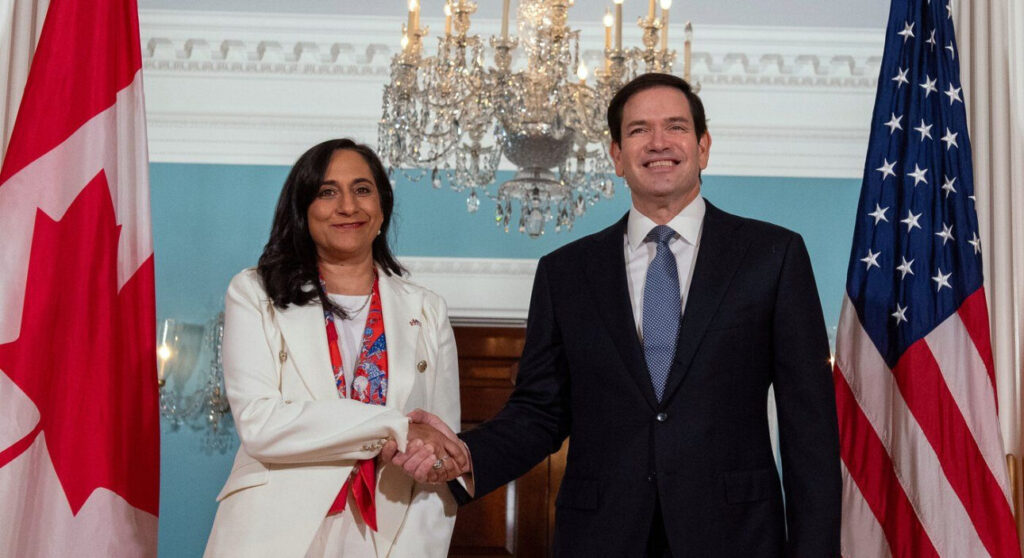
US Secretary of State Marco Rubio (right) meets Canada's Foreign Minister Anita Anand at the State Department in Washington, on Aug. 21, 2025. Photo: AP/Cliff Owen/file photo.
US Secretary of State Marco Rubio (right) meets Canada's Foreign Minister Anita Anand at the State Department in Washington, on Aug. 21, 2025. Photo: AP/Cliff Owen/file photo.
By Rick Arnold – Dec 22, 2025
The question should be easy enough for Canada’s federal government to answer: Has Canada provided military intelligence since September 2025 to U.S. forces delivering lethal air strikes on small boats in the Caribbean and eastern Pacific that have killed dozens of civilians? In recent weeks, Canadian organizations and individuals have written to their MPs and to ministers, including Foreign Affairs Minister Anita Anand, asking this same question. The silence from Parliament Hill has been resounding.
Anand’s only comment related to the killings and Canada’s possible complicity came at the end of the recent meeting of G7 foreign ministers. As reported Nov. 12 by The Hill Times, Anand said, “I would say it is within the purview of U.S. authorities to make that determination.” This was a blow to Canada’s international human rights reputation, especially after the United Kingdom had publicly declared that these killings were extrajudicial and it would stop sharing intelligence with U.S. forces immediately.
Canada has been attempting ‘smoke and mirrors’ with its Department of National Defence arguing that Canadian intel only goes to the U.S. Coast Guard (USCG). However the U.S.CG is under the direct command of the U.S. Department of War so any intel the U.S.CG gathers is being shared more widely. But now, in the latest escalation Dec. 10, it was the U.S.CG itself that led the seizure of an oil tanker off the coast of Venezuela. This oil tanker seizure has been denounced internationally and leaves Canada with nowhere to hide in arguing that Canadian intel is not being used for illegal U.S. actions in the Caribbean.
While attention in the United States has focused on Defence Secretary Pete Hegseth in one of the attacks, the U.N. High Commissioner for Human Rights and other U.N. experts have warned that the air strikes violate international human rights law and must stop. The presidents of Mexico, Brazil and Colombia have spoken in opposition to the killings and called for their cessation. France’s foreign minister said the U.S. strikes violated international law. Leaders of the Caribbean Community (CARICOM) reaffirmed the principle of maintaining the Caribbean as a Zone of Peace.
Strikes on the small boats are part of a large military build-up by the United States in the Caribbean and come during a long campaign of threats and sanctions against the government of President Nicolás Maduro that seem intended to induce “regime change.” Unsubstantiated allegations of his government’s involvement in drug-trafficking are akin to the false “weapons of mass destruction” story used by the United States to justify its 2003 invasion of Iraq.
How did Canada get into this mess? In October 2010, Canada signed a Memorandum of Understanding with the U.S. that built on a 2006 Canadian initiative called Operation Caribbe. After the signing of the 2010 MOU, the Canadian government’s website stated that Operation Caribbe was now to contribute “to U.S.-led enhanced counter-narcotics operations in the Caribbean Sea and the eastern Pacific Ocean” with Royal Canadian Navy warships and Royal Canadian Airforce aircraft deployed to “find and track” vessels “of interest” for “interception” by the U.S.
While international law allows for the interdiction of vessels if they are suspected of carrying drugs, the Trump administration’s readiness to treat the Caribbean and eastern Pacific like a war-zone and to disregard international law by not inspecting the boats or arresting their crews for subsequent trial, puts a spotlight on Canada’s military collaboration and potential complicity in these U.S kill operations.
An investigation by Project Ploughshares confirmed that at least two of the early U.S. attacks on small craft “relied on advanced electro-optical/infrared (EO/IR) sensor systems built in Hamilton, Ontario, by L3Harris WESCAM,” likely mounted on a MQ-9 Reaper drone. “These sensors, sold in large volumes to the U.S. government, are designed to surveil below aircraft, identify potential targets, and coordinate airstrikes with precision.” Canadian weapons components and technology have been detected in other theatres of war despite Canada’s promises that this had been stopped. Ottawa should see to it that all future sales to the U.S. fully comply with the Arms Trade Treaty so they are no longer used in U.S. military operations leading to human rights violations and breaches of international law.
Canada should follow the lead of the United Kingdom and not contribute intelligence to U.S operations in the Caribbean. It should put Canadian participation in Operation CARIBBE on hold, so long as extrajudicial high seas killings and illegal seizures of vessels are being carried out by U.S. forces under orders from the Trump administration.
Ottawa should break its silence now and speak out against the unlawful attacks and extrajudicial killings of civilians by U.S. military forces in the Caribbean and Eastern Pacific. By doing so Canada would join the international chorus of countries condemning these unlawful actions while also calling on the United States government to cease further attacks.
Rick Arnold was born and raised in Venezuela. He graduated in Latin American Studies from Yale University and is the current chair of the Trade Justice Group of the Northumberland Chapter of the Council of Canadians.
RA/OT