By Takudzwa Hillary Chiwanza – Jul 31, 2021
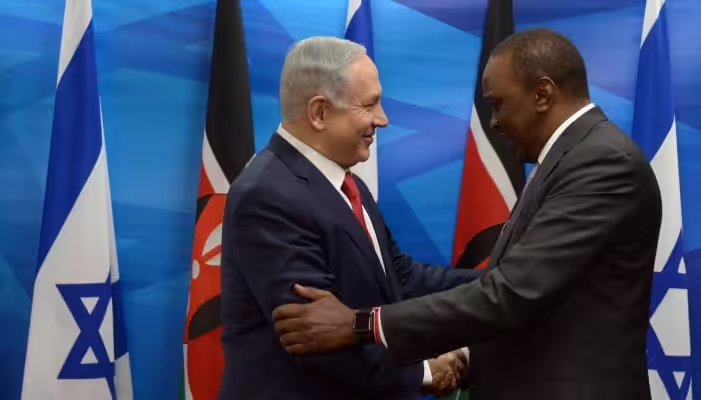
In 2016, Netanyahu was the first Israeli PM in decades to step on the African continent.
After a strenuous stretch of diplomatic offensives that has lasted about 20 years, Israel will finally join the African Union (AU) as an observer state. Israel secured observer status at the AU when its Ambassador to Ethiopia, Burundi, and Chad Aleli Admasu last week presented the country’s credentials to Moussa Faki Mahamat (chairman of the African Union Commission) at the AU’s headquarters in Addis Ababa, the capital of Ethiopia.
The presentation of Israel’s charter as an observer member to the AU in Addis Ababa and the subsequent acceptance of such officially signify Israel’s re-entry into the regional bloc. Israel previously enjoyed observer status in the Organization of African Unity (OAU). When the OAU disbanded in favour of the African Union’s formation in 2002, Israel ceased being an observer state. Its efforts to get back into the regional bloc were consistently fruitless. But a resurgent diplomatic charm on the continent, led by former Israeli PM Benjamin Netanyahu.
In 2016, Netanyahu was the first Israeli PM in decades to step on the African continent and visit four countries – the PM visited Uganda, Kenya, Rwanda, and Ethiopia. For the Israeli political establishment, enjoying observer status in the AU is something they patiently waited for, and their elation was palpable. Israel’s Foreign Minister Yair Lapid expressed the country’s “celebration” over its reinstatement to the AU.
“This is a day of celebration for Israel-Africa relations,” Lapid cheerfully remarked. “This diplomatic achievement is the result of efforts by the Foreign Ministry, the African Division, and Israeli embassies on the continent. This corrects the anomaly that existed for almost two decades … and is an important part of the strengthening of fabric of Israel’s foreign relations. This will help us strengthen our activities in the continent and in the organization’s member states.”
RELATED CONTENT: Has AU Declared War on Member States by Granting Israel ‘Observer Status’?
Such words reflect a country that has been longing to wield its neocolonial power over the continent. Proffering overt support to Israel is a contentious issue among members of the AU – and this is primarily due to the illegal Israeli occupation of Palestine. Israel already has diplomatic relations with 46 AU member states.
The issue of rallying support to oppose United Nations [Security Council and General Assembly] resolutions against Israeli occupation over Palestine forms one of the crucial reasons why Israel persistently attempts to fortify its presence and dominance on the continent. And from an Israeli perspective, the restoration of its observer status serves to create “stronger cooperation” as regards Israel-Africa relations, particularly in the realms of [unequal] trade, fighting COVID-19, and stopping the proliferation of “extremist terrorism” – with the “terrorism” point being used as a narrative to permanently blight Africa’s image so as to justify endless [neocolonial] foreign interventionism on the continent. The invisible and imperial hand of the United States lurks in the background regarding the [uneven] power dynamics of Israel-Africa relations.
The AU however maintained a strong moral approach in this diplomatic development, asserting that Israel must adopt a two-state solution as the only way to bring peace over the perennial Israeli-Palestine conflict. According to the AU, a two-state solution is the only mechanism to achieve “peaceful co-existence” (and to uphold key tenets of public international law as enshrined in the UN Charter and resolutions denouncing Israeli occupation). This is the AU’s stance on Israel’s reinstatement, and whether Israel respects this calls for deeper reflections.
The AU largely leans towards solidarity with Palestine, given a shared history of colonial domination and the fight for independence. Palestine has always supported liberation movements in Africa – and African liberation movements have always supported the Palestinian struggle. Al Jazeera comments that “Pro-Palestine language is typically featured in statements delivered at the AU’s annual summits.” In the contemporary, these dynamics may have changed but the overwhelming tone in Africa is that Palestine deserves freedom from Israeli occupation.
RELATED CONTENT: Ambassador Alex Saab Letter to the Venezuelan People: “No Retreat, No Surrender”
Palestine also has observer status at the AU. One could argue that having both Israel and Palestine as observer members could foster healthy dialogue between the two states. But it is an avowed fact that Israeli intransigence is backed by the US and its Western allies and that there is nothing AU member states can do to move Israel towards a long-lasting peace solution, such as a two-state solution or even a one-state solution.
Israel’s moves towards being allowed in the AU should be read in the wider context of neo-capitalism which demands Israel to maintain racist and colonial domination over Palestine through Zionism – making Israel a settler-colonialist and apartheid state. At the same time, purported “trade” between Israel and Africa keeps the latter prejudiced.
Israel is fortifying its neocolonial presence on the continent via “innovation” – what such innovation entails is “security, technology, agriculture, health, water, and energy.” All this does is maintain Africa’s dependence on foreign aid and interventionism.
Although the AU’s position is clear, demanding Israel to find a peaceful solution with Palestine, it is doubtful that such a nuclear state will listen to the voices of Africans who stand in solidarity with the Palestinian struggle. All these diplomatic developments should be taken with a pinch of salt.
Featured image: Netanyahu and Uhuru Kenyatta, President of Kenya.
(The African Exponent)