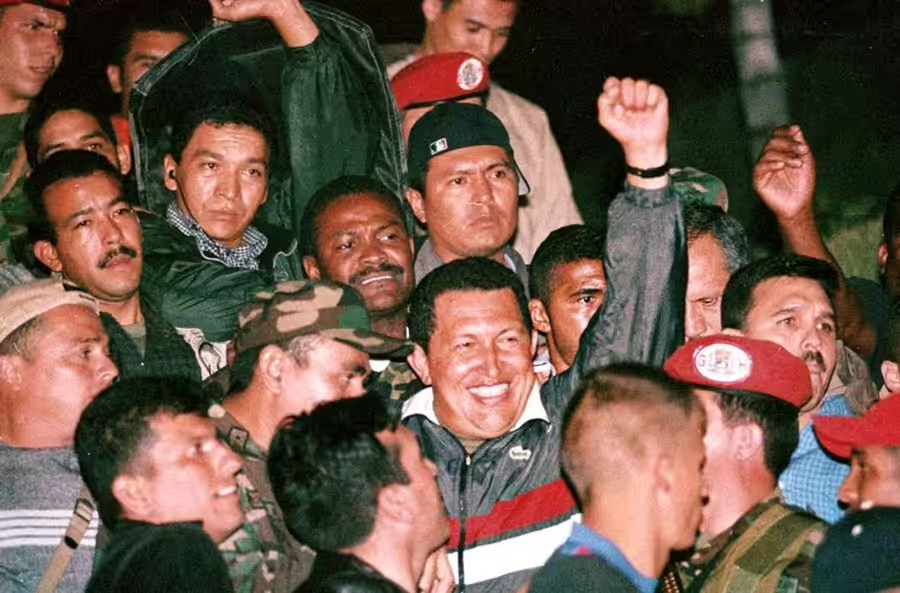
President Chávez freed from captivity by the people, thus defeating the coup within 48 hours. File photo.
President Chávez freed from captivity by the people, thus defeating the coup within 48 hours. File photo.
By Tim Young – Apr 18, 2023
“The period since Chavez’s death has seen the most concerted efforts to oust the government & usher in a regime amenable to the US’ political and economic agenda.”
Twenty-one years ago this month the United States supported a coup in Venezuela to overthrow President Hugo Chávez’s radical reforming government and preserve US strategic and business interests.
Chávez had won the presidential election in 1998 with 57% of the vote and set about to transform the country. A rigged two-party system had for forty years ensured a grossly unequal distribution of wealth, enriching both its local elites and multinational companies while leaving up to seven in 10 Venezuelans living in poverty.
But Chávez planned to change that by using Venezuela’s massive oil wealth, with the largest reserves in the world, to deliver wide-ranging social and economic improvements for the benefit of the majority of its citizens, especially the poorest and most maginalised.
Elite hostility towards Chávez came to a head in 2001 over his proposal for 49 enabling laws empowering the executive to legislate on hydrocarbons, land tenure and fishing. Included were measures on the production and taxation of oil, increasing government oil royalties and setting a 51% stake in all joint ventures with foreign companies.
April 2002 Coup: When the People Defended Chávez and the Revolution
This last provision effectively ended oil executives’ hopes of privatisation of the state oil company PdVSA and jeopardised their control and corrupt siphoning off of its profits.
While ordinary Venezuelans were inspired by the promise of these momentous changes, they alarmed the country’s powerful elites. The US were worried not only about Venezuela’s internal transformations but also Chávez’s promotion of a unified Latin America, free from the interference of foreign powers.
As the threatened elites inside Venezuela began to envisage ousting Chávez, the US poured hundreds of thousands of dollars into strengthening the opposition and planning for a coup.
US’s complicity in the coup, rather than be denied as is usually the case in such illegal actions, was subsequently acknowledged in a US State Department document: “…it is clear that NED [the National Endowment for Democracy], Department of Defense (DOD), and other U.S. assistance programs provided training, institution building, and other support to individuals and organizations understood to be actively involved in the brief ouster of the Chávez government.”
The foundations for the coup were laid in December 2001 with a national lock out, not very well supported, led by business interests and the CTV (a rotten trade union federation close to one of the corrupt, centrist traditional parties and opposed to Chávez).
The coup proper began with a national “strike” (mostly involving temporary closures of small businesses rather than actual strikes by workers) on 9th April 2002 called by the coup organisers – business federations, a sector of the PdVSA leadership, media companies and the Catholic Church, grouped as the Coordinadora Democrática.
The following day, as the CTV leader declared the strike indefinite, Army General Néstor González González threw his lot in with the coup plotters, accusing Chavez thus: “We are a country worthy of being governed by someone better than you.”
Events moved quickly, with a massive opposition march on the presidential palace coming up against supporters of the elected government and presidential guard troops, who fired tear gas at the opposition demonstrators.
In the ensuing melee, sniper fire which mostly killed chavistas was blamed by the opposition-controlled private media on Chávez, leading military leaders to demand his resignation. Chávez refused but was taken prisoner and held on a military base.
The coup plotters appointed Pedro Carmona, head of the main business association, Fedecámaras, as president of the new regime and immediately abolished Venezuela’s Congress, Supreme Court, and constitution, to applause from the US and a lightning-fast offer of assistance from the IMF.
But as the Venezuelan media claims that Chavez had resigned were shredded, tens of thousands streamed down Caracas’s barrios to demand Chávez’s return. Coupled with support from loyal armed forces, the coup was overturned on 13th April and Chávez restored to the presidency.
But the US – and Venezuela’s elites – have not been reconciled to the social and economic reforms and developments in popular participation initiated by President Chávez.
The shutdown in 2002-3 of the oil industry, led by the same organisations who instigated the April 2002 coup, caused over $7 billion economic damage. Two years later, the opposition again failed to depose Chávez through a recall referendum, losing by 58% to 42%.
But the period since Chavez’s death in 2013 – and the subsequent election of President Nicolas Maduro – has seen the most concerted efforts to oust the government and usher in a regime amenable to the US’s political and economic agenda. These has involved economic strangulation, delegitimating any unfavourable election results and an ever-present threat of violence and intervention.
In 2014 and again in 2017, at the behest of the US State Department, six months-long campaigns of opposition violence on the streets saw government institutions attacked, everyday life disrupted and Chavistas assaulted. While these episodes caused massive economic damage and disarray, both failed to provide the flashpoint for an armed intervention to bring down Maduro’s government.
Since then, US sanctions, first introduced by Obama in 2015 and ramped up by Trump into a crippling economic, trade and financial blockade, led to a 99% fall in oil revenues and well over hundred thousand unnecessary deaths. Complementing this, Trump threatened military action against Venezuela.
Trump also backed Juan Guaidό’s attempt to bring about ‘regime change’ by declaring himself ’interim president’ in 2019, bankrolling his activities, including insurrectionary adventures, with confiscated Venezuelan assets until the right-wing Venezuelan opposition ditched him in December 2022.
The war in Ukraine may have forced Biden to ease sanctions slightly to get oil flowing to the US, but the fundamental dynamic of securing ‘regime change’ has not gone away. The need for our international solidarity hasn’t either.