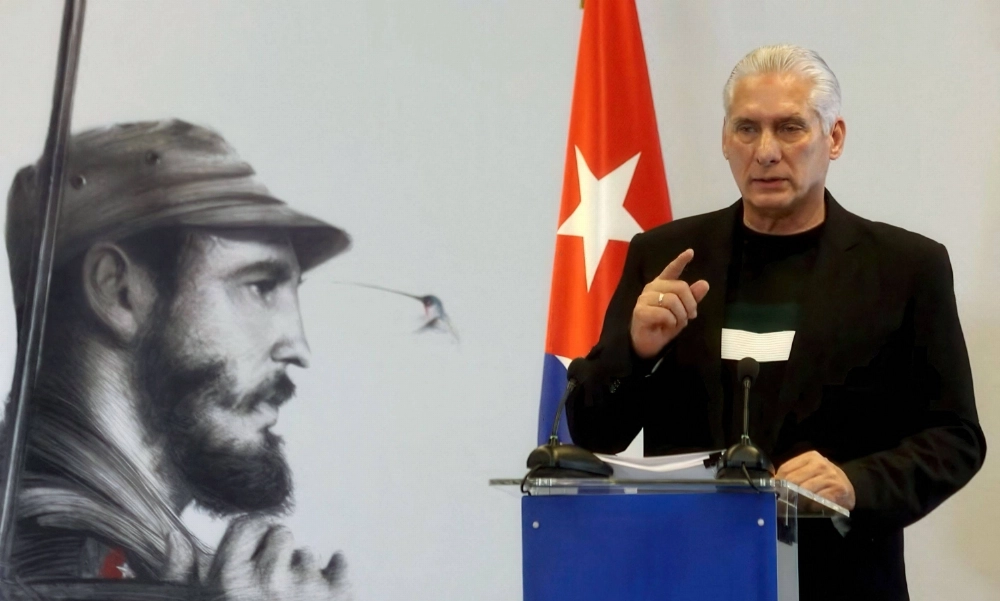
Cuban President Miguel Díaz-Canel holds press conference on February 5, 2026, addressing the US-imposed oil blockade. Photo: EFE.
Cuban President Miguel Díaz-Canel holds press conference on February 5, 2026, addressing the US-imposed oil blockade. Photo: EFE.
The president of Cuba, Miguel Díaz-Canel Bermúdez, addressed the complex energy situation that the country is facing, resulting from the tightening of the economic, commercial, and financial blockade imposed by the United States. At a press conference on Thursday, February 5, he noted that the country has adopted a strategy to expand the use of its own energy sources and rely less on imports.
The president explained that since December 3, when the US naval blockade against Venezuela began, Cuba has not received a single drop of fuel, a situation that impacts public health, the economy, transportation, electricity generation, and the daily subsistence of the country.
He added that the intensification of pressures from Washington generates a deliberate psychological impact, aimed at instilling fear among shipowners, shipping companies, and international suppliers, as part of a strategy of economic strangulation. The intensification of the US siege on fuel purchases confirms the validity of the strategy approved by Cuba to ensure energy sovereignty.
➡️ Luego, agregó, comenzó el bloqueo energético y naval a Venezuela que ha impedido que barcos de ese país, incluso de otras naciones con combustible venezolano, lleguen a Cuba. pic.twitter.com/o1DKbzQ9x2
— Cubadebate (@cubadebatecu) February 5, 2026
He assured the Cuban people that his government is working to minimize the effects of this aggression, so that the population is affected as little as possible, as well as for the reactivation of the economy.
He stated that Cuba does not renounce the right to receive fuel from abroad. It is a sovereign right, Díaz-Canel emphasized, noting that the option of surrender does not exist, and made it clear that the US has no right to impose its economic warfare policy on Cuba and third countries.
#ENVIVO | ”Cuba no es un país terrorista, Cuba no ha hecho ni propuesto ni armado una acción agresiva que ponga en peligro la integridad territorial del Gobierno de #EEUU, nosotros no protegemos terroristas. No hay bases miliares de otros países en Cuba. Hay solo una base… pic.twitter.com/1Gl9IZlyFr
— teleSUR TV (@teleSURtv) February 5, 2026
He reported that the Council of Ministers approved guidelines for a contingency plan aimed at addressing the US economic strangulation attempt. He acknowledged that temporary restrictions on consumption and greater energy savings will be necessary, but emphasized that these are not permanent measures, but rather adjusted to the real conditions of the country, the details of which will be explained by the relevant ministers.
He highlighted that the response of the Cuban state is based on a comprehensive strategy for transforming the energy matrix, which includes the recovery of electricity generation capacity (more than 900 MW has been recovered), the use of domestic sources, the increase in storage capacities affected after the accident at the Matanzas supertanker base, the increase in national crude oil production, electricity generation from natural gas (Energas companies), and the development of its own fleet of ships.
In parallel, the construction of photovoltaic parks began, and 49 were completed during 2025 (with capacity of around 1,000 MW), which helped reduce the electrical deficit during the day. They generate 38% of the energy that the country produces at that moment, in circumstances where Cuba has been unable to rely on distributed generation (combustion engines) for several weeks due to lack of fuel.
He detailed that 5,000 2 kW photovoltaic systems are being installed on 5,000 previously unelectrified homes, which will allow Cuba to achieve 100% electrification.
Additionally, another 5,000 photovoltaic systems are being installed in prioritized service centers, such as maternity homes, nursing homes, senior residences, polyclinics, housing for children in vulnerable situation, and bank branches.
Likewise, another 10,000 photovoltaic systems are being delivered to Education and Health workers. Tariff conditions are being applied to acquire these systems, and new investments in wind generation capacity are being developed.
The program includes increasing the production of associated gas from oil and supplying manufactured gas to 20,000 new customers in Havana.
He added that successful tests for the refining of Cuban crude oil and the production of derivatives were already conducted in December 2025, as well as the acquisition of engines capable of using that fuel.
Díaz-Canel emphasized that none of these actions, on their own, can solve the problem immediately, but he stressed that the situation is not more serious thanks to the country’s progress in changing the energy matrix. The will to resist, recover, and create will include expanding the production of goods and services at the local level, he announced.
From Blockade to Asphyxiation: the US War on Cuba Enters Its Most Brutal Phase
These statements come alongside a growing diplomatic response by Cuba in international forums, where it has systematically denounced the economic, social, and humanitarian impacts of the US blockade, in place for more than six decades and described by Havana as a policy of collective punishment against the Cuban people.
Cuban authorities have demonstrated that the impact of the blockade goes beyond the macroeconomic level, directly affecting access to medicine, fuel, medical supplies, technology, transportation, and basic goods, with palpable consequences in the daily lives of the population.
The president questioned the human implications of this policy. “What does it mean to prevent fuel from reaching a country?” he asked, pointing out that it is a measure that directly affects the lives of millions of people.
In his latest report to the United Nations General Assembly, Cuban Foreign Minister Bruno Rodríguez Parrilla explained that between March 2024 and February 2025, the damages caused by the blockade amounted to $7.556 billion, representing a 49% increase compared to the previous period and confirming a permanent tightening of the economic suffocation policy. The accumulated losses have already surpassed $170.677 billion, according to official figures presented to the UN.
Cuba has also highlighted that the US unilateral coercive measures violate international law and the United Nations Charter, as they are forms of “economic warfare” aimed at provoking a social outburst and destabilizing the constitutional order of the country. These measures have been accompanied by pressure and threats against third states to weaken the international consensus against the blockade.
(Telesur)
Translation: Orinoco Tribune
OT/SC/DZ