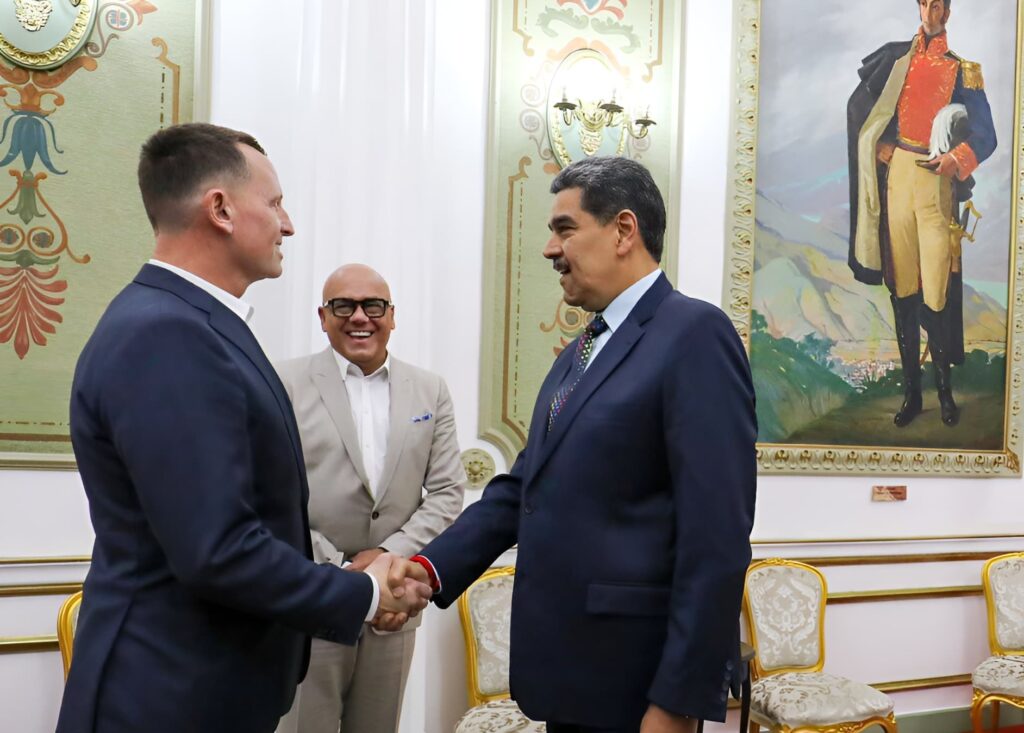
Venezuelan President Nicolás Maduro (right) shaking hands with US Special Envoy for Special Missions Richard Grenell (left), while Venezuelan National Assembly President Jorge Rodríguez looks on, Miraflores Palace, Caracas, January 31, 2025. Photo: Presidential Press.
The recent release of US Air Force veteran Joseph St. Clair—who had been detained in Venezuela since late 2024 after crossing the border into Colombia and was implicated in activities linked to the sabotage of the national electricity system—confirms once again that the direct negotiation channel between the governments of Nicolás Maduro and Donald Trump not only remains active, but continues to consolidate itself as an effective tool to resolve sensitive issues for both parties.
The delivery, conducted this Wednesday, May 21, on the Caribbean island of Antigua by the Venezuelan government to Richard Grenell, special envoy of the Trump administration, represents a new chapter in this bilateral dynamic that is developing outside the ideological confrontation and political maximalism that has been going on so far.
This fact cannot be understood without placing it within the broader context of internal disputes in Washington over how to approach Caracas. On the one hand, Marco Rubio, the current secretary of state of the US empire, insists on maintaining a policy of “maximum pressure,” obsessed with “regime change” agendas that have proven historically unsuccessful.
On the other hand, Richard Grenell leads an alternative line based on realpolitik, pragmatism, and the pursuit of common interests, without ignoring differences but prioritizing tangible results.
The language of the special envoy’s X post on St. Clair’s reception in Antigua reveals the existence of such a schism, when he says this “was only possible because @realDonaldTrump puts Americans first,” without mentioning the State Department, the supposed executor of Washington’s diplomacy, headed by a figure known for his aggressiveness against Cuba, Nicaragua, and Venezuela, due to his political roots in Florida.
The surrender of this soldier of the US colony is, in itself, a significant gesture by the Venezuelan government. It reflects a willingness to resume direct diplomatic channels with Washington—despite handing over a man accused of terrorist plots—and a political will to build bridges with the US empire under conditions of reciprocity and respect for sovereignty.
This type of measure allows for decompression of tensions and the creation of trust-building spaces, which are necessary for addressing more complex issues.
Movement in the energy (and geopolitical) sector
While the veteran’s release symbolizes a diplomatic breakthrough, the parallel movement surrounding Chevron further deepens the strategic nature of this new chapter in the bilateral relationship.
According to reports from the Wall Street Journal and Bloomberg, the Trump administration is reportedly preparing to extend General License 41a, granted by the Treasury Department’s Office of Foreign Assets Control (OFAC), for another 60 days. This license allows Chevron and other companies to operate in Venezuela under certain limits.
This extension, scheduled to expire on May 27, would signal Washington’s willingness to relax its sanctions policy in pursuit of shared economic and energy goals. Official confirmation is still pending and could come as early as May 27 itself.
This is no coincidence. Under the expressed understanding that Trump is not seeking regime change or wishing to see China expand its influence in the Venezuelan oil sector—as Grenell revealed on Steve Bannon’s podcast on May 20—this energy window takes on crucial geopolitical significance:
Bannon: Is there any discussion about a Chevron expansion? Is that in the cards, or is it something President Trump is working on?
Grenell: No, President Trump authorized that extension if we were able to make some progress, if we were able to build some trust, if we were able to do that today. So the extension will be granted.
Maintaining companies from the US entity like Chevron in Venezuela not only guarantees a flow of crude oil to key refineries in Texas and New Mexico, but—under Washington’s logic—also limits opportunities for rivals of the US empire to gain a foothold in a resource-rich market underutilized by years of blockade and disinvestment. This geopolitical calculation could also apply to Trinidad and Tobago, which seeks to continue its shared gas field projects with Venezuela.
The combination of security cooperation—in regard to the veteran’s repatriation—and flexibility with sanctions in the energy sector marks a pattern: both countries are moving toward a relationship less conditioned by ideological dogmas, and more guided by strategic rationality.
Though this directly clashes with the positions of extremist groups inside and outside the US colony—with efforts led by Marco Rubio and María Corina Machado—it reflects a political realism that recognizes that protracted conflicts cannot be resolved unilaterally. Venezuela, far from being an abstract platform for ideological battles, is an international player with negotiating capacity and its own agenda.
However, obstacles persist, and they are of a serious criminal nature. The war against Venezuelan migrants, often channeled through coercive policies such as mass transfers to the CECOT mega-prison in El Salvador, demonstrates that coercive practices remain on certain fronts.
But Grenell’s growing prominence regarding Venezuela shows another possible path: one prioritizing discreet dialogue, minimal consensus-building, and resolving real problems rather than empty rhetoric or utopian interventionist plans.
Towards a progressive process of negotiations? The incident involving the veteran and the imminent extension of Chevron’s license are milestones that, though seemingly small, form a network of agreements that could eventually shape a stable structure for dialogue between the two countries.
Such moves strengthen President Maduro’s legitimacy within Venezuela—by demonstrating his ability to negotiate with foreign powers on equal terms—while providing Washington operational leeway to protect its interests without resorting to economic warfare.
In this context, the “maximum pressure” model of the US empire has clearly outlived its usefulness. Far from achieving political change, it has caused profound collateral damage to Venezuelan society and undermined the credibility of the US colony as a reliable international partner.
The path now opened by these actions promises a relationship based on mutual recognition, functional interdependence, and pragmatic management of shared interests.
Yet, Grenell’s remarks to Bannon highlight nuances: “We want to make sure we test and build trust. A lot of the discussions about diplomacy and how to find solutions are literally about building trust to make sure one side does what they say. Because remember, they’re skeptical of us, and we’re skeptical of them.”
Though internal resistance in Washington—particularly among neoconservatives, hawks, and Venezuelan extremist groups—will not vanish overnight, the trend suggests realpolitik and silent diplomacy are gaining ground.
This dynamic, carefully managed by Grenell and supported by White House decisions, could lay the foundation for a less volatile, more predictable bilateral relationship, one better equipped to address present-day energy and geopolitical challenges.
In short, the Maduro-Trump negotiation path is now both a viable option and an operational necessity. And while Washington remains divided between those clinging to the ruins of the past and those committed to bridge-building, Venezuela continues advancing step by step, eyes fixed on a cautious yet increasingly fruitful strategy.