Editorial note: Orinoco Tribune does not generally publish pieces older than two weeks. However, an exception is being made in this case, as the current article remains as, or more, relevant today as when it was first published.
By Qiao Collective – Jul 1, 2024
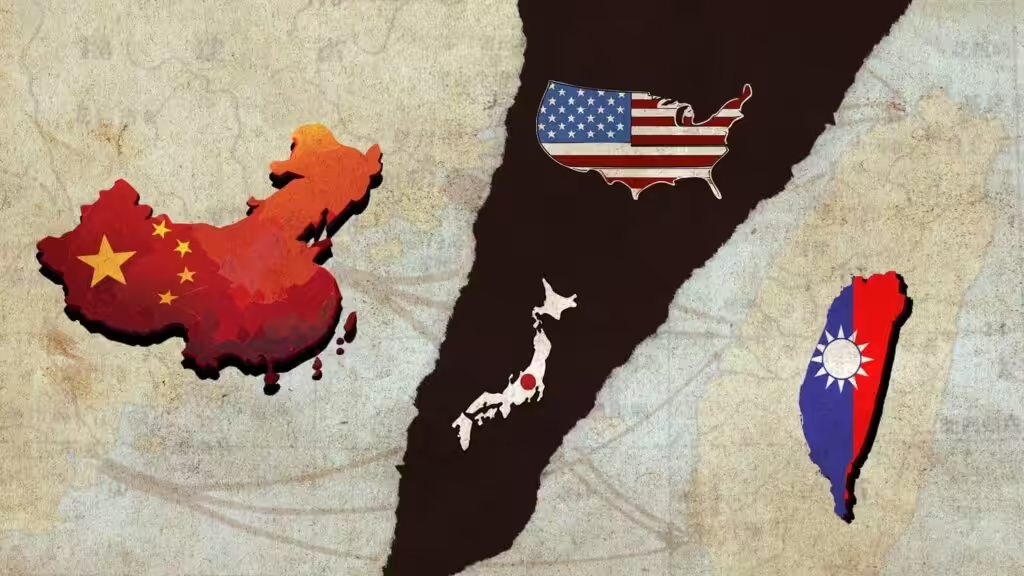
In the Western imagination, Taiwan exists as little more than a staging ground for ideological war with the People’s Republic of China (PRC)—a crossroads of democracy versus authoritarianism, Western values versus Chinese backwardness, and free market capitalism versus closed-door communism. Yet for centuries, the island of Taiwan has played a rich and pivotal role in broader Chinese history. Located just one hundred miles from the mainland’s southeastern coast, Taiwan was linked to the mainland through migration, trade, language, and culture long before European and Japanese colonizers seized on its strategic location as a launchpad for economic and military forays against China at large. Today, this history continues as U.S. imperialism positions Taiwan as an ideological and military base for its new Cold War against China.1
Taiwan’s separation from the Chinese mainland began in 1895, when the Qing government was forced to cede Taiwan to Japan after its defeat in the First Sino-Japanese War. While Japan’s surrender at the end of the Second World War legally restored Chinese sovereignty over Taiwan, the Chinese Civil War and the global Cold War once again rendered Taiwan an instrument for imperial ambitions against China. For the ascendant postwar United States, the 1949 establishment of the PRC under the Communist Party of China (CPC) marked the “loss of China”—a blow only partially recouped by propping up the fleeing Chiang Kai-shek government in Taiwan as “Free China.” In 1950, as the United States waged war to prevent the socialist unification of Korea, President Harry S. Truman dispatched the U.S. Navy’s Seventh Fleet to the Taiwan Strait to similarly foreclose the possibility of a unified socialist China.
The legacy of that militarized division remains today, as the United States enforces the separation of Taiwan from the PRC through multibillion-dollar arms sales, menacing war games, and a concerted propaganda drive, which together undermine the possibility of peaceful reunification. This bipartisan campaign of hybrid warfare has intensified over the last fifteen years following China’s rise as a major power, the corresponding U.S. “Pivot to Asia,” and the era of “decoupling” pursued by both the Donald Trump and Joe Biden administrations. As the U.S. military declares the Pacific its primary theater of war, successive U.S. administrations have marshaled enormous economic, military, and ideological resources to build up Taiwan as a focal point for this new Cold War. This program violates the letter of the One China principle and the spirit of the United States’ own “One China policy,” which together have formed the basis for bilateral relations since 1979. Furthermore, they neglect the centuries-long shared history of Taiwan and its people with their neighbors across the strait.
Just as Western colonialism was once justified as a “civilizing mission,” U.S. imperial designs on China at large march under the banner of promoting “democracy” and defending the “international rules-based order.” The U.S. claim to be acting in defense of Taiwan’s “vibrant democracy” from Chinese authoritarianism is particularly ahistorical, given that it is responsible for propping up the Kuomintang (KMT) military dictatorship under Chiang and his successors for almost forty years. Meanwhile, despite grandiose language about U.S. global leadership, the reality is that the majority of the world understands cross-strait relations to be an internal matter for China. Only eleven United Nations member states maintain formal diplomatic relations with Taiwan (as the Republic of China [ROC]), and no country recognizes Taiwan as an independent nation. This fact is unsurprising; UN recognition of the PRC as the legitimate representative of China came on the wings of overwhelming support from the Third World. Having experienced the genocidal violence and economic exploitation inherent to the Western imperial system, the Global South, like China itself, adheres to the tenets of sovereignty and non-interference.
Though ideologically diverse, proponents of Taiwanese independence rely on an overlapping revisionist toolkit that elides the historical context of the unresolved civil war shaping the cross-strait relationship. Instead, China’s aspirations for national unity are cast in terms of imperialism and expansionism. The era of KMT martial law is erroneously invoked as precedent for authoritarian Chinese encroachment, obscuring the historical KMT-CPC rivalry and the role of the United States in supporting the military dictatorship. Meanwhile, the history of Japanese colonialism has been systematically revised as “benign” rule to form the bedrock for a non-Chinese local identity. Claims that Taiwan’s democracy has “voted out” reunification as a political pathway omit the crucial context that the island’s most vocal left-wing supporters of unification were systematically purged, jailed, and murdered under Japanese colonialism and KMT rule. Efforts to co-opt Taiwan’s yuánzhùmín, or Indigenous peoples, into the project of Taiwan independence rely on a similar level of obfuscation; despite the separatist camp’s appropriation of decolonial rhetoric, yuánzhùmín have historically been apathetic toward the pro-independence Democratic Progressive Party (DPP).2 In spite of these attempts to stake Taiwan separatism to a schema of ethnic difference, official demographics list 95 percent of Taiwan’s population as being Han Chinese, the majority ethnic group of the Chinese mainland.
While those on the left may be (rightfully) skeptical of the elite rhetoric of freedom and democracy, this rhetoric of Chinese imperialism, settler colonialism, and ethnic chauvinism may be harder to parse for those unfamiliar with Taiwan’s history. Yet, whether it is couched in the moralizing language of classic Cold Warriors or self-styled leftists, Taiwanese independence ultimately serves the material interests of Western imperialism. Like the European and Japanese imperialists who colonized Taiwan for access to Chinese trade from the seventeenth through twentieth centuries, the United States transparently envisions the island as an outpost for efforts to contain China militarily while decoupling from it economically.
More than seventy years since U.S. military leader Douglas MacArthur described Taiwan as an “unsinkable aircraft carrier” in the nation’s Cold War against China, Taiwan remains a crude asset for U.S. military realpolitik. It is the linchpin of the so-called first island chain that links the four hundred U.S. military bases spread across Asia and the Pacific and, crucially, home to the Taiwan Semiconductor Manufacturing Company, the world’s largest advanced semiconductor chip manufacturer. Lofty narratives of Taiwanese independence thus ultimately fuel consent for militarization, intervention, and war while marginalizing anti-imperialist voices for diplomacy and peace. They also disguise the true intent of retaining Taiwan as a neocolonial outpost of Western empire in order to undermine China’s sovereign economic development. There is no “independence” in becoming a U.S. client regime entrapped in a capitalist world order. It would set a precedent for any country, large or small, that challenges U.S. hegemony to be balkanized with impunity. For the left to support such an outcome would be self-sabotage on an epic scale, regardless of the titanic politico-economic shifts on both sides of the strait since the Chinese Revolution of 1949.
The rest of this article explores key aspects of Taiwan’s history to provide crucial context for contemporary discussions about cross-strait relations and Chinese reunification. It is not intended to be comprehensive in scope, for Taiwan’s place in Chinese history extends far beyond the recent centuries of Western and Japanese imperialism in Asia. Nor is it intended to offer simple answers to questions about mainland China and Taiwan. It aims only to be a starting point for critical inquiry, and we urge readers to seek a diversity of sources and form their own opinions. A more detailed understanding requires further study into Taiwan’s history, cross-strait relations, Chinese politics, and ongoing geopolitical developments.
Pre-Colonial Taiwan and Early European Colonization
The first large-scale wave of human migration to Taiwan began around six thousand years ago, originating in what is today southeast China. These migrants would become the ancestors not just of today’s yuánzhùmín, but of all Austronesian peoples, whose extraordinary seafaring feats would take them as far west as Madagascar, as far east as Rapa Nui (Easter Island), and south to Aotearoa (New Zealand). On Taiwan itself, the yuánzhùmín have historically included both highland and plains peoples; the island’s Chinese name is derived from the Taivoan people of the southwestern plains.
Historical records from the Three Kingdoms period (circa 230 CE) and the Sui dynasty (from the early seventh century) suggest possible expeditions to Taiwan from mainland China, and permanent Chinese settlement on the neighboring Penghu islands began no later than the Song dynasty. However, the first verified written account of Taiwan and its peoples was provided only in 1349 by Yuan dynasty explorer Wang Dayuan.3 Shortly after, the newly founded Ming dynasty instituted a strict maritime ban and withdrew all formal settlements. Nonetheless, cross-strait trade and piracy continued in defiance of official decrees.
In the late sixteenth century, a (briefly) expansionist Japan set its sights on Taiwan, followed soon after by dueling European colonial empires. The Dutch struck first in 1624 by establishing a foothold in the southwest of the island; four years later, Spain attempted the same in the north, only to be expelled by the former in 1642. Dutch efforts to subjugate and Christianize the population were at various times fiercely resisted by both the yuánzhùmín and by the tens of thousands of Han Chinese conscripted from the mainland as agricultural laborers—most notably in a 1652 rebellion that some historians consider “the first Chinese anti-western uprising in modern history.”
Taiwan came under formal Chinese authority for the first time as a result of massive political changes on the mainland. In 1644, the Ming were overthrown by the Manchu Qing dynasty, which quickly consolidated its rule over most of China, though it took several decades to suppress the last pockets of Ming loyalist resistance. One such insurgency was led by Zheng Chenggong (also known as Koxinga) in Fujian province, directly across the strait from Taiwan. In 1662, Zheng’s army joined forces with both Han migrants and yuánzhùmín to expel the Dutch from the island and establish the Ming-restorationist Kingdom of Tungning in its place.
Given the similarity of these events to those three centuries later, their legacy remains historically contested today. The PRC honors Zheng for dealing Western imperialists their first major defeat at Chinese hands, while KMT partisans in Taiwan analogize his Ming loyalists to the post-1949 ROC (and the so-called foreign Manchu invaders to the Communists). This first attempt to use Taiwan as a base to reconquer the mainland proved just as futile as the second; in 1683, Qing forces defeated the Kingdom of Tungning and incorporated Taiwan as a prefecture of Fujian.4
In contrast to non-Chinese colonial authorities before and after, the Qing dynasty interfered minimally in the affairs especially of highland yuánzhùmín over the next two centuries.5 Until 1875, it imposed strict limitations on migration from the mainland as well as a complete ban on Han Chinese entry into the central and eastern mountains. Nonetheless migration of Hoklo- and Hakka-speaking people from Fujian and Guangdong provinces continued apace, with virtually all settling in the lowlands of western and northern Taiwan. Through this process, plains yuánzhùmín became largely Sinicized and/or assimilated into Han culture, in marked contrast to their highland counterparts. While no uprisings by the latter were recorded in nearly two centuries, intra-ethnic tensions among Han Taiwanese often erupted into violence—sometimes with a residual Ming-loyalist character—forcing the Qing to suppress such rebellions with help from yuánzhùmín auxiliaries.6
Century of Humiliation, Japanese Colonization, and the Second World War
This state of affairs persisted without major disruption until the mid-nineteenth century, when Taiwan (much like the rest of China) again became an object of Western and Japanese imperialist intrigue. During what is now known as China’s “Century of Humiliation,” events on the mainland provided crucial context for concurrent developments involving Taiwan. However, we can only review the former in cursory fashion, and encourage interested readers to consult the wealth of available literature for more detailed information.
In the First Opium War (1839–1842), Britain defeated the heavily outgunned Qing forces and forced China to cede Hong Kong and open other ports to foreign trade, inaugurating a series of unequal treaties with Western colonial powers. These continued in the Second Opium War (1856–1860), which resulted in further territorial losses, full legalization of the opium trade, and semicolonial rule via foreign concessions in most major cities. During this time the proto-communist Taiping Rebellion (1850–1864) swept through large swathes of southern China, further weakening the dynasty and largely devolving military authority to private armies raised by local officials. Many of them would later play outsize roles in the history of Taiwan.
The island was by no means unaffected by these massive upheavals on the mainland. During the First Opium War, it had briefly come under British bombardment. Later, the Taiping Rebellion sharply raised demand for rice from Taiwan, inducing U.S. merchants to forcibly reopen it to foreign trade—and, in 1857, to lobby their federal government for outright annexation.7 In 1867 and 1871 respectively, sailors from the United States and Ryukyu (an island kingdom long claimed by Japan) were shipwrecked on Taiwan and killed by the local Paiwan people, triggering punitive expeditions by U.S. and Japanese forces.8 Ironically, the Qing dynasty’s studied refusal to exercise colonial authority over the yuánzhùmín had become a pretext for overt imperialist aggression against the island. To shore up their sovereignty claim, the Qing finally lifted all restrictions on Han migration and internal movement in 1875.
The 1884–1885 Sino-French War further highlighted mainland China’s strategic vulnerability vis-à-vis Taiwan, as overall French naval superiority (and specifically their blockade on the island) essentially nullified China’s victories on land.9 Just two years later, Taiwan was thus elevated to provincial status, with Liu Mingchuan—a veteran of the anti-Taiping campaign who had commanded the Huai Army against the French—appointed as its first governor. But that administrative measure and the concurrent naval reforms proved too little, too late. The First Sino-Japanese War of 1894–1895 resulted in a humiliating defeat by a fellow Asian power (again secured largely at sea) and the permanent loss of Taiwan, which was signed over to Japanese colonial rule by Huai Army founder Li Hongzhang.
The people of Taiwan vociferously rejected this decree, proclaiming a short-lived Republic of Formosa, the motto of which “Forever Qing” reflected the people’s continued loyalties. Under the leadership of Tang Jingsong and Liu Yongfu (who had commanded the Yunnan and Black Flag Armies during the Sino-French War respectively) they mounted a spirited but ultimately doomed resistance to Japanese occupation. The island’s new rulers would face periodic armed uprisings for decades to come: at Yunlin in 1896, Beipu in 1907, and Xilai’an in 1915, Han and yuánzhùmín fighters joined forces against the colonizers. The highland yuánzhùmín, who saw their reserved lands violently reduced to an eighth of their former size under the Japanese, resisted the most fiercely. The Bunun and Atayal launched a major revolt in 1913–1914, and the 1930 Wushe uprising led by Seediq chief Mona Rudao was suppressed only with the first-ever use of chemical warfare in East Asia.10
During this period of forced colonial separation, mainland China too was undergoing epochal political changes. Neither halting attempts at modernization nor efforts to co-opt popular anticolonial sentiment during the Boxer Rebellion could save the Qing dynasty from terminal decline. In 1911, the Xinhai Revolution put an end to over two millennia of dynastic rule. But the nascent ROC honeymoon period under its first president, Sun Yat-sen, almost instantly degenerated, first into Yuan Shikai’s mercurial autocracy and then into complete territorial fragmentation during the Warlord Era (1916–1928).
Amidst near-constant civil war and colonial machinations against China, the Bolshevik Revolution sounded a clear rallying cry for national liberation from feudalism and imperialism. It resonated especially with the progressive youth who led the May Fourth Movement of 1919, abandoning bourgeois liberalism for Marxism en masse when the Western Allies connived at Versailles to transfer Shandong from Germany to Japan. That same year, Sun founded the Nationalist Party, KMT, in Guangzhou, followed two years later in Shanghai by the first congress of the CPC. Both parties looked to the USSR for guidance and material support in their shared struggle to end warlordism and reunify China, and, on Soviet advice, they formed a United Front to that end in 1923.
Their vision for Chinese reunification also naturally included the liberation of Taiwan from Japanese rule; unsurprisingly, all of these developments on the mainland found clear echoes there. The Taiwanese Cultural Association was founded in 1921 as an organ for political agitation against Japanese colonialism and for democratic self-rule.11 In 1927, some of its members established the Taiwanese People’s Party (TPP) to advance Taiwanese cultural, educational, and (limited) political autonomy within the Japanese empire under cross-class leadership. Over time, the TPP converged on a more overtly socialist program inspired by Sun’s Three Principles of the People.12 Critical to the leftward turn of both organizations was the radicalizing influence of the Taiwanese Communist Party (TCP), founded in 1928 as a revolutionary anticolonial force rooted in worker-peasant leadership and allied to the CPC. Of these formations, the TCP unsurprisingly suffered the brunt of early repression, but in 1931 all three were banned or forcibly disbanded by colonial authorities.
That year marked a general intensification of Japanese militarism, including the invasion of Manchuria and establishment of a puppet state there under the nominal rule of the last Qing emperor. In Taiwan as well, the pace of social and economic transformation accelerated on several fronts in preparation for full-scale war. The scale of industrialization, electrification, and commodity agricultural production—especially of opium—increased dramatically.13 Simultaneously, colonial authorities instituted a policy of cultural “Japanization” called kōminka, intended to remold the Taiwanese into model imperial subjects by suppressing the Chinese language, imposing new Japanese names, and promoting State Shinto in place of ancestor worship.14 Disturbingly, many contemporary Taiwan independence advocates uncritically celebrate Japan’s role in the island’s economic “modernization” and embrace kōminka as a marker of cultural distinction from mainland China.
In 1937, Japan initiated its full-scale invasion of China, using Taiwan as a key logistical node for colonial resource extraction and a launchpad for attacks on Guangdong, Hainan, and, after Pearl Harbor, the Philippines. Recognizing the island’s strategic importance, Allied forces essentially cut Taiwan off from the rest of the empire and subjected it to punishing air raids in the last years of the war, killing as many as thirty thousand civilians. Overall, some two hundred thousand Taiwanese joined the Imperial Japanese Army through voluntary enlistment or conscription, in a process eased immeasurably by kōminka; around eighty thousand were deployed in combat in the Philippines or mainland China. After Japan surrendered in 1945, it refused to repatriate or compensate any of these troops. Those who did return were often subject to reprisals from Taiwanese civilians, who overwhelmingly celebrated the defeat of their colonial occupiers.
Why Washington’s Plans To Turn Taiwan Strait Into ‘Hellscape’ Are Fundamentally Flawed
Civil War, Cold War Containment, and KMT Dictatorship
In the meantime, mainland China had been mired in nearly ceaseless war since 1927, when Sun’s conservative successor, Chiang Kai-shek, had purged the Communists and ended the First United Front. Though Chiang nominally reunited the country under one-party KMT rule, the CPC doggedly continued to wage “people’s war” from a series of rural base areas under Mao Zedong’s leadership. In 1936, the Communists compelled Chiang to enter a Second United Front against the pending Japanese invasion, during which they distinguished themselves as the leading guerrilla force in enemy-occupied territory. Though military cooperation between KMT and CPC forces had effectively ended by 1941, full-scale hostilities did not resume until postwar peace talks collapsed in late 1945.
Thus, the Chinese Civil War resumed just in time to draw in Taiwan. The Allied Powers of the Second World War demanded the island’s retrocession to China at both conferences in Cairo (1943) and Potsdam (1945), a position reaffirmed in Japan’s instrument of surrender. (Today’s pro-independence camp prefers to ignore these facts, insisting that the 1952 Treaty of San Francisco leaves Taiwan’s final status undetermined, despite vociferous protests by both the PRC and ROC.) Unfortunately, celebration of Taiwan’s restoration to Chinese sovereignty in October 1945 proved short-lived as locals confronted the corrupt and despotic reality of KMT rule.
These pent-up grievances exploded on February 28, 1947, with an island-wide mass uprising that was violently suppressed at the cost of eighteen thousand to twenty-eight thousand lives. The historical memory of the “228 Incident” remains contested today, with independence advocates flattening the conflict to one between “Taiwanese” běnshěngrén and “mainlander” wàishěngrén, and systematically downplaying the role of communists in the anti-KMT struggle.15 (Among them was Xie Xuehong, a founder of the 1928–1931 TCP who later escaped to the mainland and established the Taiwan Democratic Self-Government League—to this day, part of the CPC-led United Front.)
In the wake of the 228 crackdown, the underground CPC organization in Taiwan grew dramatically as the civil war on the mainland turned decisively in their comrades’ favor. In response, the KMT imposed martial law on the island in May 1949, mere months before its defeated forces abandoned the mainland entirely and declared Taipei the provisional capital of the rump “Republic of China.” From his island redoubt, Chiang continued to press his claim to sovereignty over all of China while establishing a regime under which at least 140,000 were imprisoned and 4,000 executed in subsequent decades. Again, contrary to revisionist claims by modern-day independence supporters, the victims of this “White Terror” consisted disproportionately of wàishěngrén targeted for their communist sympathies.
By mid-1950, Taiwan’s CPC underground was already thoroughly decimated, following the capture and defection of its leader Cai Xiaoqian.16 Though the pro-unification left remained a pole of anti-KMT opposition, its hopes for liberation by the newly founded PRC were shattered after the outbreak of the Korean War, when the U.S. Navy sent its Seventh Fleet into the Taiwan Strait.17 This move entrenched the political division of Taiwan from the mainland as a frozen legacy of the unresolved civil war. Armed hostilities since then have mostly been limited to the Taiwan Strait Crises of 1954 and 1958, which took place solely on mainland China’s side of the strait around the ROC-held islands of Kinmen and Matsu.
To wage anticommunist counterinsurgency and prepare for military reunification, the KMT also instituted far-reaching transformations in domestic Taiwanese society. Suspecting prewar běnshěngrén elites of rampant collaboration with Japan, the new regime staffed its bureaucracy largely with wàishěngrén and mandated the exclusive use of Mandarin in government and education.18 (These policies extended to highland yuánzhùmín, who were redesignated as “mountain compatriots” and pressured to assimilate like their lowland counterparts.) The state also implemented far-reaching land reforms, undercutting communist support and garnering the KMT a durable mass base in the countryside—while further alienating běnshěngrén landowners, some of whom later formed the nucleus of the Taiwan independence movement.
Taking full advantage of its strategic location, the ROC regime positioned itself as an indispensable ally of the United States and an anticommunist bulwark in the region and worldwide. The 1954 Sino-American Mutual Defense Treaty established the Taiwan Defense Command in Taipei, which at its peak hosted nineteen thousand U.S. troops, and was a key support base for the war on Vietnam. Taipei also became the nerve center of the World Anti-Communist League, an international network of far-right forces still headquartered there today.19 Through the 1960s, with the mainland gripped by the upheavals of the Great Leap Forward and Cultural Revolution, Chiang’s regime pressed its claim to represent the “real” China while safeguarding its historical traditions by launching a “Chinese Cultural Renaissance Movement.”20 He also plotted on three occasions to reconquer the mainland militarily at moments of particular instability or perceived weakness, backing down only under U.S. pressure.21
The following decade, however, was bookended by dramatic blows to the ROC’s long-untenable claim to represent the legitimate government of all of China. In 1971, the UN General Assembly voted decisively to recognize the PRC as “the only legitimate representatives of China to the United Nations” and “expel forthwith the representatives of Chiang Kai-shek.” Months later, U.S. President Richard Nixon visited Beijing and acknowledged in the Shanghai Communiqué that “all Chinese on either side of the Taiwan Strait maintain there is but one China and that Taiwan is a part of China.” This rapprochement culminated in the 1979 normalization of relations between the PRC and the United States, wherein the latter recognized the former as the sole government of China and terminated the Sino-American Mutual Defense Treaty. (It was quickly replaced by the Taiwan Relations Act, providing for continued arms sales and de facto diplomatic relations through the American Institute in Taiwan.)
Amid these titanic diplomatic shifts, the deaths of Chiang (1975) and Mao (1976) would signal sea changes in domestic politics on both sides of the strait. After brief interregnums, Chiang’s son Ching-kuo and Deng Xiaoping assumed power in Taiwan and the mainland respectively in 1978. Both leadership transitions inaugurated parallel processes of political and economic liberalization.
On the mainland side, this took the form of Deng’s “Socialism with Chinese Characteristics,” which would in time create openings for Taiwanese capital to invest in China’s manufacturing boom. This accompanied a far more immediate and dramatic ideological shift in official messaging to “Taiwan compatriots.” An earnest appeal for cross-strait exchange and reconciliation from the National People’s Congress in 1979 was soon followed by substantive offers of nearly unimaginable economic, cultural, and even military autonomy for Taiwan under a “one country, two systems” framework for reunification.22
While liberalization in mainland China opened new political possibilities for reunification, the parallel process in Taiwan ironically began to foreclose them by undermining the cross-strait consensus behind the One China principle. By the time he assumed the ROC presidency, Chiang Ching-kuo had long since decimated the pro-unification left as his father’s secret police chief. This political vacuum was filled by a far more pliant and Western-friendly opposition, namely the liberal dângwài (“outside the [KMT] party”) movement rooted principally in the aggrieved běnshěngrén petty bourgeoisie.23 This bloc was temporarily repressed in the 1979 Kaohsiung Incident, but recovered quickly and consolidated by 1986 into the pro-independence DPP. After martial law was lifted and opposition parties legalized in 1987, nothing stood in the way of its open entry into Taiwanese politics.
Democratization, De-Sinicization, and the New Cold War
The end of martial law marked a new and uncertain phase in cross-strait relations and Taiwanese politics. With the prospect of reunification under the ROC definitively foreclosed, Taiwan struggled to reconcile its Chinese identity with the reality of its long political separation from the mainland as a U.S. client regime. The island’s pro-unification left was a shadow of its former self, largely reduced to aging survivors of the White Terror. Without their leadership, the door was open to political and cultural de-Sinicization of Taiwanese society: wholesale rejection of Chinese nationality, overt historical revisionism to cultivate an artificial localist identity, and the radicalization of the Taiwan independence movement.
Chiang Ching-kuo died in 1988 and was succeeded as ROC president and KMT chairman by his handpicked successor Lee Teng-hui, the first Taiwan-born běnshěngrén to serve in either position. His ascent faced internal party opposition but was secured by the support of Chiang’s former secretary James Soong Chu-yu.24 Lee would in turn appoint Soong as KMT Secretary-General and later as Chairman of the Taiwan Provincial Government.
In 1992, the ROC Constitution was amended to allow for direct presidential elections as well as fresh legislative elections limited to the “Free Area” under de facto ROC jurisdiction (that is, Taiwan, Penghu, Kinmen, and Matsu). That same year, cross-strait talks in Hong Kong resulted in a “1992 Consensus” affirming that both the PRC and ROC acknowledge Taiwan and the mainland as part of “One China,” despite differing interpretations on each side.
Nonetheless, throughout his career, Lee supported Taiwanese localism in defiance of his own party’s line on reunification (for which he was eventually expelled in 2001). He also routinely endorsed right-wing revisionist narratives about Japanese militarism in the Second World War, visited Japan’s controversial Yasukuni Shrine, and boasted of his voluntary service in the Imperial Japanese Army—positions not uncommon within the separatist camp.25 His support for Japan’s territorial claim to the Diaoyu Islands, challenged by both the PRC and ROC, elicited widespread outrage on both sides of the Taiwan Strait. Bizarrely, Lee was also the only ROC president to have joined the CPC; considerable evidence suggests that he was a mole who later betrayed many erstwhile party comrades.26
On the diplomatic front, Lee unsuccessfully lobbied for re-admission to the United Nations every year starting in 1993 while cultivating unofficial ties with ASEAN countries. In 1995, the United States granted his request for an entry visa in violation of its stated One China policy. There he advocated for Taiwan to “break out of diplomatic isolation” and “enhance mutually beneficial relations [with the United States],” precipitating what became known as the Third Taiwan Strait Crisis. In the months leading up to the 1996 ROC election, both PRC and ROC forces conducted military exercises and missile tests in the strait, and the United States deployed two carrier battle groups to the area.
Lee won that election and promptly initiated a campaign of cultural de-Sinicization in order to build the ideological foundation for Taiwanese localism and pro-independence agitation. He appointed historian Tu Cheng-sheng to implement school textbook revisions that characterized every previous government in Taiwan, including the ROC itself, as colonial in nature.27 Furthermore, they whitewashed Japan’s colonial legacy, uncritically lauding its contributions to Taiwan’s “modernization” and comparing it favorably to the KMT. The revisions also described Mandarin as an oppressive mainland import, promoting instead the use of the “Taiwanese” dialect Hokkien (also originating on the mainland).
Lee’s moves to undermine Chinese unification deeply angered much of the KMT base but he successfully maneuvered to neutralize inner-party rivals. The widely popular Soong was directly elected as Governor of Taiwan in 1994; four years later that office was eliminated entirely when Lee dissolved the provincial government.28 Soong nonetheless ran for the KMT presidential nomination in 1999, but lost to Lee’s preferred candidate, Lien Chan, and was expelled from the party after launching an independent bid. It is widely suspected that Lee intentionally engineered the split to allow pro-independence DPP candidate Chen Shui-bian to win a three-way race with only 39 percent of the vote (versus Soong’s 37 percent and Lien’s 23 percent).
In 2004, Chen was re-elected under even more suspect circumstances, as he and his running mate had survived an assassination attempt just a day earlier. DPP supporters insinuated that mainland officials had orchestrated the attack, while opponents suspected it had been staged by Chen himself to garner sympathy votes after trailing in the polls. The only suspect was found drowned ten days later, a supposed suicide. Lien and Soong, reunited on the KMT ticket, lost the popular vote by only 0.2 percent and would never formally concede.
During his eight-year presidency, Chen further reinforced the project of political and cultural de-Sinicization. He proposed a referendum on Taiwanese statehood to pro-independence diaspora groups in 2002, dissolved the National Unification Council in 2006, and attempted to revise the ROC constitution and join the United Nations under the name “Taiwan” in 2007. In 2005, the PRC National People’s Congress responded to these provocations by passing an Anti-Secession Law that reaffirmed the One China principle and sanctioned reunification by armed force in the event of a unilateral declaration of independence.29
Chen also appointed pro-independence historian Tu Cheng-sheng as Minister of Education to “clear away the ‘remnants of Greater China consciousness.’”30 A new round of textbook edits asserted Taiwan’s transhistorical distinctness from China and systematically downplayed ties between anticolonial, working-class, and anti-KMT struggles on both sides of the strait.31 They also flattened the history of KMT-CPC rivalry and U.S. intervention into a false binary counterposing Taiwanese “democracy” to Chinese “authoritarianism.”
After a series of financial corruption scandals, Chen’s unpopularity practically guaranteed KMT presidential candidate Ma Ying-jeou’s landslide victory in 2008. During his two terms, Ma oversaw a marked improvement in cross-strait relations and increased economic and people-to-people exchanges—including a free-trade agreement, the resumption of direct flights, and a historic meeting with PRC President Xi Jinping in 2015. Nonetheless, separatist ideology further strengthened its grip, especially on younger generations. This culminated in the 2014 Sunflower Movement, which occupied the Legislative Yuan and forced Ma to abandon his proposed Cross-Strait Service Trade Agreement.32 His administration’s half-hearted moves to reverse pro-separatist textbook revisions were immediately repealed under his successor, Tsai Ing-wen of the DPP.
Tsai was elected in 2016 amid a dramatic escalation in U.S. efforts to militarily encircle China and contain its peaceful rise. These efforts had begun in earnest with Barack Obama’s “Pivot to Asia” and further intensified under his successor, Trump, who immediately broke diplomatic protocol by accepting a congratulatory call from Tsai. But Washington’s commitment to militarizing Taiwan and undermining the One China principle was truly bipartisan in nature, as the island became the focal point of the New Cold War. Under Trump, incursions by the U.S. Navy into the Taiwan Strait doubled, and annual arms sales peaked at over $10 billion.33 Trump’s successor, Biden, oversaw U.S. House Speaker Nancy Pelosi’s provocative 2022 visit to Taiwan, which triggered another round of PRC military drills, and promised U.S. troops would “defend” the island militarily against armed reunification.34
For her part, Tsai enthusiastically embraced all these developments. Her first inaugural address expressly rejected the 1992 Consensus, prompting the PRC to suspend all official cross-strait talks during her presidency. Her 2020 re-election campaign, flagging in the polls, opportunistically seized on Hong Kong’s anti-extradition bill protests to discredit the “one country, two systems” framework. In her second term, she extended mandatory conscription to one year and happily enlisted the Taiwan Semiconductor Manufacturing Company into U.S. efforts to choke off China’s supply of high-end chips.35
Tsai’s vice president, Lai Ching-te, was elected to succeed her in January 2024, winning 40 percent of the vote against a divided opposition. With U.S. aggression against the PRC continuing unabated, prospects for cross-strait de-escalation and dialogue remain deeply uncertain.
Conclusion
The modern-day context around cross-strait relations is complex and evolving, and the lives of Chinese people on both sides of the Taiwan Strait have been negatively affected by centuries of imperialism. We recognize that there is no perfect, clear-cut path to development after colonization and civil war, but insist on China’s right to defend its sovereign project of socialist construction. Cross-strait relations should be debated and resolved on Chinese terms and in Chinese dialogues only. They should not be used as crude ammunition in the U.S.-led geopolitical assault on China.
Our extensive historical timeline and resource list, Taiwan: An Anti-Imperialist Resource, can be found at www.qiaocollective.com/education/taiwan, and may serve as a useful starting point for those interested in further study.
Notes
- ↩ A note on terminology: Since 1949, the de facto governing authority over the islands of Taiwan, Penghu, Kinmen, and Matsu has retained the official name “Republic of China,” or ROC. For the sake of clarity and consistency, we adhere to this usage throughout this article. However, this does not imply recognition of the ROC’s claim to legitimacy as a continuation of the pre-1949 government of both mainland China and Taiwan. Official statements from PRC officials and media typically refer to the “Taiwan authorities,” while the pro-independence camp and mainstream Western media usually refer to this de facto state entity simply as “Taiwan”—leading to ahistorical and incorrect formulations like “president of Taiwan,” “flag of Taiwan,” and so on. In non-governmental contexts we use the common demonym “Taiwanese” for people residing and/or born and raised in Taiwan, and for entities based there.
- ↩ The term běnshěngrén (本省人, “people of this province”) refers to Chinese people in Taiwan whose ancestors (predominantly the Hoklo and Hakka peoples from Fujian province) migrated to the island before the end of Japanese colonization in 1945. The term wàishěngrén (外省人, “people from outside the province”) refers to those who moved to Taiwan from the mainland after 1945 and their descendants. Běnshěngrén do not include the non-Han peoples whose presence in Taiwan predates Chinese migration; those people are the Taiwanese yuánzhùmín (台湾原住民, “original peoples of Taiwan”). Yuánzhùmín is typically translated into English as “aboriginal” or “Indigenous,” both of which can imply a colonial relationality, the applicability of which in Taiwan is a matter of active debate. We therefore choose to leave the term untranslated, analogous to wàishěngrén and běnshěngrén, so as to clearly delineate the island’s original inhabitants from those běnshěngrén who (especially in the pro-independence camp) have increasingly taken to describing themselves as “native Taiwanese.”
- ↩ Ronald G. Knapp, China’s Island Frontier: Studies in the Historical Geography of Taiwan (Hawai’i: University of Hawai’i Press, 1980).
- ↩ Hang Xing, “Between Trade and Legitimacy, Maritime and Continent: The Zheng Organization in Seventeenth-Century East Asia,” PhD diss., University of California, Berkeley, 2010.
- ↩ John Robert Shepherd, Statecraft and Political Economy on the Taiwan Frontier, 1600–1800 (Stanford: Stanford University Press, 1993).
- ↩ Murray A. Rubinstein, “The Island Frontier of the Ch’ing 1684–1780,” in Taiwan: A New History (New York: Routledge, 2015), 107–29.
- ↩ Thomas R. Cox, “Harbingers of Change: American Merchants and the Formosa Annexation Scheme,” Pacific Historical Review 42, no. 2 (1973): 163–84.
- ↩ Wong Tin, Approaching Sovereignty over the Diaoyu Islands: From the Perspectives of Ryukyu and Okinawa, trans. Tong Xiaohua (Singapore: Springer, 2022).
- ↩ Lane J. Harris. “The Sino-French War, 1884–1885,” in The Peking Gazette (Leiden: Brill, 2018): 238–52.
- ↩ Murray A. Rubinstein, “Taiwan Under Japanese Rule, 1895–1945,” in Taiwan: A New History, 201–48.
- ↩ Hao Zhidong, “Imagining Taiwan (1): Japanization, Re-Sinicization, and the Role of Intellectuals,” in Whither Taiwan and Mainland China: National Identity, the State and Intellectuals (Hong Kong: Hong Kong University Press, 2010), 11–48.
- ↩ Chao Hsun-ta, “Chiang Wei Shui’s Left-leaning Approach (1930–1931): On the Influence of ‘The Third Stage of Capitalism’ by the Communism International to Chiang,” Taiwan Literature Studies, no. 4 (2013): 129–65.
- ↩ John M. Jennings, “The Opium Empire: Japan and The East Asian Drug Trade, 1895–1945,” PhD diss., University of Hawai’i, 1995.
- ↩ Leo T. S. Ching, “Between Assimilation and Imperialization: From Colonial Projects to Imperial Subjects,” in Becoming “Japanese”: Colonial Taiwan and the Politics of Identity Formation (Berkeley: University of California Press, 2001), 89–132.
- ↩ Chen Mingzhong, interview by Lu Zhenghui and Chen Yizhong, “A Taiwanese Person’s Path For ‘Left-Unification,’ ” translated by R. Huang, SubStack, June 26, 2008, rhuang888.substack.com.
- ↩ Lan Bozhou, “美好的世紀 [A Beautiful Century],” 人間 (Renjian), July 1987, translated by Kevin Li, Qiao Collective, February 7, 2024.
- ↩ Qin Feng, “台湾地下共产党员的命运 [The Fate of Taiwan’s Underground Communists],” 光明网 (Guangming Online), December 10, 2001.
- ↩ Chen Kongli, “台灣「去中國化」的文化動向 [Taiwan’s Cultural Trend of ‘De-Sinicization’],” 海峽評論 (Straits Review), no. 128 (2001).
- ↩ “World Anti-Communist League” Militarist Monitor, International Relations Center/Interhemispheric Resource Center, January 9, 1990, militarist-monitor.org
- ↩ Warren Tozer, “Taiwan’s ‘Cultural Renaissance’: A Preliminary View,” China Quarterly, no. 43 (1970): 81–99.
- ↩ Igarashi Takayuki, “When Did the ROC Abandon ‘Retaking the Mainland’? The Transformation of Military Strategy in Taiwan,” Journal of Contemporary East Asia Studies 10, no. 1 (2021): 136–55.
- ↩ Standing Committee of the Fifth National People’s Congress, “Message to Compatriots in Taiwan,” January 1, 1979, china.org.cn; Ye Jianying (叶剑英), interview by Xinhua, “Taiwan’s Return to Motherland and Peaceful Reunification,” September 30, 1981, china.org.cn.
- ↩ Chen Yingzhen, “台湾的美国化改造 [The Americanization of Taiwan],” in 回歸的旅途 [The Journey Back] (1997), republished in 爱思想 (Aisixiang), July 10, 2013.
- ↩ Jay Taylor, The Generalissimo’s Son: Chiang Ching-Kuo and the Revolutions in China and Taiwan (Cambridge, Massachusetts: Harvard University Press, 2009).
- ↩ Bruce Jacobs and I-hao Ben Liu, “Lee Teng-Hui and the Idea of ‘Taiwan,’” China Quarterly, no. 190 (2007): 375–93.
- ↩ Chen, Lu, and Chen, “A Taiwanese Person’s Path For ‘Left-Unification.’”
- ↩ Zhidong Hao, “Imagining Taiwan (2): De-Sinicization under Lee and Chen and the Role of Intellectuals,” in Whither Taiwan and Mainland China: National Identity, the State and Intellectuals (Hong Kong: Hong Kong University Press, 2010), 11–48.
- ↩ Taylor, The Generalissimo’s Son.
- ↩ Tenth National People’s Congress of the People’s Republic of China, “Anti-Secession Law,” adopted March 14, 2005, chinadaily.com.cn.
- ↩ Hao, “Imagining Taiwan (2): De-Sinicization under Lee and Chen and the Role of Intellectuals,” 11–48.
- ↩ Duan Lei, “Contested Memories of the Past: The Politics of History Textbooks in Taiwan,” ASIANetwork Exchange 28, no. 2, (2023): 1–15.
- ↩ Wang Hui, “当代中国历史巨变中的台湾问题 [The Taiwan Issue amid the Great Historical changes in Contemporary China]”, 爱思想 (Aisixiang), July 9, 2015.
- ↩ “Notified Taiwan Arms Sales Notified to Congress 1990–2023,” Taiwan Defense and National Security, updated December 15, 2023, ustaiwandefense.com.
- ↩ Joe Biden, interview by Scott Pelley, “The 2022 60 Minutes Interview,” 60 Minutes, CBS News, September 18, 2022.
- ↩ Rahul Varman, “What Do We Learn about Capitalism from Chip War?,” Monthly Review 75, no. 6 (November 2023): 27–40.
Qiao Collective is a grassroots media collective of diaspora Chinese writers, artists, and researchers devoted to challenging imperialism.