The flags of Venezuela and the Central Bank of Venezuela (BCV) at the BCV headquarters in Caracas. Photo: BCV.

Orinoco Tribune – News and opinion pieces about Venezuela and beyond
From Venezuela and made by Venezuelan Chavistas
The flags of Venezuela and the Central Bank of Venezuela (BCV) at the BCV headquarters in Caracas. Photo: BCV.
By Misión Verdad – Mar 24, 2026
The Central Bank of Venezuela (BCV) published updated data on the country’s balance of payments. The institution had not published these figures since 2019.
The balance of payments is the statistical record of all economic transactions (goods, services, and capital) carried out between all residents and businesses of a country and the rest of the world during a specific period. This figure illustrates how the country’s import/export trade performed.
The published data corresponds to the end of 2025. According to the main national banking institution, total exports amounted to approximately 26.785 billion US dollars (USD).
Oil exports totaled USD 18.212 billion. This represents 67.9% of the country’s total revenue from exports.
The data suggest that while oil exports remain the essential basis of foreign exchange earnings for the country, the percentage of other, non-oil activities, has become more relevant.
This is largely explained by the number of barrels of crude oil that have been exported. While Venezuela has revived its oil and fuel exports, these remain considerably lower compared to the years prior to 2019.
BCV data also indicate that oil import expenditures totaled USD 2.521 billion, a reduction of 3.74% compared to 2024.
This data is clearly linked to the import of goods and services intended for the development of hydrocarbon activity, which suggests that the reduction was associated with the restrictions imposed by hostile foreign trade measures such as the illegal US sanctions.
Detailed analysis of the economic damage
The figures released by the BCV illustrate a widespread and profound damage to hydrocarbon activities, which are the fundamental basis of the Venezuelan economy.
The amounts obtained from oil exports in 2023, 2024, and 2025 are remarkably similar to those of 1997, 1998, and 1999, a time of very low oil prices when barrels of crude were priced between USD 10 and 15 internationally.
The data indicates that similar amounts were received from oil exports during the years 2024 and 2025, this being an income in the lowest range, compared to the records from 2000 to 2019.
Regarding the data released, economist Luis Oliveros indicated on social media that Venezuela received, between 2019 and 2025 (seven years), an income similar to that which the country obtained in 2012 alone.
Oliveros described the data for 2020 as “alarming”: “In 2012, the country received USD 93.097 billion; in 2020, it was USD 4.815 billion, a decrease of 95%,” the economist stated.
The data shows a clear restriction of Venezuelan exports in terms of barrels due to the cycle of illegal sanctions.
The drop in revenue over the past seven years meant that Venezuela did not obtain substantial benefits, for example, in the 2022, 2023, and 2024 cycles, when crude oils reached 100, 82, and 81 USD/barrel (Brent), respectively.
This is significant. The impact of hostile trade measures must be estimated beyond net losses. It is also necessary to consider “lost profits”—or what the country failed to earn during those years.
Considering the last cycle of high crude oil prices (2022, 2023, and 2024) and assuming that no sanctions had been issued against the national economy and that the country maintained the level of barrel production of 2013 (just before the first sanctions), Venezuela would have received about USD 250 billion.
According to the record, non-oil activities last experienced a recession in 2021, registering -3.47%, thus reflecting the relationship of sanctions on hydrocarbons with the behavior of other sectors of the Venezuelan economy.
Other relevant data
The financial institution has disclosed other additional and complementary data.
Throughout 2025, a balance of payments surplus (positive) of USD 2.2 billion was recorded, reflecting a favorable external position.
The institution also noted a recovery in the national gross domestic product (GDP). The economy completed 19 consecutive quarters of growth, expanding by 8.66% by the end of 2025.
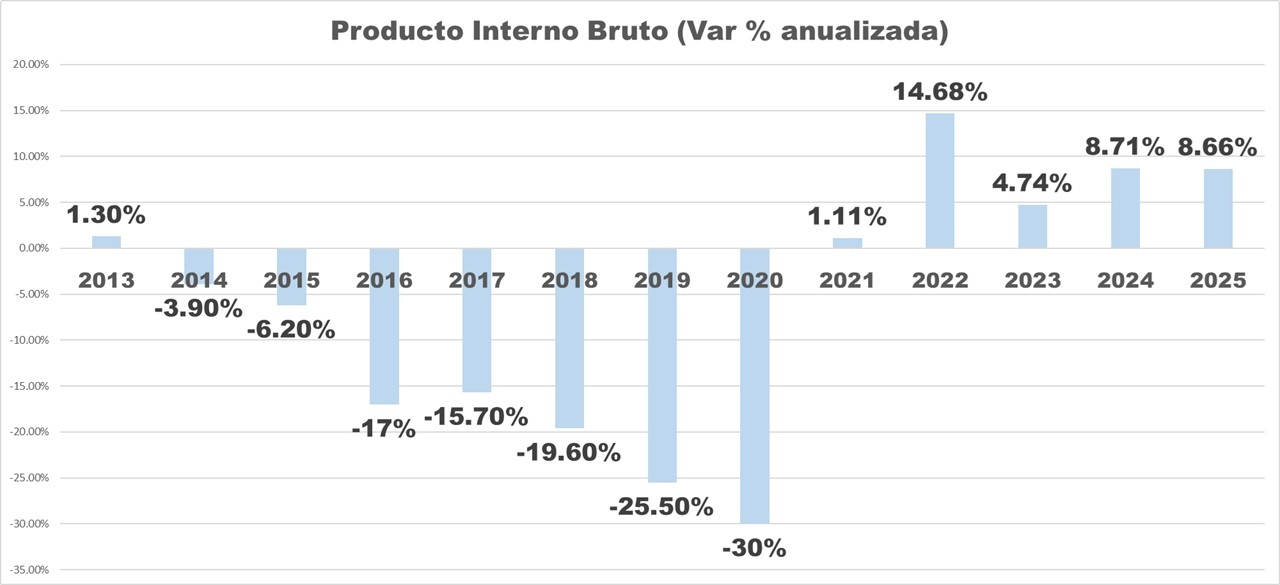
Oil activity was the main driver of growth in 2025: it showed a significant growth of 13.41% in the fourth quarter of last year.
Non-oil activity has grown since 2022, by 13.8% in 2022; 4.3% in 2023; 5.6% in 2024; and 6.3% in 2025, this sustained growth was clearly linked to the dynamics imposed by sanctions and licenses.
The year of greatest growth in the non-oil sector is precisely the point of the Biden administration’s licensing policies.
According to the Venezuelan media outlet specializing in economics, Banca y Negocios (Banking and Business), between 2021 and 2025, some sectors have stood out, such as construction, which shows high levels of sustained growth in the period, with a maximum of 86.19% in 2021 and a specific minimum of 0.54% in 2023, which can be described as very volatile behavior.
“In 2024 and 2025, construction led the non-oil sectors with annualized increases of 20.17% and 30.72%. However, this is a sector that has suffered from a historical lag between 2013 and 2019, with drops exceeding 50% annually in 2017 and 2018,” the media outlet indicated.
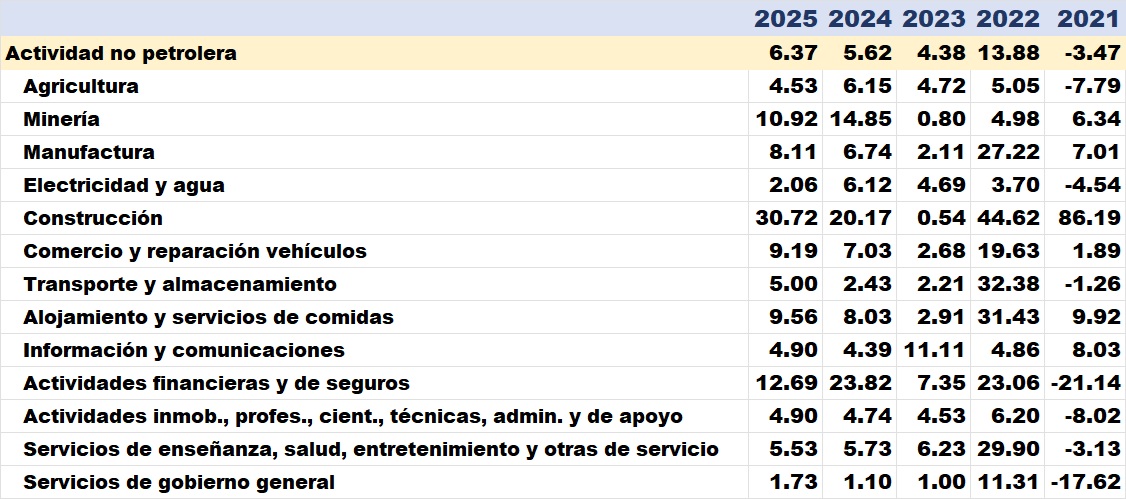
They also highlight “financial activities” and “insurance”—despite the sharp drop of -21.14% in 2021—which has been offset by the expansions of 20.17% and 30.72% reported in 2024 and 2025, due to the dynamism of the digitization of payments and the growth of credit.
“Mining” has also stood out in the last two annual periods, with above-average expansions of 14.85% in 2024 and 10.92% in 2025.
“Growth has also been conditioned by a complex geopolitical situation due to the sanctions imposed by the United States on vital Venezuelan oil operations, which have hampered the possibilities of a more accelerated expansion,” the Banca y Negocios publication stated.
Undoubtedly, the data illustrate a direct relationship between the dynamics of sanctions and oil licenses with other sectors of the economy. The impact of the economic, commercial, and financial blockade has been undeniable.
Translation: Orinoco Tribune
OT/JB/SL

Misión Verdad is a Venezuelan investigative journalism website with a socialist perspective in defense of the Bolivarian Revolution