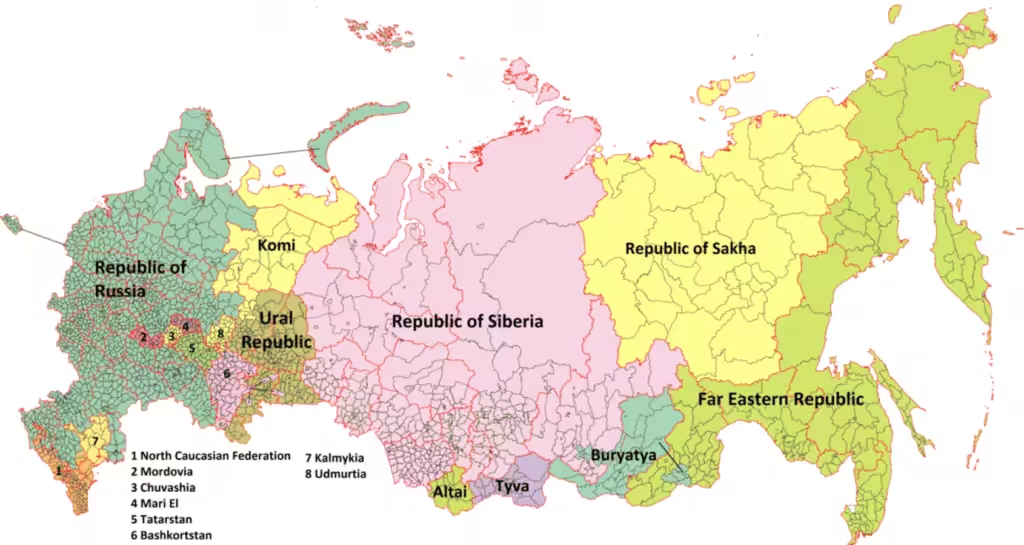
Map of western dreamed divided Russia. File photo.
Map of western dreamed divided Russia. File photo.
By Mike Whitney – Jan 5, 2023
For decades, the idea of dismantling the Soviet Union and Russia has been constantly cultivated in Western countries. Unfortunately, at some point, the idea of using Ukraine to achieve this goal was conceived. In fact, to prevent such a development, we launched the special military operation (SMO). This is precisely what some western countries –led by the United States– strive for; to create an anti-Russian enclave and then threaten us from this direction. Preventing this from happening is our primary goal. Vladimir Putin
Here’s your geopolitical quiz for the day: What did Angela Merkel mean when she said “that the Cold War never really ended, because ultimately Russia was never pacified”?
1- Merkel was referring to the fact that Russia has never accepted its subordinate role in the “Rules-based Order.”
2- Merkel was referring to the fact that Russia’s economic collapse did not produce the ‘compliant state’ western elites had hoped for.
3- Merkel is suggesting that the Cold War was never really a struggle between democracy and communism, but a 45 year-long effort to “pacify” Russia.
4- What Merkel meant was that the western states –particularly the United States– do not want a strong, prosperous and independent Russia but a servile lackey that does as it is told.
5- All of the above.
If you chose (5), then pat yourself on the back. That is the right answer.

Last week, Angela Merkel confirmed what many analysts have been saying for years, that Washington’s hostile relations with Russia –which date back more than a century– have nothing to do with ideology, ‘bad behavior’ or alleged “unprovoked aggression”. Russia’s primary offense is that it occupies a strategic area of the world that contains vast natural resources and which is critical to Washington’s “pivot to Asia” plan. Russia’s real crime is that its mere existence poses a threat to the globalist project to spread US military bases across Central Asia, encircle China, and become the regional hegemon in the world’s most prosperous and populous region.
So much attention has been focused on what Merkel said regarding the Minsk Treaty, that her more alarming remarks have been entirely ignored. Here is a short excerpt from a recent interview Merkel gave to an Italian magazine:
The 2014 Minsk Accords were an attempt to give Ukraine time. Ukraine used this period to become stronger, as seen today. The country of 2014/15 is not the country of today….
We all knew that it was a frozen conflict, that the problem was not solved, but this was precisely what gave Ukraine precious time.” (“Angela Merkel: Kohl took advantage of his voice and build”, Corrier Della Sera)
Merkel candidly admits that she participated in a 7 year-long fraud that was aimed at deceiving the Russian leadership into thinking that she genuinely wanted peace, but that proved not to be the case. In truth, the western powers deliberately sabotaged the treaty in order to buy-time to arm and train a Ukrainian army that would be used in a war against Russia.
But this is old news. What we find more interesting is what Merkel said following her comments on Minsk. Here’s the money-quote:
I want to talk to you about an aspect that makes me think. It’s the fact that the Cold War never really ended, because ultimately Russia was never pacified. When Putin invaded Crimea in 2014, he was excluded from the G8. In addition, NATO has deployed troops in the Baltic region, to demonstrate its readiness to intervene. And we too have decided to allocate 2% of GDP to military expenditure for defence. CDU and CSU were the only ones to have kept it in the government programme. But we too should have reacted more quickly to Russia’s aggressiveness. (“Angela Merkel: Kohl took advantage of his voice and build”, Corrier Della Sera)

This is an astonishing admission. What Merkel is saying is that ” the Cold War never ended” because the primary goal of weakening (“pacifying”) Russia –to the point that it could not defend its own vital interests or project power beyond its borders– was not achieved. Merkel is implying that the main objective of the Cold War was not to defeat communism (as we were told) but to create a compliant Russian colony that would allow the globalist project to go forward unimpeded. As we can see in Ukraine, that objective has not been achieved; and the reason it hasn’t been achieved is because Russia is powerful enough to block NATO’s eastward expansion. In short, Russia has become the greatest-single obstacle to the globalist strategy for world domination.
It’s worth noting, that Merkel never mentions Russia’s alleged “unprovoked aggression” in Ukraine as the main problem. In fact, she makes no attempt to defend that spurious claim. The real problem according to Merkel is that Russia has not been ‘pacified’. Think about that. This suggests that the justification for the war is different than the one that is promoted by the media. What it implies is that the conflict is driven by geopolitical objectives that have been concealed behind the “invasion” smokescreen. Merkel’s comments clear the air in that regard, by identifying the real goal; pacification.
In a minute we will show that the war was triggered by “geopolitical objectives” and not Russia’s alleged “aggression”, but first we need to review the ideas that are fueling the drive to war. The main body of principles upon which America’s foreign policy rests, is the Wolfowitz Doctrine, the first draft of which was presented in the Defense Planning Guidance in 1992. Here’s a short excerpt:
Our first objective is to prevent the re-emergence of a new rival, either on the territory of the former Soviet Union or elsewhere, that poses a threat on the order of that posed formerly by the Soviet Union. This is a dominant consideration underlying the new regional defense strategy and requires that we endeavor to prevent any hostile power from dominating a region whose resources would, under consolidated control, be sufficient to generate global power.
There it is in black and white: The top priority of US foreign policy “is to prevent the re-emergence of a new rival, either on the territory of the former Soviet Union or elsewhere, that poses a threat on the order of that posed formerly by the Soviet Union.” This shows the importance that Washington and its allies place on the territory occupied by the Russian Federation. It also shows the determination of western leaders to prevent any sovereign state from controlling the area the US needs to implement its grand strategy.
It doesn’t take a genius to figure out that Russia’s transformation into a strong and independent state has not only put it squarely in Washington’s crosshairs, but also greatly increased the chances of a direct confrontation. Simply put, Russia’s return to the ranks of the great powers has placed it on Washington’s ‘enemies list’ and a logical target for US aggression.
So, what does this have to do with Merkel?
Implicit in Merkel’s comments is the fact that the dissolution of the communist state and the collapse of the Russian economy was not sufficient to leave Russia “pacified”. She is, in fact, voicing her support for more extreme measures. And she knows what those measures will be; regime change followed by a violent splintering of the country.
Putin is well-aware of this malignant plan and has discussed it openly on many occasions. Take a look at this 2-minute video of a meeting Putin headed just weeks ago:
“The goal of our enemies is to weaken and break up our country. This has been the case for centuries.. They believe our country is too big and poses a threat (to them), which is why it must be weakened and divided. For our part, we always pursued a different approach; we always wanted to be a part of the so-called ‘civilized (western) world.’ And after the collapse of the Soviet Union, we thought we would finally become a part of that ‘world’. But, as it turned out, we weren’t welcome despite all our efforts. Our attempts to become a part of that world were rejected. Instead, they did everything they could– including assisting terrorists in the Caucasus– to finish off Russia and break-up the Russian Federation.” Vladimir Putin
The point we’re making is that Merkel’s views align seamlessly with those of the neocons. They also align with the those of the entire western political establishment that has unanimously thrown its support behind a confrontation with Russia. Additionally, the National Security Strategy, the National Defense Strategy and the Congressional Research Service’s latest report, have all shifted their focus from the war against international terrorism to a “great power competition” with Russia and China. Not surprisingly, the documents have little to do with ‘competition’, rather, they provide an ideological justification for hostilities with Russia. In other words, the United States has laid the groundwork for a direct confrontation with the world’s biggest nuclear superpower.
Check out this brief clip from the Congressional Research Service Report titled Renewed Great Power Competition: Implications for Defense—Issues for Congress:
The U.S. goal of preventing the emergence of regional hegemons in Eurasia… is a policy choice reflecting two judgments: (1) that given the amount of people, resources, and economic activity in Eurasia, a regional hegemon in Eurasia would represent a concentration of power large enough to be able to threaten vital U.S. interests; and (2) that Eurasia is not dependably self-regulating in terms of preventing the emergence of regional hegemons, meaning that the countries of Eurasia cannot be counted on to be able to prevent, though their own actions, the emergence of regional hegemons, and may need assistance from one or more countries outside Eurasia to be able to do this dependably.”….
From a U.S. perspective on grand strategy and geopolitics, it can be noted that most of the world’s people, resources, and economic activity are located not in the Western Hemisphere, but in the other hemisphere, particularly Eurasia. In response to this basic feature of world geography, U.S. policymakers for the last several decades have chosen to pursue, as a key element of U.S. national strategy, a goal of preventing the emergence of regional hegemons in Eurasia. Although U.S. policymakers do not often state explicitly in public the goal of preventing the emergence of regional hegemons in Eurasia, U.S. military operations in recent decades—both wartime operations and day-to-day operations—appear to have been carried out in no small part in support of this goal.” (“Renewed Great Power Competition: Implications for Defense—Issues for Congress”, US Congress)
It sounds alot like the Wolfowitz Doctrine, doesn’t it? (Which suggests that Congress has moved into the neocon camp.)

There are a few things worth considering in this short excerpt:
1- That “the U.S. goal of preventing the emergence of regional hegemons in Eurasia” has nothing to do with national defense. It is a straightforward declaration of war on any nation that successfully uses the free market to grow its economy. It is particularly unsettling that China on Washington’s target-list when US corporate outsourcing and offshoring have factored so large in China’s success. US industries moved their businesses to China to avoid paying anything above a slave wage. Is China to be blamed for that?
2- The fact that Eurasia has more “people, resources, and economic activity” than America, does not constitute a “threat” to US national security. It only represents a threat to the ambitions of western elites who want to use the US Military to pursue their own geopolitical agenda.
3- Finally: Notice how the author acknowledges that the government deliberately misleads the public about its real objectives in Central Asia. He says: “U.S. policymakers do not often state explicitly in public the goal of preventing the emergence of regional hegemons in Eurasia, U.S. military operations in recent decades—both wartime operations and day-to-day operations—appear to have been carried out in no small part in support of this goal.” In other words, all the claptrap about “freedom and democracy” is just pablum for the masses. The real goals are “resources, economic activity” and power.
The National Security Strategy and the National Defense Strategy are equally explicit in identifying Russia as a de facto enemy of the United States. This is from the NSS:
Russia poses an immediate and ongoing threat to the regional security order in Europe and it is a source of disruption and instability globally…
Russia now poses an immediate and persistent threat to international peace and stability….
Russia poses an immediate threat to the free and open international system, recklessly flouting the basic laws of the international order … This decade will be decisive, in setting the terms of …managing the acute threat posed by Russia.. (“The 2022 National Security Strategy”, White House)
And lastly, The 2022 National Defense Strategy reiterates the same themes as the others; Russia and China pose an unprecedented threat to the “rules-based order”. Here’s short summary from an article at the World Socialist Web Site:
The 2022 National Defense Strategy… makes clear that the United States …. sees the subjugation of Russia as a critical stepping stone toward the conflict with China.… The eruption of American imperialism… is more and more directly targeting Russia and China, which the United States sees as the principal obstacles to the untrammeled domination of the world. US strategists have long regarded the domination of the Eurasian landmass, with its vast natural resources, as the key to global domination.” (“Pentagon national strategy document targets China”, Andres Damon, World Socialist Web Site)
What these three strategic documents show is that the Washington BrainTrust had been preparing the ideological foundation for a war with Russia long before the first shot was ever fired in Ukraine. That war is now underway although the outcome is far from certain.
The strategy going forward appears to be a version of the Cheney Plan which recommended a break up of Russia itself, “so it could never again be a threat to the rest of the world.” Here’s more from an article by Ben Norton:
“Former US Vice President Dick Cheney, a lead architect of the Iraq War, not only wanted to dismantle the Soviet Union; he also wanted to break up Russia itself, to prevent it from rising again as a significant political power…The fact that a figure at the helm of the US government not-so-secretly sought the permanent dissolution of Russia as a country, and straightforwardly communicated this to colleagues like Robert Gates, partially explains the aggressive posturing Washington has taken toward the Russian Federation since the overthrow of the USSR.
The reality is that the US empire will simply never allow Russia to challenge its unilateral domination of Eurasia, despite the fact that the government in Moscow restored capitalism. This is why it is not surprising that Washington has utterly ignored Russia’s security concerns, breaking its promise not to expand NATO “once inch eastward” after German reunification, surrounding Moscow with militarized adversaries hell bent on destabilizing it.” (“Ex VP Dick Cheney confirmed US goal is to break up Russia, not just USSR”, Ben Norton, Multipolarista)
 The carving up of Russia into several smaller statelets, has long been the dream of the neoconservatives. The difference now, is that that same dream is shared by political leaders across the West. Recent comments by Angela Merkel underscore the fact that western leaders are now committed to achieving the unrealized goals of the Cold War. They intend to use military confrontation to affect the political outcome they seek which is a significantly weakened Russia incapable of blocking Washington’s projection of power across Central Asia. A more dangerous strategy would be hard to imagine.
Michael Whitney is a renowned geopolitical and social analyst based in Washington State. He initiated his career as an independent citizen-journalist in 2002 with a commitment to honest journalism, social justice and World peace.