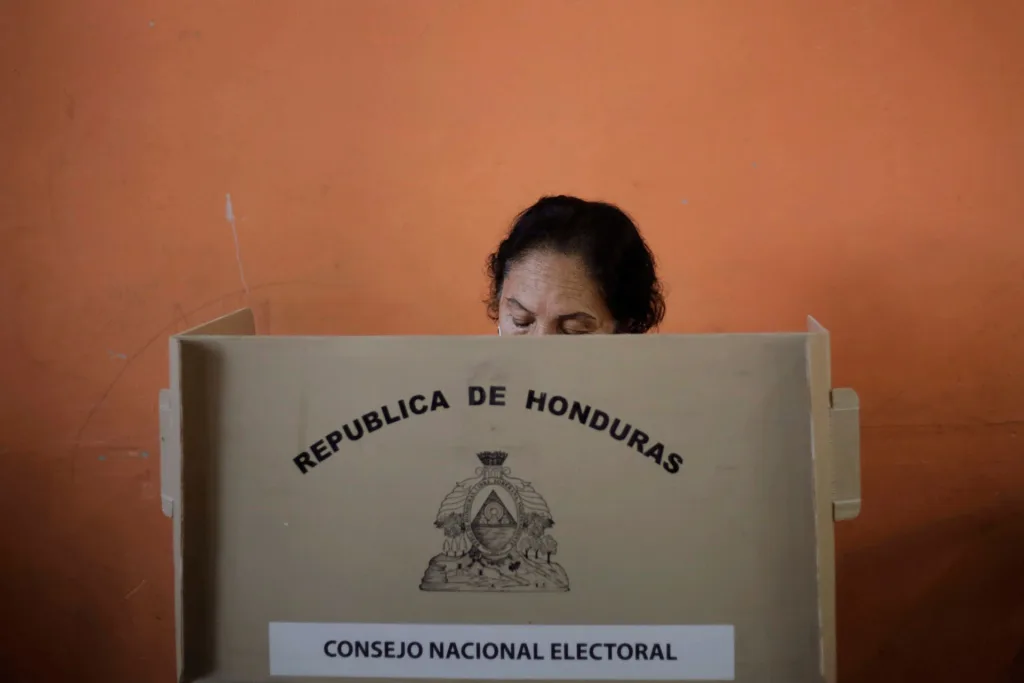
A person participates in an election in Honduras, using a voting booth provided by the National Electoral Council. The booth displays the coat of arms and name of the Republic of Honduras. Photo: Jorge Cabrera/Reuters/file photo.
A person participates in an election in Honduras, using a voting booth provided by the National Electoral Council. The booth displays the coat of arms and name of the Republic of Honduras. Photo: Jorge Cabrera/Reuters/file photo.
By John Perry – Nov 12, 2025
Trump’s gunboat diplomacy in the Caribbean grabs the headlines, while quieter moves to destabilize other progressive Latin American governments go unnoticed by corporate media. A key case is a plot that would create chaos enabling a neoliberal candidate to be declared victor, with Washington’s connivance, in Honduras’s elections on November 30.
At stake is four more years of progressive government or – otherwise – returning to the neoliberalism that prevailed after the US-backed military coup in 2009. The electoral defeat of progressive parties in Ecuador and Bolivia earlier this year, and the uncertain chances of progressive candidate Jeannette Jara in Chile’s elections this month and next, mean that Honduras is a crucial test.
Honduras has a history of rigged elections since the overthrow of Manuel Zeleya’s left-leaning government in 2009. The left was fraudulently denied power in 2013 and 2017, only winning in 2021 because Xiomara Castro’s majority was overwhelming. Although popular, Castro is constitutionally limited to a single term.
Now that her successor, Libre party candidate Rixi Moncada, has only a narrow poll lead, the opposition sees a new opportunity to seize power by manipulating the election results.
In theory, it should be no contest for Moncada, given the achievements of incumbent President Castro. Moncada is closely linked to her, having been the minister of finance and then defense in her administration.
After inheriting broken health and education systems and soaring poverty in the wake of the Covid pandemic, President Castro has succeeded in reducing poverty levels from 74 per cent to 63 per cent in four years. In an unprecedented program of public investment, her government has built eight new hospitals and renovated over 5,200 schools. Not long ago Honduras was one of the world’s most dangerous countries, but in four years her government has cut the homicide rate to its lowest since 2013. Poor inner-city barrios, long afflicted by gang violence, now cope with thousands of returning migrants, fleeing US repression and needing jobs: Castro quickly created centers to give them government help.
Honduras is still a country where Washington’s influence is very strong. While Castro has had a progressive foreign policy, cultivating China’s support, aggressively challenging Israel’s genocide in Gaza and building strong relations with the region’s progressive governments, she has had to be aware of the US embassy’s continuous efforts to undermine her.
President Castro has also faced a divided congress and hostile mayors in many municipalities. The highly militarized police forces and the army have strong ties to the US. Further, a corrupt legal system and the abiding influence of Honduras’s oligarchic, very wealthy families who control much of the country’s industry, commerce and agriculture challenge popular rule. That Castro has secured her many achievements under all these constraints is remarkable.
However, the opposition forces have come together in an attempt to deny a Moncada victory. Leaked audio recordings, which appear to be genuine, showed a leading member of the National Election Council conspiring with an opposition leader and a senior army officer to interfere with the transmission of election results during the likely heated atmosphere on the night of the count.
By focusing on early results which would appear to indicate Moncada’s defeat, the plan is to repeat what happened in 2017. Then a premature announcement of the US-backed candidate’s victory was immediately endorsed by the US embassy. While supposedly independent election observers might call this out, some of them appear to have been planted by the opposition, and there are urgent calls for the observers themselves to be “observed.”
A prequel of what might happen on the night of November 30 occurred on November 9, when the electoral council held a trial run of its system to collect and transmit voting tallies. The trial partially failed, leading to justifiable accusations from the Libre Party that a repeat of this failure on election night would create exactly the circumstances the opposition needs to execute fraud.
The context of the US imposing its hegemony over Latin America is critical. Economist Jeffrey Sachs, in an interview about Trump’s massive military build-up in the Caribbean, notes that regime change is a “core tool of US foreign policy.” The overt military attacks on Venezuela and the more covert ones planned for Honduras are part of the same imperial game plan.
Trump’s main target, Venezuela’s President Nicolás Maduro, has been designated a narco-terrorist, with a $50 million bounty on his head. A possible secondary target, Colombia’s President Gustavo Petro and his “cronies,” have just been sanctioned by the US for failing to curb drug trafficking. Needless to say, the allegations are a flimsy justification for Trump’s warmongering.
An attack on Venezuela would further damage Cuba, long supported by Venezuela. The Trump administration is also considering imposing 100 per cent tariffs on US imports from Nicaragua, spearheaded by Secretary of State Marco Rubio.
The irony, if regime-change were to be successful in Honduras, is that it would likely restore the narcostate that existed prior to Castro’s presidency. This led to the notorious former president Juan Orlando Hernández being extradited to the US where he is serving a 45-year sentence for drug trafficking offences. The casualness with which electoral interference is being considered is just one of many examples that show up Trump’s war on narcoterrorism as a sham.

John Perry is a writer based in Masaya, Nicaragua whose work has appeared in the Nation, the London Review of Books, and many other publications.