By Nick Alexandrov – Mar 15, 2021
“United States foreign policy in Somalia has always sided with the wrong side.” That’s how Mohamed Haji Ingiriis, a young Somali historian studying for his doctorate at Oxford, summarized Washington’s legacy there in an interview with CovertAction Magazine.
Instead of promoting what it claims to—peace, stability, “nation-building”—the U.S. government, Ingiriis elaborates, keeps Somalia “wartorn,” a “failed state.” The Somali people pay the cost—the ultimate cost, in thousands upon thousands of cases—as a result. But not everyone loses.

“A promising new frontier for oil exploration”
Petroleum industry analysts call Somalia “promising,” “one of the last truly unexplored oil frontiers.” And major firms are keen to profit there. Shell and ExxonMobil, for example, paid Mogadishu $1.7 million in 2019 for 30-year rights to offshore blocks, and Somalia launched “its first offshore oil and gas exploration licensing round” last year to attract other companies.[1]

Developments like these suggest Somalia’s business climate is improving, after decades of conflict made it an unattractive, if not unviable, investment site. The International Monetary Fund and World Bank recently heralded the country’s financial reforms, for example, citing its Petroleum Act, oil production sharing agreements, and related measures as key developments.[2]
But if Somalia is open for business, it is a victory for state violence.
Because to create a legal and political landscape in which oil firms can profit, the perpetually weak, unpopular Somali government had to fight to extend its reach beyond Mogadishu in order to secure control of new territories at the expense of Islamist militants like al-Shabaab. In this fight, the Somali government and its allies—Ethiopia and the U.S.—have brutalized the Somali public.
“One of the fastest-growing sources of oil for the American market”
Mogadishu officials, in their latest National Development Plan, explain that al-Shabaab “diminish[es] prospects for development activities.” The group has threatened oil and gas drilling projects in Somalia’s Puntland region, and, through repeated attacks, forced a change in routes for a crude oil pipeline running from Uganda to the East African coast. Disruptions like these alarm the U.S. government as well, because oil is one of Washington’s core concerns on the continent.[3]

And so it has been for decades. In May 2001, for example, a National Energy Policy document named West Africa “one of the fastest-growing sources of oil and gas for the American market,” and by mid-2007 “U.S. oil imports from Africa [had] nearly doubled” over the preceding five years.[4]
But there were two main threats to these oil interests. One came from within Africa: Niger Delta militias, for example, were stealing $1 billion in oil each year, thereby posing “a direct threat to U.S. strategic interests in sub-Saharan Africa.”
The second threat was China. Because it requires enormous resource inputs to sustain its economic growth—it became a net oil importer in 1993—its interest in African oil increased roughly in time with Washington’s interests, alarming U.S. officials. President George W. Bush, the Department of Defense, the CIA, the U.S.-China Economic Security Review Commission, and other elite groups all warned, circa 2006, that Beijing intended to “lock up” African oil for its own use.[5]

Facing this perceived threat, Washington resorted to its preferred diplomatic tool: the military. During the period in question, the U.S. military divided responsibilities for Africa among the European, Central, and Pacific Commands. President Bush changed that, bringing the three together under the new U.S. Africa Command (AFRICOM) in October 2008.[6]

Bombing Somali civilians is one of AFRICOM’s main projects. Washington began using armed drones there in June 2011, a decade after the first Predator drone, equipped with a Hellfire missile as an experiment, successfully fired on a tank at a remote Nevada test site.
Drones were strictly surveillance tools before then, but U.S. officials were quick to capitalize on their lethal potential. Legal experts, under Presidents Bush and Obama, justified execution by armed drone “as consistent and conforming to international law.”[7]

And Obama normalized their use, launching ten times as many drone strikes as his predecessor. In Somalia, these included the January 2014 strike that killed two children; the January 2015 attack on Dinsoor that killed at least four civilians; and the April 2016 bombing in Lower Juba that killed at least three more, including one woman.[8]
President Donald Trump ramped up these attacks, tripling their annual rate. His strikes were as precise as Obama’s. An armed U.S. drone hit the Farah Waeys settlement, home to “nomadic and semi-nomadic pastoralist farmers living in makeshift houses,” in October 2017, killing two farmers.
One of them was 25; his wife was pregnant when he died. Weeks later, on November 12, the U.S. bombed farms outside the village of Darusalaam. The attack killed three men—civilians—as they slept beneath a tree. The oldest victim was 40. His “face was disfigured” in death, “and his throat and chest were pockmarked by multiple ordnance fragments.” He had 13 children.

In another attack, in December, one victim had his “body blown to pieces.” His corpse, in the bombing’s aftermath, lay next to his seven-year-old daughter’s. Other victims included “a 45-year-old teacher and father of 10 children” and his 17-year-old daughter, and a 30-year-old camel herder.[9]
Trump made it easier to inflict this pain when he reclassified Somalia as an “area of active hostilities,” canceling Obama’s 2013 Presidential Policy Guidance.
In theory, that document outlined “substantive standards that must be met before lethal action may be taken.” In reality, it’s not clear these standards were at all “substantive.” Recall that Obama considered “all military-age males in a strike zone combatants,” unless evidence later emerged, after their murder, proving their innocence. Or that U.S. officials described the signals intelligence used, under Obama, to target Somali drone victims as “poor” and “limited.”[10]
And because these victims include farmers, fathers, children, and other innocents, Ingiriis argues that the chief losers of Washington’s air war “are the Somali people. The chief winners are al-Shabaab elements who are becoming more resilient.”

U.S. military analysts concur. Tunde Osazuwa, an activist and researcher with the Black Alliance for Peace, notes that the Africa Center for Strategic Studies—a Pentagon research institution—found that “militant Islamist group activity in Africa has doubled since 2012,” as AFRICOM’s presence on the continent deepened. Washington’s nominal counter-terrorism, in other words, has empowered terrorists.[11]
Our Man in Mogadishu
This result is unsurprising if we review the recent history of U.S.-Somalia relations, beginning with the rule of General Mohamed Siad Barre, the dictator whom the U.S. supported throughout the 1980s.
Henry Kissinger flew to Mogadishu to meet him in January 1981; Paul Manafort’s public relations team helped him burnish his public image; and President Ronald Reagan gifted $340 million in U.S. taxpayer money to his regime during 1981-1987.[12]

Barre used these funds to repress the Somali public, and his harsh rule motivated dissidents to organize, arm themselves, and attempt to overthrow him.
One opposition group, the Somali National Movement, launched a major offensive in 1988, prompting Barre to respond with—in a word—genocide.
His fighter jets leveled the city of Hargeisa in May 1989, and another attack totally destroyed another city, Burao. Hundreds of thousands fled the carnage; 200,000 died.

Washington’s support was steadfast throughout this campaign, and U.S. officials worked to silence critics, whether in Congress or independent groups like Africa Watch, who dared to challenge the wholesale slaughter of Somali civilians. Nothing could stop the U.S. government from backing its East African genocidaire.[13]

“Humanitarian” Intervention
Barre’s government collapsed when the U.S. withdrew its support in 1991, shifting its focus to the Middle East. He left a power vacuum in his wake, which guerrilla groups and warlords fought to fill.[14]
Washington intervened in this conflict in December 1992, on—U.S. officials claimed—humanitarian grounds, to alleviate drought and famine-related suffering. They soon adopted a new objective: taking down General Mohamed Farah Aideed, head of a powerful Mogadishu faction believed responsible for the June 1991 ambush and murder of 24 UN-affiliated Pakistani soldiers.[15]

But U.S. conduct gave the lie to its stated aims.
On July 12, 1993, for example, U.S. forces bombed a Mogadishu house. They claimed it was Aideed’s command center; in reality, it was full of Somali elders debating how to encourage Aideed to pursue peace.

The bombing wounded as many as 200 civilians, and killed as many as 71 people, including women and children. Months later, on September 9, U.S. forces killed 60 civilians when they fired on a crowd from a helicopter.[16]

Slaughters like these undermine the official U.S. rationale for the intervention, forcing us to find better explanations.
Historian Davis Gibbs offers a compelling one. He argues that Washington, under the cover of humanitarianism, was in Somalia “to advance the interests of a U.S. investor, Conoco”—the only U.S. oil firm left in Somalia after Barre’s overthrow. As the top World Bank petroleum engineer remarked at the time, Somali oil had “high potential,” provided the country’s citizens could “get their act together.”[17]
It would be decades before Somalia developed in line with his desires.
RELATED CONTENT: The Forever War on Terror: What on Earth is the US Doing Bombing Somalia?
Constructing the Somali State I: 1993-2005
On October 3-4, 1993, Somalis fired rocket-propelled grenades at a swarm of Black Hawk helicopters over Mogadishu. U.S. troops were on a mission to capture two of Aideed’s top lieutenants, but the grenades brought down two of the aircraft.

In the ensuing chaos, 18 U.S. soldiers were killed. Washington withdrew soon after, and the UN followed it out of the country in 1995.[18]
The decade that followed saw a series of vain attempts to establish a viable, Mogadishu-based government.
Regions like Puntland in the northeast, and Jubbaland in the south, declared themselves autonomous in 1998. And the Transitional National Government (TNG), formed in 2000 during peace talks in Djibouti, never controlled more than parts of Mogadishu before dissolving in 2003.
Its successor, the Transitional Federal Government (TFG), was at first so weak and unpopular that it could only govern from Kenya. When it moved to Somalia in June 2005, it set up operations in Baidoa—not Mogadishu—and its Parliament “met in a converted grain warehouse.”[19]
“What has happened in Mogadishu is a miracle”
As government after government tried to establish itself, other groups emerged to provide the structure and services the TNG and TFG could not.

The Islamic Courts (ICU) was the most prominent of these groups. The earliest Somali Islamic Courts, formed in Mogadishu in 1994, were “a response to the need for some means of upholding law and order.” And they succeeded in this respect, spreading to southern Mogadishu in 1998, and then unifying in 2000 to become the ICU.
That group was “genuinely popular,” and spread beyond the capital to southern Somalia’s Lower Shabelle region.[20]
Its growing popularity and territorial coverage angered the Somali warlords. And it was amidst mounting ICU-warlord tension that several Courts members disappeared, or were assassinated, in 2005.

The Courts blamed the CIA for these attacks, and formed a military wing—al-Shabaab, or “the youth”—in response.

Tensions soon exploded into all-out war, with the Courts prevailing at first, securing control of Mogadishu by early June 2006. They proceeded to clean up the city and reopened its long-shuttered airport and seaport. Residents described ICU rule as “a miracle,” and the Courts enjoyed a 95% approval rate.
This popularity allowed the ICU to extend its influence beyond the capital, and by October 2006 the group “controlled most of southern central Somalia.”[22]
These successes revealed that, for the international conferences and interim Somali regimes discussed above, the goal was not to establish effective Somali governance. Because the ICU ruled effectively, but in the wrong way: on its own terms. This was unacceptable. And Somalis would be punished as a result.
RELATED CONTENT: US Killing Civilians With ‘Impunity’ in Hidden War on Somalia: Report
“Whole neighborhoods were shelled”
The TFG was weak, but it had powerful friends. Ethiopia gave it military support during the latter half of 2006—the time of ICU rule.
Washington had been funding and training Ethiopian troops for the better part of a decade by then, through initiatives dating back to the Clinton era. Ethiopian troops proceeded to commit human rights abuses, but U.S. support persisted.[23]
By December 2006, these troops were ready. They teamed with the TFG to launch airstrikes and a ground offensive in Somalia, quickly massacring 1,000 ICU members.

Soon they captured Mogadishu; the ICU fled the city, then the country. To consolidate their victory, Ethiopian and Somali forces shelled neighborhoods, displacing hundreds of thousands, and terrorized the public through hospital bombings, rape, murder, and torture.[24]

African Union troops also participated in these atrocities.
The African Union Mission in Somalia, or AMISOM, began in January 2007, just after the ICU’s defeat. And their forces, mainly Ugandans and Burundians, routinely abused and raped women and assaulted civilians.

The U.S. government, though, stepped-up aid to Burundi and Uganda, and U.S. contractors—DynCorp International and Bancroft Global Development trained AMISOM troops—were complicit in these crimes.[25] The CIA ran a counterterrorism training program for Somali intelligence agents and operatives which built up an indigenous strike force that carried out snatch operations and targeted “combat” operations against al-Shabaab. The model was the Provincial Reconnaissance Units (PRU) in South Vietnam under the murderous Phoenix program.
“The sky was full of strikes”
Besides running de facto death squads, Washington also terrorized Somalis from above. Its first airstrikes date to January 2007—the twilight of the George W. Bush era—and gave aerial support to Ethiopia’s murderous intervention, targeting ICU and al-Shabaab members trying to flee the country.[26]
At the time—and until 2011—unmanned aircraft over Somalia were strictly surveillance tools.
The attack on Aden Hashi Ayro, a top ICU council member and al-Shabaab’s first leader, required a complex choreography of military surveillance and coordinated launches that set the trademark for the high-tech U.S. war in Somalia over the next decade.

First, two Air Force AC-130 gunships landed at a small Ethiopian airport on January 6, 2007. One of them took off for Somalia the next day, accompanied by a Predator drone—itself likely launched from a U.S. base in Djibouti, after which a pair of remote pilots, “most likely sitting in a trailer in Nevada,” took control.
The Predator then traveled 500 miles south, over the eastern Ahmar Mountains in Ethiopia and the Ogaden region’s western edge, before reaching its destination: Ras Kamboni, a remote fishing village on the Somalia-Kenya border.
The Predator proceeded to use Ethiopian intelligence to track Ayro’s convoy. It locked onto the target, and then it was time to strike: the AC-130 fired, “smashing the convoy.” The attack killed up to a dozen militants, as many as eight civilians—but not Ayro. He somehow survived, but died in another U.S. missile strike in May 2008.[27]
Weeks later, U.S. Special Forces targeted Ahmed Madobe, an ICU deputy. “At around 4am we woke up to perform the dawn prayers,” Madobe later recalled, “and that’s when the planes started to hit us. The entire airspace was full of planes. There was AC-130, helicopters and fighter jets. The sky was full of strikes.” Though he survived, the other eight members of his convoy—men and women “on the run”—were all killed. Soon after the bombing ended, “Ethiopian and U.S. forces landed by helicopter,” taking Madobe prisoner.[28]
Other U.S. airstrikes were like those targeting Ayro and Madobe: Heavy collateral damage was routine. Yet another January 2007 bombing, on Hayo, killed as many as 31 civilians and “at least one child.” The next year, on March 3, U.S. cruise missiles hit Dhobley, a town in the Lower Juba region, killing up to six civilians.
One local elder, lucky to survive, recalled the terror: “I woke up to loud blasts and flashing lights that shook my doors and windows. Airplanes were flying at a low altitude and were firing. I ran outside and hid under trees.”
And the following May, U.S. missiles killed somewhere between five and 30 civilians in Dusa Marreb, in the Galgaduud region.

The wide range reflects Washington’s studied indifference toward its bombing victims. The local population, for whatever reason, was more invested, “counting skulls to determine the number” slain in the strike’s aftermath.[29]

“The most effective system of governance Somalia has known”
Amidst this chaos, one group affords Somalis stability. This group was once part of the Courts system—and the only element able to survive the brutal, U.S.-supported Ethiopian intervention: al-Shabaab.
After Ethiopia’s assault forced Courts members into exile, al-Shabaab sought new alliances. It forged ties with al-Qaeda in 2008, as Ethiopia’s occupation continued.
Through its opposition to Addis Ababa, and through its association with the ICU, it won support—both as the occupation dragged on, and in its aftermath.

Much as the ICU had, al-Shabaab gained control over large swathes of Somali territory, winning much of the country’s south by 2010. It used violence to establish itself, exactly as the TNG and TFG had before it.
But al-Shabaab governs through more than terror. In its jurisdictions, according to residents interviewed by BBC Africa editor Mary Harper, “[it] is present and visible in people’s lives in a way that government is not, especially in rural areas, and smaller towns and villages. For many, it is simply the best option available,” and in some respects “has created the most effective system of governance Somalia has known since its collapse into chaos and conflict began in the late 1980s.”

Analysts acknowledge, sometimes begrudgingly, the group’s successes—and, often, superiority to the government—in fundraising, financial management, tax collection, and upholding the legal system.
Think of this track record, the next time a U.S. official promises to wipe out al-Shabaab.
Constructing the Somali State: 2012-Present
When al-Shabaab outperforms the Somali government today, it is not making the TNG or TFG look bad, but the Federal Government of Somalia (FGS).
This entity took over from the TFG, after the latter’s mandate expired in August 2012. In many respects, the FGS merely seems like a rebranded TFG: a government imposed on Somalia, and one determined to expand its control through violence and abuse.

The FGS ranks number one in world corruption indexes, and Somalia is one of the most dangerous places in the world to be a journalist.

Zakariye Mohamud Timaade, formerly with Universal TV who fled the country in June 2019, told Amnesty International that “the biggest fear for me was from NISA (National Intelligence and Security Agency) … I knew they wanted to kill me. In Mogadishu, you can hide from Al-Shabaab, but you cannot hide from NISA; they could easily pick me from my office.”

Somali government forces have been accused in recent years of killing and displacing civilians, murdering protestors, routine rape and torture. And a recent report on their sexual violence concluded that “impunity was the norm” for them, giving little reason to hope the number of abuses will decline with time.
Until 2027
And there seems little reason to expect an AFRICOM drawdown in Somalia. Though Trump promised to “pull American forces” from the country before he left office, and though the U.S. military claims to have followed through on that promise, there are other factors to consider.
One is the Pentagon’s ongoing presence in Kenya and Djibouti, within easy striking range of Somalia. Another is that, some two weeks after the troop withdrawal was allegedly completed, U.S. forces were back in Somalia on a training mission—a mission they announced, a year ago, that would last until 2027.

For the Somali people, this can only mean a prolonged period of suffering.
Notes
[1] Mark Henderson, “Somalia: The new oil and gas frontier,” The Africa Report, November 9, 2020, https://www.theafricareport.com/49364/somalia-the-new-oil-and-gas-frontier/; Heidi Vella, “Sizing up Somalia: a new offshore oil frontier in the making,” Offshore Technology, July 6, 2020, https://www.offshore-technology.com/features/sizing-up-somalia-a-new-offshore-oil-frontier-in-the-making/; Anish Kapadia, “Somalia poised for oil-based transformation,” Hiiraan Online, November 13, 2020, https://www.hiiraan.com/op4/2020/nov/180693/somalia_poised_for_oil_based_transformation.aspx.
[2] “Key Questions on Somalia,” International Monetary Fund, March 25, 2020, https://www.imf.org/en/Countries/SOM/key-questions-on-somalia; International Monetary Fund. Middle East and Central Asia Dept., “Country Report No. 20/44: Somalia: Enhanced Heavily-Indebted Poor Countries (HIPC) Initiative-Preliminary Document,” February 13, 2020, https://www.imf.org/en/Publications/CR/Issues/2020/02/13/Somalia-Enhanced-Heavily-Indebted-Poor-Countries-HIPC-Initiative-Preliminary-Document-49053; International Monetary Fund. Middle East and Central Asia Dept., “Somalia: Enhanced Heavily Indebted Poor Countries (HIPC) Initiative-Decision Point Document,” March 2020, https://www.elibrary.imf.org/view/IMF002/28938-9781513538327/28938-9781513538327/28938-9781513538327_A001.xml?rskey=Rs8ZF2&result=7&redirect=true&redirect=true.
[3] The Ministry of Planning, Investment and Economic Development, “Somalia National Development Plan 2020 to 2024,” https://mop.gov.so/wp-content/uploads/2019/12/NDP-9-2020-2024.pdf; Abdi Sheikh and Feisal Omar, “Al Shabaab says extends reach into Somalia’s Puntland,” Reuters, February 25, 2012, https://www.reuters.com/article/idINL5E8DP0J020120225?edition-redirect=ca; Aldrin Olayo Felix, “Al-Shabaab’s Indirect Approach and the Intensity of Terror Attacks in Kenya (2011-2015),” University of Nairobi M.A. Thesis, November 2016, http://erepository.uonbi.ac.ke/bitstream/handle/11295/99345/Olayo%20Felix_Al-shabaab%E2%80%99s%20Indirect%20Approach%20and%20the%20Intensity%20of%20Terror%20Attacks%20in%20Kenya%20(2011-2015).pdf?sequence=1; Eric Watkins, “Al-Shabaab Militancy Undermines Kenya’s LAPSSET,” Counter Terrorist Trends and Analyses 8, No. 6 (June 2016): 9-13, https://www.jstor.org/stable/26351425?seq=1#metadata_info_tab_contents.
[4] Raf Custers and Ken Matthysen, “Africa’s natural resources in a global context,” IPIS, August 2009, https://reliefweb.int/sites/reliefweb.int/files/resources/7BD9A86D325E3629C125762C004CAC93-Full_Report.pdf; Soern Kern, “How the Demand for Oil Drives American Foreign Policy,” Real Instituto ElCano, June 23, 2006, http://www.realinstitutoelcano.org/wps/wcm/connect/9e59a1004f018711bc0dfc3170baead1/1002_Kern_Oil_American_Foreign_Policy.pdf?MOD=AJPERES&CACHEID=9e59a1004f018711bc0dfc3170baead1#:~:text=Indeed%2C%20in%20his%20May%202001,gas%20for%20the%20American%20market; David H. Shinn, “Africa, China, the United States, and Oil,” Center for Strategic and International Studies, May 8, 2007, https://www.csis.org/analysis/africa-china-united-states-and-oil#:~:text=U.S.%20oil%20imports%20from%20Africa,they%20are%20projected%20to%20increase.
[5] Dr. Thomas Fingar, Deputy Director of National Intelligence for Analysis, “Annual Threat Assessment of the Intelligence Community for the House Armed Services Committee,” February 13, 2008. https://www.google.com/books/edition/Global_Security_Assessment/cCdd54RaLJgC?hl=en&gbpv=1&bsq=direct%20threat; Princeton N. Lyman, “The War on Terrorism in Africa,” in John W. Harbeson and Donald Rothchild (editors), Africa in World Politics: Reforming Political Order (Boulder, CO: Westview Press), 2009, https://webcache.googleusercontent.com/search?q=cache:ym_SXnpPp9oJ:https://www.cfr.org/content/thinktank/Lyman_chapter_Terrorism.pdf+&cd=1&hl=en&ct=clnk&gl=us; Eleanor Albert, “Backgrounder: China in Africa,” Council on Foreign Relations, July 12, 2017, https://www.cfr.org/backgrounder/china-africa; Xu Yi-chong, “China and the United States in Africa: Coming Conflict or Commercial Coexistence?” Griffith University, https://www.osti.gov/etdeweb/servlets/purl/21081165; Cindy Hurst, “China’s Oil Rush in Africa,” Institute for the Analysis of Global Security, July 2006, http://iags.org/chinainafrica.pdf; U.S. Department of Defense. Office of the Secretary of Defense. “Annual Report to Congress: The Military Power of the People’s Republic of China,” 2005, https://www.hsdl.org/?abstract&did=736024; Earl Conteh-Morgan, “The United States and China: Strategic Rivalry in Africa,” Insight Turkey 20, no. 1 (Winter 2018): 39-52, https://www.jstor.org/stable/pdf/26301066; U.S.-China Economic and Security Review Commission, 2006 Report to Congress, November 2006, https://www.google.com/books/edition/2006_Report_to_Congress_of_the_U_S_China/2cmsJL7MqMIC?hl=en&gbpv=1; David E. Sanger, “China’s Oil Needs Are High on U.S. Agenda,” New York Times, April 19, 2006, https://www.nytimes.com/2006/04/19/world/asia/chinas-oil-needs-are-high-on-us-agenda.html; The National Security Strategy of the United States of America, March 2006, https://usa.usembassy.de/etexts/nss2006.pdf; U.S. Department of Defense. Office of the Secretary of Defense. “Annual Report to Congress: The Military Power of the People’s Republic of China,” 2009, https://archive.defense.gov/pubs/pdfs/China_Military_Power_Report_2009.pdf; United States Senate. One Hundred Tenth Congress. “China in Africa: Implications for U.S. Policy.” Hearing Before the Subcommittee on African Affairs of the Committee on Foreign Relations. June 4, 2008. https://www.foreign.senate.gov/imo/media/doc/060408_Transcript_China%20in%20Africa%20Implications%20for%20US%20Policy.pdf.
[6] Peter A. Dumbuya, “AFRICOM in US Transformational Diplomacy,” Journal of Global South Studies 33, no. 1 (Spring 2016), 115-146, https://www.jstor.org/stable/pdf/48519587.“
[7] Brian Glyn Williams, Predators: The CIA’s Drone War on Al Qaeda (Washington, D.C.; Potomac Books, Inc., 2013); Milena Sterio, “The United States’ Use of Drones in the War on Terror: The (Il)legality of Targeted Killings under International Law,” Case Western Reserve Journal of International Law 45, no. 1 (Fall 2012), https://scholarlycommons.law.case.edu/cgi/viewcontent.cgi?article=1072&context=jil; “History of Drone Warfare,” The Bureau of Investigative Journalism, https://www.thebureauinvestigates.com/explainers/history-of-drone-warfare.
[8]“Somalia: Reported US Covert Actions 2001-2016,” The Bureau of Investigative Journalism, https://www.thebureauinvestigates.com/drone-war/data/somalia-reported-us-covert-actions-2001-2017; “US Forces in Somalia,” Airwars, https://airwars.org/conflict/us-forces-in-somalia/.
[9] “Somalia: The Hidden US War in Somalia; Civilian Casualties from Air Strikes in Lower Shabelle,” Amnesty International, March 2019, https://www.amnesty.org/download/Documents/AFR5299522019ENGLISH.PDF.
[10] “Somalia: The Hidden US War in Somalia; Civilian Casualties from Air Strikes in Lower Shabelle,” Amnesty International; Rita Siemion, “Presidential Policy Guidance: Procedures for Approving Direct Action Against Terrorist Targets Located outside the United States and Areas of Active Hostilities,” International Legal Materials 56, no. 6 (December 2017), 1209-1225, https://www.cambridge.org/core/journals/international-legal-materials/article/presidential-policy-guidance-procedures-for-approving-direct-action-against-terrorist-targets-located-outside-the-united-states-and-areas-of-active-hostilities/B8C3EF3F3B8FFE263989705E58D361D2; Jo Becker and Scott Shane, “Secret ‘Kill List’ Proves a Test of Obama’s Principles and Will,” New York Times, May 29, 2012, https://www.nytimes.com/2012/05/29/world/obamas-leadership-in-war-on-al-qaeda.html?_r=0; Jeremy Scahill, “The Assassination Complex: Secret Military Documents Expose the Inner Workings of Obama’s Drone Wars,” The Intercept, October 15, 2015, https://theintercept.com/drone-papers/the-assassination-complex/.
[11] “Frontlines in Flux in Battle against African Militant Islamist Groups,” Africa Center for Strategic Studies, July 9, 2019, https://africacenter.org/spotlight/fronts-fluctuate-in-battle-against-african-militant-islamist-groups/.
[12] Mohamed Haji Ingiriis, The Suicidal State in Somalia: The Rise and Fall of the Siad Barre Regime, 1969-1991 (Lanham, MD: University Press of America, 2016); Ismail Einashe and Matt Kennard, “In the Valley of Death: Somaliland’s Forgotten Genocide,” The Nation, October 22, 2018, https://www.thenation.com/article/archive/in-the-valley-of-death-somalilands-forgotten-genocide/; Peter J. Schraeder and Jerel A. Rosati, “Policy Dilemmas in the Horn of Africa: Contradictions in the U.S.-Somalia Relationship,” Northeast Africa Studies Vol. 9, No. 3 (1987), 19-42, https://www.jstor.org/stable/pdf/43660245.
[13] Einashe and Kennard, “In the Valley of Death”; “Somalia: Fall of Siad Barre and the civil war,” World Peace Foundation, August 7, 2015, https://sites.tufts.edu/atrocityendings/2015/08/07/somalia-fall-of-siad-barre-civil-war/; “Somalia,” Human Rights Watch, 1989, https://www.hrw.org/reports/1989/WR89/Somalia.htm.
[14] “Somalia Faces the Future: Human Rights in a Fragmented Society,” April 1995, https://www.hrw.org/reports/1995/somalia/#:~:text=In%201991%20Somalia%20was%20a,and%20displaced%20the%20civilian%20population; United States Bureau of Citizenship and Immigration Services, “Somalia — Things Fall Apart,” January 1, 1993, https://www.refworld.org/docid/3ae6a607b.html; Christopher Paul, Colin P. Clarke and Chad C. Serena, “Somalia (1991-2010), in Mexico Is Not Colombia: Alternative Historical Analogies for Responding to the Challenge of Violent Drug-Trafficking Organizations, Supporting Case Studies, https://www.jstor.org/stable/pdf/10.7249.
[15] “Somalia Faces the Future,” Human Rights Watch; Luiz Alberto Moniz Bandeira, The Second Cold War: Geopolitics and the Strategic Dimensions of the USA (Cham: Springer International Publishing, 2017), 17; Natalia Megas, “Did the U.S. Cover Up a Civilian Massacre Before Black Hawk Down?” Daily Beast, January 6, 2019, https://www.thedailybeast.com/did-the-us-cover-up-a-civilian-massacre-before-black-hawk-down; Guy Arnold, The A to Z of Civil Wars in Africa (Lanham, MD: Scarecrow Press, 2008), 11.
[16] “Somalia: Building human rights in the disintegrated state,” Amnesty International, https://www.amnesty.org/download/Documents/176000/afr520031995en.pdf; Megas, “Did the U.S. Cover Up a Civilian Massacre Before Black Hawk Down?”; “Somalia Faces the Future,” Human Rights Watch.
[17] David N. Gibbs, “Realpolitik and Humanitarian Intervention: The Case of Somalia,” International Politics 37 (March 2000): 41-55, https://pdfs.semanticscholar.org/7b23/9fc370ed7c65de068cd78856b6103ec1497e.pdf; Mark Fineman, “The Oil Factor in Somalia,” Los Angeles Times, January 18, 1993, https://www.latimes.com/archives/la-xpm-1993-01-18-mn-1337-story.html.
[18] Kenneth L. Cain, “The Legacy of Black Hawk Down,” New York Times, October 3, 2003, https://www.nytimes.com/2003/10/03/opinion/the-legacy-of-black-hawk-down.html.
[19] Francis E. Emathe, “Somalia Igad’s attempt to restore Somalia’s transitional federal government,” Naval Postgraduate School, December 2006, https://calhoun.nps.edu/bitstream/handle/10945/2503/06Dec_Emathe.pdf?sequence=1&isAllowed=y; “A History of Mediation in Somalia since 1988,” International Peacebuilding Alliance, 2009, https://www.interpeace.org/wp-content/uploads/2009/05/2009_Som_Interpeace_A_History_Of_Mediation_In_Somalila_Since_1988_EN.pdf; Ashley Elliot & Georg-Sebastian Holzer, “The invention of ‘terrorism’ in Somalia: paradigms and policy in US foreign relations,” South African Journal of International Affairs 166, no. 2 (August 2009): 215-244, https://www.tandfonline.com/doi/pdf/10.1080/10220460903268984; Michael Woldemariam, Insurgent Fragmentation in the Horn of Africa: Rebellion and Its Discontents (New York: Cambridge University Press, 2018), 242, https://www.google.com/books/edition/Insurgent_Fragmentation_in_the_Horn_of_A/RshJDwAAQBAJ?hl=en&gbpv=1&bsq=%22the%20Hawiye%20dominated%20the%20Somali%20capital%22; Bureau of Democracy, Human Rights, and Labor. U.S. Department of State. “Country Reports on Human Rights Practices – 2001 – Somalia,” March 4, 2002, https://2001-2009.state.gov/g/drl/rls/hrrpt/2001/af/8403.htm; “A History of Mediation in Somalia since 1988,” International Peacebuilding Alliance; Abdi Ismail Samatar, “The Miracle of Mogadishu,” Review of African Political Economy 33, No. 109 (Sep., 2006), 581-587, https://www.jstor.org/stable/pdf/4007061; Paul D. Williams, “Into the Mogadishu Maelstrom: The African Union Mission in Somalia,” International Peacekeeping Volume 16, No. 4 (2009), 514-530, https://www.tandfonline.com/doi/abs/10.1080/13533310903184713; Stephanie Hanson and Eben Kaplan, “Somalia’s Transitional Government,” Council on Foreign Relations, May 12, 2008, https://www.cfr.org/backgrounder/somalias-transitional-government.
[20] Cedric Barnes and Harun Hassan, “The Rise and Fall of Mogadishu’s Islamic Courts,” Journal of Eastern African Studies 1, No. 2 (2007), 151-160, https://www.tandfonline.com/doi/pdf/10.1080/17531050701452382; Mohamed Haji Mukhtar, Historical Dictionary of Somalia (Lanham, MD: Scarecrow Press, 2003), 101; Elliot and Holzer, “The invention of ‘terrorism’ in Somalia.”
[21] Barnes and Hassan, “Mogadishu’s Islamic Courts”; Shaul Shay, Somalia Between Jihad and Restoration (New Brunswick, NJ: Transaction Publishers, 2008), 189; Gerard Prunier and Barbara Wilson, “A World of Conflict since 9/11: The CIA Coup in Somalia,” Review of African Political Economy33, no. 110 (Sep., 2006), 749-752, https://www.jstor.org/stable/pdf/4007142.
[22] Barnes and Hassan, “Mogadishu’s Islamic Courts”; “Ethiopian troops on Somali soil,” BBC, July 20, 2006, http://news.bbc.co.uk/2/hi/africa/5198338.stm; Xan Rice, “Mogadishu’s miracle: peace in the world’s most lawless city,” The Guardian, June 26, 2006; “Islamic Courts Union,” Stanford Center for International Security and Cooperation (CISAC), https://cisac.fsi.stanford.edu/mappingmilitants/profiles/islamic-courts-union.
[23] Elliot and Holzer, “The invention of ‘terrorism’ in Somalia”; Report of the Monitoring Group on Somalia pursuant to Security Council resolution 1676 (2006), https://webcache.googleusercontent.com/search?q=cache:OyeQX6TKMwcJ:https://www.cfr.org/content/publications/attachments/Somalia.doc+&cd=1&hl=en&ct=clnk&gl=us; White House. “Fact Sheet: African Crisis Response Initiative (ACRI)”; “World Report 2001 – Ethiopia,” Human Rights Watch, December 1, 2000, https://www.refworld.org/docid/3ae6a8ddc.html; Monte Morin, “U.S. trainers prepare Ethiopians to fight,” Stars and Stripes, December 30, 2006, https://www.stripes.com/news/u-s-trainers-prepare-ethiopians-to-fight-1.58477; “US Begins Training Exercises with Ethiopian National Defense Forces,” Addis Tribune, July 11, 2003, http://www.hartford-hwp.com/archives/27e/422.html.
[24] Tsegaye Tadesse, “Up to 1,000 Islamists dead in Ethiopia offensive: Meles,” Reuters, January 20, 2007, https://www.reuters.com/article/us-somalia-conflict-meles/up-to-1000-islamists-dead-in-ethiopia-offensive-meles-idUKL2635749320061226; Hassan Yare, “Ethiopia fights rival Somali Islamists,” Mail & Guardian Online, December 24, 2006, https://web.archive.org/web/20070930205231/http://www.mg.co.za/articlePage.aspx?articleid=294514&area=/breaking_news/breaking_news__africa/; “Islamic Courts Union,” Stanford CISAC; Les Neuhaus, “Thousands Greet Somalia’s PM in Capital,” Hiiraan Online, December 29, 2006, https://www.hiiraan.com/comments2-news-2006-dec-thousands_greet_somalia_s_pm_in_capital.aspx; Lawrence Porter, “US government to set up new military command in Africa,” World Socialist Web Site, May 18, 2007, https://www.wsws.org/en/articles/2007/05/afri-m18.html; “‘So Much to Fear’: War Crimes and the Devastation of Somalia,” Human Rights Watch, December 8, 2008, https://www.hrw.org/report/2008/12/08/so-much-fear/war-crimes-and-devastation-somalia; Bruton, “In the Quicksands of Somalia”; “Shell-Shocked: Civilians Under Siege in Mogadishu,” Human Rights Watch, August 13, 2007, https://www.hrw.org/report/2007/08/13/shell-shocked/civilians-under-siege-mogadishu; Elliot and Holzer, “The invention of ‘terrorism’ in Somalia.”
[25] Paul D. Williams, “AMISOM’s Five Challenges,” Center for Strategic and International Studies, November 15, 2009, https://www.csis.org/analysis/amisom%E2%80%99s-five-challenges; “Somalia: UPR Submission 2015,” Human Rights Watch, June 22, 2015, https://www.hrw.org/news/2015/06/23/somalia-upr-submission-2015; “‘The Power These Men Have Over Us’: Sexual Exploitation and Abuse by African Union Forces in Somalia,” Human Rights Watch, September 8, 2014, https://www.hrw.org/report/2014/09/08/power-these-men-have-over-us/sexual-exploitation-and-abuse-african-union-forces; Paul D. Williams, Fighting for Peace in Somalia: A History and Analysis of the African Union Mission (AMISOM), 2007-2017 (Oxford: Oxford University Press, 2018), 60-61, https://www.google.com/books/edition/Fighting_for_Peace_in_Somalia/2ixhDwAAQBAJ?hl=en&gbpv=0.
[26] “Shell-Shocked,” Human Rights Watch.
[27] David Axe, “Hidden History: America’s Secret Drone War in Africa,” Wire, August 13, 2012, https://www.wired.com/2012/08/somalia-drones/; Michael R. Gordon and Mark Mazzetti, “U.S. Used Base in Ethiopia to Hunt Al Qaeda,” New York Times, February 23, 2007, https://www.nytimes.com/2007/02/23/world/africa/23iht-somalia.4698266.html; “Al Shabaab,” Stanford CISAC, https://web.stanford.edu/group/mappingmilitants/cgi-bin/groups/print_view/61; Axe, “Hidden History”; “Somalia: Reported US Covert Actions 2001-2016,” The Bureau of Investigative Journalism; “US Strikes & Civilian Casualties,” Airwars, https://airwars.org/civilian-casualties/?belligerent=us-forces&country=somalia&orderby=incident_date&order=asc.
[28] Jeremy Scahill, “Blowback in Somalia,” The Nation, September 7, 2011, https://www.thenation.com/article/archive/blowback-somalia/; “Somalia: Reported US Covert Actions 2001-2016,” The Bureau of Investigative Journalism.
[29] “US Strikes & Civilian Casualties,” Airwars, https://airwars.org/civilian-casualties/?belligerent=us-forces&country=somalia&orderby=incident_date&order=asc.
Nick Alexandrov is a teacher in Tulsa, Oklahoma. He writes mostly for Counterpunch Magazine with a focus on U.S. foreign policy. His articles have also appeared in Asia Times, Cubadebate, History News Network, The News International (Pakistan), Pakistan Today, Rebelión, The Root, Truthout, Tulsa World, and other publications. Alexandrov’s work has been cited in Salon and by Project Censored, and in reports published by the Center for American Progress and the London School of Economics. His articles are included in college course syllabi and have been translated into several different languages. He can be reached at: nicholas.alexandrov@gmail.com.
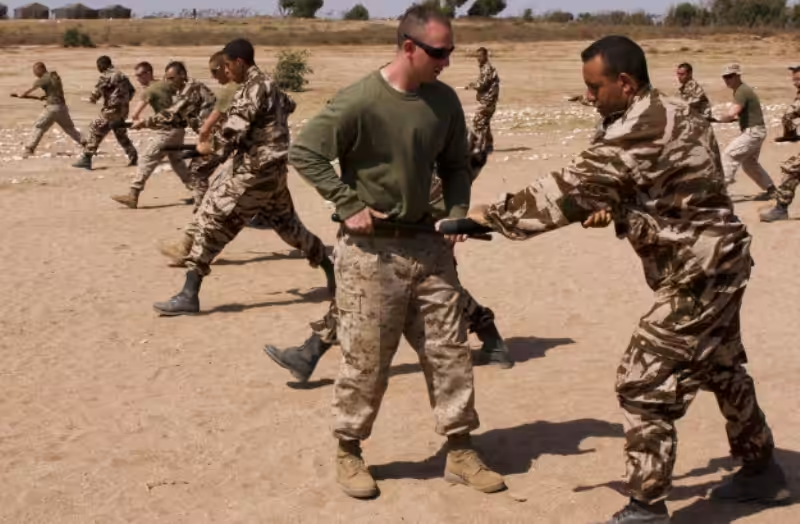
Featured image: U.S. Special Forces soldier trains Somali operative. [Source: geeskaafrika.com]