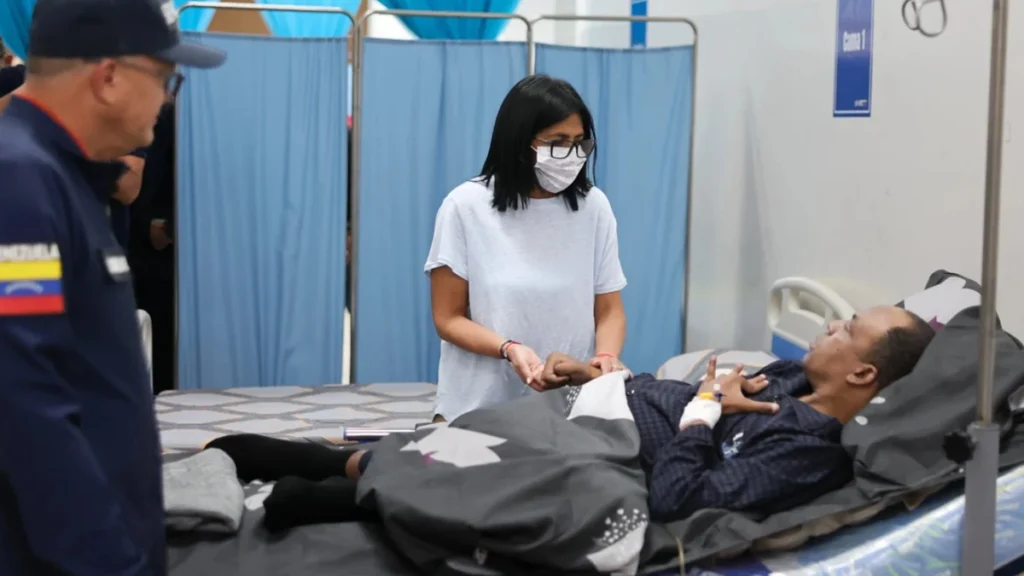
The acting president of Venezuela, Delcy Rodríguez, meets an earthquake survivor receiving treatment at a hospital, July 7, 2026. Photo: X/@mippci_ven
The acting president of Venezuela, Delcy Rodríguez, meets an earthquake survivor receiving treatment at a hospital, July 7, 2026. Photo: X/@mippci_ven
Over the past week, the Venezuelan state has established 82 temporary camps to assist residents affected by the June 24 earthquakes. At these sites, hundreds of families are receiving comprehensive assistance, shelter, medical care, and food.
The Santa Eduvigis temporary camp, located in the Urimare parish in La Guaira state, focuses especially on supporting older adults, many of whom were left alone after the natural disaster.
Lina Márquez, who was rescued from the rubble on June 25, described the experience of the earthquakes as devastating, because her apartment building collapsed.
Amid that pain, she highlighted the love, empathy, and accommodations provided at the camp, where a pastor also accompanies those affected with prayers and hymns to provide them with strength.
Thinking of her fellow citizens, Márquez sent a message of resilience focused on continuing to fight and rebuild the country together.
La Guaira was the state hardest hit by the two earthquakes on June 24, which caused the collapse of 80% of the buildings in the territory. Two weeks days after the disaster, emergency response agencies remain continue to work in order to recover bodies from the rubble.
Medical centers such as José María Vargas Hospital remain fully operational, providing surgeries, treatments, and continuous follow-up care for injured people.
As the days pass, survivors are regaining hope after receiving “a second chance at life” thanks to the tireless efforts of health workers. Gratitude for the care they received is a constant theme in the testimonies of people such as Jose Luis Borrego, who was walking home when he was struck directly by a collapsing wall.
This week, Venezuelan Acting President Delcy Rodríguez accelerated the implementation of interdisciplinary and interinstitutional measures aimed at rebuilding the areas most affected across the six states hit by the earthquakes.
Among the first steps in those efforts are field visits by civil engineers to each affected community to prepare a mapping of destroyed homes and neighborhoods.