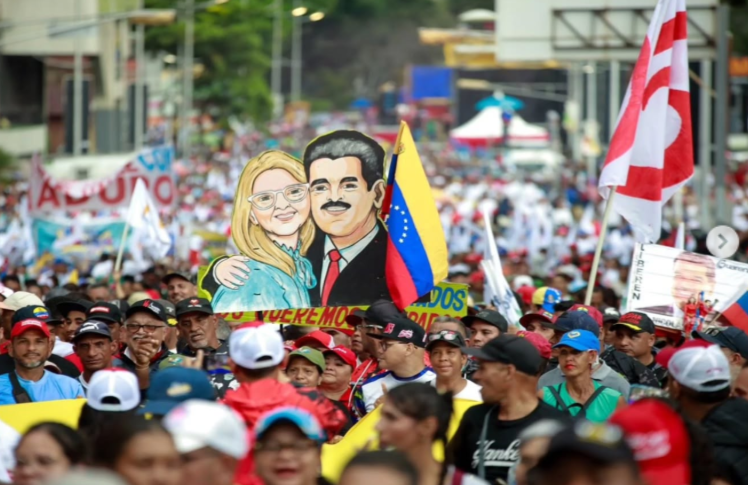
Venezuelan government supporters have taken to the streets to protest against the US attack and presidential kidnapping. Photo: Presidential Press.
Venezuelan government supporters have taken to the streets to protest against the US attack and presidential kidnapping. Photo: Presidential Press.
By Carlos Gutierrez – Feb 5, 2026
There are facts that due to their historical gravity, force us to redefine the meaning of words that already seemed consolidated: human rights, sovereignty, due process, democracy. On January 3, 2026, Venezuela was the target of a direct military attack by the United States, with a tragic toll: 100 people killed, hundreds injured, homes destroyed, and incalculable material damage. It was not a surgical operation or a “humanitarian intervention,” as barbarism is often referred to as by the imperialists, but rather an open aggression against a sovereign state
The roar of the missiles contrasted with a deafening silence: that of the Venezuelan opposition leadership.
For years, these sectors have built an obsessive narrative around the so-called “political prisoners.” An expression carefully designed to erase an essential distinction of law: not every imprisoned politician is a political prisoner. In Venezuela, as in any state that exercises its sovereignty, there are imprisoned politicians because they have committed classified crimes, judged with all the guarantees that they deny by the national legal system. But the opposition has made this narrative its moral banner, its permanent excuse, its alibi to ignore institutions and justify confrontation.
What is truly revealing is not that they defend those they consider theirs. The scandalous thing is who they decide not to defend.
While they tear their clothes for alleged violations of due process, they maintained a complicit silence in the face of the abduction of the constitutional president of Venezuela, Nicolás Maduro, and First Lady Cilia Flores. These two were transferred outside of Venezuela to be subjected to an extraterritorial trial that violates all the norms of International Law: from presidential immunity, through non-intervention, to the basic principle of sovereign jurisdiction.
Here irony imposes itself:
• Those who condemn the “politicization of justice” applaud the fact that a foreign power assumes the right to decide who is or is not president of Venezuela;
• Those who cry out for human rights remain silent in the face of an invasion that tramples them en masse;
• Those who demand due process justify an international abduction worthy of the worst chapters of the 20th century.
The contradiction is not accidental. It is structural.
Because accepting that Nicolás Maduro is today a imprisoned president in an unfair manner that violates any legal standard would imply recognizing something that the opposition refuses to admit: that their speech is neither ethical nor legal but instrumental and that human rights do not matter to them as a universal principle but as a selective political weapon.
Delcy Rodríguez: Venezuela Has Released 626 Prisoners, UN Human Rights Chief Should Verify List
There is an uncomfortable truth that must be said clearly: no one has the moral authority to defend an imprisoned politician if they do not first defend the abducted president of their own country.
No one can speak of justice while endorsing the law of the strongest.
No one can demand judicial sovereignty while celebrating its annulment from Washington.
History is replete with these inconsistencies. When this chapter is written, we will recall not only who dropped the bombs but also who remained silent, who looked the other way, and who confused the political opposition with the total renunciation of national dignity.
In the end, the question is not ideological but ethical: are human rights valid for everyone or only for allies?
The answer, today, is being provided by the Venezuelan opposition… with its silence.