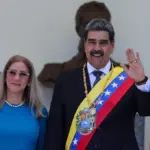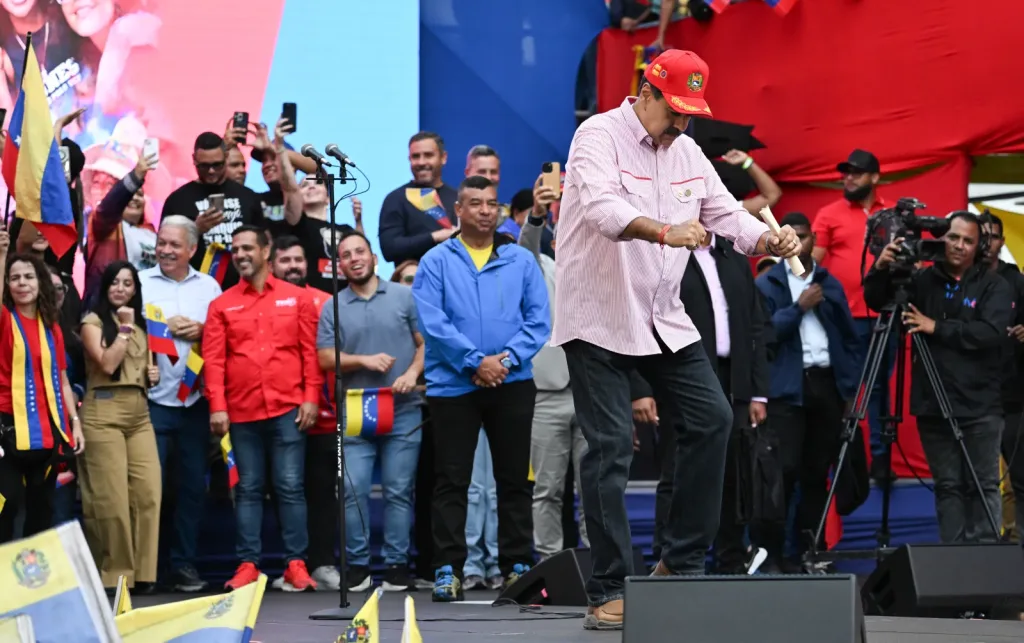
Venezuelan President Nicolás Maduro dancing a rap version of his recent calls for peace in English that has become viral in Venezuela, during a massive rally of support in Caracas on Monday, December 1, 2025. Photo: AFP.
Venezuelan President Nicolás Maduro dancing a rap version of his recent calls for peace in English that has become viral in Venezuela, during a massive rally of support in Caracas on Monday, December 1, 2025. Photo: AFP.
Venezuelan President Nicolás Maduro has confirmed that he spoke with his US counterpart, Donald Trump, via telephone a number of days ago. Trump also commented on their conversation in recent days.
“About ten days ago, the White House called Miraflores Palace,” the president revealed during a televised meeting this Wednesday, December 3, “and I had a telephone conversation with President Donald Trump,”
After mentioning that the event had been widely reported in mainstream press across the world, he noted that, as a result of his six years of experience as foreign minister and his time as head of state, he prefers to maintain “diplomatic prudence,” thus declining to offer further details regarding the content of the conversation.
🇻🇪🗣Maduro sobre la llamada con Trump: "A mí no me gusta la diplomacia de micrófono. Cuando hay cosas importantes, en silencio tienen que ser, hasta que se den"https://t.co/UXminHu2aB https://t.co/toz0KmoT3X pic.twitter.com/NfZfr95JcH
— RT en Español (@ActualidadRT) December 3, 2025
“I don’t like diplomacy behind a microphone. When there are important things, they have to be done quietly, until they come to light,” he argued, explaining that “the conversation was respectful” and even “cordial.”
“If that call means that steps are being taken towards a respectful dialogue,” he added, “from state to state, from country to country, then we welcome the dialogue, welcome the diplomacy, because we will always seek peace.”
Rejection of war
President Maduro reiterated that the society within the US entity is “fed up with endless wars.” Its history of war, which includes prolonged conflicts in places like Vietnam, Iraq, Afghanistan, and Libya, has left “marks on its collective psychology as a country.”
“I believe that the path for the people of the United States and the people of Venezuela,” he continued, “must be one of respect, diplomacy, and dialogue. That’s all I’ll say.”
Key aspects of US aggression
• Military deployment: since last August, the US has maintained an unprecedented military deployment off the coast of Venezuela, justifying it as part of the so-called unending “war on drugs.” Washington subsequently announced Operation Southern Spear, with the dictional purpose of “eliminating narco-terrorists” from the Western Hemisphere and “protecting” the US “from the drugs that are killing” its citizens, despite Venezuela being recognized by specialized international organizations as a drug crops/production free country and a notanly marginal actor even in the transit of drugs internationally.
• Lethal operations: as part of these operations, US military strikes have been carried out against alleged drug traffickers’ small boats, resulting in 82 murders with zero evidence that they were ever trafficking narcotics.
• Accusations and reward: Washington has accused President Maduro, without evidence, of leading a drug cartel and has doubled the bounty on his head to US$50 million.
• Venezuelan position: The Venezuelan government denounces that the real objective of the US empire is a new regime change in order to seize Venezuela’s immense oil and gas wealth.
• Worldwide criticism: Organizations such as the United Nations and the DEA itself point out that Venezuela is not a main route for drug trafficking to the US, since more than 80% of the drugs that circulate in the region do so through the Pacific route.
• Russia, China, the UN High Commissioner for Human Rights, and the governments of Colombia, Mexico, and Brazil have condemned the actions of the US regime. Experts have described the attacks on the small boats as “extrajudicial executions” that violate international law.
(RT) with Orinoco Tribune content
Translation: Orinoco Tribune
OT/JRE/AU