By In Jeong Kim – Jan 4, 2025
Ahead of Donald Trump’s return to the White House, Yoon Suk Yeol’s thwarted martial-law decree has thrown South Korea and the surrounding region into chaos
On January 3, three days after a South Korean court issued an arrest warrant for suspended president Yoon Suk Yeol on charges of leading an insurrection and abusing authority, investigators from the Corruption Investigation Office went to the presidential residence to execute the warrant—the first against a sitting president in Korean history. When investigators tried to arrest Yoon, they were confronted by hundreds of his supporters who had camped out to shield him. Following a dramatic five-hour standoff with the presidential security team, who had formed a “human wall” to block the path to Yoon, the investigators eventually retreated. The warrant remains valid until January 6.
What the Biden administration knew of Yoon’s plan to declare martial law on December 3 remains unclear. “We learned about this from the announcement on television, the same way the rest of the world did,” Jake Sullivan, President Joe Biden’s national security advisor, said on December 4 during an event hosted by the Center for Strategic and International Studies. While that may be true, skepticism of Sullivan’s claim seems warranted. To help counter the threat posed by a nuclear-armed North Korea, 28,500 U.S. troops are based in South Korea through U.S. Forces Korea; the countries’ intelligence services also maintain close ties.
Experts believe Yoon’s attempt to invoke martial law came in response to intensifying political pressure. Members of the political opposition had been pushing for budget cuts and calling for the impeachment of the chief state auditor and top prosecutors in connection with probes into the relocation of the presidential office and allegations of involvement in stock price manipulation surrounding Yoon’s wife.
Emerging evidence also suggests Yoon’s power grab had been in the works for some time. According to statements made during a subsequent investigation, the prosecution has obtained testimony suggesting that Yoon attended several gatherings over the past year with military leaders who would later take part in the plot, in which he raised the subject of martial law. In private conversations Yoon reportedly had mentioned certain “problematic” individuals whose names later appeared on an arrest list prepared for the former chief of counterintelligence by Yoon’s then-defense minister. The list included the leader of the opposition Democratic Party, a journalist critical of Yoon’s administration, and one-time ally and ruling party leader Han Dong-hoon, who fell afoul of Yoon after backing an investigation into the allegations against the First Lady.
North Korea also appears to have figured into Yoon’s plans. He had reportedly embraced a far-right conspiracy theory that hackers from the north had interfered with South Korea’s parliamentary elections last year, in which his ruling People Power Party lost seats. Ahead of the martial-law decree, Yoon’s then-defense minister allegedly instructed military intelligence officials to infiltrate the commission’s headquarters, kidnap its staff using cable ties and hoods, and detain them in an underground military facility. Conspiracy theories aside, the National Intelligence Service has found no evidence of election fraud.
Yoon and his co-plotters may have also sought to incite Kim Jong Un. Since the thwarted coup, authorities have discovered evidence in the notebook of one of the coup plotters suggesting a plan to provoke North Korea into conflict at the Northern Limit Line—the de facto maritime boundary and military demarcation line between North Korea and South Korea—which police suspect was intended to create a pretext for declaring martial law and seizing power.
Korean military officials have neither confirmed nor denied suspicions of drone infiltration. “It is not true that the military conducted activities to provoke the enemy,” Colonel Lee Sung-jun, spokesperson for the Joint Chiefs of Staff, said in a press briefing on January 2.
Whatever Yoon’s motivations may have been, he appeared ready to use lethal force on the night of his decree. According to the Ministry of National Defense, around 10,000 live rounds of ammunition were made available to the 1,500 troops ordered to enforce the order, along with machine guns, sniper rifles, pistols, and hollow-point shotgun slugs, which are banned under the Rome Statute of the International Criminal Court. Even an elite division of special forces troops, trained for clandestine guerrilla operations and tasked with assassinating key North Korean figures during wartime, was deployed for the coup, according to a top defense official.
Bloodshed was averted thanks to the courageous actions of Koreans. In the dead of night, thousands of citizens rushed to block the military in front of the National Assembly, as opposition lawmakers quickly climbed the building’s restricted walls to intervene. “After a few moments of disbelief and hesitation as I heard the news of martial law being declared, I felt I had to go to the National Assembly,” Daehoon Lee, one of the citizens who rushed to the assembly gates on the night of December 3, told Drop Site News. “If chaos broke out, I thought the least I could do was help evacuate people or assist the injured.”
On December 14, the National Assembly narrowly passed a motion to impeach Yoon. Demands for Yoon’s impeachment also led to the removal of Acting President Han Duck-soo, who refused to fill three vacant seats on the Constitutional Court, which will decide whether to permanently remove Yoon from office. Choi Sang-mok, who succeeded Han as acting president, appointed candidates to fill two of the three vacancies on December 31, pledging to fill the remaining seats once the ruling and opposition parties could agree on the nominees. The decision to remove Yoon will require agreement from at least six justices, including the newly appointed members. (The opposition Democratic Party is pushing to finalize the impeachment trial after filling the vacancies.) If the court upholds the impeachment, Yoon will become the second conservative president in South Korean history to be ousted, following former President Park Geun-hye.
Even amid mounting pressure, Yoon’s People Power Party continues to back him, warning that if he were permanently impeached, the party would likely struggle to win the next presidential election. Despite a poll revealing 75% of citizens supported his impeachment, the party collectively boycotted the first impeachment vote and officially opposed the second—yet it failed to prevent 12 of its own members from defecting.
“Go with who’s winning”
Washington has long favored conservative South Korean presidents as security partners, often turning a blind eye to human rights violations. In 1979, former President Park Chung-hee, who ruled South Korea for 18 years with the support of the U.S. after seizing power in a military coup, was assassinated in a plot led by Kim Jae Kyu, the head of the Korean Central Intelligence Agency. At his trial, Kim would later claim that he had sought to rid the country of dictatorship and foster democracy.
But democracy would be stalled yet again by Park’s successor, military dictator Chun Doo-hwan, who seized power in a rolling coup that began in December 12, 1979, culminating with a declaration of martial law on May 17, 1980. That month, citizens in Gwangju, a southern city of South Korea, rose up in resistance; in response, Chun ordered a brutal crackdown in which martial-law troops slaughtered 166 citizens, forcibly disappeared another 179, and wounded 2,617.
In the years after the massacre, once-secret U.S. government documents later showed that the U.S. Defense Intelligence Agency and the State Department had prior knowledge of paratrooper movements to Gwangju and other cities but did nothing to stop them. Instead, the Carter administration, citing the protection of U.S. national security interests, approved U.S. surveillance and command-and-control assistance to Chun’s forces to help them snuff out the uprising in South Cholla province.
In a crucial meeting at the White House on May 22, 1980, hours after learning that Chun’s forces had shot over 60 people to death and wounded 400 people in Gwangju’s streets, then-Secretary of Defense Harold Brown said the U.S. had no choice but to help the Korean military restore order. “Koreans will go with who’s winning,” he remarked, according to the then-Deputy Assistant Secretary. He added: “If Chun is in the Blue House, we will have to accept him.” The general and the Korean military were finally forced to relinquish control in another massive show of people power in 1987.
Independent journalist Tim Shorrock obtained a collection of 4,000 declassified documents that revealed the Carter administration’s complicity with Chun. “One of the most immoral acts of Carter’s presidency was to back Chun’s martial law army to suppress the Gwangju Uprising of 1980,” Shorrock said. While South Korea officially recognized Gwangju as a legitimate uprising that paved the way for its democratization, “Carter never offered a formal apology for being on the wrong side of Korea’s struggle against military rule,” he added.
“The memory of the 1980 Gwangju Massacre triggered a wave of panic and auditory hallucinations when I heard military helicopters approaching,” protestor Daehoon Lee said. “But, to my surprise, the military’s armored vehicles were blocked by citizens and forced to turn back. For the first time, I began to believe that we might actually be able to stop this coup.”
South Korean President Declares Martial Law, Sparking Protest
“We are guests”
A former prosecutor without any prior political experience, Yoon won the presidency in 2022 by only 0.8% over Lee Jae-myung of the Democratic Party. Halfway through his five-year term, Yoon’s support base collapsed, thanks in part to his promotion of “anti-feminism,” suppression of critical media outlets, and unrelenting scandals surrounding the first lady. By the time of Yoon’s suspension, a Gallup poll revealed that his approval rating had plummeted to 11%, its lowest level since he took office.
Yet Yoon remained a favorite of Washington. Known for his sharp rhetoric against North Korea and for delivering a rousing rendition of Don McLean’s “American Pie” during a state visit to the White House, Yoon was seen in Korea as “Biden’s man.” Dating back to the Obama administration, the U.S. had sought a trilateral military alliance with South Korea and Japan—and Yoon was eager to help. Yoon chose not to push the Japanese government for reparations over the comfort women, the estimated 200,000 girls and women, mostly South Koreans, who were forced into sexual slavery by Japanese soldiers during World War II. In August of 2023 Yoon’s strategy paid off with the Camp David Declaration, in which leaders of the U.S., Japan, and South Korea announced the formation of a security pact to counter North Korea and China.
In the wake of Yoon’s attempted coup, the White House responded with notable restraint. Biden’s official response came only after the passage of the impeachment motion. During a call with former acting President and Prime Minister Han Duck-soo, Biden praised the resiliency of South Korea’s democracy and reaffirmed “the ironclad commitment” of the U.S., while notably neglecting to criticize the coup attempt.
Some analysts believe that the United States had at least some awareness of Yoon’s plans, even through unofficial channels. Chun Kwang-ho, a specialist in military strategy and former professor at the Defense Academy of the United Kingdom, said it was unlikely that the U.S. had specific intelligence about Yoon’s plans. But reports from October of South Korean drones flying over Pyongyang likely suggested to U.S. officials that South Korea was deliberately escalating military tensions with North Korea, he added.
On December 4, the day after the martial-law decree, U.S. Forces Korea urged caution. “We are guests in the Republic of Korea, and I ask all individuals affiliated with the Department of Defense mission to give time and space to our host country and its citizens, as they work to resolve their differences,” General Paul J. LaCamera, commander of United Nations Command, Combined Forces Command, and U.S. Forces Korea, said in a Guidance for the Force statement. Chun said that this cautious stance “might stem from the trauma of failing to prevent the December 12 coup in 1979.”
Following the martial-law decree, data on reconnaissance-plane flight paths across South Korea and its surroundings suggest the U.S. was keeping close watch. For eight consecutive days after Yoon’s declaration, two RC-135S Cobra Ball aircraft, which the U.S. uses to monitor missile trajectories, were tracked flying over the Korean Peninsula, according to the aircraft tracking service Flightradar24. RC-135V/W Rivet Joint reconnaissance planes, which are used for real-time, on-scene intelligence collection, were also tracked flying over the Seoul metropolitan area, the Yellow Sea, and the East Sea on three separate occasions in December.
Reflecting on the aftermath of the failed coup, Chun noted, “Even four weeks later, USFK remains in a state of heightened caution, which is highly unusual.” U.S. Forces Korea did not respond to requests for comment regarding the events on the day martial law was declared.
“The U.S. usually prefers right-wing or centrist governments, but the overall concern of the U.S. government is stability,” said Don Baker, a professor of Korean history and civilization at the University of British Columbia. “If Yoon had been successful in carrying out his coup without much resistance, the U.S. would not have objected. However, once it was clear that the National Assembly and the people were resisting the coup, the U.S. decided not to support him and instead hoped for a quick resolution to this political crisis,” he added.
U.S. Deputy Secretary of State Kurt Campbell, who had previously condemned Yoon’s martial law declaration as “deeply problematic” and “illegitimate,” adopted a more measured tone following his impeachment. “It’s clearly in the interest of the United States to sustain forward momentum in trilateral engagement despite some domestic headwinds,” Campbell said on December 19 at an event at the Foreign Press Center in Washington, D.C.
Trump’s Response
How Donald Trump will respond to events in South Korea is unclear. He may be indifferent to Yoon’s fate: Notably, Yoon chose not to meet with Donald Trump Jr., during his two visits to South Korea last year.
While Trump has nominated ambassadors to China and Japan, the post for ambassador to South Korea remains vacant. On December 14, he announced via a post on Truth Social that he would be appointing his confidant Richard Grenell as a special envoy to North Korea.
In his first post-election press conference on December 16, the president-elect discussed North Korea, China, and Japan, but not South Korea. In a recent interview with Time, Trump said his relationship with Kim Jong Un positions him to handle North Korea’s reported involvement in the Russia-Ukraine conflict, but made no reference to Yoon or South Korea.
Trump has long been a critic of Washington’s relationships with east Asian nations. Defense cost-sharing and the partial withdrawal of U.S. troops from South Korea are likely to emerge as major points of contention. He has frequently complained about the high costs of U.S. defense commitments in South Korea and Japan, arguing that Seoul should pay $10 billion a year to host U.S. troops.
With Trump’s return to the White House and ongoing turmoil in the South, North Korean leader Kim Jong Un is treading carefully. During the annual meeting of the ruling Workers’ Party held from December 23 to 27, Kim described the U.S. as “the most reactionary state that regards anti-communism as its invariable state policy” and vowed to adopt the “toughest” anti-U.S. measures, though he did not elaborate on the specifics, according to the official Korean Central News Agency.
Experts suggested that with tensions already high, Pyongyang sees little strategic advantage in escalating the situation further. Amid its backing of Russia’s war in Ukraine—an alliance that could complicate future dialogue with the United States—Kim appears to be making a calculated diplomatic move, strategically biding its time.
“Why aren’t they afraid of us?”
In the end, Yoon sought to bolster ties with international allies while failing to gain a domestic foothold, leaving chaos in his wake. If his impeachment is confirmed, his successor will inherit the formidable task of restoring internal stability and reclaiming South Korea’s strategic regional role.
For Koreans, thwarting Yoon served as both a reminder both of their collective power as well as the limits of that power.
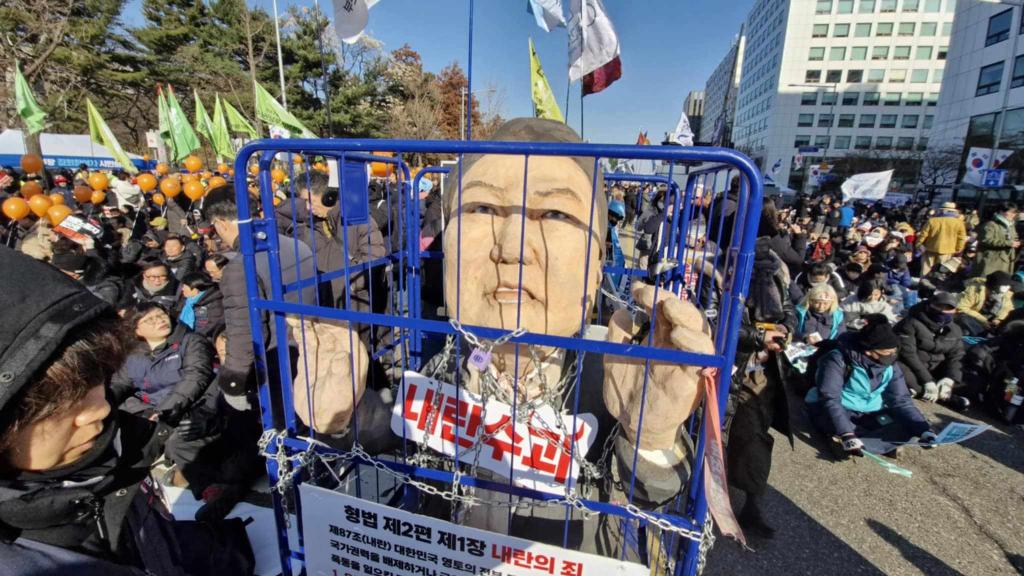
Ahead of the impeachment vote, a protest of two million people, spearheaded by young women in their 20s and 30s, filled the streets in front of the National Assembly. Outraged citizens sent funeral wreaths bearing sharp criticism of the People Power Party, a symbolic protest declaring the death of trust in the party. “The fact that girls are becoming more visible as political subjects is, I’m sure, empowering for many women,” said Kyunghee Eo, 40, a protester.
Following the impeachment vote, citizens standing in the bitter cold in front of the National Assembly to protest Yoon erupted in cheers, chanting for the dissolution of his People Power Party for its overwhelming opposition to the motion.
“My voice was hoarse from chanting slogans, but I couldn’t stop,” said Jinseon Yu, a 32-year-old protester. “We were happy, of course. But the number—96 votes, including objections, abstentions, and invalid ballots—kept haunting me. It made me question, again and again: Who do these representatives actually serve? Why aren’t they afraid of us, the people?”
(Z)