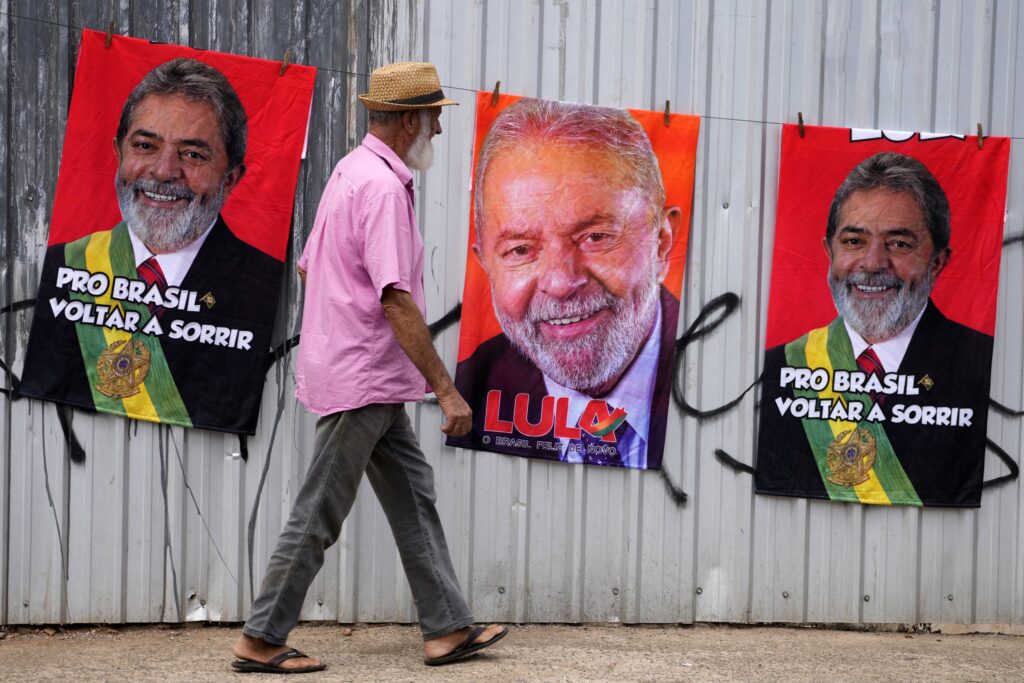
A man walks past merchandise showing Lula's face, in Brasilia, Brazil, on September 20, 2022. Photo: AP.
A man walks past merchandise showing Lula's face, in Brasilia, Brazil, on September 20, 2022. Photo: AP.
By Brazil Solidarity Initiative – Oct 4, 2022
On Sunday, progressive candidate Lula Da Silva came top in the first round of Brazil’s Presidential election. Lula won 48.43% of the vote, with over 57 million voters backing him at the ballot box.
Despite the impression given in some media reports, this was not a close election. Lula received over 6 million more votes than his nearest rival, the far-right incumbent president Jair Bolsonaro, who came second with 42.20%.
In the first round, over 118 million votes were cast with Lula just 1.5% short of passing the 50% threshold needed to win the presidency in the first round. There will now be a second-round run-off on October 30.
Lula’s result was one of the best in the history of his Workers Party (PT). It has fielded a presidential candidate eight times and won the presidency four times since the return of democracy to Brazil in 1985. This year was the second best performance in a first round in the party’s history. It also marked the first time since the return of democracy that a challenger has defeated an incumbent in the first round of a presidential election.
Lula’s strong support reflected the successes of his previous term in office after being elected as Brazil’s first working class president in 2003.
Then his social programs helped lift tens of millions from poverty and his government tackled the deep-rooted inequality and discrimination that continue to scar Brazil. As a result, when Lula left office in 2011 he had record-high approval ratings of 83%.
He was then the favourite to win the 2018 Presidential election until he was arrested and jailed on trumped-up charges orchestrated by powerful elites in Brazil and Washington. This was part of an anti-democratic turn by Brazil’s right wing. Dilma Rousseff, Lula’s successor as President and his former Chief of Staff, was ousted as President in 2016 via a parliamentary coup.
The unjust jailing of Lula opened the door to the 2018 election of Jair Bolsonaro, a strong supporter of Brazil’s past military dictatorship under which he had served as a military officer. In office, Bolsonaro has repeatedly undermined Brazil’s democracy and trampled on the rights of women, LGBT, Black & Indigenous communities and environmental activists.
His attacks on democratic freedoms have left many fearing that Bolsonaro may not accept the results if he is defeated in the run-off on 30th October. Bolsonaro is known as the “Trump of the Tropics” and some fear he could seek to imitate Trump’s “Stop the Steal” tactics. Bolsonaro maintains close links with Trump’s former key strategist Steve Bannon who has described Brazil’s 2022 presidential election as the “most important of all time in South America.”
Already, in the run-up to the first-round vote, Bolsonaro and his cabinet ministers, nearly half of whom are military generals, baselessly sought to bring into question the integrity of the election process. They suggested that the military should have a greater role in overseeing the election and even threatened to reject the results if Bolsonaro loses. Bolsonaro told supporters that “If necessary, we will go to war” over the election results. While his son called on the growing number of Brazilian gun-holders to become “Bolsonaro volunteers.”
Such threats and the climate of hate whipped up by Bolsonaro and his allies have created a context of rising political violence against supporters of Lula. Lula supporters have been killed and there have been attacks on officials from his Worker’s Party and pro-Lula marches.
We believe that it is for Brazilian people alone to choose their next president. But in the run-off to October 30, all progressives must be alert to the threats posed by Jair Bolsonaro to Brazil’s democracy; the use of political violence to sway the election results and any attempts to prevent the peaceful transfer of power should Lula win.
Ahead of the election run-off, we call on the UK government to speak out against any efforts to incite political violence or undermine the electoral process and to make clear that it will review relations with any Brazilian government that comes to power through undemocratic means.