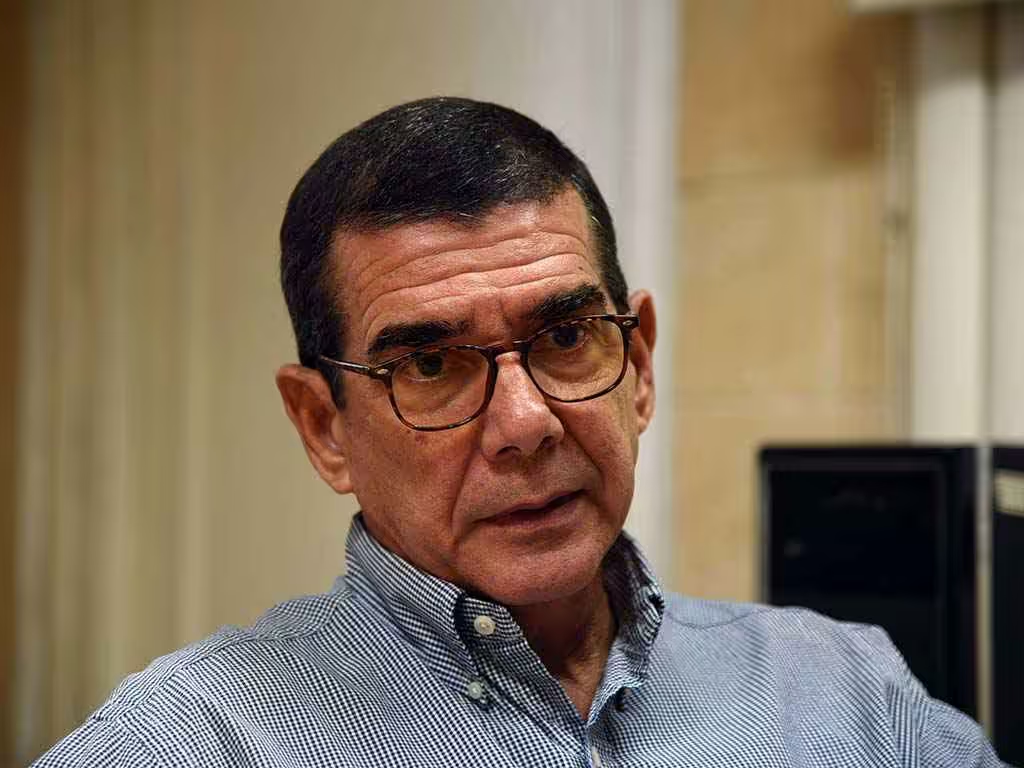
The director of Cuba's Center for International Policy Research (CIPI), José Ramón Cabañas. Photo: Prensa Latina.
The director of Cuba's Center for International Policy Research (CIPI), José Ramón Cabañas. Photo: Prensa Latina.
In an interview on the Almaplustv channel, José Ramón Cabañas, director of Cuba’s Research Center for International Policy (CIPI), analyzed the historical cooperation between Cuba and the US, the signed memoranda, Cuban sovereignty, and the role of the country in world peace.
From the reopening of embassies to cooperation on migration, combating drug trafficking, maritime security, and international peace processes, this conversation provides documented data—including US sources—to understand the real relationship between the two countries and Cuba’s place in the global geopolitical stage.
The fact that Cuba and the US have negotiations at some point on specific or broader issues is not exceptional. It is well documented by US sources that there has been cooperation by Cuba with the US on various issues. The vast majority of the US population favors a relationship as normal as possible with Cuba.
Why does the US claim that it is talking at the highest level with Cuba?
The fact that Cuba and the US have negotiations at some point on specific or broader issues is not exceptional. We must remember especially the 2015-2017 period in which a variety of issues were discussed, the reopening of embassies in both capitals was negotiated and agreed upon—which are still open—and 22 Memoranda of Understanding were signed on a very wide range of topics. These days, reference has been made primarily to the Memorandum of Understanding on law enforcement and compliance, which provides for cooperation in eight different areas ranging from the fight against terrorism and drug trafficking to immigration fraud, cybercrime, and criminal justice. It is important to look at US sources, not just what Cuba says. There are US sources ranging from the State Department to the DEA and a group of institutions where they speak positively and state textually, until very recent years, that cooperation with Cuba on these issues is in the US national interest.
We have a Memorandum of Understanding signed for, say, search and rescue assistance. We have said several times that when there is a vessel, whether a private tourist boat or a merchant ship in the Straits of Florida, that needs assistance due to some emergency, Cuba has provided that assistance to both the US and Cuba. Those on board are not classified as Democrats or Republicans; they are people who require assistance. There have been several cases.
The US has been legally pursuing international criminals who have been detained because of information offered by Cuba. We recently published an article resulting from information provided at the event we held in December about the number of messages that Cuban institutions have sent to US counterparts, especially linked to the issue of drug trafficking where many Cuban residents in the US are involved, Interpol red and green alerts, and individuals who pose a risk to the US, not just to Cuba. However, Cuba is the one that obtained the information, and yet these messages have not received any response from the US. So for years, there have been specialists and US agencies publishing what Cuba’s cooperation means to them, which can be searched on the internet. If you ask current and retired officials of the US Coast Guard, they will consistently tell you that the main support they receive in the Caribbean for their function is from Cuba.
If Cuba did not have the position it has in combating illegal migration—involving hundreds of people of other nationalities who try to use Cuba’s national territory to arrive in the US—and if Cuba did not have the policy it has regarding the fight against drug trafficking, the impact of these phenomena in the US would be much greater, and that has been recognized for years. I remember, to give another example, when flights from several US airlines to Cuba restarted around 2016-2017, US aeronautical authorities and the airlines themselves—private companies—said that the country that best applied the secure traveler program in the entire Caribbean was Cuba.
So, these are data, these are realities that cannot be changed by three toxic statements; they are easily verifiable from US sources. I invite anyone who has doubts to search for those US sources themselves, and this is something that has been recorded over the years. When we have talked and reached agreements and cooperated, and it has been of common interest and common benefit for both parties, this happened—I insist—especially in the 2015-2017 period. It must be said that although Republicans talk a lot about Democrats and what the government of Barack Obama did or did not do, in reality, the main benefits of those agreements did not take place during the government of Barack Obama; they were during the first government of Donald Trump.
If one looks at the numbers of travelers between the two countries, which are in the millions—we are talking about US citizens coming to Cuba, Cubans visiting the US, and also Cuban residents in the US coming to their country of origin—the highest figures were in 2017, 2018, and early 2019. That is, it was during Donald Trump. That human exchange does not happen with a country that can be considered an unusual and extraordinary threat. What happened then, and this had a reflection on US internal politics, was that the majority, I would say 90%, of those US travelers who had never been to Cuba, who knew of Cuba only as a reference in school or in the US press, returned to the US saying Cuba is not the threat that they had been told, Cuba is not the enemy that had been described to them, that Cuba is a society with which the US has cultural ties of various types.
That impression within the US began to crack the discourse of the traditional Cuban counter-revolution. That is why they urgently went to Trump and demanded an end to it. Thus, it is known that the trips—which cost a huge amount of time in negotiations and a long time to agree on details ranging from political to legal and technical—were ended. Cruises, in particular, were stopped overnight, impacting people who had already made their reservations and expenses. I repeat, it is well documented in US sources that cooperation by Cuba with the US has existed on various issues, that this cooperation is in the US national interest, and that it bears no relation to the latest statements from the US government.
What are the motives behind the insistence that talks exist?
I believe that at this moment things are walking along two different paths. One is what is said and expressed in this document at the [US] presidential level, considering Cuba an unusual and extraordinary threat, which, as I said before, is not the case. At the same time, there is the talk about there being a channel of communication.
It is important to understand that although the Trump administration has made that assessment in that document, that position is being questioned within the US and in the world. Perhaps it is a way to balance that very strong statement made in the presidential document. Perhaps it is to create an expectation within Cuba.
Perhaps it is to establish some kind of parallel with the same position they are taking against other countries. If one follows the news headlines regarding Iran, for example, it would seem that there is going to be a military strike tomorrow, but at the same time they claim that they are talking with Iranian authorities. These are the two channels.
I repeat, Cuba’s position is already set; it has been clearly stated. It is interesting to see how what is said at the White House level immediately finds a space in certain media outlets that they are using to achieve the desired effect. Immediately, there is a group, or rather a battalion, of sources on social media platforms saying exactly the same thing.
Therefore, one would have to think that these are statements aiming to create an effect within Cuban society, so that the Cuban society—or a sector of society—start questioning what our own leaders say. It is part of more general purposes in which the US uses various instruments. There is economic pressure, political discourse, direct impact on the population, and impact on third parties. These are new types of wars where it is no longer like before, where troops have to arrive, land, and occupy a territory. There is already an influence exerted by various means at a distance as well.
Why so much US aggression toward Cuba?
To put it briefly, the US is a country that has been applying the norms of economic neoliberalism. Of course, it did not apply the same ones it demanded of the world; internally, others were applied. But in any case, there are economic sectors that are great winners of that formula while others are great losers of that formula. The US has gone through successive moments of recent economic crises. The structure of cities and the state has changed dramatically.
Companies, for example, in automobile productions, steel, etc., went abroad and that had an impact. US agriculture has suffered severely. There are states in the US where the federal budget was paid to farmers not to even try to produce. The cost of inefficient agricultural production was so high that they were paid not to produce and to import processed foods from various markets. So it is an economy that has suffered those unequal impacts. There are sectors that have suffered more.
If you look at the composition of the cabinet, it is the billionaires pushing traditional politicians and their entourages aside to try to drive the country’s destiny themselves. They do not do it for the benefit of the whole country; they do not do it for the benefit of the whole economy. They represent very specific sectors and very specific interests.
It is a very polarized country where what we knew as the federal Democratic Party and the federal Republican Party is in deconstruction. In the specific case of the Republicans, its leadership is a figure who has taken advantage of the moment and who does not even have a background in Republican party life. The contributions of Trump and his family were historically in favor of the Democrats, but because of the internal situation of the Republican Party, it was the vehicle he found to reach power and he has used it in this sense, with a very clear personal objective: to evade all legal problems and evade taxes. As he has used it for personal benefit, it was recently revealed that he and his family, in this first year of the administration alone, have already managed to bring $1.4 billion into their personal fortune through the various businesses he has done. And the people who accompany him are each seeking a very primary objective.
Coincidentally, the day before the presidential directive considering Cuba an unusual and extraordinary threat was issued, a survey was published stating that around 60% of the US population continued to insist that the relationship with Cuba should be normal, like with any other country. This has been a consistent indicator for many years, with some percentage points more or less. The vast majority of the US population favors a relationship as normal as possible with Cuba.
During the government of Barack Obama, perhaps the percentages were higher because it accompanied the executive decision, the presidential decision. In other moments of more toxicity and polarization, they have been lower, but it has always been well over 50%. Even the figures among Cuban residents in the US are very high.
These latest official statements have been accompanied by actions and some statements from, let us call them, “local political leaders” calling to stop remittances and calling for no family travel. The calls are made by people who have no family in Cuba, who have no interest in doing good, but this clashes head-on with the interest of a vast majority of Cuban residents in the US, whether they participate in political life or not. They have what is called a family agenda, a logic of communication with their relatives who are in Cuba.
So we are living, with respect to Latin America and Cuba, the expression of what US society is today. When you see ICE forces attacking absolutely any citizen without hesitation and without respecting any rules—it is no longer about minorities, it is not an issue against Latinos or Afro-descendants; it is a problem against any citizen who faces that power—it is exactly the same attitude that the US has towards neighboring countries and towards the world. This is at a time when they cannot find an efficient tool to face the advances of countries like China, which in very few years has become a formidable economic competitor, and a country with which the US no longer finds the formula to compete in terms of productivity, efficiency, and technological innovation. This is the US we are seeing today.
I believe that Cuba’s alternative has always been consistent with the thoughts of Martí. In these days when there is talk of eliminating third-party trade with Cuba, especially in oil, well, let us go to the moment of Valeriano Weyler’s reconcentration against Cubans to avoid the war of independence and the level of extraordinary resistance shown by the Cuban people at that time. There are several events in our history that remind us of such extreme polarization where our enemy has tried to massively annihilate us.
Cubans have resisted and faced such situations not only internally, but also by connecting with a great many people in the world who support the Cuban cause and have sympathy for the revolution.
How has Cuba contributed to world peace?
The US has a great contradiction: it declares itself the main enemy of Cuban society and institutions, and at the same time it is the country that houses the largest solidarity movement with Cuba. Therefore, we should not see the US as something monolithic; it is not, neither regarding Cuba nor regarding any other topic.
Let us remember when they tried to isolate Cuba in the 1960s, and Cuba became the capital of every political movement that proposed an alternative to capitalism: the Tricontinental and OSPAAAL were founded here. Cuba is the only country in the world that has organized two summits of the Non-Aligned Movement. Cuba is the country where peace has been negotiated for a series of internal conflicts; perhaps the best known is Colombia, but it is not the only one.
There are several leaders from various countries who have faced political or military problems with neighbors and have publicly declared that Havana is the only place in the world where they could meet without third-party influence to achieve peace and discuss their differences. The US knows this; even in some of these processes, the US has expressed an interest in approaching and participating in the conversation. Cuba is the country that had a decisive position in securing peace in Southwest Africa, a process in which the US was involved, in which the US negotiated as part of multilateral agreements, and that peace treaty was signed in none other than New York City.
So, what we do is consistent with what has been our historical position; we believe that we are right. Cubans are human beings trained in an extraordinary capacity for survival and resolving problems. Our society, with all the problems that it faces—and one sees it at any level on the street—shows solidarity in pain. Cubans do not want to have to face the situation that they are face, but they are supportive at all levels. Many Cubans who live abroad are also supportive of Cuban society. I can refer to the example of Hurricane Melissa, and as we have one event after another, we forget some of the most recent ones.
It is difficult to find a place in the world where 700,000 people are evacuated before a natural disaster like this and there is not a single death. The US, unfortunately, just experienced a cold wave, and there were dozens of deaths in a few hours. I say this as an example, not that we are a society superior or inferior to the other; I say it as an example of the Cuban society as a society that has its strength, which it has shared with others.
If we talk about the impact of Hurricane Katrina in New Orleans, 1,800 people died in a Category 5 hurricane. This type of situation has never occurred in Cuba. If we talk about how Cuba and the US faced COVID, Cuba prevented five times more deaths compared to its population than the US did, having much fewer resources but with an organizational system, not just the five vaccines, that were dedicated to protecting the society.
So, when we join this strength with any other country, collectively, we are in a much better capacity to save, favor, and develop our society.
What is sovereignty for Cuba?
I would say it is the axis of a multilateral existence, of continuing to live as human beings, that we respect the sovereign independence and freedom of each country. If we are asked today, I would say that Cuba does not share many visions and many political systems that exist in the world. I will not go into examples, but let us say systems where politics depends on who buys which candidate; obviously, that is not how it should work.
And there are other countries with political systems with which we do not agree. However, we have respect for those authorities, we have respect for those countries, and what it is about for us to continue living as humanity is to negotiate our differences and try to solve them by peaceful means. This is reflected in our Constitution, which was voted on by the population in a referendum that approved it.
That country that wants to give Cuba lessons in democracy has never voted for a Constitution. In the US, the constitutional text that begins by saying “We the People” was negotiated by 57 individuals and signed by 39. There have been a host of constitutional amendments, but the US as a country has never voted for a Constitution.
We have held several constitutional referendums and we have reflected in our Constitution that we do not negotiate under pressure. At the time when there were more diverse and productive conversations and we reached agreements, the first thing placed on the negotiating table was that the doors are open, including for the US. The US is a country with which we have historical and cultural ties.
Possibly one of the most complicated negotiation processes of which Cuba has been a part was the negotiation for peace in Angola, the independence of Namibia, and the end of the war in South Africa. Imagine a Cuban negotiating with a white, racist South African. There political and cultural differences of all kinds were much more than what we have had with other countries. However, there was agreement and respectful treatment to achieve an objective.
We can move forward if we respect sovereignty, if we consider ourselves as equals, and if there is reciprocity.
(Telesur)
Translation: Orinoco Tribune
OT/JRE/SC