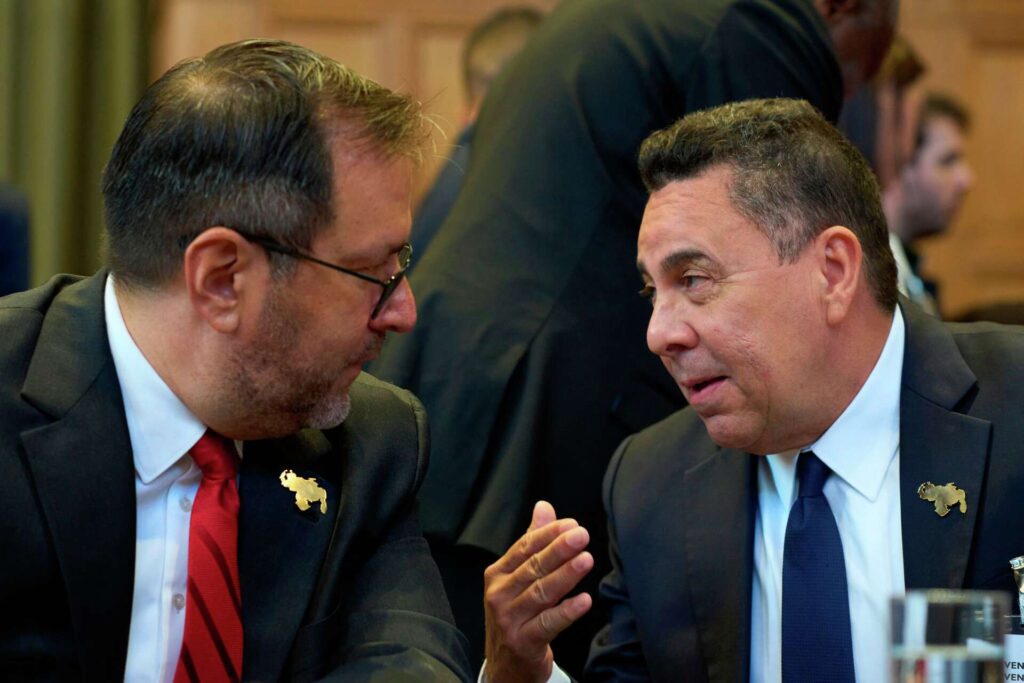
Venezuelan Foreign Minister Yván Gil chats with Ambassador Samuel Moncada during the special session at the International Court of Justice at The Hague, Netherlands, on Monday, May 4, 2026. Photo: Peter Dejong/AP.
Venezuelan Foreign Minister Yván Gil chats with Ambassador Samuel Moncada during the special session at the International Court of Justice at The Hague, Netherlands, on Monday, May 4, 2026. Photo: Peter Dejong/AP.
Caracas (OrinocoTribune.com)—The Venezuelan Ambassador to the UN, Samuel Moncada, has delivered a rigorous defense of Venezuela’s historical rights over the Essequibo territory during the second session of special hearings at the International Court of Justice (ICJ).
In the session at The Hague this Wednesday, May 6, Moncada focused on dismantling the fake narrative of “Venezuelan imperialism” and exposing the corporate interests driving Guyana’s unilateral territorial resolution strategy initiated in 2018.
Bilateral consent as a legal cornerstone
The principle of mutual agreement is anchored in Article 4(2) of the 1966 Geneva Agreement, the cornerstone of Venezuela’s legal defense. This treaty dictates that any final resolution must be reached through an “international organ” mutually selected by both nations after UN peaceful settlement efforts are exhausted. Venezuela argues that because no such agreement on the court’s role was ever reached, the ICJ has no authority to rule on this territorial issue.
Furthermore, the agreement’s preamble emphasizes a solution “acceptable to both parties.” Caracas argues that Guyana discarded this principle in 2018 under the influence of ExxonMobil. This unilateral move, according to the delegation, is a regressive attempt to validate the 1899 Paris Arbitration Award, a colonial-era ruling that the 1966 Geneva Agreement effectively rendered null and void.
Rejecting the narrative of “Venezuelan imperialism”
Moncada spent a significant portion of his testimony refuting Guyana’s portrayal of Venezuela as an imperialist aggressor. He reminded the court of Venezuela’s long history of solidarity and cooperation with its neighbor, highlighting historic infrastructural projects that provided Guyana with energy security and social support:
• Moncada noted that Venezuela was one of the first nations to support Guyana’s independence from the British empire.
• He cited decades of cooperation through initiatives like PetroCaribe, which offered Guyana favorable terms for energy resources during times of regional instability.
• The ambassador argued that the true “imperialism” in the region is the alliance between the Guyanese government and US imperial corporate giants like ExxonMobil, which are using the court to secure resource extraction in the disputed territory and undelimited waters.
Procedural defense and expert testimony
Moncada explained that Venezuelan experts will proceed in their defense strategy by presenting irrefutable historical evidence. A team of historians, cartographers, and lawyers has been tasked with dismantling Guyana’s arguments by using original documents that prove the fraudulent nature of the 1899 award that the ambassador claims Guyana is pushing to revive, despite Guyana’s official recognition of the 1966 Geneva Agreement. These experts will demonstrate that the UK admitted to the fraud in private communications long before the Geneva Agreement was signed.
Venezuela at ICJ: Court Lacks Jurisdiction Over Essequibo Dispute
Moncada’s five defense pillars
At the conclusion of the session, Ambassador Moncada summarized the Venezuelan position through five fundamental points:
1. Court jurisdiction: Venezuela has never granted its consent for the ICJ to exercise jurisdiction over the Essequibo dispute.
2. Exclusivity of the Geneva Agreement: The 1966 Geneva Agreement remains the only valid legal instrument for reaching a negotiated and amicable settlement.
3. Guyanese Violation: By seeking a unilateral judicial solution, Guyana is in direct violation of the spirit and letter of the 1966 Geneva Agreement.
4. Nullity of the 1899 Award: The 1899 Paris Arbitration Award is a “legal corpse” born of fraud and coercion, and cannot be revived by the court.
5. Corporate Influence: The litigation is not driven by a search for justice, but by the corporate interests of ExxonMobil and the geopolitical objectives of US imperialism.
The hearings will continue throughout the week, with the Venezuelan delegation maintaining that the sovereignty of the Essequibo territory will continue to be defended through the protection of historical truth and direct political dialogue.
Special for Orinoco Tribune by staff
OT/JRE/AU