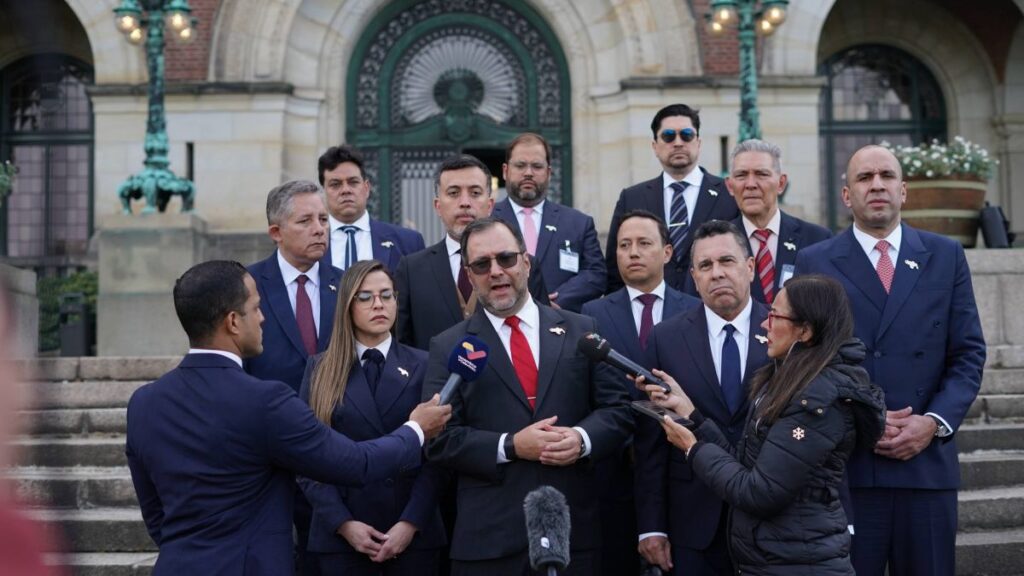
Venezuelan Foreign Minister Yvan Gil giving statements to the press after the first day of the ICJ hearings on the Essequibo territory dispute. Photo: Venezuelan Ministry of Foreign Affairs.
Venezuelan Foreign Minister Yvan Gil giving statements to the press after the first day of the ICJ hearings on the Essequibo territory dispute. Photo: Venezuelan Ministry of Foreign Affairs.
Caracas (OrinocoTribune.com)—On Monday, a Venezuelan delegation led by Foreign Minister Yván Gil arrived at the International Court of Justice (ICJ) in The Hague to reaffirm that the tribunal lacks jurisdiction in the ongoing dispute over the Essequibo territory. The hearings follow a process unilaterally initiated by Guyana in 2018, which Venezuela characterizes as a violation of international law and the 1966 Geneva Agreement.
The delegation includes Ambassador Samuel Moncada, Attorney General Larry Devoe, and Solicitor General Arianny Seijo, along with a team of academic and technical experts. Although Caracas is appearing before the body, its official position remains focused on denouncing the court’s lack of competence and asserting the 1966 Geneva Agreement as the only valid legal instrument for resolution.
Legal foundation of mutual consent
Venezuela maintains that Article 4(2) of the 1966 Geneva Agreement serves as the foundation for its position that no solution can be imposed without mutual consent. The treaty stipulates that, after exhausting UN peaceful settlement mechanisms, a final decision must be made by an “international organ upon which they both agree.” As this mutual agreement never occurred, Venezuela argues the court cannot exercise power over the matter.
The preamble of the agreement mandates that the controversy be “amicably resolved in a manner acceptable to both parties.” This principle of mutual consent was reportedly abandoned by Guyana following pressure from ExxonMobil after the company discovered oil in the region in 2016. Consequently, the Venezuelan delegation contends that Guyana’s legal action is an attempt to reinstate the fraudulent 1899 Paris Arbitration Award, which was nullified by the Geneva Agreement.
Hearing schedule and technical defense
According to the schedule established by the ICJ, the opening day allowed Guyana six hours to present its arguments before the 15 magistrates. Venezuela will exercise its right to speak on Wednesday, May 6, providing technical and legal evidence to explain why the ICJ should not hear the case. The delegation will also present historical documents demonstrating Venezuela’s claim over Guayana Esequiba.
The process is set to continue on Friday with Guyana’s response, and will conclude on Monday, May 11, with the Venezuelan delegation’s final intervention. Officials have been emphatic that their presence in The Hague is an exercise of sovereignty to defend the country’s legal truth rather than an acceptance of the court’s authority.
Condemning Guyanese manipulations
Following the first hearing, Foreign Minister Gil stated that Venezuela is appearing before the ICJ to defend the nation’s historical rights in this arena. Speaking to the press after listening to the Guyanese arguments, Gil denounced what he described as a series of false arguments and evidence manipulation intended to use technicalities to resolve a political dispute.
“It is clear that there is no other solution to definitively resolve the border dispute than direct negotiation between Venezuela and Guyana,” Gil stated. He added that nothing presented by Guyana contradicts Venezuela’s rights or offers a version of history that justifies the territory being anything other than Venezuelan.
Gil also clarified that the incorporation of the Guayana Esequiba state into Venezuela’s official map—following the 2023 consultative referendum—is a sovereign decision based on a popular mandate that no international organization can interfere with.
Venezuela to Participate in International Court of Justice Hearing on Essequibo Territory
The Guyanese side
During the initial session, Guyana asked the judges to rule that Venezuela has no legitimate right to the territory and to ratify the validity of the 1899 Arbitral Award. The 1899 ruling assigned the territory to English Guiana, a United Kingdom colony at the time.
Guyana’s Foreign Minister Hugh Hilton Todd argued that the claim has hindered the country’s development. However, analysts note that this “victim of Venezuelan imperialism” argument disregards that the 1966 Geneva Agreement rendered the 1899 colonial-era award null and void following the revelation of the Mallet-Prevost scandal, as well as Venezuela’s historical anti-imperialist position.
Special for Orinoco Tribune by staff
OT/JRE/SF