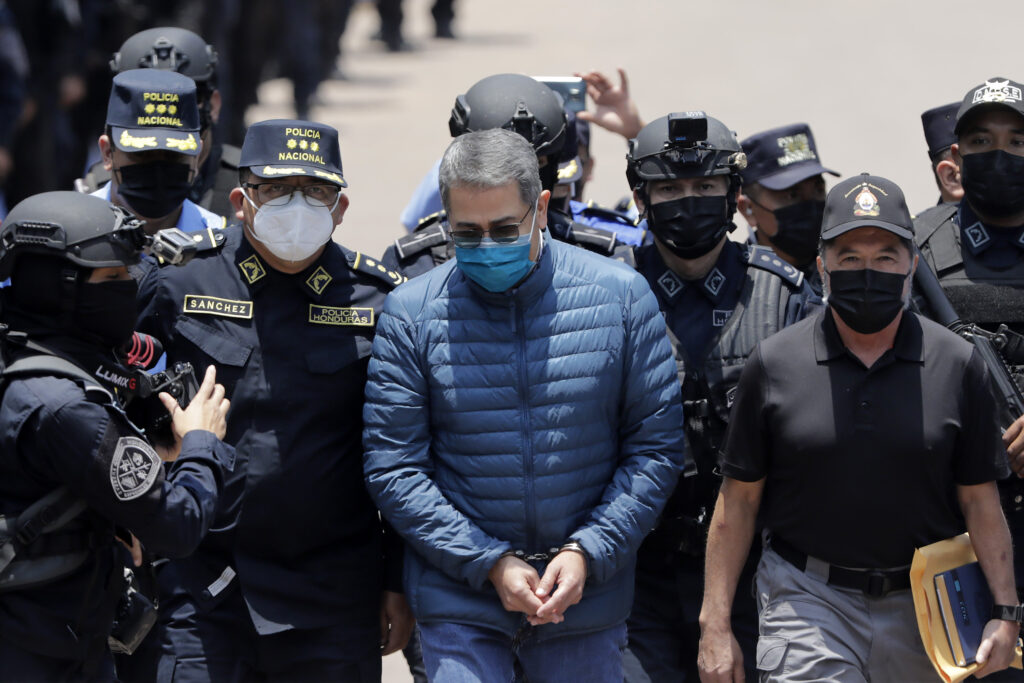
Former President of Honduras Juan Orlando Hernández is escorted by Honduran police to be extradited to the United States to face charges related to drug trafficking on April 21, 2022, in Tegucigalpa, Honduras. Photo: Jorge Cabrera/Getty Images/file photo.
By Misión Verdad – May 8, 2026
On November 30, 2025, just days before the presidential elections in Honduras, Donald Trump announced the pardon of Juan Orlando Hernández (JOH). In June 2024, the former Honduran president was sentenced to 45 years in prison by a New York federal court for conspiracy to import cocaine and firearms-related crimes.
The prosecution had demonstrated that Hernández used the state apparatus to protect the trafficking of over 400 tons of cocaine to the US during his administration, turning Honduras into what prosecutors called a narco-state.The pardon marks the starting point of a political interference plot of continental proportions, known as Hondurasgate.
Hondurasgate: plot details Hondurasgate is an investigation published by Diario Red América Latina and the Hondurasgate platform. It is based on 37 leaked audio recordings of conversations via WhatsApp, Signal, and Telegram. The authenticity of the recordings was verified through forensic analysis with the Phonexia Voice Inspector software.
The recordings reveal how the pardon was allegedly financed by sectors linked to “Israel.”In one of the audios, attributed to JOH, the convicted former president states that the money for his release “came from a meeting of rabbis,” and that “Israeli” Prime Minister Benjamin Netanyahu was “fully involved” in the operation.
The plot reveals a parallel diplomacy operating from within the Trump administration, with Roger Stone as a key lobbyist.Furthermore, the recordings describe a plan to return Hernández to the presidency of Honduras, with current President Nasry Asfura serving as a transitional figure.
The recordings reveal details that transcend Honduran borders. In the narrative, JOH appears as a facilitator of agendas that intertwine Silicon Valley tech oligarchies, confrontation with China, and criminal organizations. Among the negotiated elements are the expansion of the Special Economic Development Zones (ZEDEs)—also known as “Model Cities” and condemned as surrenders of sovereignty—the construction of a new US military base in the style of Palmerola, an interoceanic canal, and artificial intelligence legislation tailored to the interests of US and “Israeli” companies.
Meanwhile, the audio recordings document the alleged use of Honduran public funds and contributions from Javier Milei’s Argentinian government—estimated at $350,000—to finance a “media cell” aimed at discrediting progressive governments in the region, particularly those of Mexico’s Claudia Sheinbaum and Colombia’s Gustavo Petro.In the recordings, Milei is heard saying that he provided resources to “set up an office here, from the US, to attack and eradicate the cancer of the left.”
The silence of major corporate media outlets regarding these revelations speaks volumes. Although the leak includes names, amounts, threats, and plans, it has been systematically ignored by the leading Latin American news networks. The explanation lies not in a lack of evidence, but in the power structure that regulates the flow of information. When the actors involved are the US government, sectors of “Israel,” and large technology corporations, the political scandal becomes a media blackout.
US Hemispheric domination, coincidences, and certainties The National Security Strategy (NSS) published by the Trump administration in 2025 articulates a geopolitical vision where hemispheric security merges with economic and technological interests.The so-called “Shield of the Americas” promises to integrate military, intelligence, and economic resources under a logic of selective deterrence to condition cooperation on ideological alignment with Washington. However, the Hondurasgate audio recordings document that this strategy has an opaque component in which the line between public security, political intervention, and private business becomes blurred.
US Secretary of State Marco Rubio emerges as the linchpin of this architecture. The Cuban-American has built a political career promoting Latin American leaders with questionable records—from Juan Orlando Hernández to Daniel Noboa in Ecuador and Javier Milei in Argentina—under the rhetoric of fighting “narco-terrorism.” Meanwhile, he ignores or legitimizes their ties to criminal organizations. It remains a vivid memory how he publicly praised Hernández in 2018 for combating drug trafficking, just seven months before Hernández’s brother was indicted for trafficking 158 tons of cocaine.
While Rubio’s official rhetoric condemns corruption, in practice, he has pardoned and intends to reinstate a president linked to organized crime to guarantee territorial control and the interests of “Big Tech” in the metabolism of data and resources.
Opacity functions as a strategic tool and is evident in the audio recordings. These reveal that Hernández operates from the US and coordinates lawfare actions against Honduran opposition figures, including the removal of electoral magistrates and threats of “prison or death” against Electoral Councilor Marlon Ochoa.
All of this, according to the recordings, was backed by “people from ‘Israel'” and funds sent directly by Hernández. This approach—political intervention through local operatives, opaque financing, and media disinformation—replicates historical patterns documented by researchers such as Peter Dale Scott and Greg Grandin. These researchers point out that the “war on drugs” has repeatedly served as cover for intelligence operations and regime change.
The artificial intelligence legislation mentioned in the recordings would facilitate access for US and “Israeli” companies to sensitive data and emerging markets, in line with global technological competition against China. In this scenario, criminal organizations would serve as instruments of negotiating pressure and territorial control rather than targets to be combated.
The door to doubt opens The scandal raises questions about internal rivalries within the US intelligence apparatus. The US intelligence community is experiencing an unprecedented crisis marked by purges of officials, dismissals at the NSA, DIA, and FBI, restrictions on reports that contradict the official narrative, and increasing politicization of the agencies. In this context, the leak of audio recordings that directly implicate Trump, Netanyahu, and regional operatives could be a response to disputes between factions within US intelligence. Some may see an alliance with controversial figures like Hernández as a red line, while others prioritize geopolitical confrontation with China and influence in Latin America.
The central question is who leaked the recordings and why. If the audios are authentic—as forensic analysis suggests—their release could aim to dismantle the network before it consolidates. Alternatively, it could aim to expose the contradictions of a foreign policy that publicly combats drug trafficking while privately pardoning its main beneficiaries.
Furthermore, the rivalry between Rubio and US Vice President JD Vance for the Republican leadership succession in 2028 adds an additional dimension. The dispute over control of Latin American policy within the Trump administration could be generating leaks that weaken the rival.
The Hondurasgate scandal also demonstrates that the confrontation with China in the region is not only economic or military but also includes the elimination of governments that maintain relations with Beijing. In the audio recordings, Asfura comments, “The Chinese were making offers, but we are not going to give in,” revealing that the restoration of JOH (Juan Orlando Hernández) as the Honduran president is part of a broader strategy of geopolitical control.
Another question that remains is whether US agencies, which traditionally monitor organized crime, will tolerate their own operations being confused with the interests of tech oligarchies and political operatives whose only capital is violence and corruption.
In any case, the scandal demonstrates how the power system in Washington, in alliance with international actors such as “Israel” and satellite governments in the region, operates through extra-legal mechanisms to maintain its hegemony.