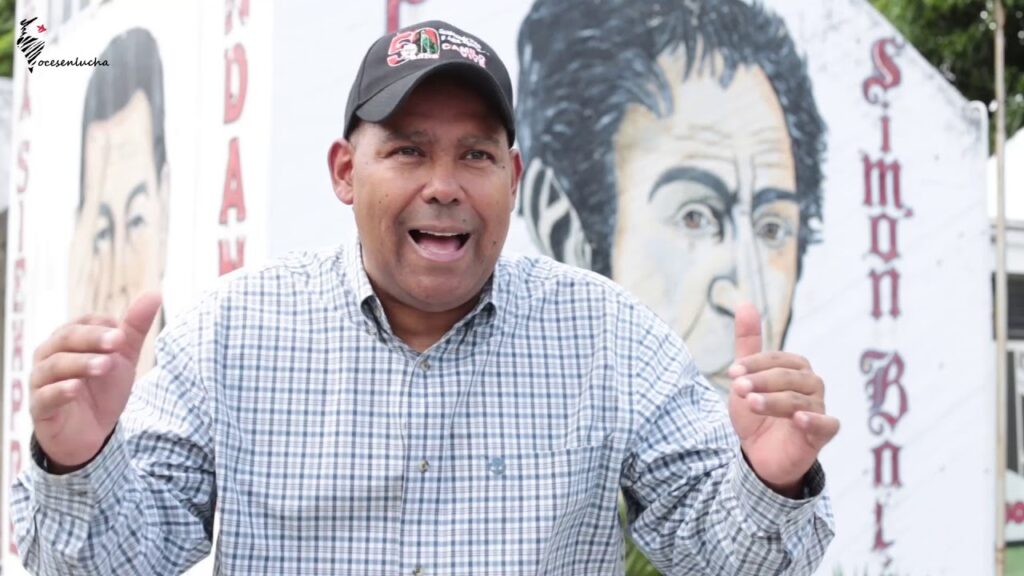
Simón Bolívar Coordinator president Juan Contreras during an interview in 2020. Photo: YT/@Vocesenlucha/File photo.
Simón Bolívar Coordinator president Juan Contreras during an interview in 2020. Photo: YT/@Vocesenlucha/File photo.
Following the US empire’s invasion on January 3, Venezuela was left in a state of shock and complexity that appears not to exclude new military movements. In recent days, “a combined operation between security agencies in Venezuela and the US in the southeast of the state of Bolívar in which organized crime structures were dismantled” has taken place, according to a statement from the Venezuelan government.
Days earlier, the Simón Bolívar Coordinator, a historic Chavista organization, had condemned DEA interference in the planning of a repressive offensive in the emblematic 23 de Enero neighborhood to derail the popular movement of that community, “the most important one in Caracas,” as described by Juan Contreras.
A community leader with a degree in social work and president of the Coordinator, Contreras is a historic militant of Chavismo and an ironclad defender of the Bolivarian Revolution. Today, he believes there are “shameful situations that must be denounced,” and holds the US empire’s government primarily responsible as “our enemy.” Contreras was born and raised in the populous and militant 23 de Enero neighborhood, where he still resides and where he received us to analyze the complex situation Venezuela is going through, particularly regarding the social movement.
– How do Venezuelan social organizations view what has been happening in the country since the January 3 US military attack?
What happened was an act of aggression, an act of war. They sought and continue to seek to break our people, but our social movements have remained active because we continue to believe in the revolutionary process. Our enemy is the US government, which must understand that the “problem” was not Chávez, because Chávez died and the revolution continued. President Maduro has been kidnapped, and yet we keep going.
What we are living today is unique in history; I do not think what is happening right now in Venezuela has occurred in any other latitude of the world. The closest thing happened in 1989 in Panama, when they kidnapped Noriega.
But here, their narrative failed: it has not been proven that Venezuela is a narco-state, a government associated with drug trafficking, or that President Nicolás Maduro was one of the biggest drug traffickers, as they claimed. On the contrary, all those narratives have now been discarded, and what is clear is that they are coming for our energy reserves. The Venezuelan people understand that clearly.
– Does defining a state of war and identifying an enemy provide the context for your condemnation regarding the danger of a DEA-orchestrated attack on 23 de Enero?
This information comes to us from a reliable source telling us that a large-scale operation is being planned against 23 de Enero, which is not a crazy idea. As a neighborhood, 23 de Enero has been a historical flashpoint since the era of the Fourth Republic, starting in ’58 after the fall of Pérez Jiménez and the arrival of representative democracy. That threat is real.
I believe the threats of the US empire were underestimated here in the past: the blocking of our coasts, the blocking of our skies… Now, what we are condemning has every sign of becoming a reality.
It is not just me or even just our source, which is a serious and reliable one, saying this. Look at all the media propaganda, starting with the journalists now living in Miami who campaign against the colectivos. “What about the colectivos? Why don’t they attack the colectivos? Why don’t they disarm the colectivos?” Marco Rubio himself has said so, and recently one of their high-ranking military leaders said the same: they are coming for the so-called “armed groups.”
The problem is that, in their narrative, they identify social movements as armed groups, claiming they are armed to justify aggression. But these people today are armed with conscience; after 27 years, these people are more Bolivarian than ever. These are the people who bet on Commander Chávez, who bet on refounding the Bolivarian Republic of Venezuela. That is why we emphasize that this is a cognitive war being waged against Venezuela.
Here, there is no guerrilla movement; what we have is a conscious, mobilized people who, through culture, awareness, and popular education, have been able to advance in building the Bolivarian embryo from the grassroots, through the mechanism of our communes and communal councils. So, the enemy intends to dismantle that organization by applying a decapitation tactic.
They want to destroy the colectivos, those who raise their voices against the empire, those who denounce what is happening in our country, those who disagree with current events, and those who have maintained a principled and firm stance against the aggression and invasion of the US empire.
– According to the information you have, how would the DEA carry out such an aggression on Venezuelan territory?
They have been operating via pressure points. In all countries, we have police forces with repressive tendencies. While one sector of their training and core cadres might understand human rights, other sectors are easily co-opted.
We have the experience of these past 27 years, during which there have been generals, colonels, and captains who turned and served the policies of the empire. Therefore, it is not far-fetched to claim that the US empire is working on certain police forces, or on specific officials who could lend themselves to an operation against the most important militant center in Caracas, which is the 23 de Enero parish.
From ’58 to ’98, this parish had approximately 160 martyrs killed by police forces. This is not paranoia; this is serious, and as the pressure accelerates on our government to head toward an electoral process, the plan of aggression could also accelerate. So, it is entirely feasible that they move forward with an action like this to eliminate what they consider “the Bolivarian resistance”—which is us, the social movements organized in communes, communal councils, and long-standing social organizations like the Simón Bolívar Coordinator, which is an expression of People’s Power.
– Did you receive solidarity from the government?
A person of significant weight within the government called us, approached us, and we talked. They committed to investigating and finding out more. Their recommendation was caution: to avoid any provocation. So we are waiting for what was discussed to be fulfilled and for an in-depth investigation into our condemnation to be carried out. Because until now, we thought the empire would never get in, yet they got in; we underestimated them, and they got in.
Today, they have the audacity to sell our oil, manage our finances, provoke us, and say they will make us their 51st state. They also hold us under a trusteeship as if they own our country, which is shameful and something we must continue to denounce. That is why we in the popular camp continue to mobilize, continuing to condemn what happened on January 3 and the consequences we are experiencing in the homeland of Bolívar.
– This situation has not yet had an international impact. What message do you have for the social and political forces of Latin America?
It has been 200 years since the Amphictyonic Congress, the call made by the Liberator, Simón Bolívar, to build a league of nations to defend ourselves from the US empire, which was already showing its claws even then. What better time to call for the continentalization of the struggle of our social organizations?
It is not just Venezuela that is at risk; it is all of Latin America. They are coming for the rest of their “backyard.” Today, in their blatantly interventionist manner, they meddle in Colombia’s elections and dictate which candidate they want to win. They did it in Honduras too.
In the face of those events, the call to continentalize the struggle must be real today. The only possibility Latin America has to escape the aggression of the White House is the coordination of the popular and revolutionary forces across Latin America. We have to come together, condemn our enemy together, and move forward together because they are coming for everything.
The only way to advance is to continentalize the struggle. This is something that not only Bolívar said, but Commander Ernesto “Che” Guevara also tried to carry out. I believe that is where we should direct our efforts: toward the coordination of the Latin American and Caribbean popular and revolutionary forces.
(Resumen Latinoamericano) by Pablo Solana
Translation: Orinoco Tribune
OT/JRE/AU