By Teri Mattsonjun – Jun 16, 2026
As nationwide protests and road blockades paralyze the country, a deeper struggle is unfolding over who controls Bolivia’s resources, development strategy, and political destiny.
As road blockades spread across Bolivia and labor unions bring major transportation routes to a standstill, the country’s political crisis has become impossible to ignore. Fuel shortages have disrupted daily life. Supply chains have been strained. Protesters have erected more than one hundred blockades across the country, demanding the resignation of President Rodrigo Paz less than a year after he took office.
At first glance, the unrest appears to be another chapter in Latin America’s long history of economic turmoil and political instability. Rising inflation, controversial reforms, and public dissatisfaction have triggered protests in many countries throughout the region.
But what is unfolding in Bolivia today is about much more than fuel prices, austerity measures, or even one unpopular government.
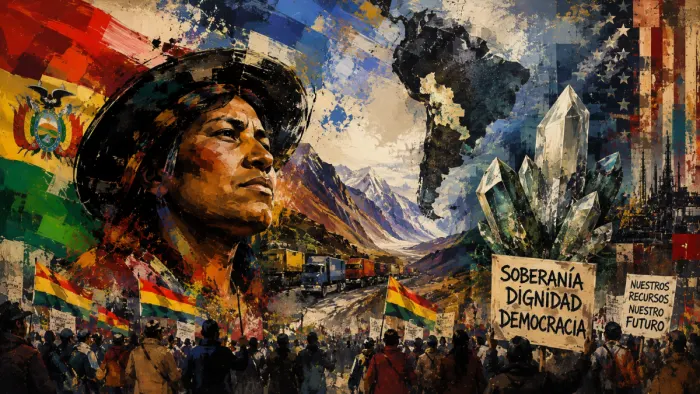
The struggle now gripping the Andean nation has become a focal point in a much larger contest over sovereignty, natural resources, democracy, and the future direction of Latin America itself. At stake is not only the fate of a government, but competing visions for how the region will develop in an era increasingly defined by geopolitical competition, resource scarcity, and renewed great-power rivalry.
For many Bolivians, the current uprising represents an effort to defend a national development model centered on public control of strategic resources and economic sovereignty. For others, it reflects growing frustration with a political system that appears increasingly disconnected from the people it claims to represent.
Whatever the outcome, Bolivia has once again become one of the most important political battlegrounds in the hemisphere.
From Electoral Victory to Political Crisis
President Rodrigo Paz assumed office in November 2025 after winning a runoff election made possible by divisions within Bolivia’s left-wing political forces.
Although a conservative candidate, Paz campaigned as a moderate alternative to a more openly hard-right opponent. Many indigenous, working-class, and rural voters who had not supported him in the first round ultimately cast ballots for him in the second, viewing him as the less dangerous option.
According to critics, however, the administration that emerged after the election bears little resemblance to the one voters believed they were electing.
Almost immediately after taking office, the government began advancing policies associated with a far more aggressive neoliberal agenda. Privatization proposals, austerity measures, reductions in state subsidies, and reforms affecting strategic sectors of the economy quickly became central features of government policy.
For many Bolivians, this was not simply a disagreement over economic management. It was a violation of the electoral mandate itself.
The sense that voters had been promised one thing and given another has become a powerful force driving the current mobilizations.
As one labor organizer recently observed, people increasingly believe they did not vote for the government they ultimately received.
That perception has transformed what might otherwise have been isolated policy disputes into a broader crisis of democratic legitimacy.
Economic Pain and Growing Resistance
The first major confrontation emerged over fuel subsidies.
The government proposed reducing subsidies while opening portions of the energy sector to greater private participation. Public opposition was immediate. Massive protests forced authorities to retreat from some of the more controversial aspects of the plan, but the dispute exposed growing tensions between the government and large sectors of the population.
The economic consequences that followed only deepened public dissatisfaction.
Bolivia is now experiencing its highest inflation rates in more than two decades. Rising prices have increased the cost of food, transportation, and basic necessities, placing significant pressure on working families already struggling with stagnant wages.
Another controversy erupted when imported fuel distributed throughout the country was reportedly of poor quality. Many Bolivians claimed the fuel damaged vehicle engines, creating expensive repair costs for transport workers, taxi drivers, small business owners, and rural residents who depend on vehicles for their livelihoods.
For workers earning only a few hundred dollars a month, repair bills equivalent to a month’s income represented a devastating financial burden.
No single event sparked the current uprising.
Instead, the protests emerged from a cumulative sense of economic deterioration and political frustration. Rising costs, declining purchasing power, unpopular reforms, and growing distrust of government institutions combined to create the conditions for a nationwide movement.
Yet economics alone cannot explain the scale of what is happening.
Land, Resources, and the Meaning of Sovereignty
The current crisis is also rooted in a question that has shaped Bolivian politics for generations: who controls the nation’s resources?
One of the most controversial government proposals involved changes to collective land ownership structures that many indigenous communities viewed as a direct threat to communal land rights.
Critics argued that the reforms would make it easier for collectively owned lands to be used as collateral in financial transactions, potentially exposing indigenous territories to eventual privatization and acquisition by transnational agricultural corporations and other foreign interests.
Public opposition forced the government to withdraw portions of the proposal, but the episode reinforced a growing belief among many Bolivians that powerful economic interests were driving policy decisions.
The issue extends far beyond land ownership.
Bolivia possesses some of the world’s largest lithium reserves and substantial deposits of other strategic minerals increasingly essential to the global economy. As demand for electric vehicles, battery storage systems, and renewable energy technologies grows, control of these resources has become a matter of international significance.
For decades, Bolivia has sought to avoid the traditional pattern in which Latin American nations export raw materials while foreign companies capture most of the profits through manufacturing and processing.
Under former president Evo Morales, the country pursued an ambitious anti-colonial, anti-neoliberal strategy of resource sovereignty. The objective was not simply to extract lithium but to process it domestically, manufacture value-added products, and retain a greater share of the economic benefits within Bolivia.
For supporters, the project represented a pathway toward genuine economic independence.
For critics, it reflected excessive state intervention and inefficiency.
Regardless of one’s perspective, the issue remains deeply important to ordinary Bolivians. Across the country, many protesters identify the defense of natural resources as one of the central motivations behind the current mobilization.
They see privatization not merely as an economic policy but as a threat to national sovereignty.
Teachers, healthcare workers, miners, indigenous organizations, peasant federations, transportation workers, neighborhood associations, and labor unions have joined together despite often possessing different priorities and political perspectives.
That unity is especially significant given the fragmentation that characterized Bolivian politics in recent years.
Internal conflicts within the Movement Toward Socialism (MAS), the political force that dominated Bolivian politics for much of the twenty-first century, contributed significantly to the left’s electoral defeat in 2025. Those divisions weakened political organizations and led many observers to believe that Bolivia’s popular movements had entered a prolonged period of decline.
The current mobilizations suggest otherwise.
While political parties fractured, the country’s social infrastructure remained intact. Unions, indigenous organizations, community associations, and grassroots networks retained their capacity to organize, mobilize, and coordinate collective action.
Bolivia’s history helps explain why.
The country possesses one of the most organized labor and social movement traditions in Latin America. Similar forms of mobilization played decisive roles during earlier periods of political upheaval, including the social struggles that reshaped Bolivian politics in the early 2000s and eventually brought Morales to power.
The road blockades now stretching across the country are not spontaneous acts of anger.
They are the product of decades of organizational experience and a political culture that views collective action as a legitimate means of influencing national affairs.
Today, that organizational capacity has once again become a powerful force.
Evo Morales Challenges Bolivian President as Protests Enter Sixth Week
A Crisis of Representation
Beyond economic grievances and resource politics lies a deeper issue: representation.
Many protesters argue that existing political institutions no longer reflect the interests or priorities of large segments of society.
Some point to the exclusion of major political forces from the electoral process. Others argue that elected officials are implementing policies that directly contradict their campaign promises.
Together, these concerns have contributed to a growing perception that conventional democratic channels are failing to provide meaningful representation.
This sentiment helps explain why demands have evolved from opposition to specific policies toward calls for the resignation of the entire government.
For many participants, changing individual laws is no longer enough.
They believe the problem is structural.
Whether that assessment is correct or not, it has become one of the movement’s most powerful unifying ideas. With one voice, they are demanding the resignation of President Rodrigo Paz and the reversal of the neoliberal economic agenda he is implementing.
Why Bolivia Matters Beyond Bolivia
The significance of the current crisis extends far beyond the country’s borders.
In recent years, U.S. policymakers and military planners have increasingly described Latin America as a strategic arena in a broader global competition involving China, critical minerals, energy resources, and regional security.
Initiatives such as the Shield of the Americas and proposals for a more integrated Greater North America reflect growing efforts to consolidate political, military, and economic influence throughout the hemisphere.
The Shield of the Americas has emerged as one of the clearest expressions of this evolving strategic vision. Presented as a framework for security cooperation among allied governments in the hemisphere, the initiative seeks to deepen military coordination, intelligence sharing, border security operations, and political alignment among participating states. Supporters describe it as a necessary response to transnational crime, migration pressures, and growing geopolitical competition from China and other global powers.
Critics, however, view the initiative through a different lens. They argue that the project reflects a broader effort to consolidate a bloc of governments aligned with Washington’s political and economic priorities. From this perspective, security cooperation becomes inseparable from questions of resource access, economic integration, and political influence. The concern is not merely about military partnerships, but about the creation of a hemispheric framework capable of shaping domestic policy choices throughout the region.
Closely related is the concept of a Greater North America, an increasingly discussed vision that extends strategic integration far beyond the traditional boundaries of the United States, Canada, and Mexico. In its broadest interpretation, the concept envisions an interconnected geopolitical space stretching from the Arctic to South America, linked through trade corridors, infrastructure projects, energy networks, migration management systems, and security agreements.
Viewed together, these initiatives represent an effort to organize the hemisphere around a common strategic architecture at a moment when access to critical minerals has become a matter of global competition. Lithium, copper, rare earth elements, freshwater reserves, and energy resources are increasingly recognized as essential assets in the twenty-first-century economy. Countries possessing those resources therefore occupy a position of growing geopolitical importance.
It is within this larger context that Bolivia’s struggle takes on significance far beyond its national borders. The debate over who controls Bolivia’s lithium reserves, public assets, and development strategy is also part of a wider contest over who will shape the economic and political future of the Americas.
Supporters argue these initiatives strengthen regional cooperation and collective security.
Critics see them as part of a larger effort to secure access to strategic resources while limiting the autonomy of governments pursuing independent development paths.
Bolivia occupies a particularly important position within this debate.
Its lithium reserves alone make it strategically significant in the global transition toward electrification and renewable energy. More importantly, Bolivia has long served as a symbol of resource nationalism and resistance to external control.
For many observers, the country’s current unrest therefore represents more than a domestic political conflict.
It has become a test of whether Latin American nations can maintain independent control over their resources and development strategies in an increasingly competitive international environment.
The questions emerging from Bolivia resonate throughout the region.
Who controls strategic resources?
Who benefits from economic development?
How much autonomy should nations possess in determining their own futures?
And what role should outside powers play in shaping those decisions?
The Front Line of a Larger Struggle
The outcome of Bolivia’s crisis remains uncertain.
On June 8, under pressure from Washington, the government expanded its authority to deploy security forces against road blockades, raising concerns about possible escalation. Protesters continue to demonstrate remarkable discipline and determination. Political negotiations have yet to produce a breakthrough.
What is already clear, however, is that Bolivia has once again become a laboratory for the political struggles shaping twenty-first-century Latin America.
The battle now unfolding is not merely about one president or one election cycle.
It is about competing visions of sovereignty, democracy, development, and power.
For Bolivians on the streets, the struggle is immediate and tangible. It concerns wages, fuel prices, land rights, and economic survival.
Yet the larger questions being contested reach far beyond Bolivia’s borders.
As the hemisphere enters a period of renewed geopolitical competition, Bolivia stands at the intersection of some of the most consequential debates of our time: who controls natural resources, who shapes national development, and who ultimately decides the future of Latin America.
For that reason, the road blockades stretching across Bolivia today are more than acts of protest.
They are a declaration that the struggle over sovereignty in the Americas is far from settled.
The opinions expressed here are solely the author’s and do not reflect the opinions or beliefs of the LA Progressive.
(LAP)

Teri Mattson
Introduced to Mesoamerican Anthropology and Archaeology in the sixth grade, Teri's lifelong passion for Latin America has inspired 35 years of travel throughout the region. The last few years include organizing and/or participating on political and social justice delegations to: Cuba, Ecuador, Guatemala, Haiti (April '16)*, Honduras, Mexico, Nicaragua and Venezuela (June ‘13, July '15, Dec. '15, May '16, Oct. '16, Mar. ‘18, May ‘18, Mar. ‘19)*
Teri recently returned from a March Anti-Sanctions delegation and 3-month visit to Venezuela to accept a position with CODEPINK as Latin America Coordinator. Teri is also a founder and coordinator for The Campaign to End US and Canada Sanctions against Venezuela.