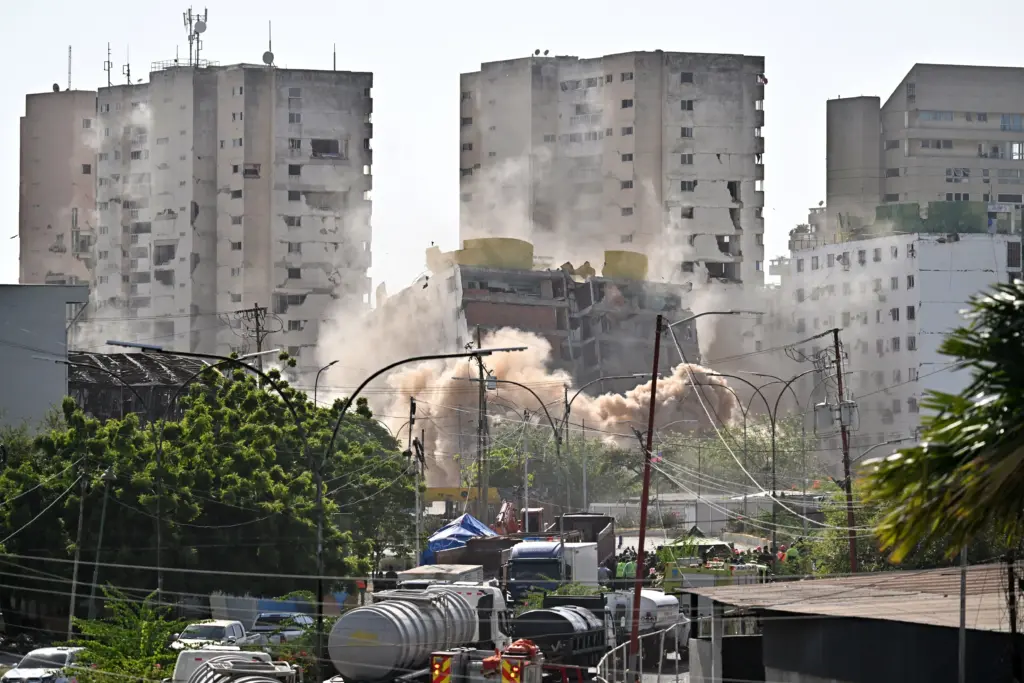
Heavily damaged building in La Guaira state, Venezuela, being demolished on Thursday, July 30. Photo: Juan Barreto/AFP.
Heavily damaged building in La Guaira state, Venezuela, being demolished on Thursday, July 30. Photo: Juan Barreto/AFP.
Caracas (OrinocoTribune.com)—On Thursday, July 30, Venezuelan Acting President Delcy Rodríguez said that the Venezuela Reborn Plan continues to advance toward its central objective: providing new homes to families affected by the June 24 earthquake.
“We reviewed the progress in housing construction and evaluated new strategies to accelerate the recovery of the impacted areas,” Rodríguez wrote on social media.
She reiterated that protecting the Venezuelan people remains a priority for her government. “We will not rest until every person can enjoy the peace of mind of a safe home,” she added.
Habitability assessments
On Friday, the Presidential Commission for the Infrastructure Habitability Assessment presented the latest results from its rapid assessments of earthquake damage. The commission reported that 39,787 buildings have been inspected so far.
Of the properties inspected, 22,646, or 57%, received a green classification, indicating that they are habitable and have no serious damage.
Another 9,076 properties, or 23%, received a yellow classification due to moderate damage requiring restrictions on their use. The remaining 8,065 buildings, or 20%, received a red classification for severe damage.
The Caracas Mayor’s Office also reported that 16,605 technical inspections have been conducted across the capital.
Caracas Mayor Carmen Meléndez released the figures during a radio interview on Thursday. She explained that, under the traffic light risk methodology, approximately 64% of the properties inspected in Caracas received green certification, indicating they are habitable and sustained only minor damage.
Another 24% received a yellow classification due to intermediate damage, while approximately 13% were placed under a red alert for severe damage.
Controlled demolition phase begins
Also on Thursday, Interior Minister Diosdado Cabello reported that authorities had completed the first controlled demolition of a structure at risk of collapse in La Guaira state.
Cabello said the operation was coordinated on the ground with the relatives of those affected. He also highlighted the joint efforts of emergency personnel to conduct the demolition safely.
“We are carrying out the first demolition here in La Guaira state. It was planned, reviewed, and conducted by officials from our Bolivarian National Armed Force and our explosives experts,” he said.
Cabello reported that the operation proceeded according to plan. “The result was what we expected from the beginning. The charges worked, the safety tests were performed, and the entire perimeter was evacuated on time. The building fell as planned,” he said.
Following the demolition, firefighters began spraying the area with water to cool the site. “Then, the explosive-detection dogs would enter to detect any unexploded material. It is part of the process,” Cabello explained.
Venezuela Decorates Outgoing UN Coordinator as Post-Earthquake Recovery Phase Begins
He added that the controlled demolition was essential for search teams to resume their work safely.
“The search could not continue because of the building’s dangerous tilt. Once the building collapsed, those tasks resumed. The search process restarted,” he said.
Special for Orinoco Tribune by staff
OT/JRE/SF