By Hedelberto López Blanch – Sep 3, 2026
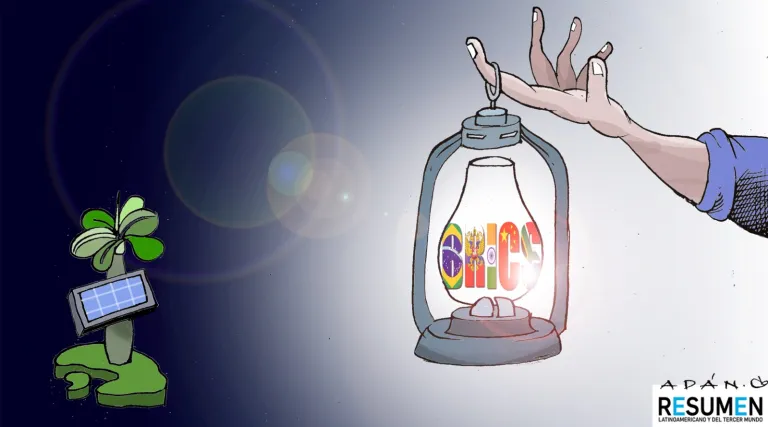
On September 12 and 13, the 18th BRICS Summit will take place in New Delhi, India, with member countries, associate members, and special guests, under the theme “Building for Resilience, Innovation, Cooperation, and Sustainability.”
The Indian Ministry of External Affairs stated that the event will be held at the Bharat Mandapam Convention Center in New Delhi, and attendees will exchange views on strengthening internal BRICS cooperation around common priorities and share perspectives on global and regional issues of mutual interest.
This would be a good opportunity for BRICS, as a progressive organization striving to bring about a multipolar world, to take the political initiative to send fuel to Cuba, breaking the inhumane and high-handed U.S. measure that seeks to overthrow the Cuban Revolution with a strict oil embargo.
As Cuban leaders and solidarity and progressive organizations around the world have denounced, what the convicted U.S. President Donald Trump and his Secretary of State Marco Rubio are committing is genocide against the Cuban people.
In the Final Declaration of the Group’s meeting of foreign ministers held in New Delhi on May 12 and 13 of this year, the participants reiterated the need to end the economic, commercial, and financial measures against Cuba.
Let us recall that on January 29, Trump signed an executive order declaring a “national emergency” in response to the absurd “unusual threat” to the security of the United States and the region posed by the Caribbean island.
On that basis, he announced the imposition of tariffs on countries that sell oil to the Caribbean nation, in addition to threats of retaliation against those who act in defiance of the White House’s executive order.
By reinforcing the blockade that Washington has maintained against Cuba for more than 60 years—and with no possibility of purchasing oil on any market—electricity, food, health care, education, and transportation services have been affected.
At the meeting of foreign ministers, Cuba’s Minister of Foreign Affairs, Bruno Rodríguez Parrilla, denounced that “with this criminal act, which violates international law and the purposes and principles of the United Nations Charter, the United States seeks to impose on the entire world the obligation to comply with the blockade against Cuba, regardless of the sovereignty of each government and the will of its peoples.”
He went on to explain that only a broad and resolute international coalition will make it possible to successfully confront the United States’ global predation, which is doomed to failure if we as nations do not allow ourselves to be intimidated. In this context, he noted, the reform of global governance and the multilateral system is not merely an aspiration; it is an urgent and indispensable political necessity.
The strength of BRICS—originally formed in 2006 by Brazil, Russia, India, and China, and expanded in 2011 to include South Africa, followed by Egypt, the United Arab Emirates, Ethiopia, and Iran as permanent members in 2024, and later Indonesia—is undeniable. Since January 2025, Cuba, Bolivia, Belarus, Uzbekistan, Malaysia, Kazakhstan, Uganda, and Thailand have been partners.
Havana has maintained strong ties of friendship and cooperation with all its members and partners over the years.
Currently, the Group wields global influence, accounting for 46% of the world’s Gross Domestic Product and 55% of the world’s population.
Given these circumstances, I would like to ask:
Will the world’s governments—and specifically the BRICS nations—allow genocide to be committed against Cuba, as is being carried out through the aggressive and inhumane policy implemented by the U.S. empire against the island?
Will international organizations such as the United Nations, BRICS, the African Union, the Eurasian Economic Union, the Shanghai Cooperation Organization, or ASEAN—with which Havana maintains good relations—continue to accept the United States’ pressure on countries not to send the necessary oil?
How long will Cuba’s friendly nations—many of which have also suffered extortion euphemistically called “sanctions”—continue to obey Washington’s genocidal and unjust actions?
Can’t they all agree to send fuel to Cuba, a country that is suffering one of the most ruthless wars waged by a decaying yet extremely aggressive empire?
During his speech at the July 26 celebrations, Cuban President Miguel Díaz-Canel Bermúdez stated:
“We denounce that those who designed this policy of suffocation—those who implement and sustain it—are responsible for the suffering of the Cuban people. We also denounce those who remain silent and tolerate the excesses of the emboldened U.S. fascist far right, which lies, steals, kills, and seeks to set itself up as the god of all destinies.”
Recently, in response to the generous aid in the form of food, solar panels, and other supplies that the People’s Republic of China has sent to the island, Díaz-Canel emphasized: “When an empire is strangling us with a blockade that has now lasted more than six decades, a sister country decided to extend a hand to us without conditions… this is pure solidarity; it is not charity—it is justice.”
He added, “Cuba has given the world doctors, teachers, and vaccines. We send medical brigades to the most remote corners of the planet. We share what little we have. We are an example of humanity. Now, when we need it most, someone is returning that gesture. And it’s not a favor—it’s a recognition that the blockade is not a problem for Cuba alone, but a problem for all of humanity.”
That is why I believe it is time to put a stop to that phantasmagorical unipolar world that the United States wants to continue imposing, and to take political action to finally create a truly multipolar one.
Hedelberto López Blanch is a Cuban journalist who writes for the daily newspaper Juventud Rebelde the weekly magazine Opciones. And is a frequent contributor to Cuba en Resumen
(Resumen Latinoamericano in English)
Hedelberto Lopez Blanch
Hedelberto López Blanch, born and currently living in Havana, Cuba, is a journalist and a doctoral candidate in Communication Sciences at the University of Havana. He currently writes a weekly column on international economic affairs for Opciones, a weekly publication of Juventud Rebelde (one of the three national newspapers in Cuba).