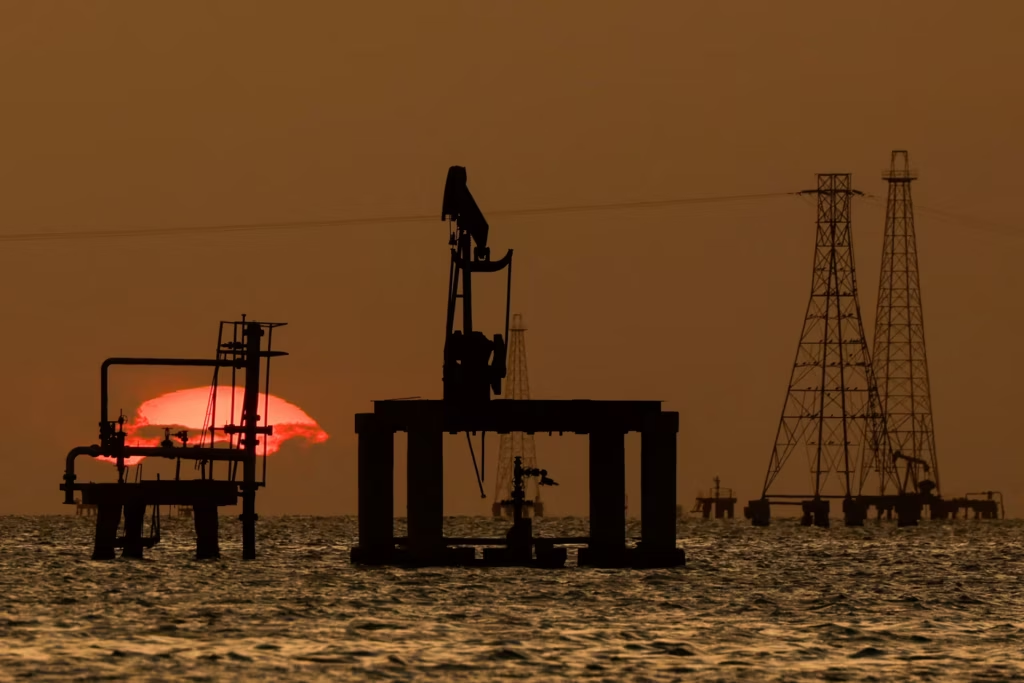
Oil platforms and pumpjacks at Lake Maracaibo, in Cabimas, Venezuela, January 26, 2026. Photo: Leonardo Fernandez Viloria/Reuters/file photo.
Oil platforms and pumpjacks at Lake Maracaibo, in Cabimas, Venezuela, January 26, 2026. Photo: Leonardo Fernandez Viloria/Reuters/file photo.
Caracas (OrinocoTribune.com)—Venezuela and the United States announced late Friday, August 28, a far-reaching energy agreement that Venezuelan authorities presented as a major step toward revitalizing the country’s oil industry. According to a statement by Venezuelan Acting President Delcy Rodríguez, the initiative contemplates more than $100 billion in private investment for 17 strategic oil fields with a combined potential of 65 billion barrels.
US President Donald Trump announced the agreement almost simultaneously but gave a markedly different description of its purpose. While the Venezuelan statement emphasized national recovery, employment, public revenue, and the reconstruction of strategic infrastructure, the US president claimed that Washington had obtained “majority US control” over the reserves, which he said would increase US oil supplies and lower oil prices.
Neither announcement identified the participating companies, the 17 fields, the agreement’s legal structure, its fiscal model, its duration, or how Washington would exercise the “control” claimed by Trump. The lack of public documentation has intensified debate among Chavistas already questioning whether sovereign negotiations are possible while Venezuela remains subjected to illegal US sanctions and the consequences of Washington’s January 3 bombing of the country and kidnapping of President Nicolás Maduro and First Lady and National Assembly Deputy Cilia Flores.
Conflicting accounts of control
The Venezuelan statement described the agreement as the product of strengthened relations between the two countries and noted that it would facilitate investment aimed at “the recovery and reconstruction of strategic infrastructure for the development of our hydrocarbons industry.”
Acting President Rodríguez also expressed her “deepest gratitude” to Trump, Secretary of State Marco Rubio, and the US government for supporting the agreement, calling it “a historic milestone in bilateral relations between Venezuela and the US.”
This language drew criticism from Chavista activists and commentators in Venezuela and abroad. Some argued that describing the current relationship as normal diplomacy obscures the extreme asymmetry created by Washington’s military aggression, its kidnapping of Venezuela’s constitutional president, and its continuing control over key aspects of Venezuelan oil exports and revenue.
The Venezuelan statement makes no reference to a 55% US share, a century-long lease, or US ownership of the reserves. However, the Associated Press reported, citing an anonymous US official, that the arrangement would create a new private company and give the United States 55% of its effective output through a combination of equity and rights to purchase oil at production cost. The same official claimed that the company had been granted 100-year rights to develop the fields.
Reuters reported that the fields are located in the Orinoco Oil Belt and Lake Maracaibo regions. Analysts cited by the news agency also questioned whether such an arrangement would comply with Venezuela’s constitutional and hydrocarbons framework.
Fiscal projection triggers debate
According to Venezuela’s announcement, the 17 fields have a “proven potential” of 65 billion barrels and are expected to attract more than $100 billion in investment while generating over $209 billion in taxes for the Venezuelan state.
The latter figure generated heated discussion on social media, although the government has not released the production schedule, investment-recovery mechanism, tax categories, royalties, operating costs, or other information necessary to evaluate the projection.
US-based Venezuelan opposition-aligned economist Francisco Rodríguez wrote: “President: According to your figures, this agreement will generate tax revenues of just $3.22 per barrel of Venezuelan oil. This represents 4.7% of the current price, and less than half the royalty rate contemplated in concessions granted by [former dictator] Juan Vicente Gómez.”
Dividing $209 billion by 65 billion barrels does produce approximately $3.22 per barrel. However, other commentators cautioned that the comparison cannot establish the state’s effective fiscal participation without knowing how much of the stated potential will be produced, over what period, and whether the $209 billion estimate includes royalties, income taxes, production taxes, dividends, or other payments.
The calculation consequently highlights the need for transparency but cannot, by itself, determine the agreement’s real fiscal terms.
Trump’s domestic political calculus
Trump called the agreement “the biggest oil deal in world history” and claimed that it would more than double “American Oil Reserves,” substantially expand US supplies, and lower gasoline prices “long into the future.”
The announcement comes as Trump faces pressure over rising fuel prices ahead of the November midterm elections. The US strategic petroleum reserve reportedly fell below 300 million barrels in early August, more than 100 million barrels below its level at the beginning of 2026, while the US-Israeli agression against Iran has severely disrupted petroleum traffic through the Strait of Hormuz.
This context has led some analysts to interpret Trump’s language as an attempt to present the agreement as an immediate domestic political victory. Nevertheless, Venezuela currently produces approximately 1.25 million barrels per day—close to 1% of global production—and specialists warn that rehabilitating infrastructure and substantially expanding output would require years and billions of dollars in investment.
For Venezuelans battered by more than a decade of illegal US sanctions, any prospect of investment, employment, and improved public services understandably offers a measure of hope, according to analysts. Critics nevertheless argue that almost eight months of the new, highly asymmetrical relationship with Washington have yet to produce a broad improvement in living conditions, while concern over the erosion of national sovereignty has continued to grow since January 3.
Orinoco Tribune wrote on social media: “Venezuelan far-right spokespeople are wailing about the announced oil deal, while the caviar left is busy destroying Chavismo. Something very confusing is happening here. The sensible move is to wait for more details before jumping to either side. But one thing doesn’t look promising for Trump: Florida and the upcoming midterms.”
For Orinoco Tribune, opposition to the agreement from both certain left-wing currents and Venezuelan far-right sectors based in Florida illustrates the complexity of Venezuela’s current political reality. It also raises questions about whether Trump will succeed in converting the announcement into greater electoral support in Florida and other Republican-leaning states.
In an interview with Press TV concerning the agreement, Orinoco Tribune editor Jesús Rodríguez-Espinoza argued that Trump’s propaganda narrative does not add up. He noted that Venezuela’s current production remains marginal in relation to global energy demand and cannot provide an immediate solution to the oil-market crisis generated by the US-Zionist aggression against Iran.
OFAC adjustments preceded announcement
One day before the oil agreement was announced, the US Treasury Department’s Office of Foreign Assets Control (OFAC) issued amendments to eight general licenses involving Venezuela’s oil, gas, petrochemical, electricity, telecommunications, gold, and mineral sectors.
The amendments removed a requirement that authorized contracts with Venezuelan state entities be interpreted under US law, allowing the parties to select Venezuelan legislation or another mutually agreed legal framework.
The measure did not lift Washington’s sanctions noor relinquish US control over authorized transactions. The licenses continue to impose restrictions on payments, participating countries, vessels, reporting requirements, and other commercial operations. They also require contractual disputes to be resolved in the United States, the United Kingdom, France, or Singapore.
The timing suggests that Washington was adapting its sanctions architecture to facilitate new corporate arrangements under Venezuela’s reformed investment framework. However, no publicly available document has established the precise legal relationship between those licenses and the oil agreement announced Friday.
PSUV and officials defend agreement
Venezuela’s deputy minister of Anti-Blockade Policies, William Castillo, called the announcement “another step” in a strategy of “diplomatic jujitsu,” describing it as a transition from aggression toward negotiation, peace, and strategic understanding.
Some Chavista critics disputed this characterization, arguing that negotiations conducted under sanctions, military coercion, and the continuing captivity of President Maduro cannot be treated as an ordinary diplomatic process between sovereign equals.
The United Socialist Party of Venezuela (PSUV) issued a statement expressing its full support for Acting President Rodríguez and the decisions adopted “amid the new scenario of international relations for the productive development of the country.”
“True to its historical commitment to national sovereignty and the well-being of the people,” the PSUV “expresses its full support for Comrade Delcy Rodríguez, acting president of the Republic, regarding the agreements signed with the United States government on energy matters.”
The PSUV added that it supports “productive recovery mechanisms that prioritize national interests and allow us to overcome the impact of more than a decade of economic sanctions, unilateral coercive measures and unfair blockades.”
Venezuelan Hydrocarbons Minister Paula Henao explained on state television that developing the 17 fields would require more than $100 billion in investment and could generate over $209 billion in taxes throughout the agreement’s operating period.
She said that these fiscal resources would be directed toward social investment, including improvements in hospitals and education, the strengthening of communal power, support for entrepreneurship, culture, and healthcare. However, she did not provide additional information concerning the agreement’s ownership, legal, fiscal, or dispute-resolution provisions.
Without publication of the underlying documents, neither the Venezuelan government’s optimistic projections nor Trump’s assertion of majority US control can be fully evaluated. The public record currently establishes the enormous scale of the announced initiative—and the sharply competing narratives surrounding it.
Full Venezuelan statement
The full English-language statement issued by the Venezuelan govveernment is reproduced verbatim below:
Venezuela announces a historic agreement with the United States government, which will have a significant impact on our nation’s revival. This initiative is the result of the strengthening of relations between Venezuela and the United States, and it will facilitate a significant flow of investment aimed at the recovery and reconstruction of strategic infrastructure for the development of our hydrocarbons industry.
I extend my deepest gratitude to the President of the United States of America, Donald Trump, as well as to Secretary of State Marco Rubio and the U.S. government for their support in developing this agreement, which represents a historic milestone in bilateral relations between Venezuela and the U.S.
The agreement will allow for a significant increase in oil production with the participation of private operators. It calls for the development of 17 strategic fields, with a proven potential of 65 billion barrels of oil, an investment of more than $100 billion, and more than $209 billion in taxes for the State. These investments will contribute not only to the recovery and modernization of our industry, but also to our country’s economic growth, the energy security of our hemisphere, and greater balance in international markets.
Our goal is to move toward consolidating our position as an energy-producing power, putting our immense reserves at the service of national development, job creation, increased income for our workers, and the well-being of our people.
Venezuela is thus ushering in a new era of recovery, growth, production, security, and prosperity for our people.
US Seeking 100-Year Deal To Make Venezuela Its Gas Pump – Media
Full statement by Donald Trump
Trump’s statement is reproduced verbatim below:
BREAKING NEWS: The United States of America has just entered into an Agreement with the Country of Venezuela on, THE BIGGEST OIL DEAL IN WORLD HISTORY! At my direction, Secretary of State Marco Rubio, and Secretary of War Pete Hegseth, working closely with Highly Respected Interim President of Venezuela, Delcy Rodriguez, and, through a partnership with private business, have secured majority U.S. control of more than 65 BILLION BARRELS of proven Oil Reserves in Venezuela, at no cost to the American Taxpayer. This Historic Transaction MORE THAN DOUBLES American Oil Reserves, greatly increases our Oil Supply, and will substantially lower Gas Prices for all Americans, long into the future, while helping to continue to set Venezuela on a course toward Tremendous Success and Great Prosperity. This Transaction will greatly strengthen the already growing relationship between Venezuela and the United States! Thank you for your attention to this groundbreaking matter. MAKE AMERICA GREAT AGAIN! President DONALD J. TRUMP
Special for Orinoco Tribune by staff
OT/JRE/SC