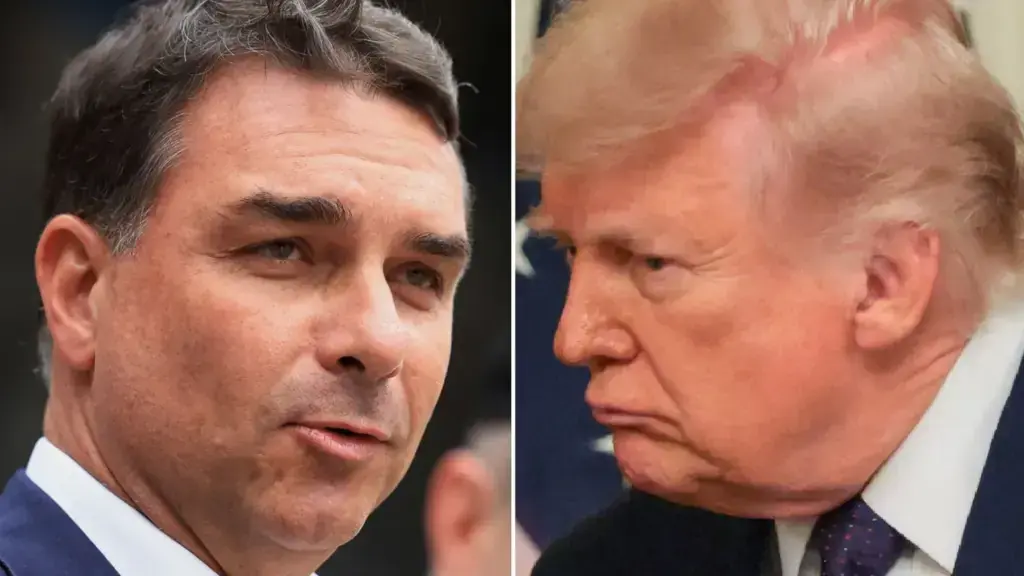
Brazilian Senator Flavio Bolsonaro and US President Donald Trump. Photo: Reuters.
Brazilian Senator Flavio Bolsonaro and US President Donald Trump. Photo: Reuters.
By Francisco Dominguez – Aug 23, 2026
Francisco Dominguez explains how Trump’s offensives against Venezuela and Cuba are only the first steps in driving progressive governments out of office in Latin America. He analyzes the US National Security Strategy, showing how, under cover of destroying terrorist networks and drug cartels, Trump is linking up with some unsavory characters with a view to controlling what happens in the USA’s ‘backyard’.
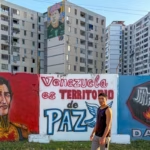
Trump’s military attack on Venezuela and the kidnapping of President Nicolás Maduro and Cilia Flores, First Lady and National Assembly member, on January 3, 2026, represents a dramatic escalation of the US aim to subordinate the entire Western Hemisphere to its political hegemony.
This offensive has been broadened by a highly threatening and intimidating naval blockade against Cuba, which has prevented the supply of oil to the country for the past five months. The explicit aim of the US is to bring about its economic collapse, including through a social revolt caused by intense levels of suffering, hunger, shortages of medicines, and electricity blackouts. In a country with a tropical climate, these blackouts can last 20 hours or more at a time, causing whatever perishable food people may have in their refrigerators to spoil.
Recently, the US has scored substantial political victories through the election of right-wing administrations in several Latin American countries, including Ecuador, Argentina, Honduras, Bolivia, Chile, Peru, Colombia, Costa Rica, El Salvador, Panama, Paraguay, the Dominican Republic, Trinidad and Tobago, and Guyana. This represents a dramatic reversal of the political trajectory of a region that experienced the Pink Tide (1999–2016), when most governments were either revolutionary or progressive. By 2026, the region’s progressive governments are Brazil, Mexico, Nicaragua, Uruguay, Venezuela, and Cuba – a remarkable shift.
Trump’s links with right-wing currents
The Trump administration has massively intensified its open interventions in recent Latin American elections, seeking, successfully in most cases, to favor extreme right-wing presidential candidates, many of them highly unsavory individuals. Examples include Honduras, Argentina, Ecuador, and Colombia, to mention only some of the most egregious instances of US interference. Some commentators are persuasively arguing: “The US once supported military coups to keep Latin America under its control. Now, a weaker left and the rise of organized crime are helping the far right assert itself. This suits the White House just fine.”
In fact, the Trump administration is consciously and actively seeking to forge links with and support extreme right-wing currents, including the governments of Milei in Argentina, Noboa in Ecuador, Paz in Bolivia, and Kast in Chile, through initiatives such as the Shield of the Americas. Its official statement makes its hegemonic objectives clear. These include aiming to:
• “expand multilateral and bilateral cooperation to enhance security”;
• cooperate in “whole of government” efforts regarding “border security, countering narco-terrorism and trafficking, securing critical infrastructure, and other areas as mutually determined”;
• “advance peace through strength”; and
• “join a coalition to combat narco-terrorism and other shared threats to the Western Hemisphere”.
The means by which these aims are to be achieved were clearly highlighted by President Trump himself: “The heart of our agreement, is a commitment to using lethal military force to destroy the sinister cartels and terrorist networks.” This involves the US training and mobilizing the military forces of partner nations to achieve these stated objectives. In March 2026, US Southern Command forces, jointly with Ecuadorian security forces, launched operations against Designated Terrorist Organizations in Ecuador. This is a disturbing manifestation of US efforts to expand its military intervention in Latin America.
US drive to militarize Latin America
The US already has military bases or military ‘facilities’ in Cuba, El Salvador, Curaçao, Colombia, Peru, Panama, Puerto Rico, Argentina, the Bahamas, Paraguay, and Honduras. In addition, US Southern Command conducts regular joint military exercises with Guyana, Chile, Uruguay, Costa Rica, and Guatemala. Thus, the US military expansion in Latin America is not only highly advanced; it has also secured formal cooperation for joint military operations against so-called terrorist organizations on the territory of Latin American nations. Trump’s drive to militarize Latin America is fostering instability and violence.
The US military expansion into its so-called backyard is consistent with the United States National Security Strategy (NSS), issued in November 2025. The kernel of the NSS is expressed with utter clarity: “We will deny non-hemispheric competitors the ability to position forces or other threatening capabilities, or to own or control strategically vital assets, in our hemisphere”. This “intrusion” by non-Hemispheric actors – China, Russia, and others – is, according to the NSS, facilitated by “rogue regimes” such as Venezuela, Nicaragua, and Cuba, which it deems “an existential threat” to the United States.
Thus, the NSS aims at a “Hemisphere that remains free of hostile foreign incursion or ownership of key assets, and that supports critical supply chains; and we want to ensure our continued access to key strategic locations. In other words, we will assert and enforce a “Trump Corollary” to the Monroe Doctrine. To achieve this, the US possesses what the NSS describes as the “world’s most powerful and capable military”. In short, the United States intends to enforce its supremacy over the Western Hemisphere – and by extension, over the wider world – by military means. The NSS labels this the Trump Corollary.
If implemented, the NSS would deny, through the threat or use of military force, the nations in its ‘backyard’ the sovereign right to engage in trade and peaceful collaboration with any “non-Hemispheric” actor. US aggression against Venezuela and Cuba are poignant manifestations of the application of the Trump Corollary, which amounts to nothing less than the return of US colonialism with a vengeance.
Keeping BRICS down and China out
To conclude that the Trump Corollary applies only to the most radical governments in Latin America, such as Venezuela, Cuba, and Nicaragua, would be superficial and fundamentally mistaken. China is the main trading partner of all the countries in South America and is the second-largest trading partner of Central American countries, with trade between China and the region continuing to grow. Following the unprovoked military attack against Venezuela in January, Trump threatened Mexico and Colombia with military strikes on their territories to “combat narco-traffickers”.
Mexico and Brazil, especially the latter, are also in the US crosshairs. A principal reason for the aggression against Brazil is its status as a founding member of BRICS – a body that is not only growing in significance, influence, and membership, but which represents an objective challenge to Washington’s hegemony and its ability to weaponize its relations with the Global South.
Trump has been interfering in Brazil’s internal affairs by openly supporting the fascist ex-President Jair Bolsonaro. He has openly questioned the decision of the Brazilian judiciary to convict Bolsonaro for his leading role in the violent coup attempt of January 2023, aimed at preventing Lula’s inauguration – essentially a copycat version of the January 6, 2021 assault on the US Capitol by Trump supporters. Bolsonaro was sentenced to 27 years in prison, a sovereign decision of Brazil’s courts that Trump has also challenged. Upon learning of Bolsonaro’s trial, a furious Trump demanded an immediate end to the proceedings and imposed economic sanctions on Brazil and on the country’s Supreme Court Justice Alexandre de Moraes, as described in this account of US meddling in Brazil.
US Meddling in Brazilian Elections, Preparing for Possible Military Intervention
The offensive against Brazil
With presidential elections due to take place in October this year, and Lula running as a candidate, Trump is determined to do everything possible to interfere in favor of the right-wing candidate, Flávio Bolsonaro, Jair Bolsonaro’s son. Trump has therefore embarked on an economic and diplomatic offensive against Brazil. Argentina’s extreme right-wing president, Javier Milei, has been instrumental in supporting and facilitating the US offensive against Brazil.
Following a quick visit to Washington in which Flávio Bolsonaro met with Trump, Vance, and Rubio in May 2026, the US State Department, just days later, designated two Brazilian gangs as “Foreign Terrorist Organizations” – a device already used in relation to Venezuela to justify military aggression. On July 30, 2026, Trump imposed sweeping tariffs of 40-50% on Brazilian goods. In August, the Trump administration revoked the visa of the Brazilian ambassador, Maria Luiza Ribeiro Viotti, forcing her to return to Brazil.
BRICS not only offers trade and credit alternatives to the Global South, thereby weakening Washington’s global hegemony; more importantly, the growing volume of trade conducted in members’ own currencies has placed BRICS at the forefront of the de-dollarization process, thereby weakening Washington’s ability to weaponize its currency, as it has done for decades. Brazil is not only one of the few progressive governments still standing; given its size and geopolitical weight, it is also a bulwark against Trumpism.
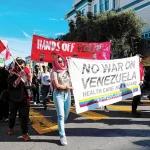
We must therefore conclude that Trump will intensify US interference in the forthcoming October election, perhaps as part of an effort to prepare the ground for more drastic forms of intervention. Progressives and anti-war activists must oppose Trump’s interference in the internal affairs of yet another Latin American country.
(Labour Campaign for Nuclear Disarmament)

Francisco Dominguez, a former refugee from Chile in the UK, is head of the Centre for Brazilian and Latin American Studies at Middlesex University, London, United Kingdom. He is also secretary of the Venezuela Solidarity Campaign in the UK.