By Derek Ford – Sep 17, 2021
All revolutionary processes are educational. From organizing meetings and study groups to writing protest speeches and propaganda before the revolutionary moment to creating new revolutionary educational and cultural institutions and training teachers and specialists after the seizure of power, revolution is educational through and through. Yet exactly what kind of educational operations does revolution entail, and how can we understand and practice them?
It is precisely these questions that Paulo Freire addressed in his classic work, Pedagogy of the Oppressed.
One hundred years after his birth in the Brazilian state of Pernambuco, Freire’s name is widely recognized and, relatively speaking, so too is his canonical text. Yet the book is referenced or discussed more than it is deeply engaged. This is particularly evident when Freire’s work is severed from its revolutionary Marxist orientation [1].
While it’s often taken as an abstract guide-book for how to teach, Pedagogy of the Oppressed is really a theoretical reflection on his own experiences teaching peasants how to read and write, a theory he extends to revolutionary movements, leadership, and organization. After spending 70 days in prison for “treachery” (teaching poor peasants to read and write), he was exiled from Brazil by the military junta in 1964. He eventually settled in Chile, which is where he wrote Pedagogy of the Oppressed. The book has been targeted by the right wing in the US (it is currently banned from public schools in Arizona). It addresses the educational components of revolutionary movements and, as such, it is littered with references to Marx, Lenin, Fanon, and others. Specifically, the book is concerned with how the revolutionary leadership pushes the struggle forward, or how it teaches and learns from the masses in struggle.
The pedagogies of oppression and liberation
The pedagogy of the oppressed has two stages. During the first stage, “the oppressed unveil the world of oppression and through praxis commit themselves to its transformation.” During the second stage, which is after the world of oppression has been transformed, “this pedagogy ceases to belong to the oppressed and becomes a pedagogy of all people in the process of permanent liberation” [2].
The first stage addresses how the oppressed view and relate to the world. It begins by acknowledging that the oppressed possess both an oppressed consciousness and an oppressor consciousness. The oppressor consciousness is the enemy that needs to be liquidated: “The oppressor consciousness tends to transform everything surrounding it into an object of its domination. The earth, property, production, the creations of people, people themselves, time—everything is reduced to the status of objects at its disposal” [3].
This is what capitalism does: it takes everything and makes it into private property, including our ability to labor. This has a profound impact on the world, even instilling the oppressor consciousness in the oppressed. Thus, we have to distinguish an oppressor consciousness from the oppressed person, and we have to transform that consciousness.
The way that we engage in that transformation is absolutely crucial, and this is where the question of pedagogy comes into play. Freire calls the traditional form of pedagogy “banking pedagogy.” In banking pedagogy, the teacher is the one who possesses knowledge and the students are empty containers in which the teacher must deposit knowledge. The more the teacher fills the receptacle, the better teacher she is. The content remains abstract to the student, disconnected from the world, and external to the student’s life. Banking pedagogy—which is what most of us in the US experience—assumes that the oppressed are ignorant and naïve. Further, it treats the oppressed as objects in the same way that capitalism does.
RELATED CONTENT: How Amílcar Cabral Shaped Paulo Freire’s Pedagogy
For Freire, education must be rooted in the daily lives and experiences of students, who are subjects rather than objects. The correct educational method for revolutionaries is dialogue, which means something very specific. To truly engage in dialogue means becoming partners with the people. In this situation, “the teacher is no longer merely the-one-who-teaches, but one who is himself taught in dialogue with the students, who in turn while being taught also teach. They become jointly responsible for a process in which all grow” [4]. This process is referred to as conscientização, or coming-to-critical-consciousness.
A decisive element to the location and direction of conscientização is the pedagogical relationship. This relates to Freire’s critique of the banking model of education and to his reconception of the teacher-student relationship. The dialogic model is a relationship between teacher and student, one which is more—but, and this is absolutely crucial, not completely—horizontal. In this schema, “people teach each other, mediated by the world, by the cognizable objects which in banking education are “owned” by the teacher [5]. The teacher does not relinquish authority or power, as if that was even possible. Instead, the teacher takes responsibility for producing new critical knowledge of reality with the student.
While the pedagogical relationship and process are important parts of Freire’s thought, they have tended to be isolated from Freire’s ideological commitments and have come to stand in for Freire’s entire work. As a graduate student in a fairly critical school of education, I was only assigned the first two chapters of the book, and I’m convinced this is common practice. These chapters are rich; they’re where he denounces banking pedagogy and formulates dialogical pedagogy in response. When we stop here, however, we don’t discover the reason why he bothered writing the book in the first place.
By selectively reading the book, Freire’s dialogic pedagogy is substituted wholesale for his broader conceptual and political work, his vocabularies and theories that generated new understandings of education and revolution. There is nothing inherent in dialogue or dialogic pedagogy that necessarily leads to progressive, critical understandings. For this to happen the content must be placed in a particular context by a teacher. Peter McLaren, one of the few US educational theorists to insist on Freire’s revolutionary commitments (and a comrade of Freire’s), goes so far as to say that “political choices and ideological paths chosen by teachers are the fundamental stuff of Freirean pedagogy” [6]. We can’t divorce the methodology from the ideology, the theory from the method, or the critical from the pedagogy in Freire’s work.
The dangerous fourth chapter
Freire begins the last chapter of Pedagogy of the Oppressed with Lenin’s famous statement: “Without a revolutionary theory there can be no revolutionary movement,” which Freire rewords to insist that revolutions are achieved neither by verbalism nor by activism “but rather with praxis, that is, with reflection and action directed at the structures to be transformed” [7]. It would be just as wrong to claim that reflecting on and helping name oppression is enough for revolution as to claim that activism is enough for revolution. The task of revolutionaries is to engage with our class and our people in true, authentic dialogue, reflection, and action. If we have dialogue and reflection without action, then we are little more than armchair revolutionaries. On the other hand, if we have only action without dialogue and reflection, we have mere activism.
Reflection and action are not divisions of labor between revolutionary leaders and the people, whereby the leaders think and direct and the people are only able to act on their orders. “Revolutionary leaders,” he writes, “do bear the responsibility for coordination and, at times, direction—but leaders who deny praxis to the oppressed thereby invalidate their own praxis” [8]. People and revolutionary leaders act together, building and acting in unity before, during, and after the revolution.
The prerequisite for such leadership is the rejection of the “myth of the ignorance of the people” [9]. Freire acknowledges that revolutionary leaders, “due to their revolutionary consciousness,” have “a level of revolutionary knowledge different from the level of empirical knowledge held by the people” [10].
The act of dialogue unites lived experience with revolutionary theory so that people understand what causes their lived experience to be as it is. This is a restatement of Lenin’s conviction that spontaneous knowledge of exploitation and oppression must be transformed through the Party into revolutionary consciousness of the relationship of our experience to the relationship of broader social, economic, and political forces at differing scales: within the factory, the city, the state, and the world.
This is a Marxist philosophy of education in that it rests on the presumption of competence. We can see it, for example, when Engels writes that he and Marx “cannot co-operate with men who say openly that the workers are too uneducated to emancipate themselves, and must first be emancipated from above by philanthropic members of the upper and lower middle classes” [11]. We can also see it in What is to be Done? as Lenin argues against economist Marxists, who hold that the working class develops its own revolutionary consciousness spontaneously as a result of daily struggles with the bosses. Lenin argued that spontaneity was only consciousness “in an embryonic form,” and that something more was needed. Spontaneity is necessary but is ultimately limited to “what is ‘at the present time’” [12]. In other words, spontaneity by itself isn’t able to look beyond isolated daily struggles and forward to a new society. Lenin called the spontaneously generated mindset “trade union consciousness.”
Lenin believed that workers were capable of more than trade union consciousness. He actually derided those who insisted on appealing to the “average worker:” “You gentlemen, who are so much concerned about the ‘average worker,’ as a matter of fact, rather insult the workers by your desire to talk down to them when discussing labor politics and labor organization” (p. 153). He wrote that organizers had actually held workers “back by our silly speeches about what ‘can be understood’ by the masses of the workers” [13]. The economist organizers treated workers as objects rather than subjects. They didn’t believe in the people or their potential.
Freire actually calls on Lenin when he insists revolutionary leadership is open and trusting of the people. “As Lenin pointed out,” he writes, “the more a revolution requires theory, the more its leaders must be with the people in order to stand against the power of oppression” [14]. This isn’t a naïve acquiesce but a belief in the power of the masses to become not only agents of revolutionary movements but creators of revolutionary theory through the Party. As Lenin also observed, that the Party creates a particular group of theoreticians: In the Party “all distinctions as between workers and intellectuals… must be obliterated” [15].
There is no abstract celebration of “horizontalism” within such a pedagogy. The form of the revolution and its leadership isn’t accorded abstractly; it can be more horizontal or more vertical and triangular, depending on the circumstances. Here, Freire turns to Fidel Castro and the Cuban Revolution to argue that their historical conditions compelled them to revolt without building widely with the people. Yet the leadership pursued this task immediately after taking power through organization, specifically the party. Tyson Lewis is one of the few to observe that “Freire himself clearly saw his pedagogy as a tool to be used within revolutionary organization to mediate the various relationships between the oppressed and the leaders of resistance” [16]. This is why Freire looked so favorably upon Amílcar Cabral [17].
Uniting politics and pedagogy for revolution
Revolutionary organizers, therefore, are defined not just by the revolutionary ideals they hold or actions they take, but by their humility, patience, and willingness to engage with all exploited and oppressed people. It is not possible for us to “implant” the conviction to fight and struggle in others. Coming-to-critical-consciousness is a delicate and contingent process that can’t be scripted in advance. Still, there are a few general components to it.
First, we have to truly get to know our people, their problems, and their aspirations. This means that we have to actually learn from people, acknowledging that, even if this is their first demonstration, or even if they voted for a democrat in the last election, they actually have something to teach us. The more experiences we learn from the people the richer our theories are and the more connection they can have to the daily realities of workers and oppressed people today. Our class is bursting with creative and intellectual powers that capitalist society doesn’t allow us to express or develop. The revolutionary party is stronger the more it cultivates these powers.
Second, we have to provide opportunities for others to understand their problems in a deeper and wider context, and to push their aspirations forward. Freire gives a concrete and relatable example of this:
…if at a given historical moment the basic aspiration of the people goes no further than a demand for salary increases, the leaders can commit one of two errors. They can limit their action to stimulating this one demand or they can overrule this popular aspiration and substitute something more far-reaching—but something which has not yet come to the forefront of the people’s attention… The solution lies in synthesis: the leaders must on the one hand identify with the people’s demand for higher salaries, while on the other they must pose the meaning of that very demand as a problem. By doing this, the leaders pose as a problem a real, concrete, historical situation of which the salary demand is one dimension. It will thereby become clear that salary demands alone cannot comprise a definitive solution. [18]
Through this process, both the people and the revolutionary leadership act together and collectively name the world. Genuine knowledge is produced, and authentic action is taken, and real conviction for the struggle is strengthened.
Freire’s popularity presents an opening to draw many into the struggle and, in particular, the communist struggle. By re-establishing the link between his pedagogy and politics, we can draw those who admire his work into the movement. At the same time, we can better understand, adapt, and practice his pedagogical principles in our day-to-day organizing. “Only in the encounter of the people with the revolutionary leaders,” Freire writes in the book’s last sentence, “can this [revolutionary] theory be built” [19].
References
[1] This process started with the advent of US “critical pedagogy” in the early 1980s, and Freire’s later work might have played a role in it as well. See Malott, Curry S. (2015). History and education: Engaging the global class war (New York: Peter Lang), 63.
[2] Freire, Paulo. (1970/2011). Pedagogy of the Oppressed (New York: Continuum), 54.
[3] Ibid., 58.
[4] Ibid., 80.
[5] Ibid.
[6] McLaren, Peter. (2015). Life in schools: An introduction to critical pedagogy in the foundations of education, 6th ed. (Boulder: Paradigm Publishers), 241.
[7] Freire, Pedagogy of the oppressed, 125-126.
[8] Ibid., 126.
[9] Ibid.
[10] Ibid., 134.
[11] Marx, Karl and Friedrich Engels. (1991). “Marx and Engels to August Bebel, Wilhelm Liebknecht, Wilhelm Bracke and others (circular letter),” trans. P. Ross & B. Ross, in Marx and Engels collected works (vol. 45), ed. S. Gerasimenko, Y.Kalinina, and A. Vladimirova (New York: International Publishers), 408, emphasis added.
[12] Lenin, V.I. (1902/1987). “What is to be done?” in Essential works of Lenin, ed. H.M. Christman (New York: Dover Publications), 67.
[13] Ibid., 156.
[14] Freire, Pedagogy of the Oppressed, 138.
[15] Lenin, “What is to be done?”, 137.
[16] Lewis, Tyson E. (2012). “Mapping the constellation of educational Marxism(s),” Educational Philosophy and Theory 44, no. S1: 98-114.
[17] Malott, Curry. (2021). “Amílcar Cabral: Liberator, theorist, and educator,” Liberation School, 20 January. Available here.
[18] Freire, Pedagogy of the Oppressed, 183.
[19] Ibid.
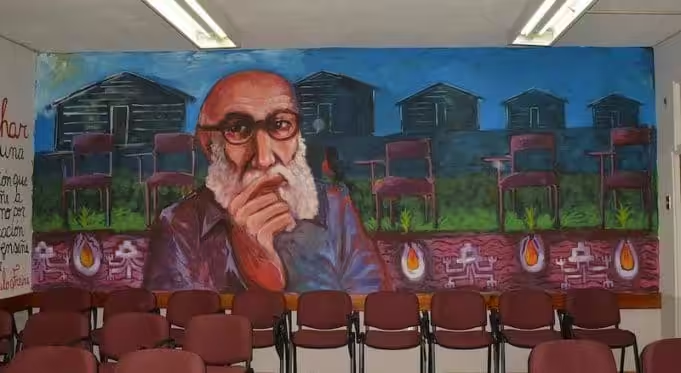
Featured image: Paulo Freire mural in the Faculty of Education and Humanities, University of Bío-Bío, Chile. File photo from Wikimedia Commons.