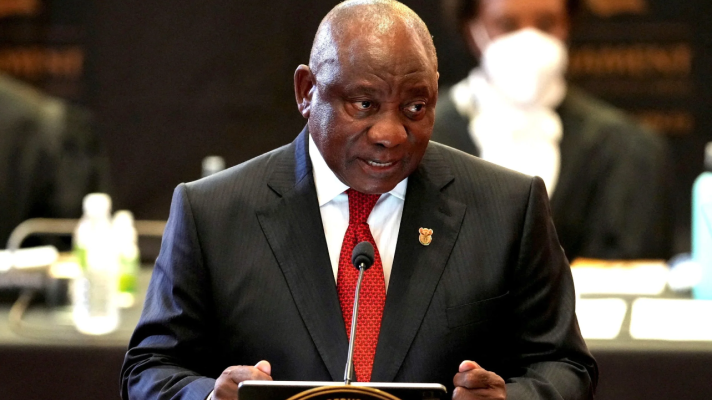
South Africa's president Cyril Ramaphosa was the first African leader to condemn the US military attack of January 3. Photo: Nic Bothma/Reuters.
South Africa's president Cyril Ramaphosa was the first African leader to condemn the US military attack of January 3. Photo: Nic Bothma/Reuters.
In Africa, there is usually little news coverage about Latin America, but the US military intervention in Venezuela on January 3 made the front pages of newspapers and led radio and television newscasts. Most African countries have expressed clear condemnation of the military attack carried out by the US under President Donald Trump. South Africa, a BRICS member and one of the continent’s leading countries, was among the first to do so, and ranks among the most critical, following months of various tensions with the Trump administration.
In its official public statement issued that same day, January 3, South Africa said that the removal of President Nicolás Maduro constitutes a “manifest” violation of the United Nations Charter and that it is imperative to oppose this act by the US because failing to do so would normalize a scenario in which the principle that no nation is superior to another exists only on paper, while in practice, military power dictates the rules. The government of Cyril Ramaphosa called for the urgent convening of the UN Security Council.
Since Donald Trump took office in January 2025, relations with South Africa have been strained. The occupant of the White House claims that a “white genocide” is underway in the country, without any evidence of such. But the issues are not merely rhetorical. While pursuing a hardline immigration policy, Trump has promoted the reception of white Afrikaner migrants as refugees. Likewise, he did not attend the G20 summit held in Johannesburg last November and has imposed restrictions on South African diplomats regarding arrangements for the next meeting, which is scheduled to take place in the United States in 2026.
The South African government’s position is not uniform. This stance has generated new problems within the Government of National Unity between the Democratic Alliance (DA) and the African National Congress (ANC), the majority party in the coalition, which has clear anti-imperialist roots and holds the Ministry (Department) of International Relations and Cooperation. According to the DA, the ministry’s call for an urgent meeting of the UN Security Council “smacks of hypocrisy and contradiction,” and they reproached their allies for not having taken the same position during the Russia–Ukraine conflict in 2022 (at that time, South Africa abstained from voting on a resolution condemning Russia).
The rest of Africa
At the continental level, on January 3 itself—the day of the armed action against Venezuela—the organization that brings together the continent’s 54 countries, the African Union (AU), expressed its “deep concern” over the events in the South American and Caribbean country, including the abduction of President Nicolás Maduro, while reaffirming its commitment to the fundamental principles of international law. At the regional level, one day later, the organization that includes most West African countries, ECOWAS, condemned the US action in line with the AU’s statement but without mentioning the Venezuelan president.
Although Venezuela’s foreign policy toward Africa began in the 1960s, it gained significant momentum under the government of Hugo Chávez. The Bolivarian leader coined the idea of “Mother Africa” starting in 2002, which translated into a significant increase in diplomatic, commercial, and cultural relations with African nations. During Chávez’s presidency, diplomatic relations were established with every country on the continent, 17 diplomatic missions were opened, and a vice ministry for Africa was created. As part of this outreach, Chávez became the first president of a non-African country to speak at the AU’s annual meeting in 2006 and promoted the creation of the Africa–South America (ASA) summits, whose second edition in 2009 was held on Venezuela’s Margarita Island.
Notably, this January, the UN Security Council is chaired by an African country: Somalia. It is worth recalling that recently, Somaliland—the northern region of the country that proclaimed independence from Somalia in 1991 and until recently had no official recognition—was recognized by Israel on January 6 and visited by Israeli Foreign Minister Gideon Saar, a move that Somalia condemned as a serious violation of international law.
South Africa took the lead in condemning US actions in Venezuela, in what can be seen as a new chapter in relations between the two countries. Other nations were slower to respond. For example, on January 8, the countries that make up the Alliance of Sahel States (Burkina Faso, Niger, and Mali), with a clear anti-imperialist stance, issued an official statement condemning the “act of aggression by the United States.” They criticized the “illegal kidnapping of President Nicolás Maduro and his wife” and reaffirmed their commitment to a world order based on respect for the principles of the United Nations Charter. It is striking that oil-producing countries such as Angola, Algeria, or Nigeria have not yet issued official statements.
In Nigeria, on Christmas Day, US air forces carried out strikes in Sokoto State, in the country’s northeast (Nigeria being the most powerful member of ECOWAS), against Islamic State targets. According to the US Secretary of Defense, the attacks were coordinated with the Nigerian government following Donald Trump’s allegations of killings of Christians in the country.
The geopolitical game
African countries’ solidarity with Venezuela stems from their historical experience with the consequences of colonialism and imperialism.
In these calls for dialogue and for maintaining a multilateral order that respects the sovereignty of peoples, one can discern a fear that the era of rule by the strongest may once again become the politics of the present and the future.
At the same time, there is caution in realpolitik, as important issues are under discussion with the United States, such as visa and migration matters and the renewal (or not) of the African Growth and Opportunity Act (AGOA), which has allowed African products to enter the US market with low or no tariffs. It is within this delicate balance that Africa’s highly diverse continent continues to navigate.
Translation: Orinoco Tribune
OT/CB/SL
Cameron Baillie is an award-winning journalist, editor, and researcher. He won and was shortlisted for awards across Britain and Ireland. He is Editor-in-Chief of New Sociological Perspectives graduate journal and Commissioning Editor at The Student Intifada newsletter. He spent the first half of 2025 living, working, and writing in Ecuador. He does news translation and proofreading work with The Orinoco Tribune.