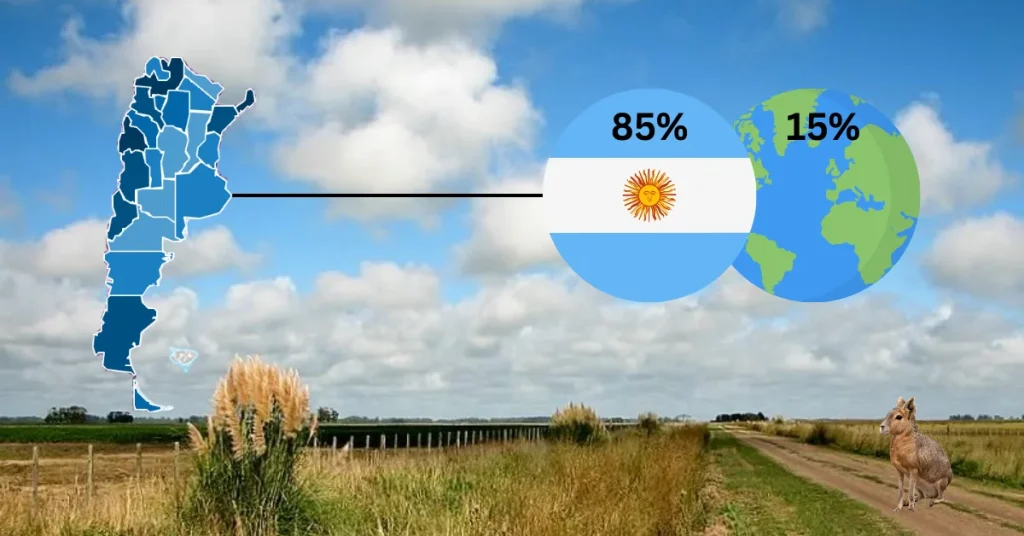
The image illustrates the proportion of foreign land ownership in Argentina before the repeal of the "Ley de Tierras" (Land Law) in December 2023. Photo: BowTiedMara/file photo.
The image illustrates the proportion of foreign land ownership in Argentina before the repeal of the "Ley de Tierras" (Land Law) in December 2023. Photo: BowTiedMara/file photo.
A recent map prepared by researchers from the National University of Buenos Aires (UBA) and CONICET (National Council for Scientific and Technical Research) reveals that 13 million hectares (32.1 million acres) of Argentinian territory—almost 5% of the country and an area equivalent to the size of England—are in foreign hands.
The study carried out by the Land Observatory warns that 36 departments already exceed the 15% foreign ownership limit established by Law 26.737, a regulation that the Javier Milei government seeks to repeal.
Historian Matías Oberlin, one of the creators of the Map of Foreign Land Ownership in Argentina, explained that “this isn’t a recent process; it’s been going on for a long time, but the law is holding it back. The moment they lift that restriction, the map will turn red.” The project was based on requests for access to public information and culminated in an interactive map that refutes the official version of the law’s uniform enforcement.
Strategic resources and critical areas
Four departments have over 50% foreign ownership: Lácar (Neuquén), General Lamadrid (La Rioja), and Molinos and San Carlos (Salta). All of these are rich in strategic resources such as fresh water, lithium, critical minerals, and rare earth elements. Other critical areas include Iguazú (Misiones), Ituzaingó and Berón de Astrada (Corrientes), and Campana (Buenos Aires), where foreign ownership exceeds 30%, especially in riverside areas along the Paraná River.
| Department (Province) | Ownership percentage | Strategic resources and features |
| Lácar (Neuquén) | Over 50% | Fresh water, strategic minerals, and Patagonian lakes |
| General Lamadrid (La Rioja) | Over 50% | Lithium, rare earth elements, and critical minerals |
| Molinos (Salta) | Over 50% | Lithium, strategic minerals, and high-altitude aquifers |
| San Carlos (Salta) | Over 50% | Lithium, critical minerals, and strategic resources |
| Iguazú (Misiones) | Over 30% | Native forests and vital water resources |
| Ituzaingó (Corrientes) | Over 30% | Paraná River access and strategic aquifers |
| Berón de Astrada (Corrientes) | Over 30% | Riverside areas and strategic territorial value |
| Campana (Buenos Aires) | Over 30% | Industrial and riverside land along the Paraná River |
According to researchers, the US leads in foreign land ownership in Argentina, with more than 2.7 million hectares—an area larger than Rwanda. Italy and Spain follow. “Benetton is a prime example,” Oberlin noted, referring to the Italian company that owns vast tracts of land in areas such as Cushamen, in Chubut, a region plagued by intense socio-environmental conflicts.
| Country of origin | Hectares owned | Comparison or key examples |
| US | Over 2.7 million | Larger than Rwanda |
| Italy | Significant holdings | The Benetton Group (vast tracts in Chubut) |
| Spain | Significant holdings | Intensive land use in various strategic regions |
Threat to sovereignty and the environment
The government is pushing to repeal the Land Law as part of the May Council’s legislative package. Chief of Staff Manuel Adorni has openly expressed this intention, in line with the Decree of Necessity and Urgency (DNU) 70, issued at the beginning of Milei’s administration. Researchers warn that eliminating this legal framework would facilitate land purchases in sensitive areas: Patagonian lakes, native forests, border regions, and aquifers vital for the life of millions of people.
Presence of Israeli Soldiers Reported in Argentine Patagonia
“The repeal aims to enable purchases in areas with exceptional natural and strategic value,” warn Oberlin and sociologist Julieta Caggiano, members of the Agrarian History Research Program at the University of Buenos Aires and the Latin American Interdisciplinary Observatory of Agricultural Policies (MILPA). Both emphasize that dismantling existing protections reconfigures who decides, who has access, and who is excluded in key areas of the national territory.
In a global context marked by tensions over the control of water and energy, the discussion about foreign ownership of land in Argentina transcends the administrative sector and raises dilemmas of sovereignty, development, and territorial justice.
(Telesur) with Orinoco Tribune content
Translation: Orinoco Tribune
OT/JRE/SL