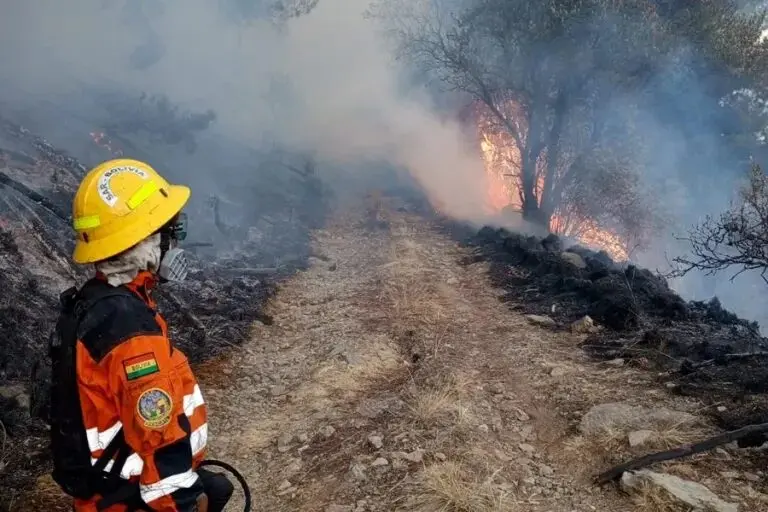
Firefighters and members of the Bolivian Army combat the hotspots in the rural areas of San Lorenzo, Tarija. Photo EFE.
Firefighters and members of the Bolivian Army combat the hotspots in the rural areas of San Lorenzo, Tarija. Photo EFE.
The governor of Tarija called for national solidarity, requesting immediate support for the teams fighting the fires.
The municipality of San Lorenzo, located in the department of Tarija, Bolivia, was declared to be in a state of emergency under the category of “disaster” this Sunday. The official declaration is in response to forest fires that are advancing uncontrollably and have consumed thousands of hectares, causing severe damage to the flora, fauna, and productive areas of the territory.
This legal mechanism empowers the municipal government to immediately reallocate public funds. Furthermore, it allows for extraordinary financial assistance to be requested from the central government, a necessary measure given that local response capacities have been overwhelmed by the magnitude of the disaster.
In the area of security and defense, Defense Minister Ernesto Justiniano announced this Sunday that a specialized aircraft will arrive in the coming hours to reinforce the aerial firefighting efforts. Simultaneously, the relevant authorities reported that a thorough investigation has been ordered to identify those responsible for starting the fires.
The flames have been spreading rapidly since last Thursday. The first to respond were civilian fire departments, but the challenging weather conditions and strong winds prevented them from containing the blaze in its initial stages.
Over the weekend, the response was expanded with the addition of contingents from the Bolivian Army, personnel from the departmental government, and community volunteer groups. Despite the extensive deployment of personnel and resources, the fire remains active in the region.
The president of the Volunteer Firefighters Association, Henry Rivera, explained that the fire is “not under control” and that the current priority is protecting populated areas. The communities most affected by the emergency are Quirusillas—including all its surrounding cantons—Ancahuasi, and the Campanario crossroads.
Regarding the terrain, Rivera explained that “the wind, the rugged topography, and the abundant vegetation act as natural fuels that accelerate the fire’s spread and hinder the work” of the brigades, who must withdraw at nightfall for safety reasons.
In response to the crisis, the governor of Tarija, María René Soruco, issued a call for national solidarity, requesting immediate support for the teams fighting the fire and urgently requesting personal protective equipment for the firefighters.
For their part, social organizations and defenders of Mother Earth’s rights are demanding a thorough investigation to determine responsibility and halt practices that violate the country’s food sovereignty.
The Bolivian government is maintaining its active operation, with its focus on the arrival of a water bomber. Meanwhile, in San Lorenzo, the fire continues to spread, and firefighters are awaiting a break in the weather.
Why Bolivia Is Exploding: The Battle Over Sovereignty, Lithium, and Latin America’s Future
(AlmaPlus/Telesur)
Translation: Orinoco Tribune
OT/CB/SL