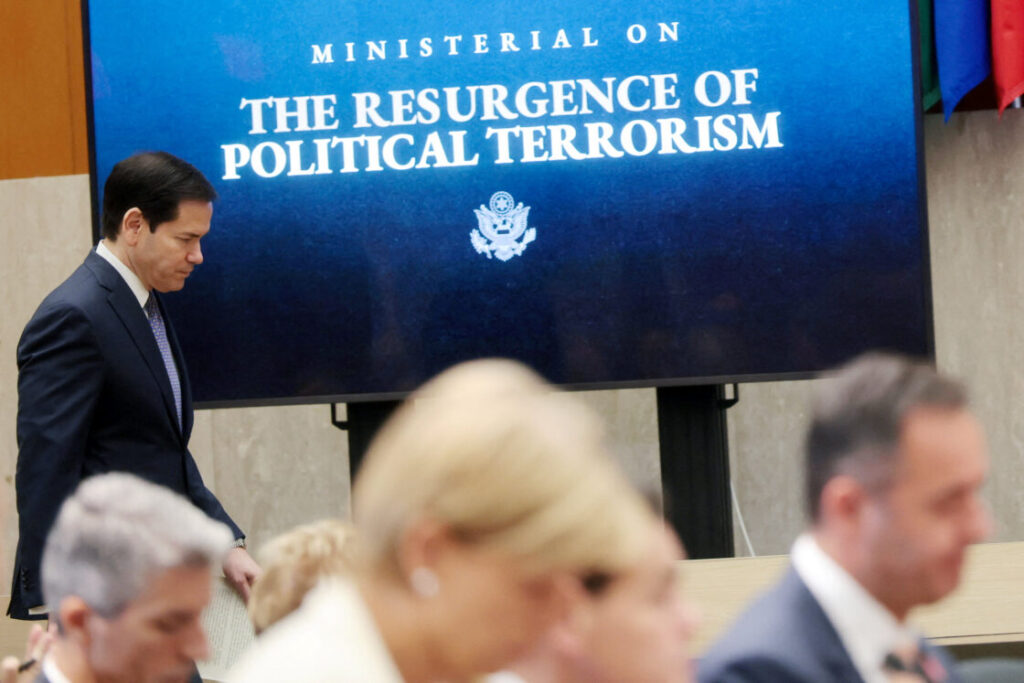
US Secretary of State Marco Rubio arrives to speak during the ministerial meeting on July 16. Photo: Reuters/Jonathan Ernst.
US Secretary of State Marco Rubio arrives to speak during the ministerial meeting on July 16. Photo: Reuters/Jonathan Ernst.
By Arantxa Tirado – Jul 19, 2026
With a press release, the US State Department announced on July 15 that the following day it would hold a ministerial meeting “to combat the resurgence of political terrorism.” The meeting, chaired by Secretary of State Marco Rubio, brought together representatives from more than 60 countries with the aim of “fostering stronger joint action” against what the US government describes as the “renewed threat” of “far-left political terrorism.”
Were it not for the fact that we live in post-truth times—in which any statement can be dissociated from reality or issued without any correspondence to the facts—it would be surprising to read that something called “far-left political terrorism” exists and, moreover, constitutes a threat to the societies of the free world. The difficulty of finding concrete and contemporary examples of such a transnational threat is compounded by the ambiguity of the term “far left,” the definition of which is the subject of debate and no small disagreement.
Although the meeting had been framed as an alliance of like-minded governments, countries governed by progressive forces—such as Mexico and Spain—were invited to participate, in what appears to be more of an attempt to align international agendas with the ideological parameters of the current US administration. This is not new: we saw it with the global war on terror unleashed by George W. Bush following the attacks on the Twin Towers in New York—a turning point in US global policy that deployed a unilateralism now deepening under Donald Trump’s second presidency.
However, the geopolitical moment is different, and the hegemonic decline of the US is accelerating at a rapid pace. Following the estrangement between the US and its Western allies over differences on NATO and the crisis with Greenland, the US is now driving a meeting that seeks to convince the world’s governments that they share a “transnational threat”—a common enemy made up of antifascist, communist and Marxist forces. “Convince,” I write, but given this administration’s anti-diplomatic conduct, it would be more accurate to write “inform.”
From radical Islamism as public enemy number one in the crusade of Bush Jr., the US moves to creating a new ethereal enemy in which, like a catch-all drawer, all dissent will be labeled as terrorist. The coincidence of this meeting’s announcement with the detention in Ibiza of pro-Palestinian US billionaire Fergie Chambers—at the US’s request, accused of “terrorism financing” for supporting Palestinian resistance organizations—is a clear message of what awaits any citizen who confronts the US and Zionism. This fate will be even worse for anonymous and resourceless people who stand up to the brutal imperialist domination the US seeks to exercise worldwide, whether directly or through its allies.
Marco Rubio, ideological leader and anticommunist
Beyond Trump’s statements labeling as communist any position that is even minimally progressive, the person who appears to be setting the most political tone in this administration is not even US President Trump but Secretary of State Marco Rubio, backed by National Security Advisor Stephen Miller, who also spoke briefly. Rubio’s speech of more than half an hour focused on linking political violence to the revolutionary left—a feat of projection worthy of psychological analysis.
Rubio’s harangue had the tone of a religious preacher establishing a dual world where the forces of good and evil stand opposed, as in the best days of McCarthyism. He went so far as to say that “communism is a world without God,” “a world without courage, without creativity or ambition, a world without heroes, without glory or great causes to fight for; a world without miracles, without myths, without men who rise above others to perform incredible and extraordinary feats.” Fidel Castro, whose centennial birth anniversary falls in a few weeks, laughs from beyond. Rubio also added that “communism never works in practice”—forgetting to mention that the US has gone to great lengths to ensure communism cannot work in any country on the globe.
Indeed, Rubio has played a major role in deploying the anticommunist agenda from within US institutions. His political career has left a strongly ideological imprint since his days as a local representative in Miami and his arrival in the Senate in 2010, backed by the reactionary Tea Party, representing Florida—as Hedelberto López Blanch explains in his book Rubio: An Uncontrollable Mythomaniac. A member of the powerful anti-Castro lobby that has conditioned US foreign policy in both Democratic and Republican administrations, Senator Rubio was also the driving force behind several of the main laws targeting Bolivarian Venezuela, such as the Venezuela Defense of Human Rights and Civil Society Act of 2014—renewed in 2016 and 2023—and the VERDAD Act of 2019. These laws served to establish a political framework on which to build the legal architecture for imposing more than 1,000 unilateral coercive measures the US placed on Venezuela before January 3, 2026. As in the times of the Cold War and McCarthyism, Rubio saw communism above and beyond reality.
With this event on the subject of “the threat of the far left,” US Secretary of State Marco Rubio has taken a further step in his ideological offensive—one that serves to mark a political line within an administration exercising a self-interested “pragmatism” in its relationship with Venezuela. Although Rubio is a key figure in that strategy of control over the country, his supposed current cordiality and good treatment of Chavista authorities contrasts with his prior positions and his openly hostile discourse against Cuban leadership. In this sense, the July 16 event serves to stage a hardline posture—a reminder that the power groups commanding what is still the world’s leading power will not settle for control of resources alone but must also ideologically defeat the political alternatives that confront them.
Fighting an enemy that no longer exists?
It is worth noting that the meeting opened with a presentation by US Under Secretary of State Christopher Landau drawing parallels between the current situation and the political reality of the 1970s. Landau addressed the assembled country representatives by invoking political groups of that era, such as the Weathermen Underground in the US, Baader-Meinhof in Germany, and the Latin American Tupamaros and Montoneros, attempting to convince them that similar situations are being experienced today.
It is no coincidence that US representatives hark back to the Cold War—their mindset continues to operate within the anticommunist logic characteristic of that era. At that time, the world was divided by an ideological struggle between the socialist bloc and the capitalist bloc. The mere existence of the Soviet Union, the struggles for African decolonization, May 1968, and the rise of Marxist ideas strengthened a political effervescence that translated into a multiplicity of political groups seeking to make revolution in every corner of the planet—organizations that the US and its Western allies fought with fire and blood, deploying various counterinsurgency strategies.
The present world, however, is far removed from that moment of political eruption by revolutionary forces. Today, few formally socialist states remain in the world, and some of them—such as Cuba—are suffering from the strangulation of decades of economic blockade and political siege. It is equally no coincidence that Rubio hates Cuba’s revolutionary government for its role in promoting some of those groups during the 20th century.
Beyond staging an event against the resurgence of left-wing political terrorism in the face of a reality that refutes these premises, perhaps what was most striking about the speeches was the emphasis placed on Marxist ideas as a threat. It is paradoxical that in a world where Marxism is a minority tendency—where, unlike other historical moments, calling oneself a Marxist carries no cachet in academic or political circles, quite the contrary—the US should place Marxism in its crosshairs, linking it, as in Cold War times, to terrorism and the embodiment of evil.
In any case, what for Rubio and company may be an attempt to tarnish Marxist ideas and the communism based on them should, for Marxists, be a source of pride—to be conceptualized as the principal enemy of the group of psychopaths leading humanity toward barbarism. The specter of communism continues to wander the world as a warning to the ruling class. And it is good that it does so.
Looking in the mirror of someone else’s fear
Beyond Rubio’s paranoia or the genetic anticommunism of the global ruling class, Thursday’s meeting confirms that Marxism is a powerful theoretical tool that poses a real threat to the ideological principles of capitalism and to its common sense—laden as it is with fallacies. The capitalist worldview believed itself triumphant and hegemonic after the collapse of the socialist bloc is now in the throes of neoliberal alienation. However, crises such as that of 2008, the pandemic, and the growing inequalities experienced in advanced capitalist societies—including the US itself—have led broad social sectors to question the existing order and seek revolutionary alternatives.
However, not all of these radical alternatives are equally contestatory or capable of transcending the established order. While radical right wingers and neo-fascists shore up the system by sustaining—when not deepening—the capitalism responsible for humanity’s problems, the alternatives inspired by Marxist ideas propose transformative options that shake existing power. They raise the need to move toward another conception of social relations—one not based on the exploitation of human beings by each other or of nature by human beings. Hence their “dangerousness” to the limitless exploitation and absolute privatization of life and natural resources defended by the ruling class.
The principal message of the Washington event for the forces of the left should not only be to accept that the times ahead will be more difficult for all those who oppose the representatives of this unbridled and moribund capitalism—who will be labeled as communists even if they are not, conceptualized as enemies and persecuted, at varying levels, as such. What matters most is to be conscious of the power that Marxist ideas have to confront it, defeat it and build another socialist world that humanity needs with ever greater urgency.
The revolutionary left may now be a minority—scattered and defeated in various arenas. Yet these experiences of resistance and organization, seen through the eyes of those who oppose them, serve to recall their importance and magnify their achievement. The game is not over. The red child of History will have the last word.
(La Marea) by Arantxa Tirado
Translation: Orinoco Tribune
OT/CB/SL