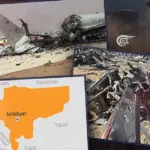
An RAF Typhoon takes off from Akrotiri on Cyprus to bomb Yemen. Photo: MOD.
An RAF Typhoon takes off from Akrotiri on Cyprus to bomb Yemen. Photo: MOD.
By Mark Curtis – Jan 12, 2024
The UK military’s latest bombing of Yemen comes on the 60th anniversary of a forgotten British campaign in the country involving brute force and deliberate attacks on civilians, declassified files show.
UK air strikes in Yemen – that have dared to challenge Western support for Israel over Gaza – are taking place exactly 60 years after a brutal British bombing campaign in the country.
The so-called Radfan revolt of early 1964 in modern-day Yemen has long passed out of historical memory.
We should remember it though, as evidence of how British foreign policy is practised in reality – and how we only truly find out about that reality once government files are released decades later.
Independence on our terms
The Radfan is a mountainous area about 50 miles north of Aden, Yemen’s major southern port. In the early 1960s, it was part of a British colonial creation – the Federation of South Arabia, a grouping of sheikhdoms and sultanates established by London.
The UK was prepared to grant independence to South Arabia, but only on certain terms. Sir Kennedy Trevaskis, the high commissioner in Aden, noted that independence should “ensure that full power passed decisively into friendly hands”.
This would leave the territory “dependent on ourselves and subject to our influence”.
Much of the population refused to cooperate with British plans, and not only politicised groups in Aden. In January 1964 tribesmen in Radfan launched raids on federation targets and British convoys in the area.
They were concerned about receiving declining revenues as a result of British plans for a customs union across the federation and were inspired by the anti-colonialism of Egypt under Gamal Abdel Nasser, the Arab nationalist leader in the Middle East.
‘Whatever methods are necessary’
The response of the British authorities under the Conservative government of Alec Douglas-Home was ferocious. Colonial secretary Duncan Sandys called in April 1964 for the “vigorous suppression” of the revolt and that the UK military be authorised “to use whatever methods are necessary”.
The only thing that concerned Sandys was to “minimise adverse international criticism” – indicating that propaganda operations, then as now, were of utmost importance.
The idea was “to make life so unpleasant for the tribes that their morale is broken and they submit.”
A political directive issued to British forces in April 1964 stated that UK troops “must take punitive measures that hurt the rebels, thus leaving behind the memories that will not quickly fade.”
The idea was “to make life so unpleasant for the tribes that their morale is broken and they submit.”
Captain Brian Drohan, a scholar at the US military academy at West Point who has also analysed the British declassified files, wrote that “the Radfan population felt the full force of colonial coercion as British forces bombed villages, slaughtered livestock, and destroyed crops”.
‘Casualties to women and children must be accepted’
One tactic was “ground proscription”, in which certain areas in Radfan were designated as off limits.
“All inhabitants, regardless of their status as civilians or combatants, were required to leave, turning virtually the entire population of a proscribed area into refugees”, Drohan notes.
British soldiers were ordered to confiscate property, burn fodder, and destroy grain stores and livestock. Rules of engagement allowed commanders to use aerial and artillery bombardment “to the maximum extent necessary” when villages refused to surrender.
In such circumstances, “casualties to women and children must be accepted”, the UK directive stated.
As part of a British army deployment, which involved the Parachute regiment and marines, a small SAS team was also sent in April, assisted by ground attack Hunter warplanes. The SAS killed some 25 rebels but lost its commander and radio operator, whose bodies had to be left behind.
These were decapitated and the heads displayed in Yemen, an incident that caused anger and shock throughout Britain.
Air strikes
Air strikes were approved in May and Trevaskis suggested sending soldiers to “put the fear of death into the villages” controlled by the rebels.
If this wasn’t enough to secure submission, then Trevaskis said “it would be necessary to deliver some gun attacks on livestock or men outside the villages”.
He added: “Since tribesmen have been regularly firing at our aircraft and have hit several of them, we might be able to claim that our aircraft were shooting back of [sic] men who had fired at us from the ground”.
For the RAF, air proscription meant that “villages may be attacked with cannon and grenades” and allowed pilots to target cattle, goats, crops, and people in proscribed areas, the files state.
“Trevaskis suggested sending soldiers to “put the fear of death into the villages” controlled by the rebels”
British forces had been authorised by ministers to “harass the means of livelihood” of villages in order to bring the rebels to submission.
Livestock and crops were sources of wealth and sustenance for the Radfani tribes. “Attacks against these targets amounted to economic warfare waged against entire communities with little attempt to distinguish between civilian and combatant”, Drohan notes.
In one attack, a single Shackleton bomber expended 600 20mm cannon rounds and dropped 60 aerial grenades. The pilot reported firing his cannon at a herd of goats while dropping six aerial grenades on another goat herd, 11 on cattle, eight on “people”—without specifying civilian or combatant— and an additional 14 on “people under trees.”
In more than 600 sorties over Radfan, the RAF fired 2,500 rockets and 200,000 cannon rounds.
There were no restrictions on using 20lb “anti personnel bombs” – similar to what are now called cluster bombs – although “the public relations aspect” of these “will want very careful handling”, the Ministry of Defence noted.
Thus defence secretary Peter Thorneycroft asked the Chief of the Air Staff to “ensure the secrecy of the operation” to use these bombs.
Poverty
As the files in so many other of Britain’s wars in the Middle East show, UK planners were perfectly aware of the plight of the people they were attacking.
The Middle East Commander in Chief, Lt Gen Sir Charles Harington, recognised that the Radfan tribesmen “have been eking out a poor and primitive existence for hundreds of years”. Their situation was that “there is barely sufficient substance to support the population, families seldom making more than £50 a year profit”.
“Therefore”, he noted, “the temptation and indeed the necessity to look elsewhere for aid is understandable” – which is what many people did, turning to offers from Nasser’s Egypt and the new republican government in North Yemen, against whom the UK was also fighting a covert war.
Harington also noted that if Britain “had given more financial help” to the Radfanis in the past “the temptation to go elsewhere for the price of subversion might have been avoided”.
Bribes
Paying bribes to local tribal leaders was another way to secure control over the population. Sandys called for the high commissioner to pay “personal subsidies” to key members of the council of the Federation of South Arabia.
In January 1964, Trevaskis was given £50,000 to pay such bribes. He was also provided with £15,000 “to help undermine the position of the People’s Socialist Party in Aden”, the most important political opposition to continued British rule in the territory.
The high commissioner noted that this money would help “to prevent their winning coming elections”. In July 1964 ministers also approved £500,000 for Trevaskis “to distribute to rulers where this would help to prevent tribal revolts”.
With the advantages of airpower and artillery, the British military captured its territorial objectives by late July as Radfan tribes retreated over the border into North Yemen. Having removed them from their homes, UK forces occupied the Radfan and continued enforcing proscription through air and ground patrolling.
Official figures are that Britain lost 13 soldiers during the conflict. It is not known how many Radfanis were killed.
The Federation of South Arabia went on to become part of independent South Yemen in 1967, after a protracted liberation war against British forces.
Mark Curtis is the editor of Declassified UK, and the author of five books and many articles on UK foreign policy.