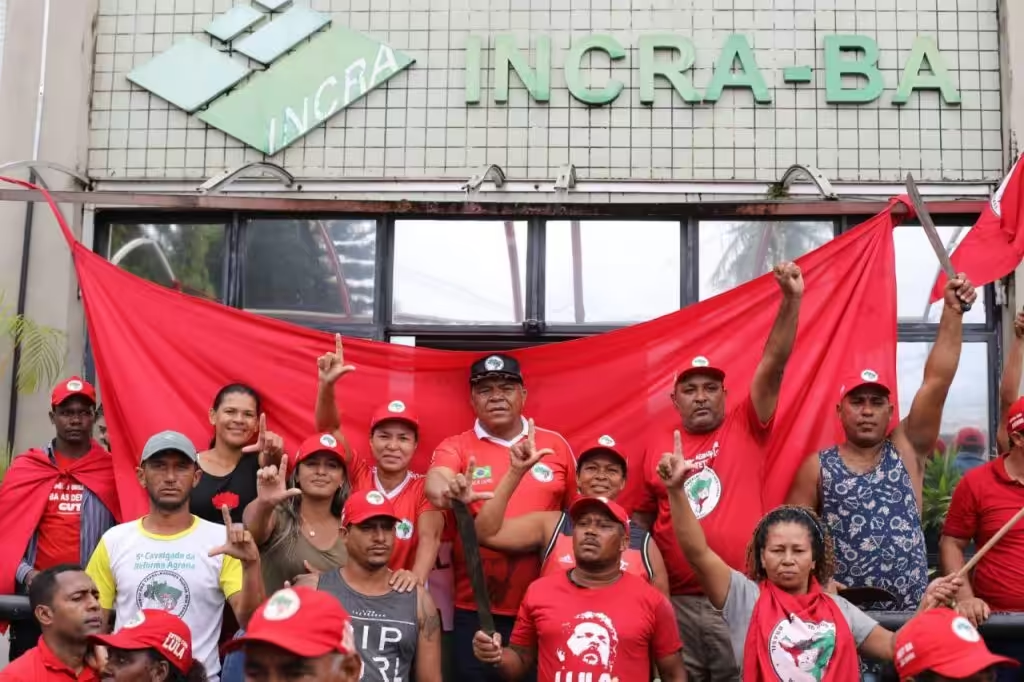
MST members hold a vigil outside the INCRA headquarters in Rio Grande do Sul, Brazil. Jonas Souza Santos/MST.
MST members hold a vigil outside the INCRA headquarters in Rio Grande do Sul, Brazil. Jonas Souza Santos/MST.
The Landless Workers’ Movement (MST) of Brazil is holding a vigil in front of the headquarters of the National Institute of Colonization and Agrarian Reform (INCRA) in the state of Rio Grande do Sul. The sit-in demonstration began on Friday, March 13, and aims to pressure the federal and state governments to expedite the resettlement of families who lost their homes and livelihoods during the May 2024 floods. The demonstration also demands a solution for the hundreds of farmers who remain in temporary camps throughout the state.
According to Carla Kamila Marques, leader of the MST for the state of Rio Grande do Sul, the vigil at INCRA will continue until a high-level meeting between the federal agency and the state parliament is held. The main objective is to unblock the transfer of state lands to the movement to turn them into productive settlements that would enable the recovery of those affected by the floods.
#ENFOTOS | 📌El Movimiento de los Trabajadores Rurales Sin Tierra #MST de Brasil ha iniciado una vigilia este viernes en la sede regional del Instituto Nacional de Colonización y Reforma Agraria #Incra.
🔴El MST, una fuerza fundamental en la defensa de los derechos campesinos,… pic.twitter.com/yNyfv93469
— teleSUR TV (@teleSURtv) March 13, 2026
For its part, INCRA tried to calm tensions by announcing the opening of selection processes for the Nova Conquista II settlement in Eldorado do Sul and the settling of families in former forest areas of Vitória das Missões and Cruz Alta.
However, for the MST, these measures are insufficient given the magnitude of the housing and productive crisis left by the floods. While the state government claims to be waiting to coordinate with the presidency of INCRA in Brasília, MST maintains pressure through protest, emphasizing that agrarian reform is the only real way to rebuild the rural communities affected by the floods.
These actions occur in a context where Brazil recently suffered floods, and the municipality of Juiz de Fora in Minas Gerais state officially declared a State of Public Calamity after a day of devastating rains that resulted in at least 22 fatalities, 40 missing persons, and thousands of affected people.
The storm, which began on the afternoon of February 23, caused the Paraibuna River to overflow and triggered a series of landslides that buried homes in various neighborhoods. The magnitude of the phenomenon is historic: the total precipitation in February reached 584 millimeters, double the average expected for the entire month and exceeding 100 millimeters at some points during the early hours of the disaster.
The situation is critical throughout the Zona da Mata region. Of the confirmed deceased, 16 are from Juiz de Fora and six from the neighboring town of Ubá. Rescue teams, supported by tracking dogs, worked ceaselessly to locate the missing, while the Fire Department faced serious difficulties due to roadblocks caused by fallen trees.
http://87.106.166.27/brazils-mst-promotes-agrarian-reform-amidst-environmental-crisis-during-nature-day/
The emergency forced the suspension of classes and the closure of bridges at risk of collapse, while the Civil Defense coordinated shelters for the thousands of people who lost their homes. With the declaration of a calamity, the immediate arrival of federal resources was awaited to begin the reconstruction of urban infrastructure and to care for the injured in regional healthcare centers.
The National Meteorology Institute maintains active alerts, warning of new rainfall in the coming days. Given this persistent risk, the authorities urged preventive evacuation in vulnerable hillside areas, such as Vila Ideal and Lourdes. They also planned the execution of urgent engineering projects to reinforce barriers in the city's most critical points. In this context, the MST's struggle is constant amid the country's climate reality.
(Telesur)
Translation: Orinoco Tribune
OT/SC/SF