

Kenyan communist leader Booker Omole educating inmates in a prison cell. Photo: X/@BookerBiro.
Kenyan communist leader Booker Omole educating inmates in a prison cell. Photo: X/@BookerBiro.
By Pavan Kulkarni – Mar 13, 2026
Withdrawing from the case, the complainant and the key witness named in the chargesheet has accused the police of fabricating charges and weaponizing the criminal justice system.
The chargesheet against Booker Omole, the general secretary of the Communist Party Marxist – Kenya (CPM-K), began to unravel in the very first pre-trial hearing on March 9. Abducted on February 24 without a warrant by men in plainclothes, tortured in custody, and imprisoned, Omole was released on bail on March 3.
At his pre-trial hearing on Monday, the complainant and the main witness named by the police in the chargesheet submitted an affidavit in the court, saying that he was “unequivocally” withdrawing his “complaint and all statements recorded” pertaining to the case.
Stating that “these proceedings are a weaponization of the criminal justice system aimed at … harassing and intimidating” Omole, he added that the police had fabricated the charges.
“It is clear that the complainant was forced into this by the police,” Omole told Peoples Dispatch. “The Registrar of Firearms Bureau also presented a report to confirm that I am a legally registered owner of the firearm,” he was accused of possessing illegally.
Surviving an assassination attempt
It was the same firearm he had used to survive an assassination attempt last year during the Gen Z protests between June and July, sparked by police brutality amid a worsening cost-of-living crisis under the austerity regime instituted by President William Ruto.
“Many activists suspected of being involved in the protests were being abducted without warrants and tortured,” Omole recalled. “Six gunmen broke into my house. I shot one dead at my bedroom door.”
After a gun fight, “one more was found dead outside on the road, probably from a bullet wound. Others who fled were arrested, but the judicial enquiry never concluded.” The case went dark “because they were intelligence officers,” he maintains.
“It was an ambush.”
“But I did not have this gun with me in the car when I was stopped” on February 24 at a roadblock set up at the bypass to turn to Nairobi on his way back from Isiolo, where he was travelling with a party comrade and a foreign delegate for political work and to raise funds.
“It was an ambush. Some 20 men, without uniforms, surrounded our car and started to grab us. We did not know who they were. So we resisted and fought back,” he recalled. It was only when the public gathered, demanding to know who the men were, that they identified themselves as police.
“The accusation that I threatened to kill them during this scuffle is ridiculous. There were 20 of them – armed – how could I have threatened to kill them?”
They took all three into custody, along with their two cars, and drove them to the apartment the party had rented to host its international delegates. The police named the owner of this apartment, Andrew Amoth, as the main complainant and witness in the chargesheet.
A chargesheet riddled with contradictions
The police maintain they swung into action after Amoth allegedly made a noise complaint against the guests who had rented his apartment. “But his apartment is in Nairobi. I was abducted on my way from Isiolo. How could I be making noise in Isiolo and Nairobi at the same time? When the police write a cooked story,” Omole remarked, “such contradictions appear.”
Upon their arrival at the apartment, the police allege that Omole drew his gun on the landlord. But Omole maintains he was already detained and brought there in police custody. “At no point did … Omole point a firearm at me,” the landlord insisted in his affidavit.
Upon raiding the apartment, the police found 320,000 Kenyan shillings, equivalent to about USD 2,500, which they insisted was a fund to sponsor an insurgency against the government. They then drove Omole to the Mlolongo police station, where, according to Amoth’s affidavit, they tried to extort this amount from Omole.
The Officer Commanding Station (OCS) at Mlolongo is Peter Mugambi, whom Omole described as “a well-known criminal within the police. He is also a sworn anti-communist, Evangelical Christian.” Omole had already had a run-in with him back when he was the OCS of Bamburi. At the time, “he had accused me of organizing a terrorist cell to overthrow the government.”
Now under his wing again at the Mlolongo police station, the police tortured Omole, dislocating his arm, already injured in the scuffle during his abduction. “They even strangled me”, demanding to know who was financing him for leading the protest outside the US embassy against the abduction of Venezuela’s president, Nicholas Maduro.
“They insisted I must also be a member of a drug cartel,” like Maduro, echoing the allegation the US had concocted before his abduction. Just as this allegation was dropped by the US prosecution when Maduro was produced in a court, the Kenyan police also dropped this from the chargesheet.
They instead claimed to have found narcotics in the apartment. “Contrary to what is stated in the Charge Sheet, I confirm that no narcotics, drugs, or illegal substances were found in the apartment,” its owner and complainant said in his affidavit. “As the lawful owner and occupant of the premises, I find any suggestion to the contrary to be false and did not originate from any evidence recovered from my home.”
The chargesheet was made available to Omole only when he was produced in the Mavoko Law Court in Machakos on February 26, well past the 24 hours since detention as mandated by law. His injured arm was crudely bandaged as he was rushed into the courtroom by more than half a dozen policemen who kept out all his comrades and journalists. Denied bail on the technical grounds that the police had not provided the pre-trial document to the court, Omole was sent to Kitengela Remand Prison.
http://87.106.166.27/communist-party-marxist-kenya-leader-booker-omole-released-on-bail-others-arrested/
“A prison within a prison where they send you to break your spirit”
On the night he was brought to this prison, he was held in isolation, in what he estimates to be a 2-by-1 meter cell, where his tall and athletic frame could barely move about. “There is no toilet,” added Omole. “You are given a bucket to defecate in. It is a prison within a prison where they send you to break your spirit.”
The following day, he was transferred to the “capital remand prison”, in a uniform, scrawled with the red letters “SW”, standing for Special Watch, assigned to those deemed dangerous. His inmates here were charged or convicted with the death penalty, carrying crimes like murder, robbery with violence, etc.
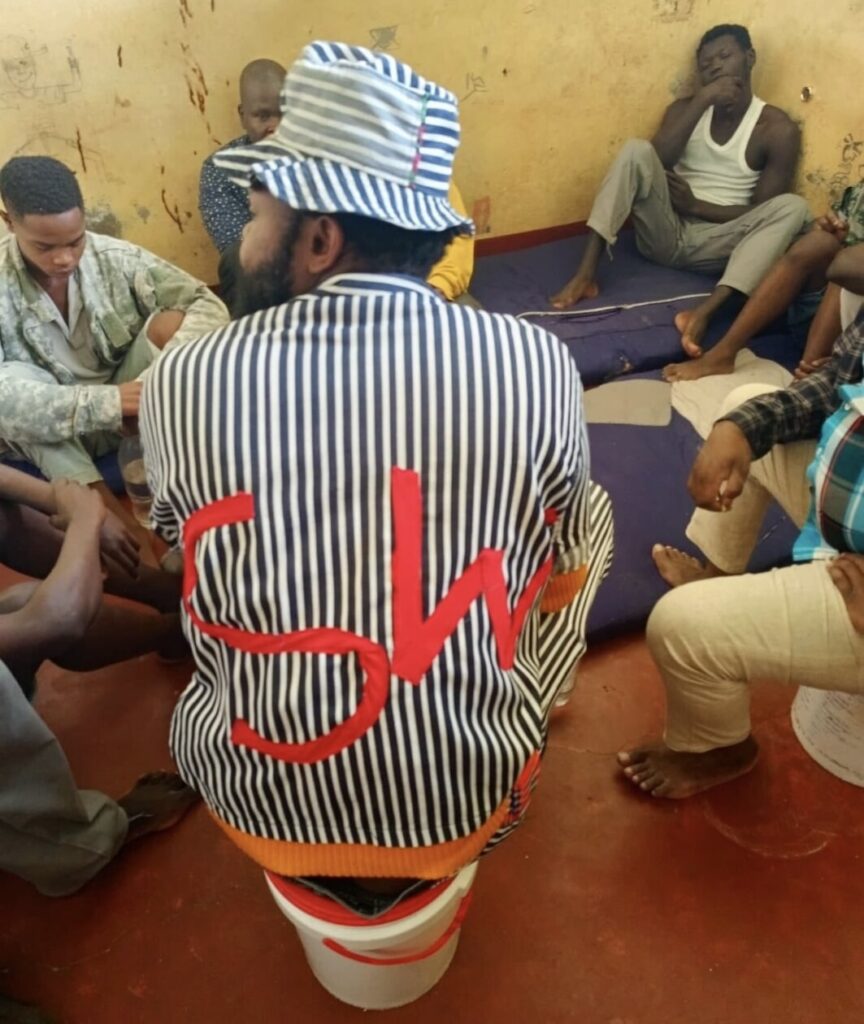
“We were about 400” held on a floor consisting of what he estimates to be an 8 by 20 meters hall, with rows of 3 by 4 meter cells on either side – 27 prisoners packed in each. Several human rights reports have also documented the overcrowding in Kenyan prisons, requiring inmates to sleep on their sides, facing the same direction to fit in, “packed close to one another like sardines.”
“If a privileged prisoner who could pay the police was brought in, a cell would be emptied for him,” which would further overcrowd other cells, added Omole. “So inmates spend most of their time in the hall.”
Holding political education sessions for prisoners and wardens
Sitting on the lid over a dustbin in this hall, shuffling between books, Omole can be seen in a video snuck out of prison lecturing the inmates gathered around him about the commonalities between the guerrilla warfare led by Mao in China and the Mau Mau uprising led by Dedan Kimati in Kenya.
“We had three such sessions at night,” he recalled, observing that the prisoners were readily receptive “to our ideas”. All of them were poor and strongly insisted that it was their instincts to survive poverty that got them into crime.
“None of them had any regrets for their crimes,” he said, adding that they only swore that if given a second chance, they would not get caught. “This goes to show that the idea of prison as a place to reform criminals and rehabilitate them back into society is a myth.”
Wealthy criminals, rarely imprisoned, have a relatively comfortable living space and are not crammed in like the rest. They get to “take walks and have a smoke.” Prison authorities, bribed, allow them wholesome meals brought in from outside. The rest, who cannot pay, have to make do with “some soup and corn bread,” perceptible in their bony frames seen in the video. The prisoners were therefore acutely aware of the class contradictions, Omole said.
This, he said, was “already a firm basis to start the discussion about the capitalist system.” The inmates did not need much explanation to grasp why Kimati, who fought for land, remained criminalized as a terrorist for the most part since independence by the “neo-colonial state”, while the representatives of the wealthier classes were hailed as the heroes of Kenya’s freedom struggle.
Outside of this floor where the violent criminals were held, there was also the so-called “prison school”, where inmates gather for sort of group therapy sessions, recollecting “what got them into prison” and reiterating “why they must change. I exploited that platform to deliver an agitational lecture.”
Prison wardens live like prisoners themselves
The junior prison wardens took an interest, initially out of simple curiosity about a political prisoner. As it grew, “I also held a session with them,” Omole said. “They needed a public figure to engage with their issues.” Their condition was little better than the prisoners themselves. Their homes were essentially four walls and a roof made of iron sheets, emanating a chilling cold in winters and blistering heat in summers.
”There are seven gates” between the rows of jails, with two junior prison wardens placed as guards between each. “They are also locked in. They don’t have the keys. If there is a fire outbreak, they can’t escape either. They have to die with the rest of the prisoners. These work conditions,” Omole explained, naturally gravitated them toward the left-wing ideas he was espousing. “We became good friends. They helped us smuggle in political literature.”
But the political literature was later discovered by the higher authorities. “I was handed another 8 hours in the isolation cell.”
In the meantime, the police finally provided the court with the pre-bail hearing document, whereupon he was granted bail on March 3 for an amount of 500,000 Kenyan shillings, more than the 320,000 the police had allegedly tried to extort from him.
The judge also ordered the police to return all the possessions they had seized from Omole and his co-accused. It included “two cars, an iPhone, a laptop, and the 320,000 Kenyan shillings” they found in the apartment. When Omole went with his lawyer to collect them, he said that Mugambi let loose his police to expel him from the station, leading to a scuffle.
Chargesheet unravels
On March 9, the court issued another order to return them. At the pre-trial hearing that day, Amoth, the complainant and main witness, submitted an affidavit to withdraw from the case, while the Registrar of Firearms also confirmed his gun was legally owned.
The Department of Public Prosecution then sought leave to amend the chargesheet, to change the accusation of illegal possession of a firearm to misuse of a firearm. However, Amoth said in his affidavit, “At the time the police arrived, the firearm was secured in a safe in the upper bedroom, and the magazine was separated from it.”
So the charge of misusing a firearm will not hold either, Omole said, adding the chargesheet will likely be dropped as “defective and untenable. If that happens, we will file a case for wrongful detention and prosecution, and demand compensation.”
While confident that the case against him will fall apart, Omole is certain that the “crackdown against our party will only intensify as we grow in strength. The task we face today is to build a revolutionary organization, capable of fighting back.”

Journalist


