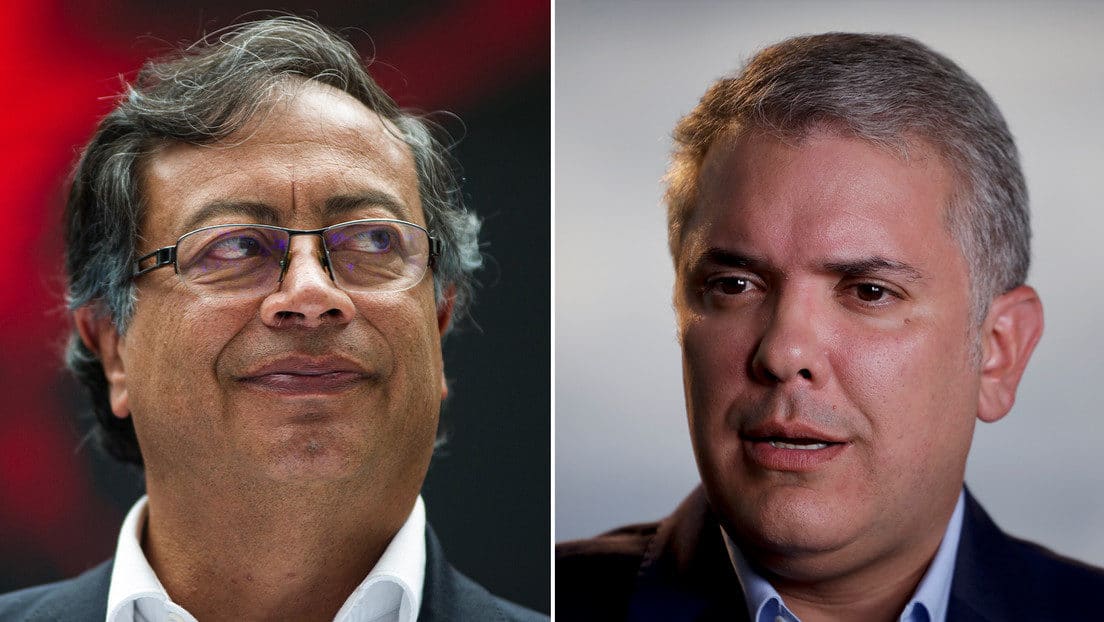
Colombian President Gustavo Petro accused his predecessor, former President Iván Duque (2018-2022), of “tearing to shreds” the peace agreement signed by the government of Juan Manuel Santos with the former FARC guerrillas, by not fulfilling the commitments made by the Colombian state with the former combatants.
During his participation in the National Council for Peace, Reconciliation and Coexistence, Petro said that Duque had four years to enforce the agreements, as he had been president for four of the seven years of the existence of the agreement since it was signed in 2016.
“How many hectares did Duque buy to comply with the first point of the agreement?” questioned Petro, adding that Duque barely complied with “0.3% of the agreement” during his government.
“¿Cuántas hectáreas compró Duque para cumplir el primer punto del acuerdo? 17.000, ¿qué hizo Duque entonces? Hacer trizas el acuerdo de paz”: Presidente Gustavo Petro pic.twitter.com/KFreqd68QT
— BluRadio Colombia (@BluRadioCo) April 11, 2023
“What did Duque do? He shredded the peace agreement to pieces,” the president stressed.
Petro added that in order to comply with the first point of the peace agreement, which was about “Comprehensive Rural Reform” and which includes the purchase of land by the government in order to reduce the inequalities between the countryside and the urban areas, his government and the next one, at least until 2031, have to buy 3 million hectares and hand them over to the peasantry.
Duque solo formalizó 1.300.000 hectareas de tierras, que significa titular a quienes ya están allí, de las 7 millones que pide el acuerdo de paz, pero peor…
Duque solo compró 13.000 hectáreas para la refoma agraria de 3.000.000 de hectáreas que pide el acuerdo https://t.co/1GbniUXaZc
— Gustavo Petro (@petrogustavo) April 11, 2023
President Petro stated that Duque, during his entire term, only formalized the delivery of titles of 1.3 million hectares of land for people who were already in those lands, a figure that cannot be counted as part of point one of the agreement, which requires the purchase of an additional 3 million hectares.
FARC-EP Leaders Back to Armed Struggle – FARC Party Will Continue within the Peace Agreement
Official data
According to Colombia’s National Land Agency, the figures for land titling must be separated from those for purchases because they are different items. The first is the formalization of land tenure, while the second implies the transaction to acquire it.
In this regard, the institution clarified that in the Duque Government, land purchase data had been doubled because 709,936 titled hectares were included in the Land Fund, as if they had been purchased.
👉 En el Gobierno de @IvanDuque se duplicaron cifras. Incluyeron en el Fondo de Tierras 709.936 hectáreas tituladas, como si hubieran sido compradas.
🧵 Hilo a continuación 👇👇
— Agencia Nacional de Tierras (@AgenciaTierras) April 11, 2023
“In reality, in the four years of the government of Iván Duque, only 13,706 hectares were purchased, and in seven months of the government of President Gustavo Petro, 7,028 hectares have been purchased,” the institution explained.
The agency added that during Petro’s administration, more than 1 million hectares have been formalized in seven months, while in Duque’s four years, a total of 1.3 million hectares had been titled.
Moreover, according to the institution, in Petro’s seven months, four Peasant Reserve Zones have been constituted, corresponding to 396,560 hectares, while in Duque’s administration “zero zones were approved, with zero hectares.”
Duque’s opinion
Former President Duque claimed that he can respond “to lies and fallacies,” “with facts and accurate data.” However, his clarifications created more doubts in the controversy.
The former president claimed that during his administration, “1.7 million hectares of land were transferred to the Land Fund, in more than 14,000 properties.”
A la mentira y las falacias se les responde con hechos y datos precisos. Para el 7/08/2022 ingresaron 1.7 millones de hectáreas al Fondo de tierras, en más de 14.000 predios.
Algunos confunden predios con hectáreas intencionalmente o por falta de rigor.
Fuente: @AgenciaTierras pic.twitter.com/Zzu8NAEE4E
— Iván Duque 🇨🇴 (@IvanDuque) April 11, 2023
“Some confuse properties with hectares intentionally or due to lack of rigor,” Duque commented, citing data from the National Land Agency, the same data that had been adultered, according to the agency itself.
Total Peace in Colombia: President Petro Meets With FARC Leaders
Duque also posted on Twitter some graphs and a list of his land achievements. However, none of them talk about land purchases.
“The facts and figures, once again, disprove the fallacies. The advances in land titling and properties in the Land Fund are evident,” said Duque.
Los Datos y las Cifras, una vez más, desmienten las falacias.
Quedan en evidencia los avances en titulación y predios en el Fondo de Tierras. pic.twitter.com/FKEw1eK1eM— Iván Duque 🇨🇴 (@IvanDuque) April 11, 2023
Former FARC combatants have accused the Duque administration of violating the peace agreements signed in 2016 and of provoking the emergence of the FARC dissidents, who justified their return to arms due to non-compliance with the treaty and fear of being killed. Among the signatories who returned to war is guerrilla leader Iván Márquez.
According to data from Colombia’s Institute for Development and Peace Studies (Indepaz), since the signing of the agreements in 2016, 354 demobilized ex-guerrillas have been killed, the vast majority of them during the Duque administration.
(Resumen Latinoamericano – English)