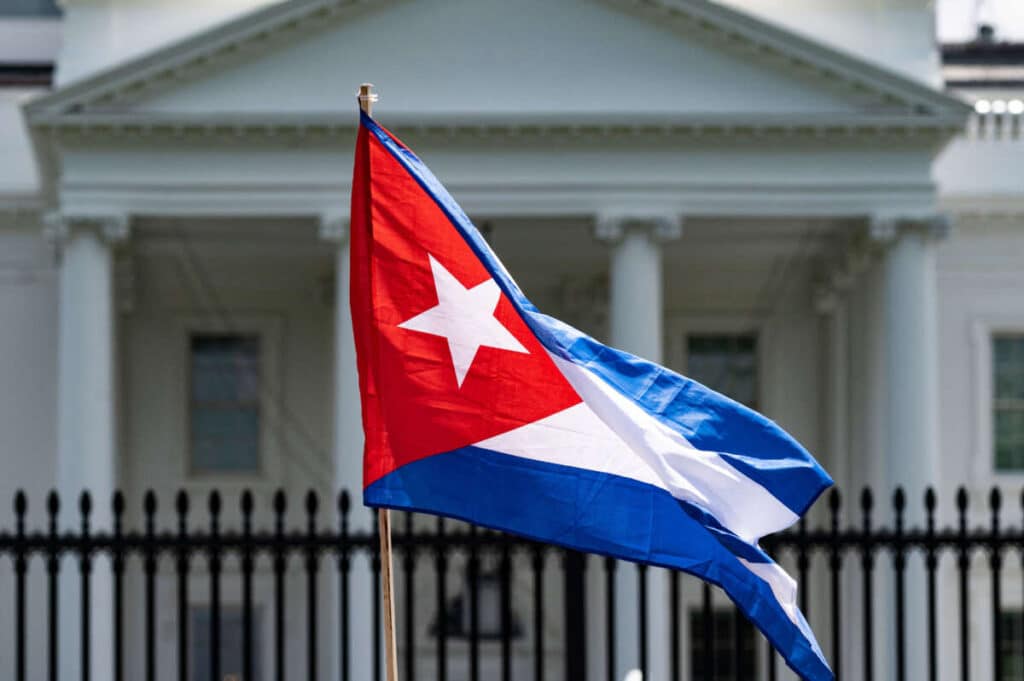
A demonstrator holds up the Cuban flag while protesting in front of the White House in Washington, D.C., on July 12, 2021. Photo: Jim Watson/AFP via Getty images.
A demonstrator holds up the Cuban flag while protesting in front of the White House in Washington, D.C., on July 12, 2021. Photo: Jim Watson/AFP via Getty images.
By Marjorie Cohn – Jan 5, 2023
Biden has maintained many of Trump’s sanctions against Cuba. He must fulfill his promise to reverse Trump’s actions.
The current U.S. government, the one of Joseph Biden, of all those that the Cuban Revolution has known, is the one that has most aggressively and effectively applied the economic blockade,” Carlos Fernández de Cossío, vice minister of Foreign Affairs of Cuba, declared in a speech on December 14. “It is the one that punishes the most, the one that causes the most damage to the daily life of Cubans and the economy as a whole.”
Fernández de Cossío cited the disruption of Cuba’s fuel receipt by sea, and economic depression resulting in the “extraordinary flow of Cuban migrants” as examples of the severe harms that Cubans have faced under the Biden administration’s implementation of the blockade.
In his address at a conversation series on “Cuba in the Foreign Policy of the United States of America,” held on December 14 at the Higher Institute of International Relations in Havana, Fernández de Cossío took aim at the Biden administration’s enforcement of the blockade against Cuba, stating, “there can be no doubt that the economic blockade is the defining factor in the bilateral relations” between the United States and Cuba.
Biden pledged during his 2020 presidential campaign that he would “try to reverse the failed Trump policies that inflicted harm on Cubans and their families.” In 2021, he claimed, “We stand with the Cuban people.”
But Biden’s actions belie his words. Fernández de Cossío said that Biden has applied “with absolute and surprising loyalty … the policy of maximum economic pressure that was designed by his predecessor, Donald Trump.”
In 2015, the Obama administration restored full diplomatic relations with Cuba, released Cubans imprisoned in the U.S. for trying to deter further terrorist attacks against Cuba, relaxed restrictions on Americans traveling to Cuba, and ended some economic prohibitions between the U.S. and Cuba. It also facilitated the export of U.S. internet hardware and telecommunications and established increased cooperation between the United States and Cuba in intelligence-gathering, drug interdiction, scientific research and environmental protection.
Trump undid the progress Obama had made and imposed 243 onerous new sanctions — known as unilateral coercive measures in international law — on Cuba as part of his “maximum pressure” strategy.
The Embargo Was Imposed to Cause Cubans Hunger and Desperation
More than 60 years ago, following the triumph of the 1959 Cuban Revolution, the U.S. government imposed an economic embargo on Cuba. The rationale for the embargo was detailed in a State Department memo that advocated the “disenchantment and disaffection” of the Cuban people through “economic dissatisfaction and hardship” so they would overthrow the Fidel Castro government. The memo recommended the denial of “money and supplies to Cuba, to decrease monetary and real wages, to bring about hunger, desperation and overthrow of government.”
The embargo (which the Cubans call a blockade) “is not a single law, but a complex patchwork of laws, presidential proclamations, and regulations that Fidel Castro once called ‘a tangled ball of yarn,’” American University professor and Cuba scholar William M. LeoGrande wrote in the National Security Archive. “It has evolved over the sixty years since President John F. Kennedy put it in place, loosening and tightening from one administration to the next, depending on the president’s preference for using hard power or soft power in dealing with Cuba.”
Since the Cuban Revolution, the United States “has waged an unceasing assault, both military and economic, against the Cuban people, organizing an invasion, assassinations, terrorist attacks against civilians and systematic economic sabotage,” Isaac Saney wrote at Resumen. The blockade has cost Cuba more than $130 billion in damage, according to the United Nations.
Some Positive Bilateral Steps Taken Last Year
Despite this rocky history, Fernández de Cossío acknowledged that some positive bilateral steps were taken between the United States and Cuba last year. He cited migration cooperation; U.S. grants of 20,000 visas annually; a return to U.S. embassy services in Havana; cooperation between Cuban Border Guard Troops and the U.S. Coast Guard for interception on the high seas and return to Cuba; an agreement to hold exchanges on law enforcement, oil spills, health and the environment; and commercial flights from the United States to different Cuban provinces. The United States has again authorized “people to people” educational group travel to Cuba, but individual travel for education is still prohibited.
Fernández de Cossío also praised U.S. offers of humanitarian aid to Cuba “without political conditions” after a fire at the supertanker base in Matanzas last August and $2 million for repairs after Hurricane Ian. But Cuba still has not received that assistance.
Negative Steps Taken by the Biden Administration
The vice minister of foreign affairs also listed “developments in the opposite direction.” These include the recent U.S. designation of Cuba as a country of special concern in matters of religious freedom “without any real basis, on grounds that are dishonest.”
“In late 2022, the Biden administration took the unprecedented action to list Cuba as a nation of ‘special concern’ regarding religious freedom — which even the Trump administration did not do, and which was not recommended by the related commission created by U.S. law. This is absurd,” Art Heitzer, co-chair of the National Lawyers Guild’s Cuba Subcommittee, told Truthout.
“Members of my Methodist church were prosecuted by the U.S. government for visiting their sister Methodist church’s centennial in Havana,” Heitzer said. “The late Cardinal Jaime Ortega, then head of Cuba’s Roman Catholic Church, told me after mass at the cathedral that he favored ending the U.S. embargo; and because of religious objections, the Cuban government delayed by several years the referendum process which has now granted constitutional protection to same-sex marriage.”
Fernández de Cossío also mentioned the Biden administration’s commitment in May to allow remittances to Cuba, but said that still has not happened and there is no “commitment to dismantle the measures announced by the Trump administration to disrupt the remittances.”
In addition, although the U.S. government announced measures to boost internet penetration and interconnection in Cuba, the United States still prohibits access for Cubans to more than 200 private commercial websites, according to Fernández de Cossío. This includes sites for education, health, science and technology, art, culture and innovation.
The U.S. government, Fernández de Cossío stated, admits that it “intends to promote the Cuban private sector, not to contribute to the development of the Cuban economy, not to improve the standard of living of the population, not to help a majority sector of the population, but rather identifies it as an instrument of political subversion … a political weapon.”
What Biden Could Do to Relax the Blockade
Fernández de Cossío described steps Biden could take “to deliver on his declared priority of promoting human rights and caring for the welfare of the Cuban people.”
Biden could remove Cuba from the list of State Sponsors of Terrorism. In 2015, the Obama-Biden administration removed Cuba from the list. But at the end of Trump’s term, his State Department added Cuba back onto the list. Within weeks, Fernández de Cossío noted, “45 banks and financial institutions with long-standing relations with Cuba severed their ties with our country.” This impacted Cuba’s trade and access to credit. “It is a devastating impact,” he said. “And even today, on account of its presence on that list, Cuba is still encountering trade and financial organizations that refuse to interact with us for fear of retaliation by the U.S. government.”
Dozens of lawyers have signed an open letter to Biden, stating, “There is no legal or moral justification for Cuba to remain on the State Sponsors of Terrorism list.” They wrote, “Biden has the power to remove Cuba from [the list] and reverse many Trump-era sanctions through executive action. However, Biden has chosen to defend Trump’s aggressive policies.”
Trump also stiffened the economic and travel blockade and activated Title III of the Helms Burton Act, which was enacted to discourage foreign investment in Cuba. Trump’s activation of Title III greenlighted thousands of lawsuits that will discourage tourism and investment in Cuba. In one such lawsuit, U.S. District Judge Beth Bloom issued an order on December 30 against four Florida-based cruise shipping companies that sailed to Cuba, requiring them to pay more than $400 million in damages. Fernández de Cossío pointed out that Biden could have suspended Title III like Trump’s predecessors. Activating Title III has had “a deterrent impact on our developmental purpose of attracting foreign capital,” he added.
In addition, “[The Biden] administration could have ceased the practice of pressuring governments in Africa, Asia, and Latin America to refuse medical cooperation provided by Cuba,” Fernández de Cossío said. “This U.S. action, of course, is intended to prevent dozens of thousands of people from receiving medical services, which is what Cuban doctors provide.”
Biden could also have ended “punitive measures, threats, and persecution against fuel exporting companies, shipping companies, port agencies, insurance and reinsurance agencies all aimed at depriving Cuba of fuel supplies that our country requires to function,” which “has had an extremely severe impact on the economy and the lives of the Cuban people,” according to Fernández de Cossío.
Rinse and Repeat: Will Biden Make Normalizing Relations with Cuba a Priority?
The Purpose of the Blockade Is Regime Change
The blockade, the vice minister said, “has an impact on everything.” That includes electrical service, transportation, the availability of medicine and material for medical services, and the ability to obtain supplies for food production and building materials.
“The U.S. government cannot pretend to treat Cuba as if it were part of its territory or treat Cuba as if it were a colonial dominion, or treat Cuba as if it were an adversary defeated in a war. We are none of the three,” Fernández de Cossío declared. He cited Cuban President Miguel Díaz-Canel’s observation that the intention of the United States is “to strangle the Cuban economy and thus try to provoke social collapse and a political crisis in Cuba.” Although the U.S. has failed in that purpose, it has led to “economic depression” in Cuba and “the extraordinary flow of Cuban migrants.”
Biden himself has called Cuba a “failed state,” and his administration “is doing virtually all that it can to make it so,” Heitzer said.
“The embargo’s overt purpose is to strangle the Cuban economy to promote regime change,” according to the Alliance for Cuba Engagement and Respect (ACERE), a coalition of organizations working to end the Cuba blockade. The United States spends more than $25 million each year to fund regime change programs against Cuba.
On November 3, for the 30th time, the United Nations General Assembly called for an end to the illegal U.S. blockade against Cuba. The vote was 185 in favor, two opposed (the U.S. and Israel), and two abstentions (Brazil and Ukraine). The resolution affirmed “the sovereign equality of States, non-intervention and non-interference in their internal affairs and freedom of international trade and navigation, which are also enshrined in many international legal instruments.”
Joe Biden must make good on his promise to reverse Trump’s actions tightening the blockade against Cuba, return to the measures taken by the Obama-Biden administration, and work to dismantle the illegal and immoral blockade once and for all.
Marjorie Cohn is a professor of law at the Thomas Jefferson School of Law, San Diego, California, and a former president of the National Lawyers Guild. In 1978 Cohn received a job in the International Association of Democratic Lawyers.