By W. T. Whitney, Jr. – Feb 28, 2021
Cuba’s socialist approach to developing vaccines against COVID-19 differs strikingly from that of capitalist nations of the world. Cuba’s production of four vaccines is grounded in science and dedicated to saving the lives of all Cubans, and to international solidarity.
The New York Times’s running report on the world’s vaccine programs shows 67 vaccines having advanced to human trials; 20 of them are in the final phase of trials or have completed them. The United States, China, Canada, the United Kingdom, Germany, South Korea, and India have each produced many vaccines; most vaccine-manufacturing countries are offering one or two vaccines.
Cuba is the only vaccine manufacturer in Latin America; there are none in Africa. The only state-owned entities producing the leading vaccines are those of Cuba and Russia.
Cuba’s Finlay Vaccine Institute has produced two COVID-19 vaccines. Trials for one of them, called Sovereign I, focus on protecting people previously infected with COVID-19. The antibody levels of some of them turned out to be low, and the vaccine might provide a boost.
The other vaccine, Sovereign II, is about to enter final human trials. For verifying protection, these trials require tens of thousands of subjects, one half receiving the vaccine and the other half, a placebo vaccine. Cuba’s population is relatively small, 11 million people, too small to yield enough infected people in the short time required to test the vaccine’s protective effect. That’s why Sovereign II will be tested in Iran.
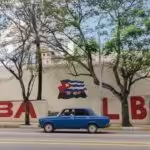
100 million doses of Sovereign II are being prepared, enough to immunize all 11 million Cubans, beginning in March or April. The 70 million remaining doses will go to Vietnam, Iran, Pakistan, India, Venezuela, Bolivia, and Nicaragua. Sovereign II “will be the vaccine of ALBA,” explained Venezuelan Vice President Delcy Rodríguez, referring to the solidarity alliance established in 2004 by Venezuelan President Hugo Chavez and Cuba’s Fidel Castro.
“Cuba’s strategy in commercializing the vaccine represents a combination of what’s good for humankind and the impact on world health. We are not a multinational where a financial objective comes first,” says Vicente Vérez Bencomo, director of Cuba’s Finlay Vaccine Institute. Income generated by vaccine sales abroad will pay for health care, education, and pensions in Cuba just as happens with exports of medical services and medicines.
RELATED CONTENT: Two Victories in Cuba Shape the World Today
Cuba’s Center for Genetic and Biotechnological Engineering is developing two other COVID-19 vaccines; One, named “Mambisa” (signifying a female combatant in wars of liberation from Spain), is administered via the nasal route, just as is Cuba’s hepatitis B vaccine. The other vaccine, named “Abdala” (a character in a Jose Martí poem) is administered intramuscularly. The two vaccines are involved in early trials.
Cuba was ready
Cuban education emphasizes science and technology. In the 1990s, Cuba accounted for 11% of doctorate-level Latin American scientists. Cuban scientists work in the 50 or so biomedical research and production facilities which together make up Cuba’s state-owned BioCubaFarma Corporation, and which produces vaccines, drugs, medical tests, and medical equipment. It makes 60% of medicines used in Cuba, and 8 of 12 vaccines.
Cuba previously produced a pioneering vaccine that prevents life-threatening infection caused by type B meningococcus. Cuba developed a genetically-engineered hepatitis B vaccine and a vaccine offering palliative treatment for lung cancer. A Cuba-developed vaccine offers protection against infection, particularly childhood meningitis, caused by the Hemophilus Influenza type B bacterium.
In fashioning vaccines, Cuban scientists relied on familiar technology.
To provide an immunological extra, the antigen of Cuba’s Sovereign II vaccine is mixed with tetanus toxoid, as was done with Cuba’s Hemophilus influenza vaccine. As with other vaccines, scientists used a segment of the virus’s protein – here the COVID-19 virus – to form an antigen to stimulate protective antibodies. By contrast, the U. S. Pfizer and Moderna vaccines contain the whole viral protein, not a segment. That protein contains “genetic instructions” which enter human cells, causing them “to make spike proteins, which then get released into the body” where they trigger antibodies.
Observers suggest that this innovative U.S. technology may be less safe than the one used in Cuban vaccines. Not requiring extremely cold storage, as do the U.S. vaccines, the Cuban vaccines are suited for areas without adequate refrigeration capabilities.
RELATED CONTENT: Cuba Aims to Immunize its Population this Year with its own Coronavirus Vaccine
Cuba’s bio-medical production sector has also created drugs for treating Covid-19 infection. Interferon, an antiviral agent developed in Cuba, produced in China, and used throughout the world, prevents many Covid – infected patients from becoming critically ill. The Cuban anti-inflammatory drug Jusvinza, used for treating auto-immune diseases, and Cuba’s monoclonal antibody Itolizumab, which moderates exaggerated immune responses, are both effective in reducing Covid-19 deaths.
The other way
The U. S. approach to producing and distributing COVID-19 vaccines is based on private enterprise, although the U. S. government did deliver billions of dollars to pharmaceutical companies to produce vaccines free of charge to recipients. The companies have contracted with purchasers abroad.
According to forbes.com in November, 2020, ‘If Moderna’s [vaccine] can get FDA approval and can make enough doses, its top line could be nearly $35 billion higher … than … in the last 12 months.” Another report suggests that, “The companies (Pfizer and Moderna) stand to earn billions of dollars in profits from their COVID vaccines this year [and] there will be more profits in later years.” The companies “claim the rights to vast amounts of intellectual property.”
With corporations in charge, distribution of COVID-19 vaccines is skewed. As of Jan. 27, “some 66.83 million doses have been sent out, of which 93 percent were supplied to only 15 countries.” In Latin America, only Brazil, Argentina, Mexico, and Chile have secured purchase contracts adequate for immunizing entire populations. The companies’ contracts with African nations allow for immunization of only 30 percent of Africans in 2021. Meaningful immunization has yet to begin there.
The wealth divide determines distribution. Epidemiologists at Duke University report that, “While high-income countries represent only 16% of the world’s population, they currently hold 60% of the vaccines for COVID-19 that have been purchased so far.” Cuban journalist Randy Alonso reports that only “27 percent of the total population of low and middle income countries can be vaccinated this year.”
“The world is on the brink of a catastrophic moral failure – and the price of this failure will be paid with lives and livelihoods in the world’s poorest countries,” declared Dr. Tedros Adhanom Ghebreyesus, director of the World Health Organization, on January 18. He warned that, “some countries and companies continue to prioritize bilateral deals, going around COVAX, driving up prices and attempting to jump to the front of the queue.”
The WHO initiated the global vaccine collaboration COVAX to assure access by poor nations to COVID-19 vaccines. The 190 nations that are enrolled agreed to obtain vaccines through COVAX. Rich nations would supply COVAX with funds to enable 90 poor nations to receive no-charge vaccines. COVAX anticipates distributing two billion doses, enough to immunize only 25 % of the populations of poor nations during 2021.
Problems include: wealthy nations order vaccines independent of COVAX; they buy more vaccine than they need; manufacturers set prices; and prices are secret, variable, and very high.
Most other countries producing COVID-19 vaccines are at variance with Cuba through their profiteering and because they are complicit with the U.S. economic blockade of Cuba. Pursuing routine overseas commercial affairs, they all too easily adjust to U.S. regulations by means of which that cruel policy is enforced. More to the point, the U.S. blockade hinders Cuba’s vaccine efforts, and they are silent.
“We don’t have in Cuba all the raw materials and supplies we’ll need for the unprecedented scale of production that vaccinating our whole population requires,” Dagmar García-Rivera, Director of Research at Cuba’s Finlay Vaccine Institute, explained. “They have to be purchased and for this, we need financing. This is made infinitely more difficult by the US embargo … Procuring the necessary reagents for research and the raw materials for production is a challenge we face daily.”
In confronting the pandemic, Cuba exhibits attention to detail suggestive of a level of caring and concern not readily matched elsewhere. For example, Cuba’s government-friendly cubadebate.cu website provides a daily, detailed update of the infection’s impact. Its report on Jan. 27 presents data relating to cities, provinces, the nation, and the world – and the nation’s intensive care units. Readers learn that of 43 patients in intensive care that day, 16 were in critical condition, stable or unstable, and 27 were in “grave” condition.
All 43 cases are reviewed, beginning with: “Cuban citizen, 75 years old, from Alquízar, in Artemisa, already suffering from arterial hypertension and ischemic cardiopathy who is afebrile, on mechanical ventilation, is hemodynamically stable… with acceptable blood gases (oxygen and CO2), is improving radiologically with inflammatory lesions in the right [lung] base – reported as critical but stable.” The cases of four Cubans who died that day are also presented.
Fighting a pandemic in Cuba, it’s understood, is no casual matter. Nor is the health of Cuba’s people.
Featured image: File Photo

W.T. Whitney Jr.
W.T. Whitney Jr. grew up on a dairy farm in Vermont and now lives in rural Maine. He practiced and taught pediatrics for 35 years and long ago joined the Cuba solidarity movement, working with Let Cuba Live of Maine, Pastors for Peace, and the Venceremos Brigade. He writes on Latin America and health issues for the People's World.