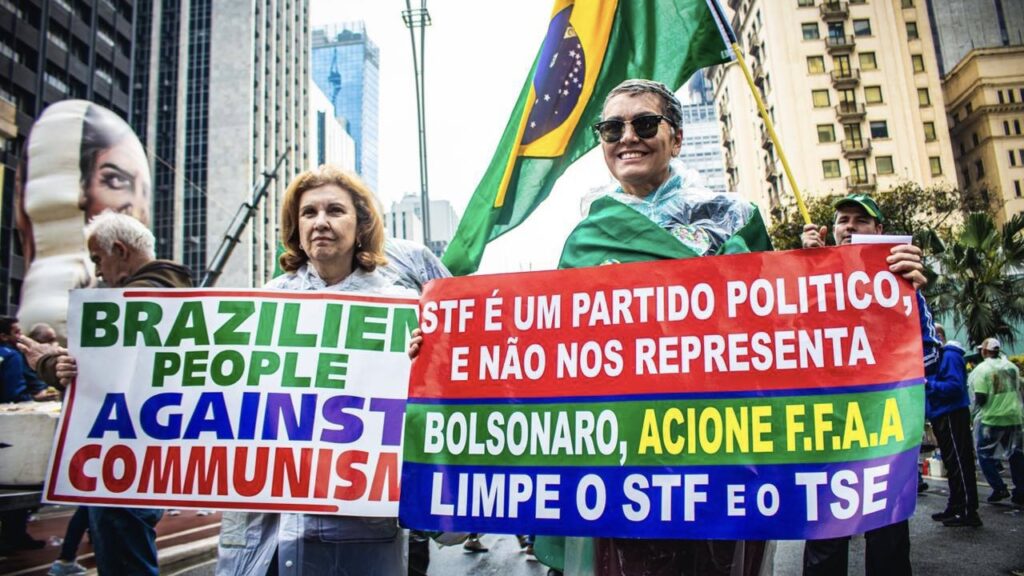
Bolsonaro supporters on September 7 in São Paulo. Photo: Junior Lima.

Orinoco Tribune – News and opinion pieces about Venezuela and beyond
From Venezuela and made by Venezuelan Chavistas
Bolsonaro supporters on September 7 in São Paulo. Photo: Junior Lima.
By Zoe Alexandra – Sep 13, 2022
In the lead-up to the general elections in Brazil, the far-right has intensified its campaign of hysteria and fear-mongering instead of providing concrete solutions to the crises affecting the people
Brazil is less than a month away from historic elections. Over 156 million Brazilians will go to the polls on October 2 to cast their vote for the president of the republic, State governors, 27 senators, 513 federal deputies, and State and district deputies. The elections take place amid an acute political, economic, and social crisis in the country. The past several years have seen a dramatic increase in hunger, homelessness, unemployment, and the prices of basic commodities. The currency, the Real, has tumbled. Above all, the colossal number of deaths due to COVID-19 continues to cast a shadow on the lives of millions.
Despite this moment of national crisis, the far-right candidate in the elections, President Jair Bolsonaro, has dedicated much of his campaign to sowing divisive, angry, and hateful rhetoric.
This messaging was on display in the massive right-wing protests organized by Bolsonaro supporters in Brasília, São Paulo, and Rio de Janeiro on September 7, the 200th anniversary of Brazil’s independence from Portugal. In response to a call made by Bolsonaro himself, tens of thousands of his supporters took to the streets donning green and yellow clothing and Brazilian flags.
More than a celebration of the country’s independence, the mobilizations were focused on mobilizing support for Bolsonaro as well as for other right-wing congressional candidates in the upcoming elections. The mobilization in Rio de Janeiro is already being investigated by the Public Prosecutor’s office for having used public funds meant for the celebration of Independence Day for political campaigning. In addition, Bolsonaro and his allies have been criticized for their speeches that contained not only open calls for violence and misinformation that has already been debunked, but also threats to subvert the democratic order and break electoral law.
“Military intervention, NOW!”
Bolsonaro’s supporters for the past several years have been calling for the Armed Forces of Brazil to intervene against “corrupt” institutions, largely of the judicial branch, to “save” Brazil. The September 7 rallies saw thousands of people raise slogans and hold banners demanding “MILITARY INTERVENTION NOW!” and “purge of the STF [Supreme Federal Court]!”
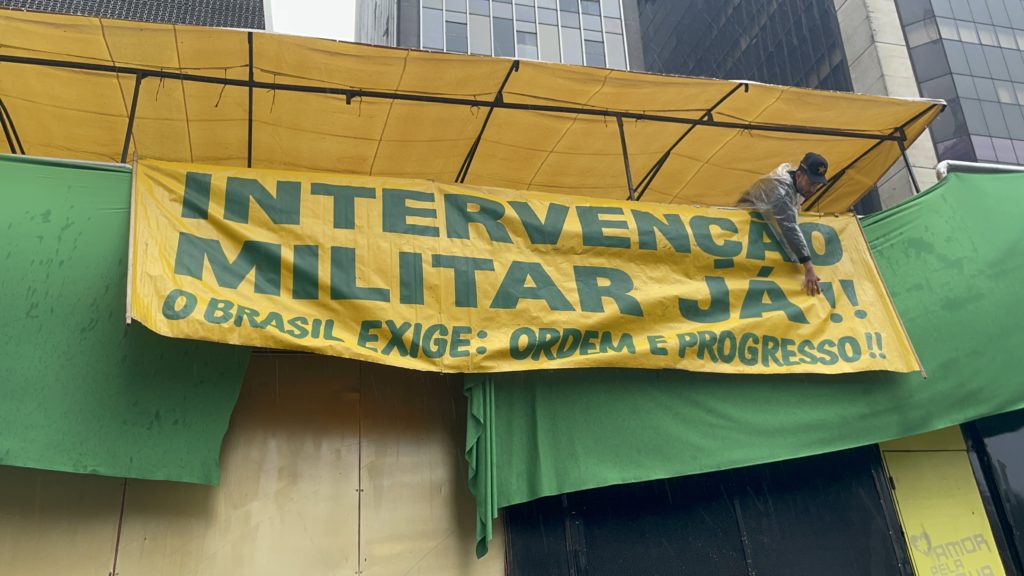
Where does this call for a military ‘self-coup’ come from?
Despite having won the presidential elections in October 2018, Bolsonaro alleged that he was robbed of a first round victory because Brazil’s electronic voting system allowed for the manipulation of results. Since then, his criticisms of the electronic voting system have only intensified and he has time and again demanded a return to paper ballots. It is important to note that both the allegations of fraud and about the electronic voting system have been debunked.
The problem for Bolsonaro is that the electoral system is under the power of the Supreme Electoral Tribunal (TSE). The TSE is part of the judicial branch and is composed of seven ministers, three of whom are from Brazil’s Supreme Federal Court (STF). Bolsonaro has tried to pressure the TSE and STF to enact his desired changes, but they have defended the current system. In response, he has called for and attempted to disband the current TSE and STF.
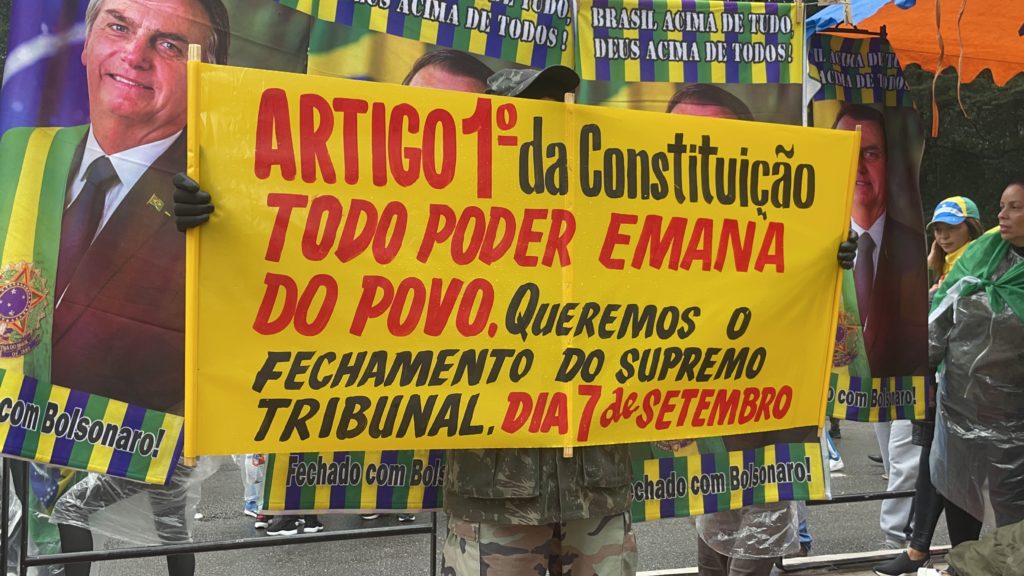
In February 2021, Daniel Silveira, a far-right, Bolsonarist, ex-military policy officer, and federal deputy, was arrested and put in prison after publishing a video with threats against the TSE and the STF and statements defending the AI-5 decree of the last military dictatorship which tore down the constitution. His arrest warrant was issued by Alexandre De Moraes, president of the STF, and upheld in a unanimous vote by the 11 members of the STF. This action further angered Bolsonaro and his supporters, with the president issuing a pardon to get him out of prison.
The STF has provoked the ire of Bolsonaro and his supporters for numerous other actions. At the beginning of the pandemic, Bolsonaro attempted to restrict local government officials from implementing isolation policies with a presidential order, but the STF ruled against it, allowing State governors to have autonomy from the executive to implement stricter COVID-19 policies. The judicial body has also investigated him and his sons for violations of the law, including sharing fake news about the voting system and spreading false information about COVID-19 medication.
Save Brazil from communism?
The promise to “save Brazil from communism” is a major talking point of Bolsonaro and the dozens of far-right candidates standing for Congress and local government seats. This rhetoric is far from new. In recent election campaigns in countries across Latin America and the Caribbean, this slogan is often accompanied by “so we don’t become like the leftist dictatorships of (insert Venezuela, Nicaragua or Cuba).” In Brazil, Argentina is also widely used as a cautionary tale. Bolsonaro, as well as his colleagues and supporters, describe these countries as lawless, economically devastated and lacking morals, amongst other charges.
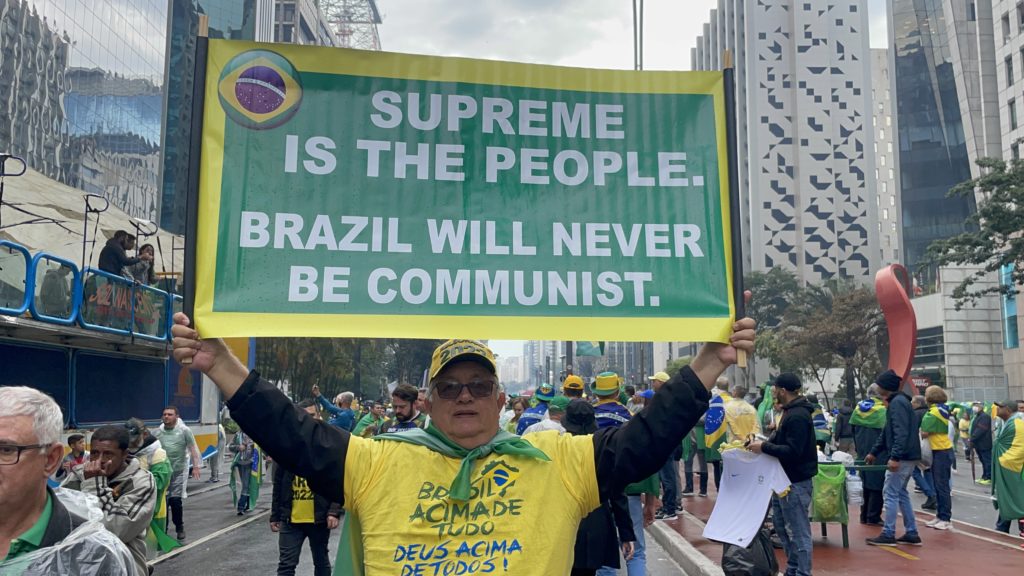
However, little attention is paid to the current situation in Brazil which has seen tremendous setbacks in the past several years under the governments of neoliberal conservative Michel Temer and far-right neoliberal Bolsonaro.
Under Bolsonaro’s administration, the program Bolsa Familia, recognized internationally by the United Nations and the World Bank for its success in combating poverty and taking Brazil off of the UN’s hunger map, was ended. In its place, his administration implemented significantly less-funded and limited programs, Auxílio Brasil and Alimentar Brasil.
The results are palpable and devastating. According to the 2nd National Survey on Food Insecurity in the Context of the COVID-19 Pandemic in Brazil published in June 2022, 33 million Brazilians are hungry, which is the highest number recorded in the last 30 years. Nearly 125 million people are suffering from some level of food insecurity. This is an increase of 60% since 2018.
The Brazilian currency, the real, has devalued by 37.5%, with USD 1 equivalent to 5.2 reals in 2022, compared to an average of at 1.95 reals to 1 USD in 2012. Over the past 12 months, Brazil has seen over 8% rate of inflation in items of basic consumption. Furthermore, according to a study by the Institute of Teaching and Research (Insper), the real has lost 50% of its purchasing power over the past 10 years.
The homeless population in Brazil has also increased by leaps and bounds in this same period. A study by the Institute of Applied Economic Research showed that this population increased by 140% between September 2012 and March 2020. They estimate that in March 2020, there were 221,000 people living on the streets in the country and that this number would increase. 70% of this population works in some capacity and 67% of them are Black.
Is it really communism that Brazil needs saving from?
God, homeland, family, freedom
The slogan “god, homeland, family, freedom” can be heard in almost every speech made by Bolsonaro as well as by Bolsonarist candidates and supporters. The appeal to return to these “traditional values” is one of his key messages, and part of his widespread appeal to more socially conservative sectors of Brazilian society such as Evangelicals and other Christian groups.
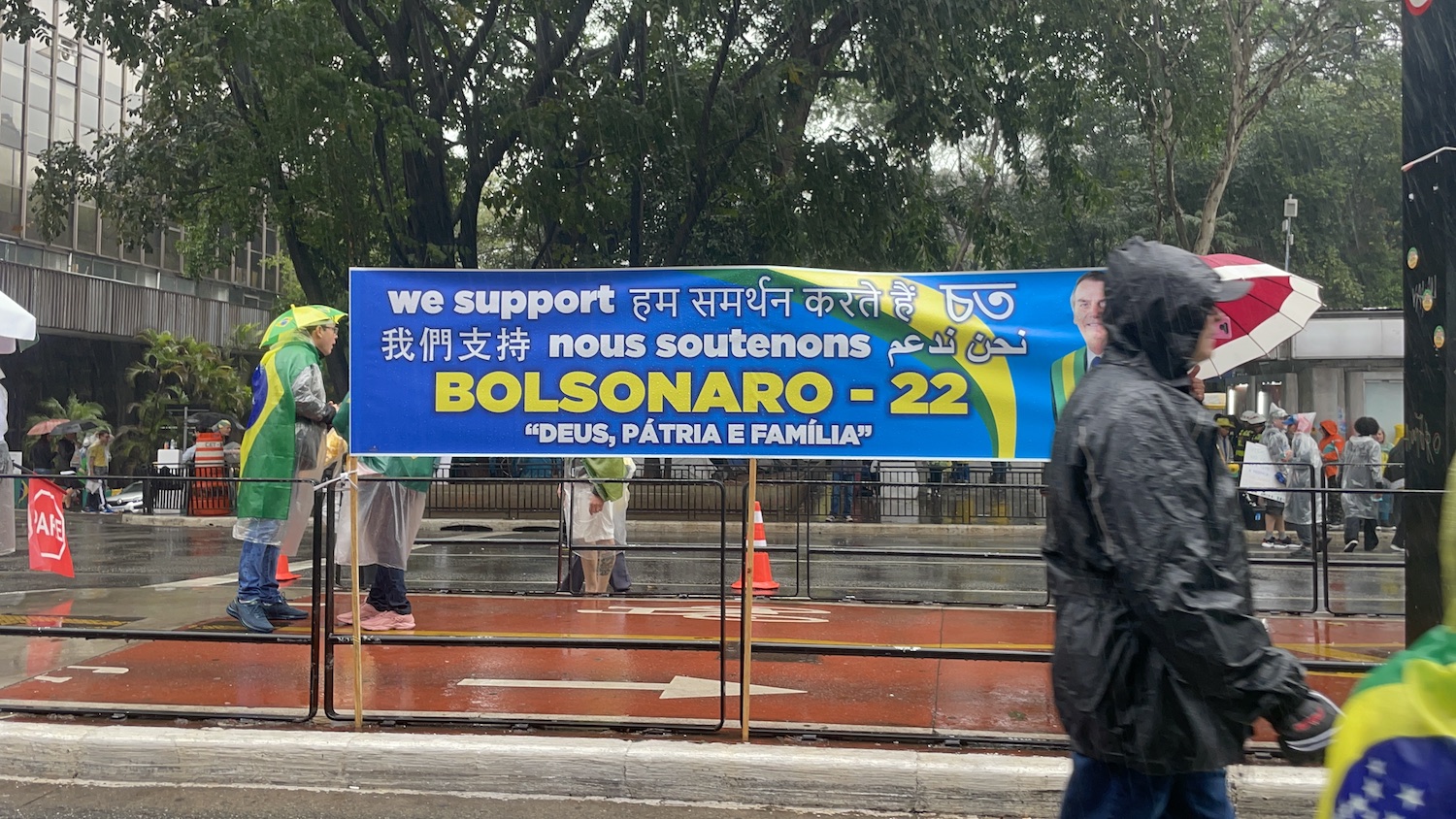
The slogan itself has roots in a multitude of far-right, Christian movements in Brazil’s history including the fascist Free Brazil Association, the Tradition Family Property movement, Brazilian Integralist Action parties, and others. In 2022, this slogan can be seen as a response to the expansion of the rights of oppressed groups such as women and LGBTQI+ people. It is often accompanied by diatribes against the right to abortion, the right to same-sex marriage, and the minimal rights and recognition won by transgender people. For Bolsonarists, all these developments mark the ‘degradation’ of society and a violation of these ‘traditional values.’
As elections draw nearer, these messages only intensify and multiply. They fuel fake news campaigns on social media and troll attacks on opponents. Instead of focusing on the real issues facing the Brazilian people and solutions to resolve them, the far-right has appealed to the broad discontent of the population and fed them hatred and fear.
Movements fight for the excluded
Meanwhile, people’s movements in Brazil have doubled down on their efforts to support and protect vulnerable populations in Brazil that have been most affected by this crisis. The examples are boundless. On Sunday September 11, after a Bolsonaro supporter publicly humiliated a woman by threatening to cut off her food assistance because she supports Lula, the Landless Rural Workers’ Movement (MST) vowed to provide her with food produced by the movement for the next six months.
Brazil’s MST on the Fight Against Evictions and Bolsonaro (Interview)
On September 7, movements in Brazil organized the “Cry of the Excluded” to draw attention to the incomplete nature of independence and the historic inequities that exist within the country. This year, movements organized mass food distribution drives and emphasized their demand that the government guarantee access to housing, food, and healthcare for all.
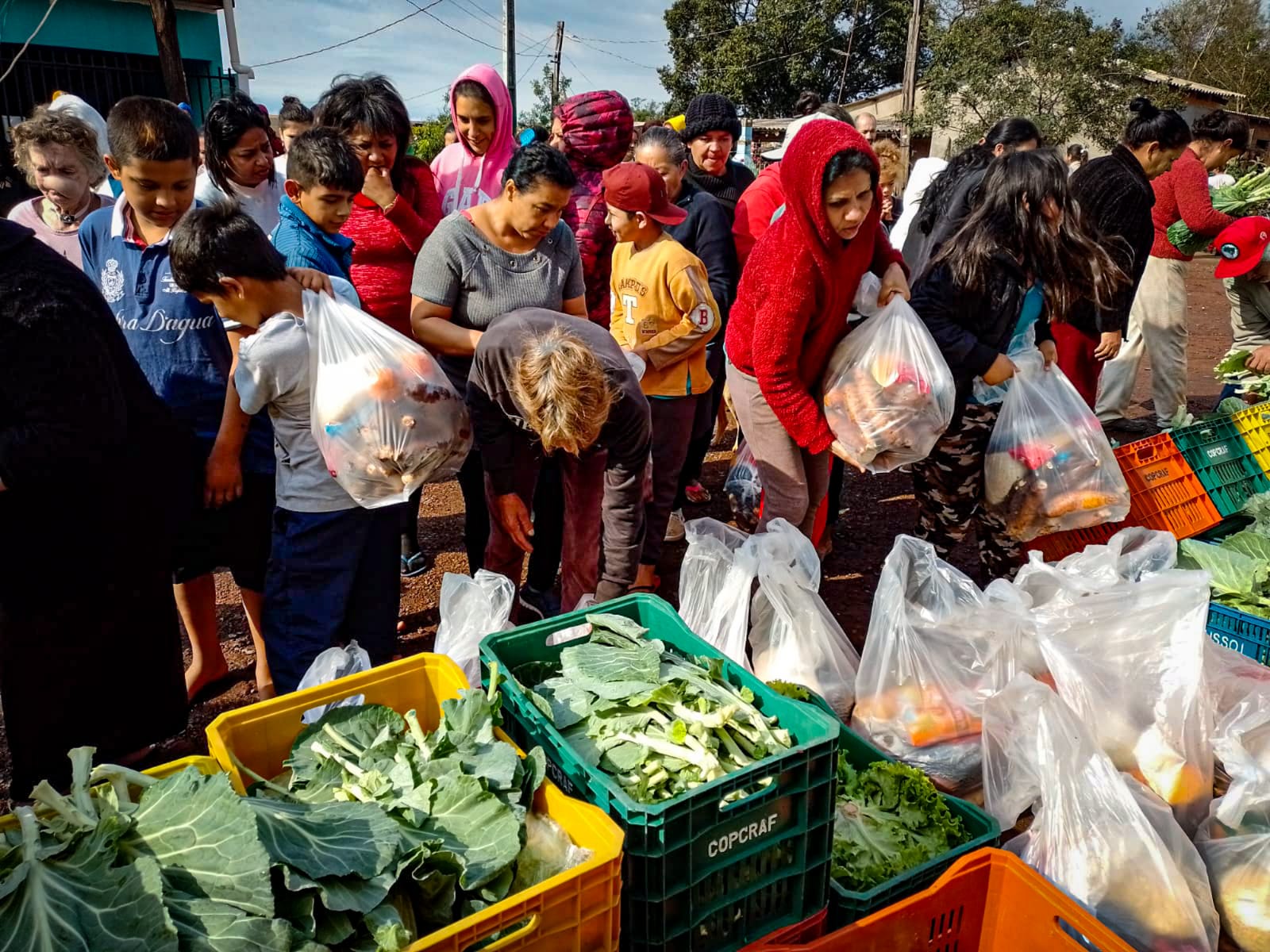
In a symbolic action at the Independence Monument organized by the MST, Popular Youth Uprising, and People’s Brazil Movement, militants held up banners reading “For a people’s independence” and “Democracy always – #OutBolsonaro”. One of the participants, Renata Menezes of the youth of the MST, declared, “It is only possible to be a sovereign country if we direct our destiny towards the well-being of all Brazilian people. We will only be independent if we build a sovereign project for the people in our country.”