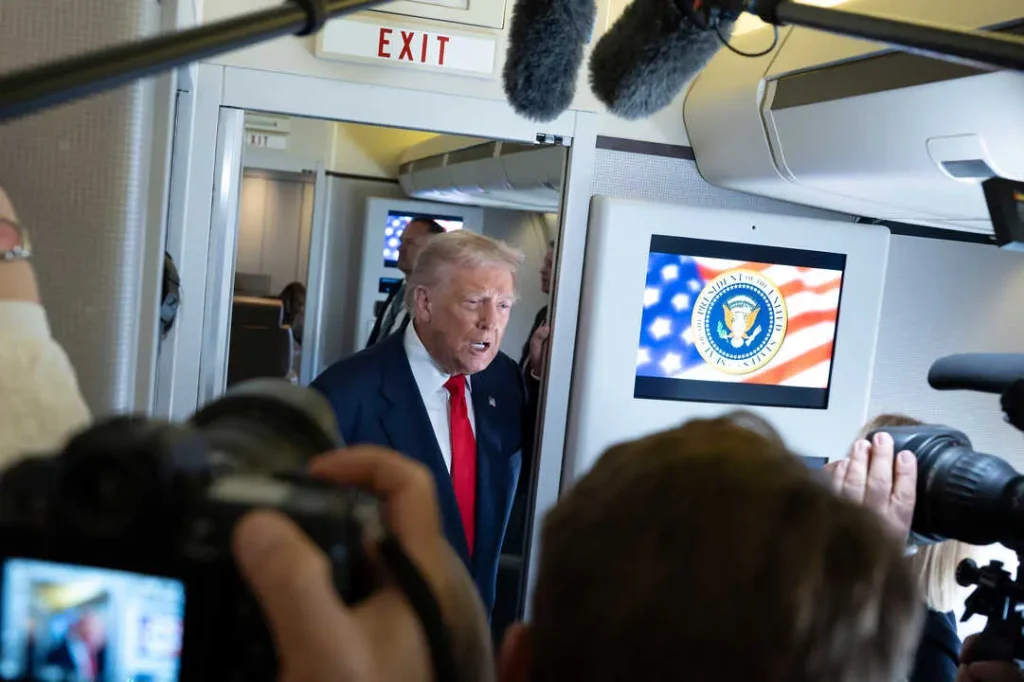
US President Donald Trump speaks to the press at the Andrews Joint Base. Photo: Joyce Boghosian/White House/Zuma Press.

Orinoco Tribune – News and opinion pieces about Venezuela and beyond
From Venezuela and made by Venezuelan Chavistas
US President Donald Trump speaks to the press at the Andrews Joint Base. Photo: Joyce Boghosian/White House/Zuma Press.
Several weeks after the kidnapping of President Nicolás Maduro by US forces, Donald Trump announced plans to “market” Venezuelan crude oil through US oil corporations such as Vitol, Trafigura, and Chevron.
He promises the return of ExxonMobil and ConocoPhillips to Venezuela, talks about “confiscating” 50 million barrels of Venezuelan oil in storage, and proposes a scheme in which the United States would control Venezuela’s oil exports. The question is inevitable: is this viable or simply another fantasy of Trumpian rhetoric?
To answer these questions, Diario Red spoke with Einstein Millán Arcia, a petroleum engineer who graduated from the Universidad de Oriente of Venezuela (1979), got a master’s degree in petroleum engineering from the University of Oklahoma (1990), and has served as manager and advisor to the Venezuelan state-owned oil company PDVSA, YPFB-Bolivia, Kuwait Oil Company (KOC), and PEMEX (Mexico), as well as other oil companies.
As a PDVSA employee, he was part of the team that brought the oil company back on its feet after the 2002 sabotage against the company, led by former executives at odds with Hugo Chávez, and later of the PDVSA Gas Anaco team. Thanks to this experience, he knows the ins and outs of the Venezuelan oil industry and the risks that PDVSA faces in this new political moment in the country.
In his opinion, the possibility of Venezuela handing over all its oil to the United States would be like the Venezuelan government itself “plunging a sword of Damocles into its own back.” Something that is unviable and unrealistic.
In your opinion, how does what happened on January 3—the kidnapping of Maduro and all the announcements now circulating about the US government or its trading companies marketing Venezuelan crude—affect Venezuelan oil?
There is talk of the return of some companies whose assets were nationalized, or of the 50 million barrels of oil that would be delivered to the United States, according to Trump.
You know what the prevailing rhetoric in the United States is like these days: mostly fantasy with just a small grain of truth. So much so that the US Attorney’s Office appointed by Trump himself declared that the story of the Cartel de los Soles is false, and the charge [of drug trafficking against President Maduro] was discredited.
The idea that the US will confiscate Venezuelan oil production and commercialization, do business, and then keep the money to convert it all into US products for export to Venezuela is also false.
The case is as follows: if Venezuela falls into a situation like that, it becomes insolvent. How does it pay salaries? How does it maintain the institutions? How does it sustain the nation’s internal system? Under what parameter will it survive as a country?
The official statements issued by the acting president [Delcy Rodríguez] and by Petróleos de Venezuela also contradict Trump’s rhetoric, as they assert that business with the United States will be conducted just as with any other entity, such as Chevron or any other multinational corporation. That is the official position that has been maintained so far.
Trump claims that the United States will be the sole marketer of Venezuelan oil. At the same time, Washington blocks and confiscates vessels of the “ghost fleet” that were transporting Venezuelan crude to China at steep discounts through intermediaries. In light of this scenario, several questions arise. Is it possible for two marketing mechanisms to coexist in the medium and long term? On the one hand, a portion of Venezuelan production operating under the scheme proposed by Trump, where sales are deposited into accounts from which Venezuela can purchase goods, and on the other, continued flows to China and Russia via shadow fleets. Or, instead, will the United States monopolize the marketing of Venezuelan oil?
That is what Trump aspires to, but it is unfeasible, since it would leave a country without funds, adrift, and unable to sustain itself socially, economically, or politically. It would not be sustainable. It would be like the government itself plunging a sword of Damocles into its own back.
That is unviable, unrealistic, even comical if you will—something that makes you laugh: that a government, even an acting government, would accept such terms. That is why the issue is not what Trump proposes; it is what suits Venezuela. That is the government’s firm position.
It is one thing for Venezuela to sell crude oil to US corporations, and another for it to deliver the crude to the US government. PDVSA and Venezuela must be open to negotiating with anyone on terms set by law and in Venezuela’s best interest.
In regard to foreign currencies, PDVSA relies on limited revenue sources, such as Chevron, for example, and some spot sales. However, most of the revenue comes from cryptocurrencies and other arrangements with countries such as China, which receives 85% of Venezuela’s oil exports.
Other inflows, through Turkey and other Middle Eastern countries, come in exchange for raw materials, which provide Venezuela with constant liquidity. That sustains and enables the Venezuelan state to prosper, especially when you consider that Venezuela’s oil production increased in 2025 to over one million barrels per day and will close 2026 at around 1.2 million barrels per day—perhaps even higher if you factor in the 60,000 to 70,000 barrels per day of condensate that are not reported to the Organization of the Petroleum Exporting Countries (OPEC).
Sure, but what Trump is saying now—according to the Wall Street Journal and Reuters—is that he wants to put trading firms like Vitol, Trafigura, or Chevron in charge of selling Venezuelan crude around the world, a kind of indirect export control. Beyond political will, in operational terms, would that new format of oil viceroyalty proposed by Trump be viable?
It is not about what Trump proposes, I repeat. The important thing is whatever suits Venezuela. That is the [Venezuelan] government’s firm position.
Now, Venezuela has always traded some of its crude oil with Glencore and third parties, such as independent Swiss brokers, for example, as well as Malaysian and Abu Dhabi brokers. There is nothing new there. But handing over Venezuela’s entire oil resource exclusively to a foreign government is not viable. It makes the country unviable. That is what it is all about. It is like shooting yourself in the foot.
Now, regarding the possible lifting of sanctions: Trump is lifting the same measures he imposed in 2019 and 2020, including the ban on the sale of Venezuelan oil. He also met at the White House with oil companies such as Repsol, Eni, and Chevron, the very ones that received licenses during the Biden administration.
What impact could resuming that agenda of opening up and bringing back foreign companies have, given that PDVSA has ceded equity stakes in oil projects because sanctions have left it in a complicated financial situation?
These companies have always negotiated with Venezuela on good terms: Repsol, Eni, Maurel & Prom, Shell, Exxon itself, ConocoPhillips, Chevron, Total. That means the State could reserve the right to award assets whenever it is deemed expedient to achieve a rapid increase in production and deliver a greater return to our nation. That is the government’s position, and it is the position of Petróleos de Venezuela (PDVSA).
Now, it is the terms that you have to know how to negotiate. Because, for example, it is impossible for conditions like those prevailing in Guyana to exist, where companies like Exxon Mobil pay 2% royalties and have capital recovery of up to 75% of gross sales revenue.
The negotiations must respect the established law regarding royalties, taxes, and profits. Now, that does not mean it cannot be renegotiated.
What you need to understand is that there is a huge difference between a production cost of $30 per barrel for a company like Exxon on an asset with a limited production window, such as those in Guyana, which last less than 10 or 15 years, and assets like Venezuela, where production costs can be as low as $10 to 15 per barrel and last for more than 20 years, because these assets hold remaining reserves of medium, light, and condensate crude oil exceeding 30 billion barrels in Venezuela, not counting the 270 billion barrels of heavy and extra-heavy crude.
In addition, there are 200 trillion cubic feet of gas, which, converted into crude oil equivalent, represent a monumental productive capacity.
This magnitude of resources guarantees that, sooner or later, all these corporations will establish themselves in Venezuela, since there is no other country in the region, apart from Canada, with sufficient reserves to sustain operations over such a long time frame.
There is talk of the possibility that oil companies such as ExxonMobil and ConocoPhillips, whose assets were nationalized in Venezuela under Hugo Chávez’s government, may return.
These companies had rejected the new terms of the Hydrocarbons Law, which stipulated that PDVSA must hold a majority stake, leading to nationalization and multimillion-dollar claims against the Venezuelan state.
Trump has even suggested that they first invest in the country, and then they will see how the money they are claiming for the nationalizations is “returned” to them.
First, for them to return, there needs to be stability in relations between the two governments. That is not ready yet. Now, with ExxonMobil, there is no debt, since that was declared in an international court. Yes, there is a misunderstanding, but no debt, since the International Center for Settlement of Investment Disputes did not rule in Exxon’s favor. That lawsuit reached a settlement in which Venezuela emerged as the winning party.
Now, the lawsuit by ConocoPhillips is still pending resolution. The lawsuit is still ongoing.
It is necessary to delve into a bit of history. Between 1914 and 1920, Shell and Exxon arrived in Venezuela through their predecessor companies. Shell was only just beginning its international expansion, while Exxon consolidated its global corporate structure precisely thanks to its Venezuelan operations.
In fact, the first mass exports of both companies came from Venezuela, which catapulted them into transnational corporations.
These companies obtained disproportionate profits by taking advantage of the rudimentary Venezuelan accounting system and the lack of international oversight.
In practice, they extracted discretionary volumes of oil and reported figures at their convenience, especially during the world wars when controls were virtually nonexistent.
In this context, the 1976 nationalization was the product of a transparent and legally impeccable process, accepted by both parties.
The companies received cash compensation of over $1.5 billion at the time, as well as favorable export agreements and service contracts that accounted for 1.7% of Venezuelan exports.
Therefore, they lack any legal basis to claim additional compensation for that nationalization, and their track record in the country is far from exemplary.
Venezuela National Assembly Approves Hydrocarbons Law Reform in First Discussion
And what about the price that PDVSA will ultimately receive for its sales? Because until now, due to the embargo and sanctions, anyone trading and buying Venezuelan oil received a discount of between 1o and 20 dollars.
Global oil markets are governed by three factors: quality differentials, discounts, and risk premiums. The differential is based on crude oil quality, while the risk premium determines the applicable discounts.
There is a fundamental distinction in our exports: Orinoco Belt crude oil in its unrefined state and Merey, which is refined crude oil. Merey has a lower sulfur content than Iraq’s Basra Light and Saudi Medium crude. Although there is talk of “Venezuelan acidic crude,” our Merey is less acidic than Saudi medium and Basra light. This is why it is priced the way it is.
It is important to clarify a key technical point: the crude oil from the Orinoco Belt is not bitumen; it is petroleum. It flows naturally from the wells under initial conditions. Its API gravity reaches as high as 17 degrees in some blocks of the Belt, although other blocks range from 6 to 7 degrees API, and most exceed 10 degrees API.
Before the sanctions and the 2008-2009 Oil Sovereignty Plan, Venezuela maintained a diversified crude oil portfolio. The Orinoco Belt produced between 300,000 and 400,000 barrels per day, while the rest came from light, medium, and condensate. This production of light, medium, and condensate crude oil covered the country’s diluent needs.
Imports were targeted for specific processes: just 17,000 to 18,000 barrels per day. Production costs before 2008 were less than $6 or $7 per barrel. Before 2006, they were below $4 per barrel. All of this is officially documented.
When the Orinoco Belt’s production was massively incorporated, and PDVSA reoriented its activity from traditional light, medium, and condensate crude fields toward heavy and extra-heavy crudes, the production of condensate, light, and medium crude slowed while that of heavy and extra-heavy crude accelerated.
This reduction in light, medium, and condensate crude eliminated the diluent available to upgrade the Orinoco Belt crude and convert it into Merey. PDVSA had to import diluents, which directly impacted production costs.
Moreover, this cost increase put our flagship crude at a disadvantage, and it began to be exported en masse compared to other grades. Previously, varieties such as Tía Juana Light and Mesa were exported. Later, exports were concentrated solely on Merey.
All of this affected profits, since thinner had to be imported. Imports reached 200,000 barrels per day in 2025. Currently, it stands at 180,000 barrels per day, ten times more than it was until 2007-2008. This factor drove production costs from $4-6 to $14-18, and finally to $36 per barrel. Now they have stabilized between $27 and $33.
At the same time, the country’s risk premium rose due to sanctions and political instability. Buyers, especially those in the spot market, demand discounts to assume the risk, which reduces profit margins for Venezuelan crude.
The result is a mix of decisions made during Rafael Ramírez’s tenure as president of PDVSA under the Chávez government, plus the sanctions imposed by the US in collaboration with Venezuelan opposition sectors.
It is a political conspiracy combined with a strategy from the North to facilitate unconventional situations, such as those in the Essequibo, Brazil’s pre-salt summit, and Argentina’s Vaca Muerta.
The numbers prove it. The United States exceeds $50-60 per barrel in production costs, Guyana is at $30, Argentina is $40-45, Brazil is $49-50, Colombia is $45-50, and Trinidad and Mexico have similar figures as Colombia.
No one could compete with Venezuela before 2007, when our costs were one-tenth of theirs. This entire situation was woven from the start to enable these major developments.
Now that the United States has reached its peak production, thanks to fracking, and is entering a decline, it has become a priority for it to secure its energy by appropriating resources from other countries without negotiating, as required under the global economic order.
[Author’s note: API gravity (American Petroleum Institute gravity) is a scale that measures the density of crude oil relative to water. It is the most widely used international standard for classifying oil quality. The higher the API gravity, the lighter and less dense the crude; the lower the API gravity, the heavier and denser the crude.]
(Diario Red) by Bruno Sgarzini
Translation: Orinoco Tribune
OT/SC/SF