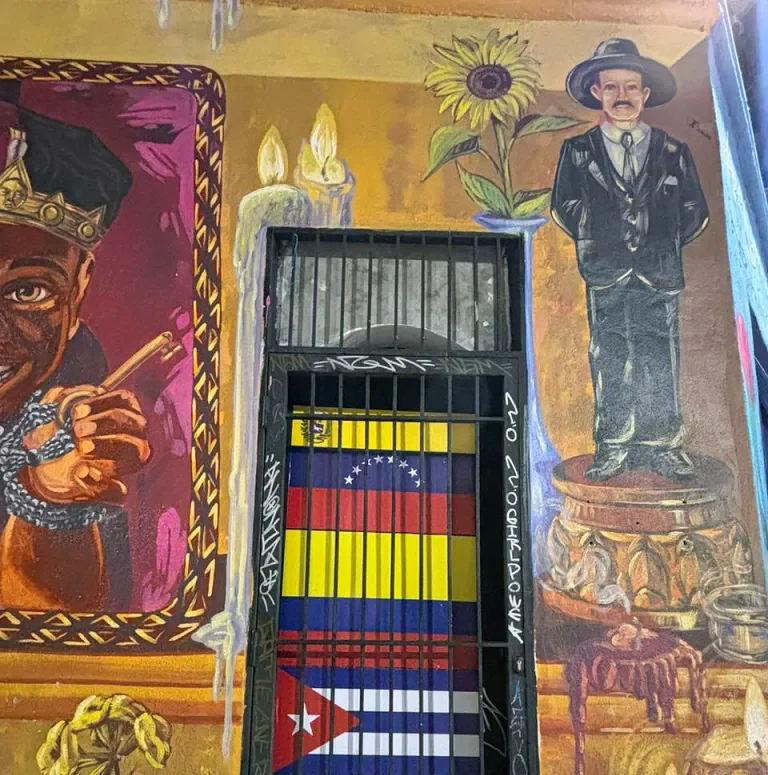
El Rincon de Pichon. Photo: Resumen Latinoamericano.

Orinoco Tribune – News and opinion pieces about Venezuela and beyond
From Venezuela and made by Venezuelan Chavistas
El Rincon de Pichon. Photo: Resumen Latinoamericano.
By Alejandra Garcia – Feb 26, 2026
In the heart of Caracas, San Agustin transformed from one of the city’s most dangerous parishes into a cultural epicenter that breathes music, history, and resistance. A Cuban flag alongside the Venezuelan flag welcomes those who arrive in the neighborhood, announcing that here culture and memory intertwine with every drumbeat and every mural.
Along its bustling streets, a discreet bar draws attention: El Rincon de Pichon. More than a place to listen to salsa, it is a refuge of history and tradition, a space where the walls tell the story of the neighborhood and of those who have made it vibrate with Caribbean and urban rhythms. Murals and photographs pay tribute to the members of the Grupo Folklorico y Experimental Madera, which since 1977 transformed the music and cultural identity of San Agustin.
To speak of San Agustin is to speak of Afro-descendancy, resistance, and culture. For more than three decades, this parish began to gain recognition as the cultural heart of Caracas, although its reputation as a dangerous and violent neighborhood kept the more cautious away. Nevertheless, its syncretism and its salsa spirit attracted those seeking the most authentic celebrations of Venezuelan Black identity.
Many residents of San Agustin come from Barlovento, Miranda State, a land of drums and blazing sun, bringing with them life projects rooted in their heritage, rhythms, and ways of loving, dancing, and cultivating. It was there, in the late 1970s, that Madera emerged. Their music blended Afro-Venezuelan rhythms with experimental elements and strong social and political content. Their lyrics served as tools against oppression, discrimination, and the invisibility of Black identity, seeking emancipation and equality.
Professor Irama La Rosa, director of the Southern Feminist School Argelia Laya, recalls how Madera’s poetry and critical messages spread across the national landscape, resonating alongside the songs of Ali Primera, one of Venezuela’s most important singer-songwriters. “Madera never had the support of major record labels; nevertheless, they always enjoyed enormous acceptance and affection within the underground veins of popular culture,” La Rosa recounted.
Afro-Venezuelan Consciousness, Transformation, Development and Tourism in Caracas’ own San Agustin
Thus, when Madera’s powerful voice was suddenly silenced as the boat carrying several of its members sank in the Orinoco River, the pain of this loss was undeniably profound. The tragedy of August 15, 1980 represented a loss of cultural heritage and was crucial in positioning the Parish of San Agustin as a Cultural Parish for an entire country and for all of Latin America and the Caribbean.
In his mourning song “Tin Marin,” Ali Primera immortalized the feeling of an entire nation and the idea that the memory and struggle of peoples never fade: “They only got wet and are standing on the shore…”
It is no coincidence that a Cuban flag appears on one of the walls of San Agustin, or that references to the island can be found in every corner of the bar El Rincon de Pichon. Two years before the tragic incident, in 1978, a member of the group traveled to Cuba to study Bata drums: Jesus “Chu” Quintero. He brought back from Cuba the measurements and forms of the bata drums, which were later crafted by artisans in Venezuela for the group’s use.
San Agustin and Madera are synonymous with cultural identity and a deep connection to Cuban music. Today, it is a neighborhood that celebrates its history with color, joy, and music. Every mural, every song, is a reminder of the resistance, creativity, and hope of a people who do not forget their roots or their struggle.
To remember Madera from San Agustin is to honor suffering peoples; it is to intertwine the histories of Cuba and Venezuela through art and music of resistance. As the group sings: “History will thank your machete and your dignity / under the yoke you will never be / if you fight for bread, work, and land.” In San Agustin, history remains alive, and it keeps dancing.
Alejandra Garcia is the lead correspondent for Resumen Latinoamericano – English in Latin America, she is also an evening news anchor for Telesur.