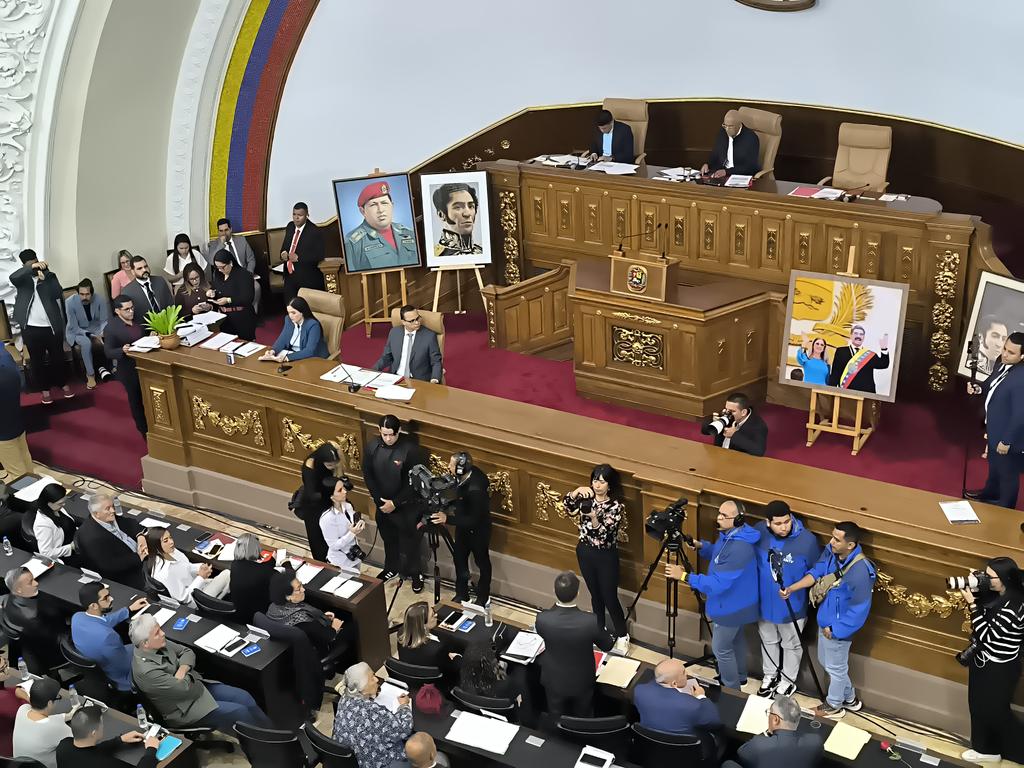
Venezuelan National Assembly discusses the Law of Amnesty for Democratic Coexistence, February 12, 2026. Photo: AVN.
Venezuelan National Assembly discusses the Law of Amnesty for Democratic Coexistence, February 12, 2026. Photo: AVN.
By Misión Verdad – Feb 27, 2026
The National Assembly of Venezuela unanimously approved the Amnesty Law for Democratic Coexistence, a law promoted by Acting President Delcy Rodríguez to offer clemency to individuals prosecuted for political events from 1999 to 2025, with specific application mechanisms and exclusions.
The law, which was then sent to the national government for promulgation after an extensive process of consultation and parliamentary debates, was presented by its proponents as a step toward promoting democratic coexistence among Venezuelans.
The process of constructing and approving this law represents, in political and institutional terms, a turning point regarding how the Venezuelan State has used, at different moments in its recent history, similar legal instruments to manage periods of high conflict and restore spaces of political coexistence. In that sense, the current amnesty law is part of a historical pattern of clemency measures that have accompanied the end of tense political cycles, paving the way for the beginning of new ones.
Hugo Chávez’s amnesty after 2002-2003
One of the most significant precedents in recent Venezuelan history regarding the State’s use of amnesty as a tool for political recomposition dates back to December 31, 2007. Through a Decree with the Rank, Value, and Force of Special Amnesty Law, President Hugo Chávez enacted a grace mechanism aimed at closing the legal and political gaps resulting from confrontations in the previous years. This decree was published in the Special Official Gazette No. 5870 and focused on events related to the April 11, 2002, attempted coup, episodes of political violence, and the oil strike that marked the first decade of the millenium in Venezuela.
The decree included significant exclusions, among them individuals involved in crimes against humanity or serious human rights violations, in accordance with the constitutional parameters of the time. This meant that the measure was a pardon subject to legal criteria that sought to balance clemency with constitutional and judicial obligations.
This amnesty ended a phase of open confrontation, redirecting Venezuela’s political and institutional life. In practice, it provided resolution for processes that had been one of the most visible points of tension between the State and various opposition sectors, reopening spaces for institutional normality. In statements at the time, government authorities highlighted that this measure aimed to send a message of peace and invite all sectors to participate legally in national politics.
President Maduro’s presidential pardon of 2020
The most recent precedent, promoted by the current government, was the presidential pardon decreed by President Nicolás Maduro on August 31, 2020. The measure was formalized in Decree No. 4,277 and published in Special Official Gazette No. 6,569. It included a wide range of citizens with criminal cases associated with the political conflict of the previous years.
The analytical value of this case lies in how the government argued for the pardon and what objectives it sought to achieve in the institutional arena. Decree 4,277 establishes three lines of reasoning that are key to understanding its political function:
This framing of the pardon was emphasized by the highest levels of the government. President Maduro said that the decree provided for “dialogue, reconciliation, reunion, and the broadest guarantees for the democratic political life of the country.” Meanwhile, the then-Minister of Communication Jorge Rodríguez stated that the intention was to “deepen the process of national reconciliation” in light of the electoral scenario.
In addition, the measure received institutional support from the National Constituent Assembly (at that time a high-ranking political body within the institutional order), which considered it a decision aimed at “strengthening national dialogue and peace.”
Over 3,000 Venezuelans Granted Amnesty Under Reconciliation Law
The current Amnesty Law
The new Amnesty Law introduces a scope and a normative architecture that distinguish it from its predecessors. While the earlier ones responded to specific circumstances, the current law explicitly assumes a broad historical period (from 1999 until its entry into effect) and addresses it as a political cycle characterized by episodes of confrontation.
The law establishes an expedited institutional procedure with specific deadlines for courts to review cases, and includes the review of both precautionary measures and final judgments, suggesting a legal operation on a larger scale. Additionally, it creates a parliamentary oversight body to monitor its implementation. This element reinforces its political and institutional dimension.
One of the most notable features of the law is that it precisely defines its exceptions. It does not cover crimes such as intentional homicide, crimes against humanity, drug trafficking, or armed acts against national sovereignty. It does not dismantle the State’s penal framework nor does it nullify other existing laws, including those sanctioning expressions of political violence.
In a previous analysis, Misión Verdad explained that this law is part of a normative reorganization of the internal political field. It reaffirms the rules of the game while offering the possibility of political reintegration to those who fall within the established norms.
Another distinguishing element is that the law explicitly introduces the notion of rectification and not recidivism. The beneficiaries who commit new offenses after the law takes effect will be prosecuted according to the ordinary legal system. This turns the amnesty into a kind of conditional pact. Political pardon is accompanied by an expectation of behavior in accordance with constitutional and legal norms.
It is a law that intends to redefine the conditions of political participation under explicit rules of democratic coexistence. In this sense, it seeks to establish a new starting point for internal political interaction. This structural dimension helps us realize that it is part of a historical pattern in which the Venezuelan State has used instruments of clemency to redirect cycles of confrontation, while simultaneously preserving the fundamental limits of the institutional order.
Translation: Orinoco Tribune
OT/SC/SF

Misión Verdad is a Venezuelan investigative journalism website with a socialist perspective in defense of the Bolivarian Revolution