By Kit Klarenberg – Apr 27, 2021
Western media coverage of Myanmar has relied heavily on organizations funded and developed by a notorious US intelligence cutout and UK Foreign Office partner. Can they be trusted?
On April 11, news site Myanmar Now exposed what appeared to be the most gruesome massacre to date in the conflict-ridden country. According to the online outlet, at least 82 people had been slaughtered by security forces in the town of Bago.
Details of the mass killing were graphic in the extreme. In all, 40 to 50 residents were reportedly struck by heavy artillery fire, including several youths. The victims were supposedly stacked inside a local pagoda, an anonymous eyewitness claiming some were still alive, and “could be heard moaning from the mass of corpses.”
The next day, Myanmar Now alleged that the killers among the military’s security forces had covered their tracks, concealing and destroying all traces of their hideous crimes. The pagoda, according to the outlet, “appeared as it had before the crackdown … blood had been washed away, the bodies gone, and occupying soldiers cleared out.”
Victims were all said to be activists protesting Myanmar’s military government, known as the Tatmadaw, which wrested power from the elected government on February 1. The process transformed the country into a subject of intense Western media interest, while the West’s ongoing campaign against the Tatmadaw escalated.
Coverage of the alleged atrocity by Myanmar Now, which is based in the capital of Naypyitaw, was picked up by a panoply of mainstream news outlets – Al-Jazeera, BBC, Deutsche Welle, Reuters, and Voice of America, among others. Each published articles based exclusively on the platform’s reporting, with the first four recycling a particularly incendiary quote from the protest’s organizer.
“It is like genocide. They are shooting at every shadow,” the organizer despaired. “We sympathize with the situation in ethnic areas. I feel like they are committing genocide against their own people.”
Myanmar Now’s bombshell headline broadcast to the world “the second highest [toll] in a single day,” and “the highest number of casualties in one day in a single location” since the February 1 military coup. The source of the figure was an NGO run by Burmese exiles based in neighboring Thailand, called the Assistance Association for Political Prisoners (AAPP). This organization has also featured extensively in Western coverage of developments in Myanmar.
What no news outlet has to date acknowledged though is both AAPP and Myanmar Now have received extensive funding from the US government’s regime-change arm, the National Endowment for Democracy (NED). The NED is notorious for sponsoring media and civil society organizations around the world to undermine governments the US seeks to topple. Its founders have even admitted the NED was created specifically to do overtly what the CIA used to do in secret.
But that’s not the only reason to question the true motives and objectives of these two central nodes of the Myanmar opposition, or to view their reporting with a degree of skepticism.
Thomson Reuters spawns and develops “independent media” advancing UK interests
No mention of Myanmar Now’s NED funding can be found on the US government organization’s website. However, this sponsorship was referenced in an August 2019 Columbia Journalism Review profile of the outlet’s founder, Swe Win, a long-time agitator against the country’s military government who was jailed in 1998 for participating in a student protest.
Released under general amnesty in 2005, Swe relocated to Thailand and became a senior reporter at Myanmar exile-founded The Irrawaddy – which has also been bankrolled by the NED – before returning to Yangon in 2012.
Myanmar Now is not only underwritten by the NED; it was created by Thomson Reuters Foundation (TRF), the charitable arm of the London-based wire service. As Max Blumenthal reported for The Grayzone, TRF has partnered closely with the UK Foreign, Commonwealth, and Development Office (FCDO) in several covert information operations aimed at advancing British foreign policy interests.
TRF stated in leaked documents that it spawned Myanmar Now in 2015 during the run-up to the country’s national elections – its first openly contested vote since 1990. From its inception, Myanmar Now has disseminated information in both English and Burmese for national and international syndication.
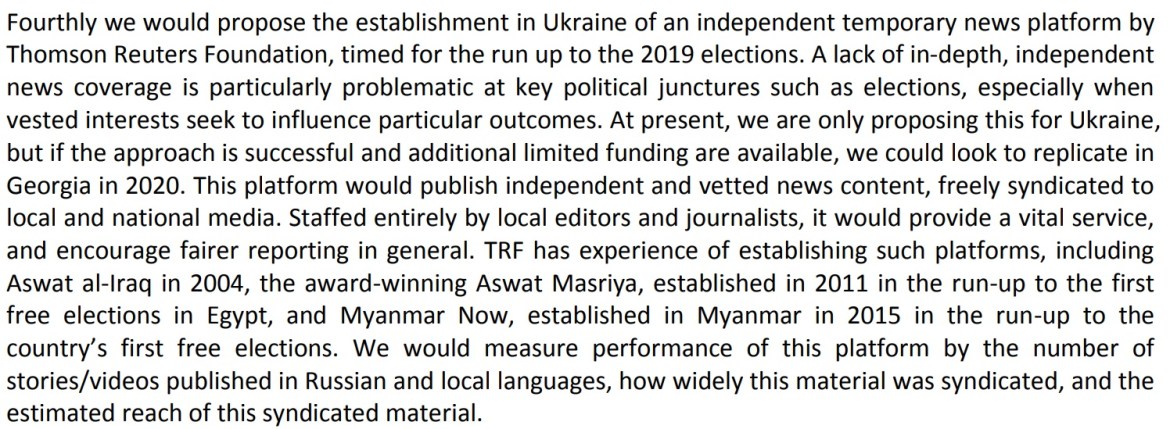
Myanmar Now is eerily evocative of another “independent news service” established by TRF at a similarly politically expedient time: Aswat Masriya, an Egyptian publication founded in the wake of the country’s 2011 revolution. Covertly funded by the UK FCDO to the tune of £2 million over six years, the operation was run out of the newswire’s Cairo offices, where an army of local journalists trained by TRF churnedout in excess of 1,200 stories every month in English and Arabic, which were subsequently picked up by over 50 media outlets worldwide weekly.
The UK’s rationale for sponsoring Aswat Masriya’s launch was fairly obvious. The ouster of long-time pro-Western Egyptian leader Hosni Mubarak, the country’s fraught transition to democracy, and subsequent election of Muslim Brotherhood candidate Mohamed Morsi, had the potential to threaten London’s sizable financial interests in Cairo and the region more broadly. A news platform issuing content for both domestic and overseas consumption would afford London a significant degree of narrative control within and without the country as events unfolded.
This interpretation is amply underlined by Aswat Masriya’s output, which featured uncritical articles on events such as President Abdel Fattah al-Sisi’s “landslide” election victory in 2014, in which the former military honcho secured a flagrantly ill-gotten 96.91 percent.
The Reuters-created outlet also became known for the routinewhitewashing of egregious abuses by Egyptian security forces, including the brutal armed repression of an August 2013 protest in Cairo, in which at least 817 demonstrators were massacred.
Indeed, no indication of Egypt’s rapidly deteriorating human rights conditions under al-Sisi’s rule could be detected from any of Aswat Masriya’s reporting at any stage. With a dependably pro-Western leader securely installed in power, the UK pulled funding for the endeavor in March 2017, and it shuttered.
In an email statement to The Grayzone, the Thomson Reuters Foundation denied that the UK FCDO supported Myanmar Now’s creation as it did Aswat Masriya, and stated it was no longer involved in the initiative. However, the Foundation’s submissions to the FCDO specifically stated it has founded “similar platforms” in Myanmar, Iraq, Zimbabwe, and elsewhere. TRF also declined to clarify how Myanmar Now was funded, if not by the UK government.

Data on NED grants allocated to Myanmar-based organizations between 2016 and 2020 indicate that Washington has spent hundreds of thousands of dollars annually on “[promoting] transparency and accountability by increasing the public’s access to credible information” via “Burmese and English-language websites and social media pages.” Investigative reporting on “social and political issues” – Myanmar Now’s stock-and-trade – was highlighted as a key program objective.
RELATED CONTENT: Protests Continue in Myanmar, Junta Defies Calls to Stop Violent Crackdown
Conversely, AAPP – cited in more than 60 stories published by Myanmar Now since February 1 – is openly named as an NED grant recipient, receiving at least $592,000 in direct funding since 2016 alone.
The NGO’s founder and joint secretary, Ko Bo Kyi, was even for a time an NED fellow, researching “prison reform as a prerequisite to democratization in Burma.”

The West’s go-to Myanmar casualty tracker, sponsored by the West
Established in Thailand in March 2000 and primarily staffed by former political prisoners, the Assistance Association for Political Prisoners claims to track in real-time the number of people arrested, imprisoned, charged, evading arrest, sentenced, and killed since February 1. It’s a noble endeavor in principle, however, the group’s stated methodologyfor defining political prisoners raises questions about its reliability – particularly as nuggets from its daily briefings so often translate to attention-grabbing, heartstring-tugging headlines in the Western media.
The Association “maintains that the motivation behind the arrest of every individual in [its] database is … political, regardless of the laws they have been sentenced under,” characterizing them as political prisoners based on their perceived “actions rather than their alleged charges.”
Further, AAPP says it “does not decide political prisoner status based on the laws individuals are arrested, charged, or sentenced under,” due to its awareness of “false, tenuous, or trumped-up criminal charges used to imprison political activists, journalists, students, and those in real or perceived opposition to past and current regimes.”
That entirely innocent people have been arrested, prosecuted and imprisoned illegitimately by Myanmar’s military regime is hard to doubt. After all, political persecution of dissenters and protesters is regularly practiced inside self-proclaimed liberal democracies.
But AAPP’s loose, highly subjective definition of what constitutes a political prisoner opens the door for labeling literally anyone arrested as a persecuted dissident – even those actually guilty of serious crimes, which wouldn’t mark them as political prisoners by most objective conceptions of the term. Such slanted methodology can only raise questions about whether the AAPP’s casualty figures should also be accepted at face value.
There have been countless intense clashes between protesters, anti-government armed groups, the military, and its supporters in recent months. In some cases, even the BBC has conceded the violence may have been prompted by activists hurling bricks at police officers, among other provocative acts.
Women at front ✊📣 #WhatsHappeningInMyanmar #AgainstMyanmarMilitaryCoup pic.twitter.com/z8ngYDwRan
— Naw Dee Mar Le (@nawdeemarle) March 29, 2021
Further, as the pro-opposition Frontier Myanmar documented, protesters in various regions are equipped with “AK47 and M16 assault rifles and hand grenades,” using their arsenal to attack police and soldiers. They’re further resolved to “[adopting] new hit-and-run tactics to make life difficult for security forces.”
“Soon we will fight back with a guerrilla strategy,” said an activist quoted by the outlet. “We have fewer members than the security forces, so we need to change tactics.”
This April 27, the Karen National Union militia seized a base from the Tatmadaw during fighting near Myanmar’s border with Thailand.
It’s unclear how many of those incarcerated by the junta have engaged in activities that would be legitimate grounds for arrest anywhere else in the world. What’s certain, though, is that the US-funded AAPP focuses exclusively on the condition of opposition activists, any and all of whom could conceivably be classified as political prisoners according to the organization’s loose definition, and based on its in-house assessment of their “actions.”

“The more civilians were killed, the chances of international intervention became bigger”
As essentially the English-language media’s sole source of information on casualties and junta abuses in the country, the Assistance Association for Political Prisoners occupies a position of extraordinary privilege. Western citizens are compelled to take AAPP’s ever-updating assorted victim tallies entirely on faith, without balance, challenge or any context about its US government funding or highly partisan political orientation.
Unsupported claims of impending or ongoing “genocide” issuing from individuals who could hardly be considered impartial observers have previously provided justification for destabilizing Western interventions in Kosovo, Libya, Syria, and elsewhere. These apocalyptic warnings have later been found to be false, while in many cases, opposition elements in these conflicts deliberately attacked authorities in order to precipitate harsh retaliation.
RELATED CONTENT: Myanmar Workers and Unions on the Front Lines in Fight Against Coup
For example, in 1998 the CIA trained and armed Kosovo Liberation Army (KLA) operatives despite the US State Department classifying the group as a terrorist organization, and a UN Security Council resolutionbanning support for terrorist activity in the province. The KLA proceeded to assassinate Serbian politicians and policemen, and harass and intimidate local residents who did not support Kosovan independence, triggering a harsh response.
“The more civilians were killed, the chances of international intervention became bigger, and the KLA of course realized that. There was this foreign diplomat who once told me, ‘look, unless you pass the quota of five thousand deaths, you’ll never have anybody permanently present in Kosovo from foreign diplomacy’,” an Albanian Kosovar negotiator unconnected to the KLA remarked to the BBC.
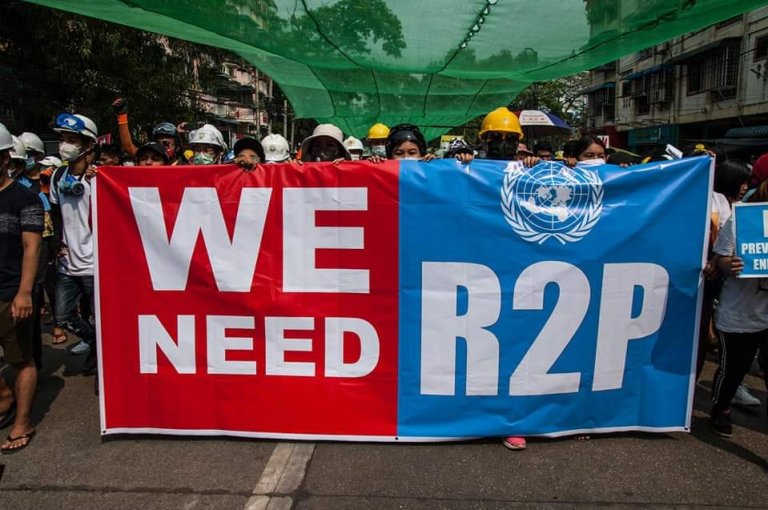
As in Kosovo, opposition activists in Myanmar are pleading for Western states to uphold its “responsibility to protect” (R2P), breaching night-time curfews to write “We Need R2P” and “R2P – Save Myanmar” in candlelight. These calls have found a sympathetic audience with the same Western media that relies so heavily on Myanmar Now’s bracing dispatches and AAPP’s dubiously calculated casualty figures.
This April 11, France 24 interviewed the Sunday Times’ Asia Correspondent Philip Sherwell about the purported Bago massacre. Sherwell’s matter-of-fact responses to the host’s queries concerning events he had not personally witnessed were effectively verbatim quotes from Myanmar Now’s report on the incident. Though he did not directly cite the outlet or AAPP, the segment’s subtitle, “security forces kill 82 in single day in Bago,” clearly indicated Sherwell’s reliance on the two sources.
While conceding it was “very difficult” to get an accurate reading on the number of people killed, he praised the methodology of “local pressure groups” who “speak to families [and] know people who are there,” and do “quite a good job in their estimates.”
Based on the questionable research of AAPP and Myanmar Now, as well as footage shared by activists – a shaky phone camera clip of troops patrolling a residential street played on a loop throughout the French state broadcaster’s report – Sherwell declared that the figure of 82 dead was “probably in the right area,” and, if anything, “conservative.”
Mainstream dependence on obviously dubious and biased organizations for insight on complex events in faraway lands is nothing new.
The Syrian Network for Human Rights (SNHR), a go-to source of casualty figures and atrocity allegations in the Syrian crisis for Western news outlets, is universally portrayed as an “independent” monitoring group by the journalists and rights organizations. As The Grayzone revealed however, the Qatar-based operation – which openly lobbied for “immediate intervention” in Syria, along the lines of NATO’s 1999 bombing of Yugoslavia – is staffed by leaders of the Syrian opposition and financed by the very foreign governments fueling the crisis.
Despite its near-total reliance on opposition sources, Western news outlets have documented demonstrators in Myanmar engaging in highly inflammatory activities, which extend far beyond attacks on government forces and other state organs.
In March, Reuters reported that China’s extensive infrastructure projects in the country are a key target for anti-military demonstrators, who have chanted, “China’s gas pipeline will be burned.” As the news wire noted, China has earmarked billions of dollars for a variety of programs in Myanmar under its global Belt and Road Initiative (BRI), including an economic corridor ending at a $1.3 billion deepwater port, industrial zones, a new city adjacent to the commercial hub of Yangon, and a railway to the border.
The Trump administration tried and failed to stop BRI in its tracks, framing it as insidious empire-building while desperately pressuring allies not to join. Joe Biden raised the stakes significantly this March,proposing the creation of an international infrastructure fund to rival the Chinese program.
At almost precisely the same time, the Myanmar opposition carried out a wave of arson attacks on Chinese-owned factories in the country, while leaving those owned by Hong Kong, South Korea, Taiwan, and Thailand in the same areas unscathed. AAPP may well consider individuals arrested for these crimes to be political prisoners, for their selective pyromania purportedly has partisan motives.
Reuters stated that a key source of grievance for the protesters was a leaked government document revealing that Chinese officials had asked the administration to “provide better security and intelligence on ethnic minority armed groups on the pipeline route.” Meanwhile, the AP claimed the arsonists were “angered” by China’s “adherence to a policy of non-interference in other countries’ politics,” and resultant refusal to intervene in the burgeoning strife.
US-financed Myanmar demonstrators attack Chinese infrastructure project
That Beijing seeks improved protection for its various Belt and Road projects in Myanmar is unsurprising. For years, its infrastructure has been subject to attacks from militants, scuppering their completion. And the specter of US meddling has been consistently present.
For example, the Myitstone Dam in the north of Myanmar wassuspended indefinitely in 2017. Construction began eight years earlier, and was met with fierce opposition locally. A 2010 US embassy cable released by WikiLeaks described mobilization against the dam as evidence of “the growing strength of civil society groups in Kachin.”
Authored by the then-US charge d’affaires, Larry Dinger, the embassy official took a degree of credit for the opposition, noting that many of those protesting the dam were “recipients of embassy small grants.”
Indeed, the US embassy in Myanmar had been paying local groups in Kachin that opposed the Chinese project, even as it acknowledged the dam would help remedy the “acute electricity shortages that plague the country.”

The northern Myanmar state is also home to the separatist Kachin Independence Organization (KIO), which has a dedicated armed wing with estimated 12,000 fighters.
Building the dam shattered a ceasefire struck with the military in 1994, and fighting has continued ever since, putting construction on hold. By extension, full-on civil war could put a permanent, brutal end to all Belt and Road projects dotted throughout the country, and Washington planners are surely well-aware, and fully welcoming, of the prospect.
While its insurrection against the government did not begin until 1961, the KIO traces its origins back to the conclusion of World War II, when the British created all-Kachin battalions to “protect and safeguard” its recaptured territories, including the nearby Indian subcontinent. In the process, as the NED-funded Irrawaddy reported in 2012, a majority of the KIO’s operatives were trained in guerrilla fighting by the CIA’sforerunner, the Office of Strategic Services (OSS), and the UK Special Operations Executive.
During the next decade, US-backed forces from the right-wing Kuomintang of Chiang Kai-Shek hopped the border and “took over and governed a huge swath of Myanmar running between Thailand and China,” according to Public Radio International.
They funded their struggle by way of the “golden triangle” – a patch of land intersecting China, Thailand, Myanmar and Laos that served as the nexus of the global opium trade. This region provided most of the world’s heroin for the rest of the 20th century, until the US-led intervention in Afghanistan made that country the global market leader.
Though it remains unclear whether KIO’s struggle for independence was directed or even approved of by London and Washington, a leaked US State Department cable from April 2008 indicates diplomats have derived intimate insight into KIO’s activities and thinking from a high-level informant in the Kachin National Organization.
A “priority US policy objective”
Further emphasizing the significance of Kachin to US meddling in Myanmar, data on NED activities show hundreds of thousands of dollars have been spent on projects in the region in recent years, including bankrolling the Kachin State News and Information Service, to inform citizens on “political, social, and economic developments.”
While initiatives like these might seem benevolent, similar US efforts in geopolitical flashpoints like Hong Kong have had a significantly destabilizing effect, and by design.
What’s more, they represent a negligible fraction of NED operations in Myanmar. In all, the US government’s meddling machine sponsored at least 299 projects at a total cost of $23,126,786 between 2016 and 2020.
By contrast, the NED supported just 23 projects costing $3,574,162 inBangladesh, 81 projects costing $9,665,597 in Thailand, and none in Laos – Myanmar’s neighboring states – during the same period.
This staggering outlay underlined the country’s immense strategic significance to Washington. It is also a testament to the efficacy of NED programs in achieving US political, financial, and ideological objectives in the country. Financing flows so voluminously and freely because it has been proven to work.
A 2006 report by Western celebrity-backed NGO the Burma Campaign UK highlights the central role the NED has played in fostering and promoting the country’s “pro-democracy” movement.
It notes that restoration of democracy in Burma is a “priority US policy objective,” and NED efforts “inside and outside” the country “are designed to disseminate information … supportive of Burma’s democratic development,” and “build capacity to support the restoration of democracy when the appropriate political openings occur and the exiles/refugees return.”
The report stated: “Through sub-grants to approximately 30 Burmese pro-democracy groups … NED plans to concentrate in two core areas: media/information and institution building … NED support will target those organizations that have a demonstrated ability to reach audiences inside Burma as well as those that have an ability to grow and adapt as the situation evolves [emphasis in original].”
A dedicated section laid out the NED’s projects in Myanmar at the time. Monks and Buddhist lay people were “educated” on “nonviolent struggle for democracy” and “human rights” by way of material such as “pamphlets, stickers and calendars.” Activists on both sides of “the Thai-Burma border” were taught “effective techniques of nonviolent political action,” provided “financial, logistical, and technical support,” their “strategic” activities “coordinated.”
Furthermore, the first “independent” Burmese-language satellite television program was launched, and “ethnic-language radio broadcasting” was established to supplement the already extensive output of Voice of America and CIA-created Radio Free Asia in the region.

The making of Aung San Suu Kyi
These two US government propaganda outlets, Voice of America and Radio Free Asia, were at the forefront of a “campaign” across Southeast Asia to secure the release of Aung San Suu Kyi, then-general secretary of Myanmar’s National League for Democracy (NLD) party, who had been sporadically under house arrest since 1989. This included publishing audio versions of her speeches for download locally and internationally.
By that time, Aung San Suu Kyi had become the darling of Western politicians, news outlets, and self-described human rights NGOs, designated by Amnesty International a “prisoner of conscience,”dubbed by Time Magazine a “Child of Gandhi” and his spiritual heir due to her supposed commitment to nonviolence.
Suu Kyi was granted a host of awards and fellowships the world over, serenaded by musician Bono, made an honorary Canadian citizen, and eventually awarded the Nobel Peace Prize.
The growing international calls for Suu Kyi’s release finally bore fruit in 2010, and she immediately became NLD president, conducting a whirlwind tour of parliaments and seats of government across the globe.
Five years later, Suu Kyi’s party swept to victory in a historic landslide election victory. Western governments hailed the moment as the dawning of a new era of progress, human rights, and democracy in Myanmar. In the process, she became foreign minister and state counsellor, the country’s de facto prime minister.
Within three years, Suu Kyi’s saintly façade had comprehensively cracked under the sheer pressure of reality, all accolades and baubles bestowed upon her stripped away, save for the Nobel Peace Prize, and only then because no provision for its revocation existed.
Her active, conscious and unabashed complicity in the government-directed butchery of Rohingya Muslims, which included blocking an attempted visit by United Nations investigators, defending their ethnic cleansing, and her determined defense of malicious prosecutions of reporters attempting to cover the catastrophe, was so brazen it couldn’t be concealed or ignored.
Just two weeks before the coup, Suu Kyi’s government filed preliminary objections to the International Court of Justice charges of genocide leveled against it. Even mainstream corporate media outlets have been forced to acknowledge the Rohingya have much better prospects under the military government, which was in the process of granting them citizenship at the time of Suu Kyi’s election victory.
As NED scrambles to regain control of Myanmar, it’s not clear which humanitarian, political prisoner, or activist will be selected and molded by the agency to fill Suu Kyi’s shoes – and in turn embraced by pundits, journalists, politicians, rights groups, and billionaire-backed charities as the latest incarnation of Nelson Mandela ready to save the country from its brutal ruling junta.
Given their total collective failure to reflect on how and why they could be so duped, that they will fall for the same ruse anew is almost inevitable.
That the NED will be the party responsible for choosing and grooming the next heroes of Myanmar’s opposition is also clear. After all, with so much blood and treasure splurged over so many years on constructing a suitably pro-Western political system in Naypyitaw, and installing a pliant government there, a highly valuable and once-seemingly secure imperial holding now hangs in the balance.
As the conflict in Myanmar deepens, Washington has plenty of leadership candidates to choose from, and plenty of cannon fodder to expend as atrocity propaganda. One prospective nominee is Captain Tun Myat Aung, who defected from the military earlier in April. As reportedby Myanmar Now, he has called for Western weapons to be funneled to the country, Syria-style, in order to smash Myanmar’s “fascist army.”
Kit Klarenberg is an investigative journalist exploring the role of intelligence services in shaping politics and perceptions.
Featured image: Myanmar opposition members call for Western military intervention at March 2021 rally