By Arnold August – Nov 9, 2021
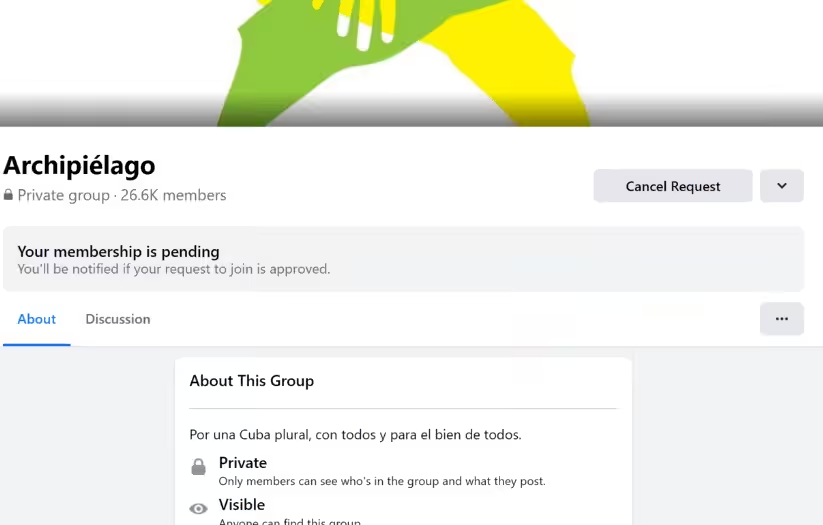
Editor’s Introduction: The Canada Files is fortunate to have Arnold August as a columnist, acclaimed since 1997 as one of the most important non-Cuban English-speaking experts on Cuba’s political system and cultural debates. He obtained access to the Cuban dissident run Facebook Group Archipiélago. With his fluency in Spanish, he took a deep dive into it, divulging astonishing posts with original analysis never before published in English.
This article contains the following sections:
• Peaceful?
• “Peaceful” Miami-Based Exiles?
• Cuban Version of the Violent Barricades in Venezuela?
• Amplifying November 15 Internationally
• A “Leftist” Feature of Archipiélago and Annexationism: Is This Possible?
• The Left in North America: Where Does It Stand?
• 15N: What Are Cubans at the Grass-Roots Level Presently Saying?
On July 10–11, 2021, regime-change demonstrations of the “colour revolution” type broke out in several cities across Cuba, turning violent in some instances. They were driven mainly by pro-US social media prompts, with some Cuban citizens joining in for legitimate reasons in the context of the current system and not against it. Since then, the same forces, operating under a new banner and a private, two-month-old Facebook group named Archipiélago, are gathering for a second round of demonstrations to take place on November 15. To delve into it, I applied to become a member and was eventually (and surprisingly) accepted.
Peaceful?
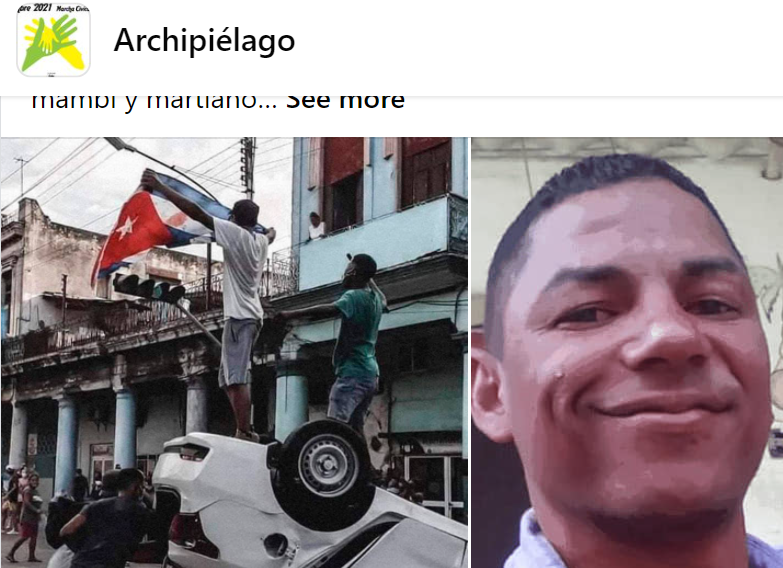
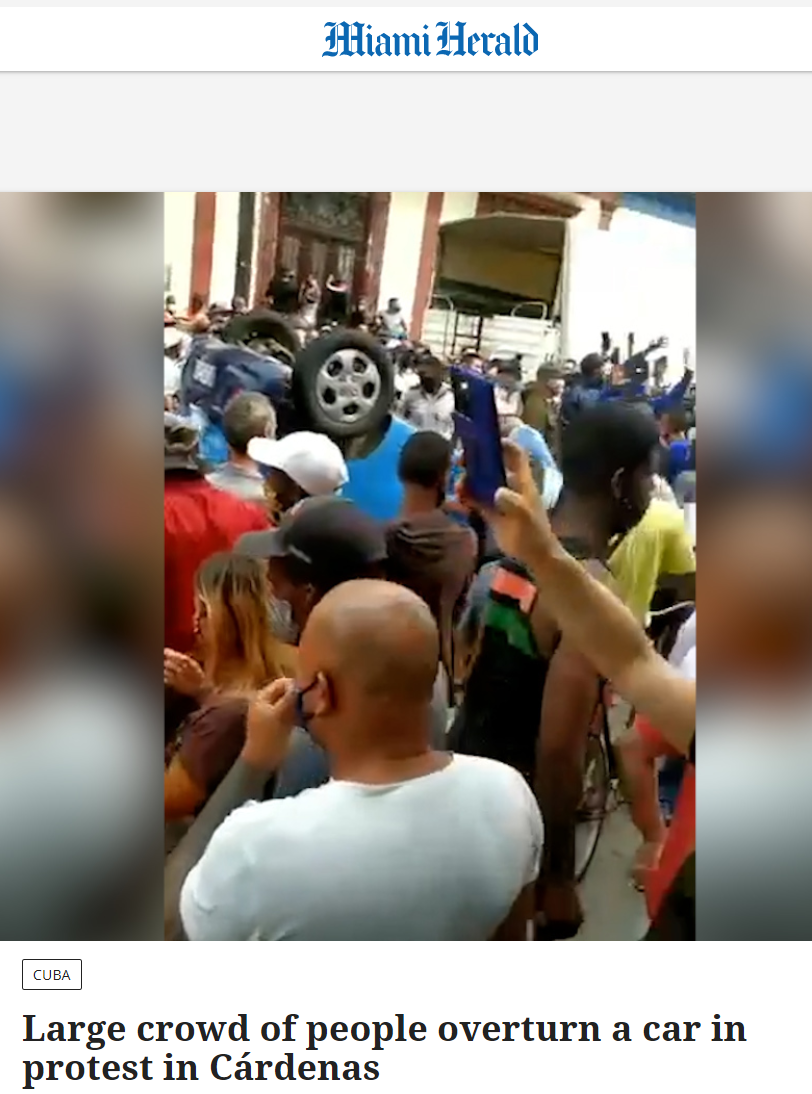
Several points stand out. Despite what they profess, Archipiélago is far from being a peaceful organization. This Facebook group of supposed “pacifists” features a riot in which a vehicle was overturned.
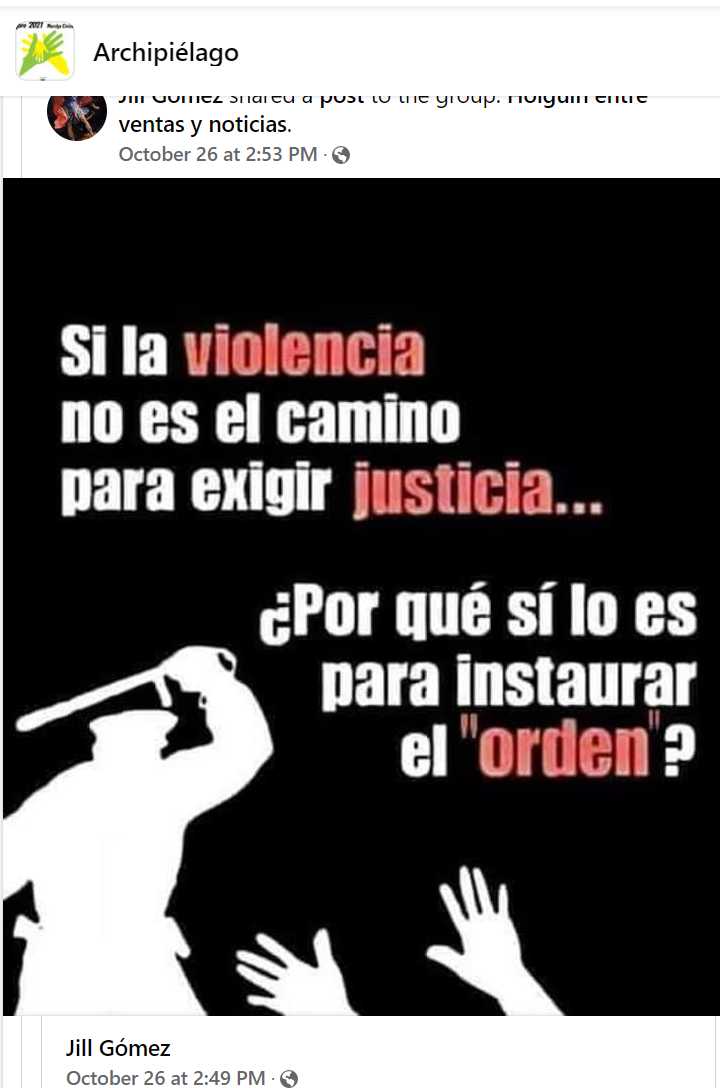
Even more explicitly, they ask below, “If violence is not the way to demand justice… why is it the way to establish ‘order’?” Reading between the lines, is this a barely veiled justification for the use of violence?
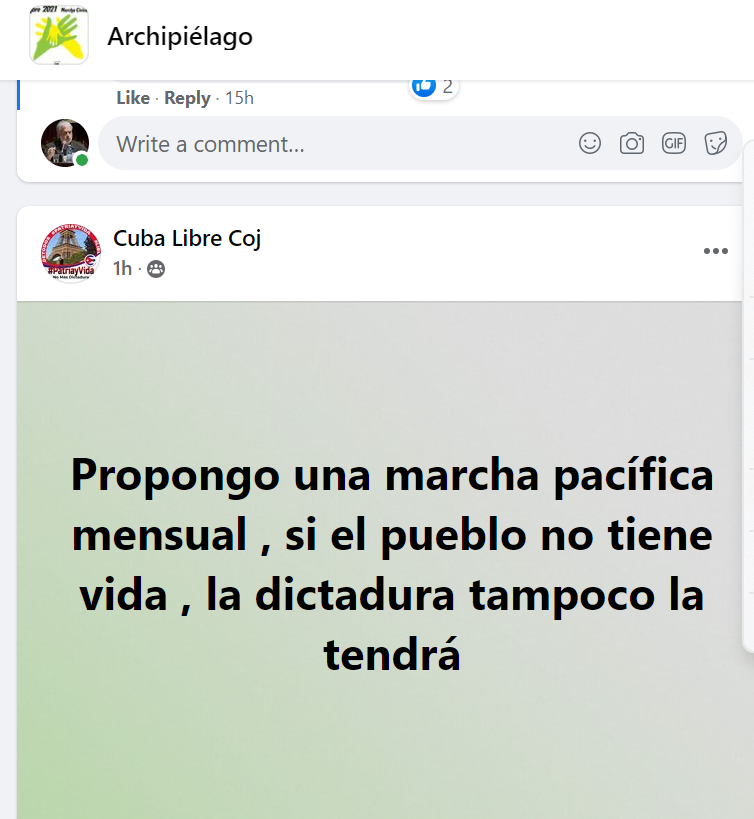
Furthermore, the following post calls for “a peaceful monthly march, if the people have no breathing space, the dictatorship will have none either.”
The incitement to chaos is evident as they stir up hatred, with a group member pleading in a comment: “Monthly is too long to wait, weekly is better as they will die more quickly.”

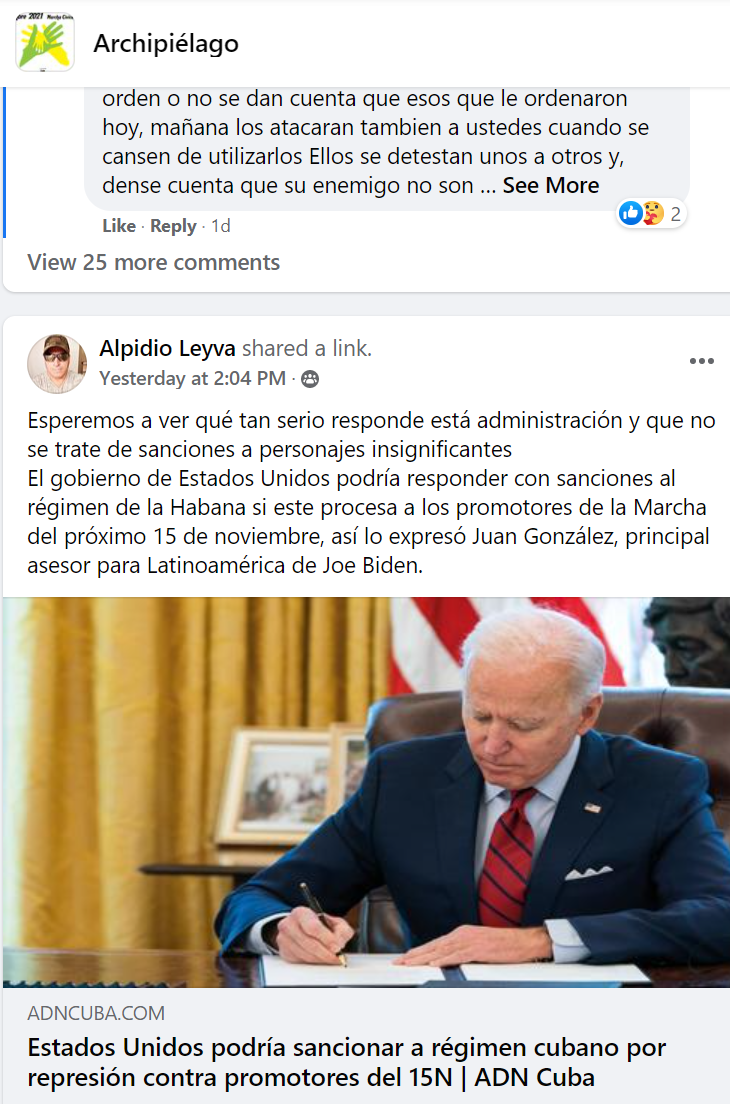
However, the incitement to simple individual violence also gives way to a collective genocidal policy. In response to the US threat to sanction Cuba if the Cuban government interferes in the planned November 15 march, Archipiélago ups the ante by demanding that “the sanctions not be limited to insignificant individuals” – that is, by calling for more sanctions “against the regime.” This in effect would further punish the Cuban people as part of the drastic tightening of the blockade from Trump to Biden.
RELATED CONTENT: The United States is Organizing a Color Revolution in Cuba for November 15
We must recall here the genocidal basis of the US blockade against Cuba as expressed in the 1960 Memorandum from the Deputy Assistant Secretary of State for Inter-American Affairs (Mallory) to the Assistant Secretary of State for Inter-American Affairs (Rubottom): “denying money and supplies to Cuba, to decrease monetary and real wages, to bring about hunger, desperation and overthrow of government.”
“Peaceful” Miami-Based Exiles?
During the course of a special edition of the popular Cuban TV program Mesa Redonda, Rogelio Polanco Fuentes, the head of the Ideological Department of the Central Committee of the Communist Party of Cuba, released a recording of a telephone conversation between Ramón Saúl Sánchez and Archipiélago coordinator Yunior García Aguilera.
Who is Ramón Saúl Sánchez? This is a very abbreviated list of his terrorist activities:
“[He was] born in 1954 in Cuba, at the age of 13 he went to live in the US.
Several declassified FBI reports outline the dangerousness of this terrorist. One of them, reports that in December 1980, hours after the explosion of a bomb at the Cuban consulate in Montreal, the alleged perpetrators were arrested on the Canada-United States among them Ramón Saúl Sánchez Rizo.
Another 1982 FBI report deals with an attempted attack against the Cuban ambassador to the UN, detonating a bomb in his car, states: ‘Ramón Saúl Sánchez built the remote-controlled bomb with the help of others members of Omega 7.
Omega-7 came to be considered by the FBI as ‘the most dangerous terrorist organization in the United States.’
In 1984, Ramón Saúl was sentenced to a four-year prison sentence for refusing to appear before a North American grand jury in New York that tried to clarify the activities of Omega-7.
He was a protagonist in the sinking of the fishing boats near the Bahamas, injuring two fishermen, as well as promoting the kidnapping of people in Venezuela, México and the US.
He is the leader of the terrorist organization Jóvenes de la Estrella, a group with which he carried out a dynamite attack at the Miami airport on October 17, 1975.
Second in command of CORU, which carried out more than 90 terrorist attacks against Cuban facilities in various countries, including within the United States itself, the most notable being the blowing up of the Cubana de Aviación plane over Barbados, where 73 people died.
He was a very active element among those who promoted fundraising to help Luis Posada Carriles and the rest of the terrorists arrested in Panama for planning an attack against the Cuban president (Fidel Castro) during the X Ibero-American Summit.”
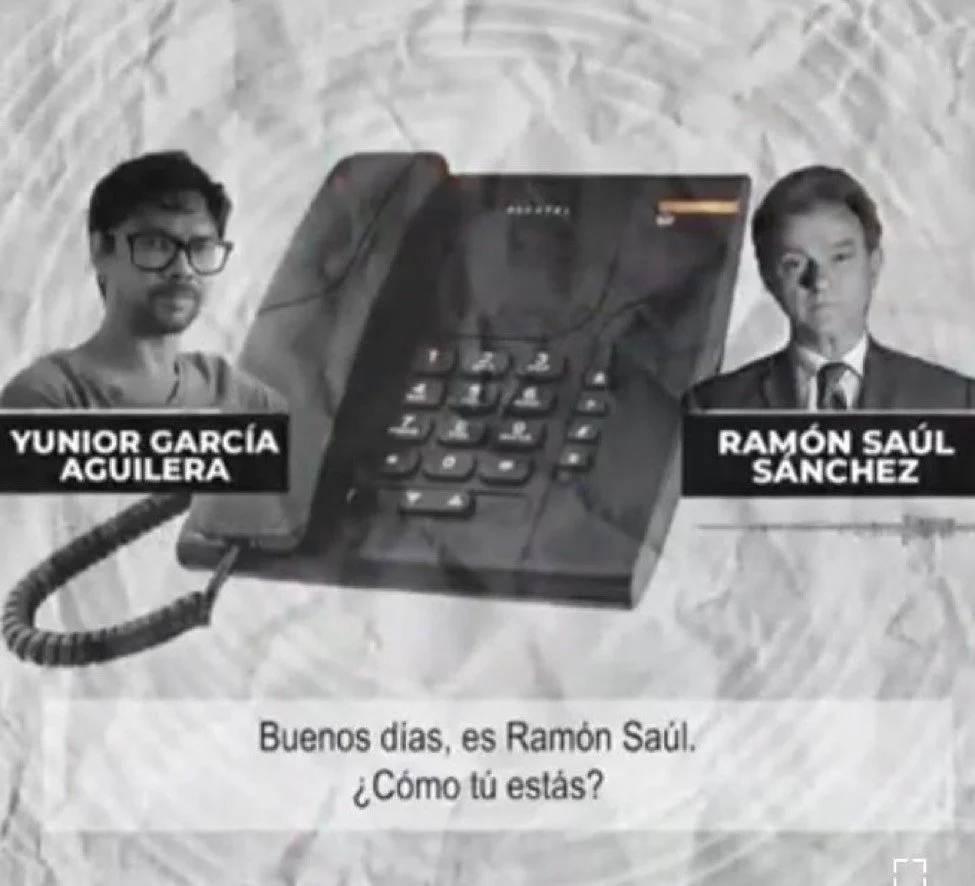
Here is the full transcript translated from Spanish between Ramón Sánchez (RS) and Yunior García (YG).
“RS: Yunior?
YG: Yes?
RS: This is Ramón Saúl, how are you?
YG: Hi, how are you, Ramón? So, I don’t know if you saw the announcement we made to move it up to the 15th.
RS: We, the Movimiento Democracia and the Movimiento de Opositores por una Nueva República, are a hundred percent in agreement with what Archipiélago is saying, with what you are saying. So we are with you. One question: Do you think it would be fruitful, or would it be counterproductive, if we managed to shine the freedom lights from offshore of Cuba on that day?
YG: It’s complicated, I think that has to be thought through. I do agree that we need the support of the whole exile community, wherever they are.
RS: We are with you one hundred percent. We have great admiration for you and Otero Alcántara [another star dissident.] We have very good access to the media. So, anything you want to publicize, send it over here and we’ll take care of getting the word out. Or anything else where you think we could be useful. I feel proud to be able to support what you guys are doing.” (Emphasis added)
Yunior had to respond to the leaked telephone conversation. In an interview with a dissident media outlet in Spanish, 14yMedio, he complained that there were “missing parts of the conversation,” but does not (English version) say what was missing. However, he did not deny the most important part of the recorded conversation, namely when he said they “need the support of the whole exile community.” Furthermore, Archipiélago actually takes a stand in favour of working unconditionally with the exile community by saying in the post below, “When exiles contribute to the cause it is not mercenaryism, we are all Cubans, they are part of the same nation and have the right to contribute to the cause.”

Cuban Version of the Violent Barricades in Venezuela?
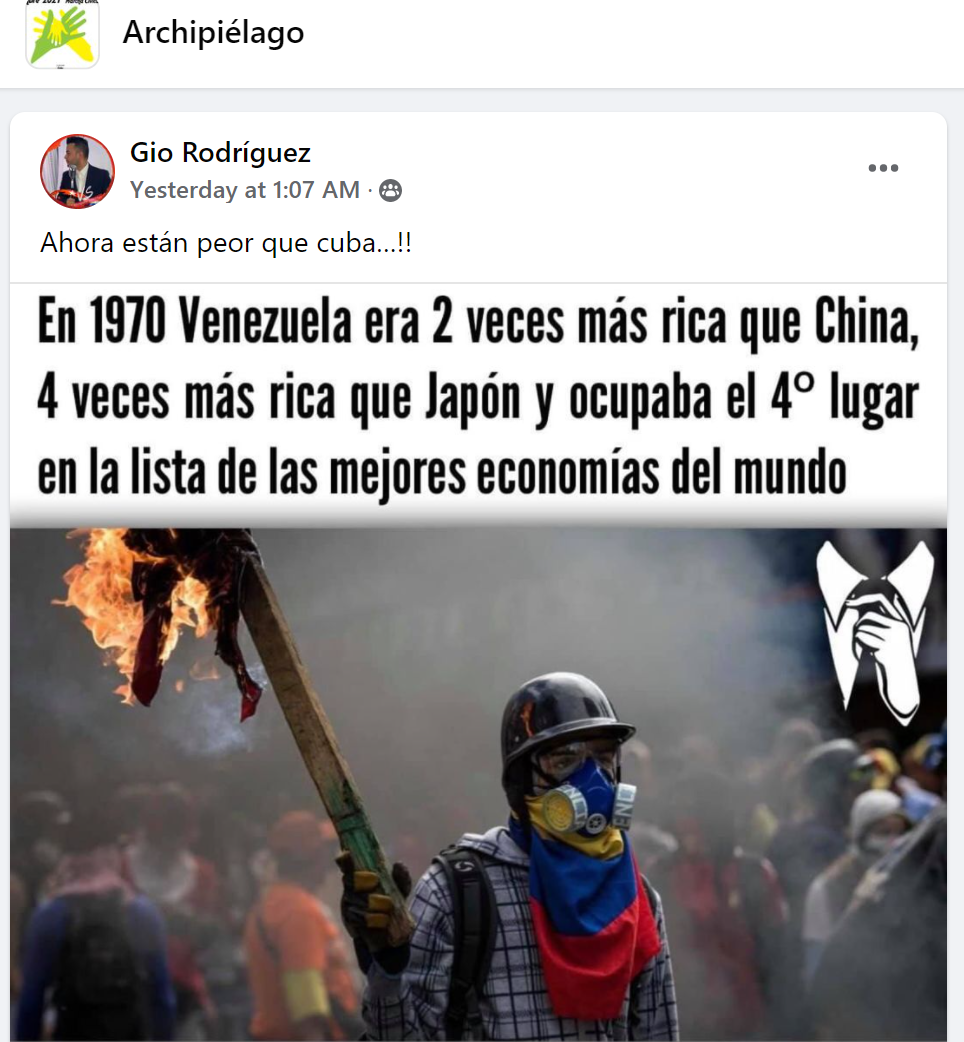
In Polanco’s Mesa Redonda presentation, he referred to “his personal experience in Venezuela, a country where he served as a diplomatic official. In this sense, he recalled that in 2013, 2014 and 2017 the so-called guarimbas [barricades] were developed. These were violent actions by representatives of opposition sectors in Venezuela to overthrow the Bolivarian government that caused innumerable economic and human damage to society.” (Below is a scene from the guarimbas in Venezuela posted as a “model” by the Cuban Archipiélago.)
Polanco continues:
“There is a report from the Venezuelan state, ‘The truth of Venezuela against infamy: data and testimonies of a country under siege,’ published in September 2020 that has elements that are related to the actions that are intended to be carried out in our country. This report states that the total number of deaths during the violent protests in February 2014 was 43 people, while in the protests from April to July 2017 the Public Ministry registered 121 deaths and 1958 injured, however, in relation to the protests of 2014 the then Secretary of State of the United States John Kerry issued a statement in which he affirmed that ‘the demonstrations were peaceful and accused the Venezuelan government of confronting peaceful protesters by force,’ he said.”
“A detailed examination, says the report, of the events that occurred reveals that most of the demonstrations provoked and promoted by opposition leaders between April and July 2017 were carried out in violation of current national and international legislation. These demonstrations led to actions of extreme violence characterized by the use of firearms, Molotov cocktails, mortars and homemade weapons, the placement of barricades, death traps on public roads, damage to institutions, schools, health centres, and siege against military and police facilities. There were three unprecedented practices in the recent history of the country: setting fire to people designated as supporters of the government, using children and adolescents to prepare firebombs, guarding barricades and attacking the security forces, as well as the combination of high levels of violence with religious and patriotic symbols.”
Regarding the well-known NED and USAID funding of state subversion, Polanco explained that among those organizations born in Latin America is CADAL (Center for the Opening and Development of Latin America), which is part of a wide network of non-governmental organizations that the United States uses to channel financing for its political operators through NED and USAID. The links between the United States and its political operators in Cuba are obvious.
He revealed that two Cuban citizens are part of the generous beneficiaries of the funds of these US organizations: Manuel Cuesta Morúa and Yunior García Aguilera, signatories of the documents delivered to the Cuban authorities regarding the intention to carry out marches in various cities of the country. Both, he explained, travelled to Argentina in 2018 to participate in a CADAL promoted event pushing for subversion in Cuba by the Armed Forces (a pipe dream if ever there was one).
Polanco denounced the fact that both CADAL and its director, Gabriel Salvia, have been very active in supporting the provocations leading up to 15N in Cuba.
“In 2019, Cuesta Morúa and García Aguilera continued their preparations in a workshop sponsored by the Universidad San Luis Campus Madrid. There they received lessons from Richard Youngs, an expert on public protests as a method of political change.”
As Youngs points out, riots are increasingly a major route through which ordinary people seek to achieve social, political and economic transformation. “Protesters must make tough decisions, do they just disengage from politics or build new kinds of civic campaigns? Do they join existing political parties or do they move away from mainstream politics altogether?”
The official [Rogelio Polanco] also highlighted how the report itself acknowledged with concern the fact that the media intended to present these events as peaceful demonstrations. ‘Some here are beginning to look for so-called non-violent methods of struggle to obtain advice and carry out some of these actions in Cuba.’”
In fact, during the July 11 protests, we actually witnessed the inception of what the US and its allies would like to happen all over Cuba and on a sustained basis. A riot occurred in Cárdenas with the use of projectiles, rocks, the overturning of a car, looting, yet the media persisted in portraying this as “peaceful protests” while highlighting the Cuban government “crackdown.
“Peaceful” was the keyword used in July as part of the narrative to blame Cuba for the arrest of those violent elements. Yet, as we head toward November 15, it is no accident that the Miami press has been all over the fact that a car was overturned in Cárdenas on July 11. The mainstream media knows full well that erecting barricades and weaponizing objects such as cars constitutes a key ingredient in destabilizing the state and creating chaos, injuries and even deaths, as occurred in Venezuela. Thus, it delights in reporting that a “large crowd of people overturn a car in a protest.”
Yunior García Aguilera is clearly an agent of the US playing out the role he was trained for by the US. Here is further information released on November 1.
On that day, Dr. Vázquez González, a Cuban who for more than 25 years has been the agent Fernando of the Cuban State Security Organs, came out in public after having infiltrated the counterrevolutionary groups.

Dr. Vázquez González confirmed what Polanco asserted regarding the meetings abroad in which “agent Fernando” participated along with Yunior García, his collaborator Manuel Cuesta Morúa and others, including two non-Cuban army generals. “Agent Fernando” revealed photos and videos as the iron-clad proof of Yunior directly working with the US over a period of several years. “Agent Fernando” indicates that the playwright Yunior perfectly fits the role of promoter for the provocative march on November 15. In a new video, “agent Fernando” explained that the:
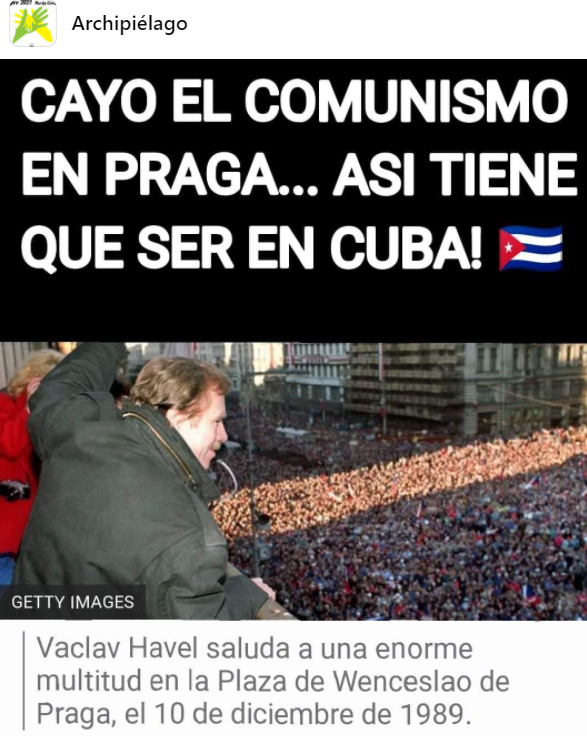
“strategy is not new, since Yunior García Aguilera tries to reissue an event from three decades ago, when on a similar date playwright Václav Havel, defender of the hegemonic purposes of the US administration, addressed the public in Prague, the capital of then Czechoslovakia. On the night of November 26 of last year [2020], prior to his presence in front of the Ministry of Culture, Yunior published on his Facebook wall the question ‘Cuba, and what should we do now?’ [Similar to] Havel’s statement: ‘Something must be done,’ during the Prague protests. It was that November 27, 2020, when Yunior appeared as an agent of change, a role rehearsed by the United States in the color revolutions. Dr. Vázquez González added that what is sought is to cause chaos, disobedience in society, so that international organizations apply sanctions and that this then leads to military intervention and the imposition of an alternative government in our country.”
The Archipiélago post below: “Communism fell in Prague. So must it be in Cuba!”
The overall narrative on the “peaceful” Cuban protests is presented courtesy of The Washington Post in its Editorial Board publication on October 15, “Opinion: Cuba’s peaceful opposition mounts a comeback.” Irrespective of what happens on November 15, the script has already been worked out. The “protesters” are the victims while the government is at fault. Thus, buzzwords such as “peaceful protests” or “pro-democracy protests” are completely arbitrary, based on the objectives of the US and its allies.
If a movement anywhere in the world is against a government not to the liking to the US, it is dubbed a “pro-democracy movement,” thus justifying any means used by its perpetrators. On the other hand, any movement that is in defense of an “anti-US government” is dubbed “terrorist” or “extremist.” The most glaring example of this false dichotomy is in the US itself. No matter how many millions of people demonstrate in the US against the antidemocratic and racist nature of the US state, they are never called “pro-democracy movements.”
Thus, people should be aware, and not be fooled by the cacophony of the “peaceful protests” mantra that is bound, in one way or another, to accompany the events of November 15 and their aftermath.
Amplifying November 15 Internationally
A key ingredient of the Archipiélago destabilization effort is to internationalize it. Members maintain a regularly updated chart which indicates where pro-November 15 marches are to take place outside Cuba. Almost all of them are located in North America and Europe where the Cuban exiles are located.
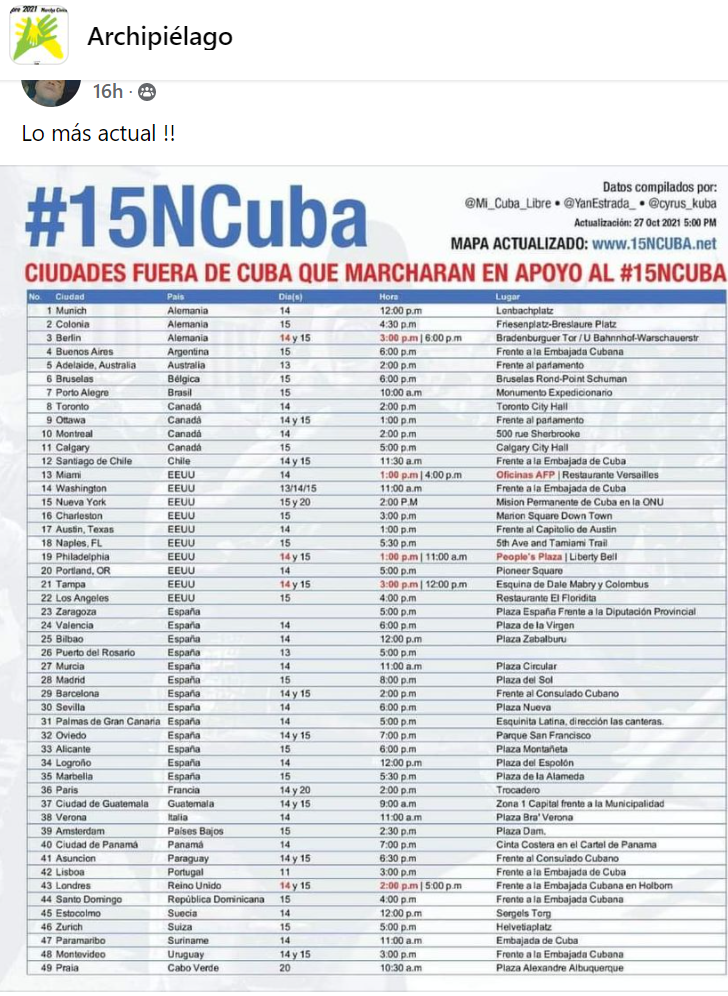
The goal is now to build on July 11, thus making for a caustic mix of local incidents within Cuba to be amplified outside the country using the hashtags #15NovCuba or #15Nov (which, by the way, can be used by supporters of the Cuban government to attract attention while nevertheless opposing the counterrevolutionary forces).
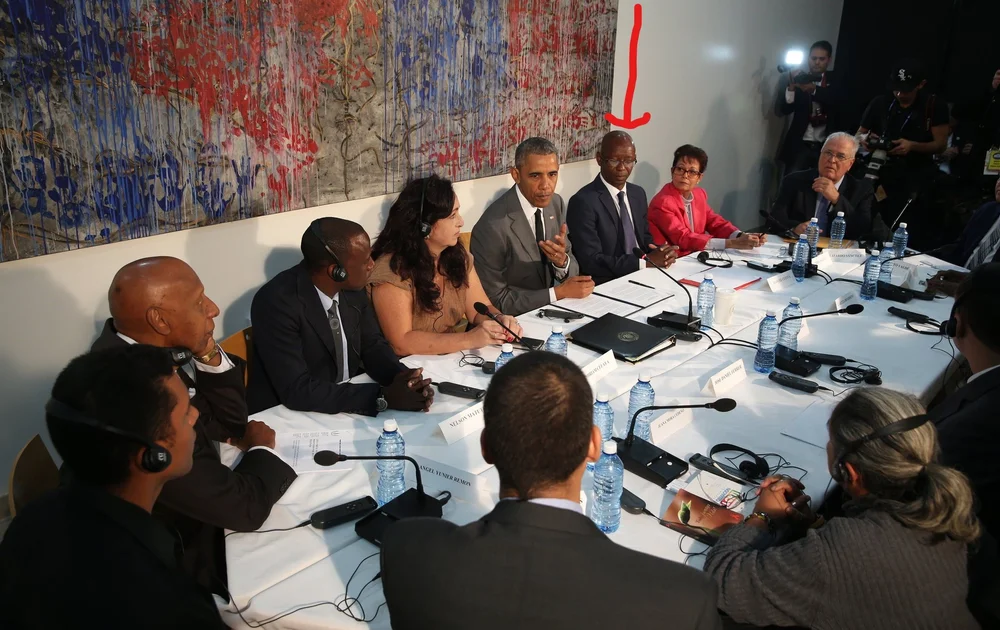
The counterrevolution has experience going back many years with links in Cuba, the US and elsewhere. For example, one of the key players, Manuel Cuesta Morúa, is a close collaborator of Yunior. He was one of a select group of dissidents who met with then President Obama during his trip to Cuba in March 2016. In the picture, Cuesta Morúa is seated on Obama’s left.
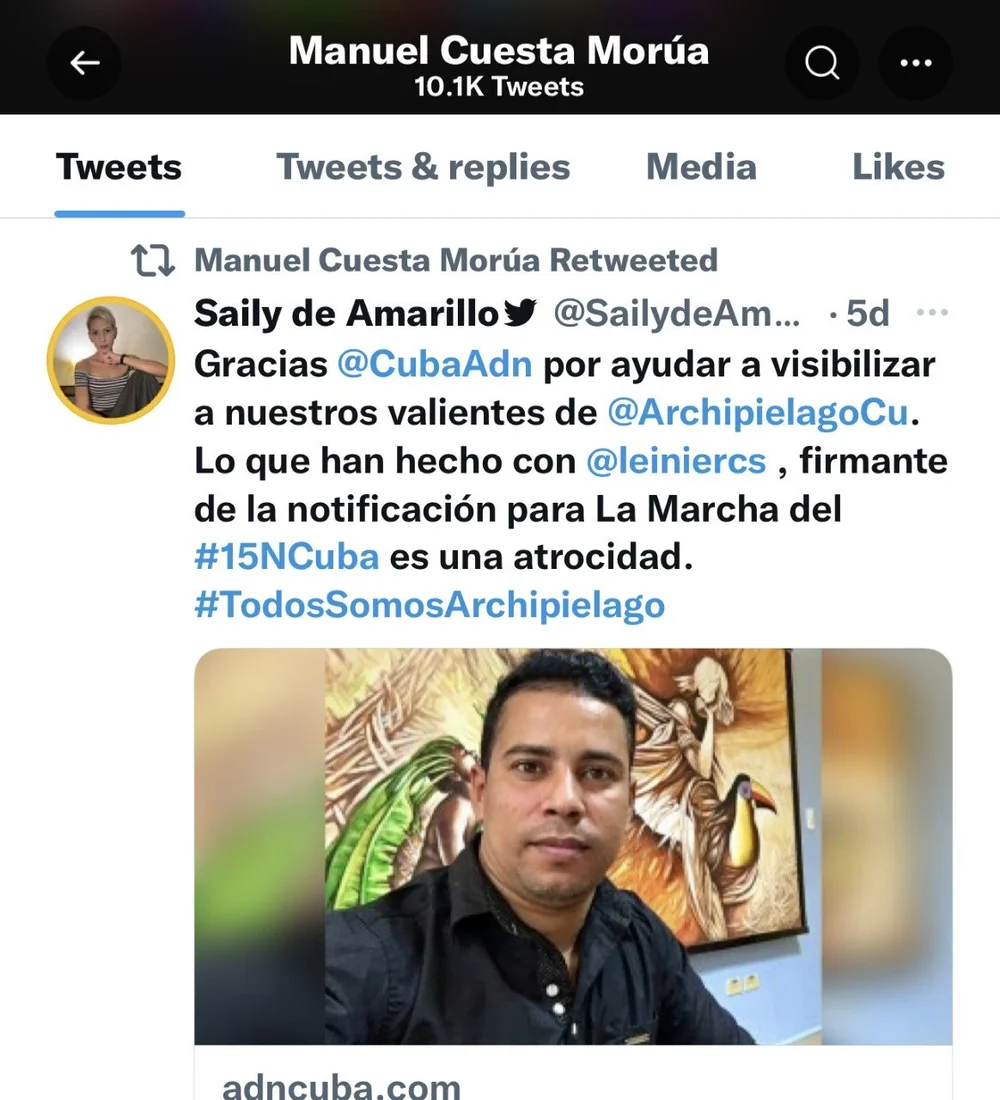
One of the specialities of Cuesta Morúa in the current situation is to amplify 15N to the Miami counterrevolutionary press, which supports any type of terrorist activity. For example, here he retweets a post that thanks ADN Cuba, one of the main US-based and funded counterrevolutionary outlets, for giving visibility to the work of Archipiélago and the upcoming 15N.
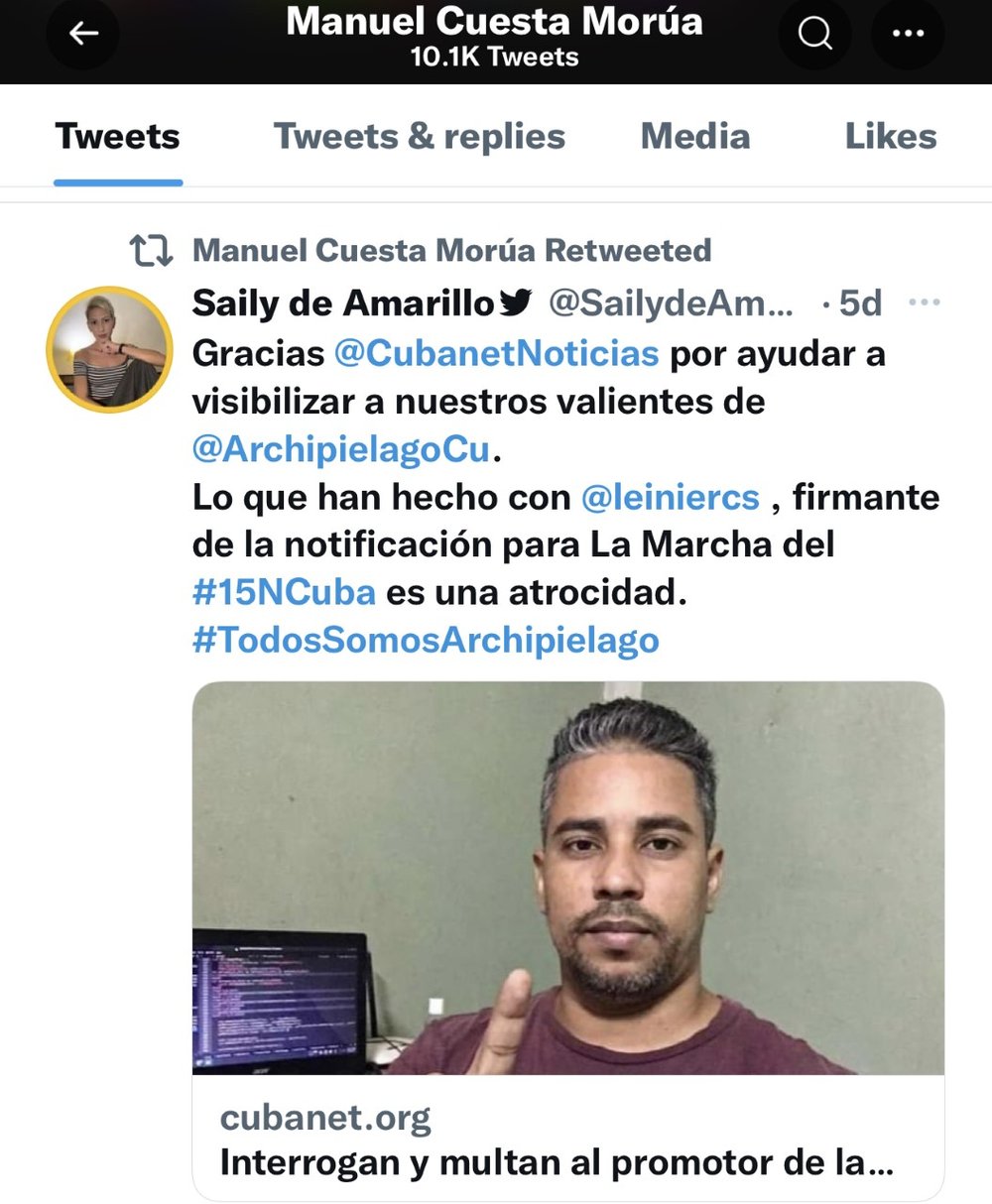
Here is Cuesta Morúa’s retweeted thank-you note to USAID-funded CubaNet, another US-based outlet amplifying the 15N march:
US-based and funded Diario de Cuba (DDC) also gets the nod from Cuesta Morúa when it declares, following July 11, that the “Cuban government can no longer speak in the name of the Cuban people.” While it may seem to be an innocuous comment, this is how the US and its allies act: based on this false narrative, they float an “alternative” government as the real representative of the people, as they do in Venezuela, and justify interference, including military intervention, to back up their choice.

A “Leftist” Feature of Archipiélago and Annexationism: Is This Possible?
This is not the only feature that Cuesta Morúa and his collaborators learned from their training in Argentina and Spain with CADAL. He possibly learned from CADAL the need to portray their movement as not openly right-wing but rather as pseudo left. Believe it or not, he has picked up the popular #DefundThePolice slogan in some Western capitalist countries and applied it to the so-called violence of the Cuban police.

If readers believe that the attempt by the counterrevolution to provide a “left” image to the movement is an exaggeration, below is an Archipiélago post that quotes Fidel Castro’s famous statement that “Revolution is to change everything that needs to be changed.”
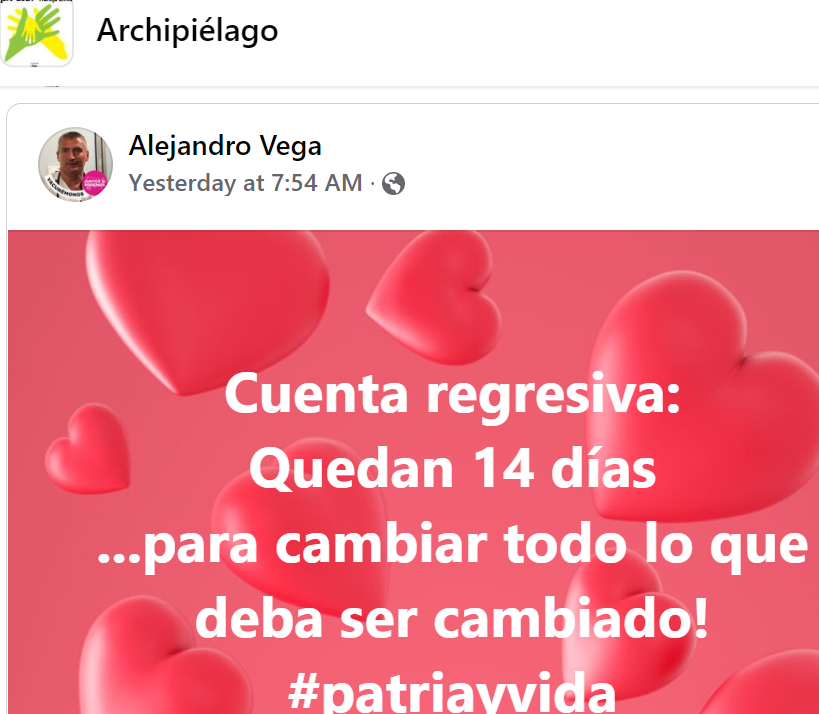
The quote is almost verbatim from Fidel, minus the words “Revolution is…” Nonetheless, one should not take this lightly. After all, Cuesta Morúa and Yunior were probably trained to use “left”-sounding phrases to recruit sections of Cuban society, especially intellectuals.
Sadly, the fact is that some “pro-Cuba” intellectuals and artists in Cuba also use this Fidel phrase to push for their interpretation of change such as capitalist reforms, a multi-party system and a more “open” Cuba policy toward the US, as if the decades-long Cuba-US standoff is the fault of both the US and Cuba. Every indication is that these elements are already indirectly on board with the colour revolution by “both siding” the events: they are opposed to the violence of the colour revolution and that of the Cuban government.
These Cuban intellectuals living in Cuba are not ashamed to complain that the current post-July 11 period is plagued by “two extremes” – the Cuban government (which they now casually describe as a “regime”) and the agitators, with no room for a “reasonable perception.” They also promote the November 2020 San Isidro Movement that arose out of a wide-open debate and polemic in Cuba regarding Decree 349 on the Cuban government’s policy on culture and involved in November 15.
Junior was featured in this San Isidro Movement along with other US-supported individuals. It was the forerunner of July 11 as, and according to some intellectuals, a “made in Cuba opposition.” Of course, in order to remain in the good books with the elites in the West, the intellectuals abundantly use the buzzwords “cracking down hard” and “repressive violence” in reference to the Cuban government.
For a very precise analysis of how these intellectuals operate in Cuba and abroad, see the video presentation in a recent Geopolitical Economy Research Group webinar on Cuba by Cuban revolutionary blogger Iroel Sánchez, with English subtitles. This 15-minute YouTube is worth viewing in its entirety, as Iroel is not one of the “go to” Cubans sought after by the mainstream media and academia. The exact portion where he deals with these intellectuals is from 5:03 to 5:15.
Furthermore, in carefully diving into the pages of the Archipiélago Facebook group, one notices, for example, that it features some out-of-context left quotes from Martin Luther King. Furthermore, its main spokesperson Yunior said in an interview with the Miami Herald, “I am calling on the left worldwide, which is usually complicit and unfortunately usually behaves in a hypocritical way, to tell them that there are no left or right dictatorships, good or bad, there are dictatorships, and we must oppose them all.”
Why does Yunior feel confident in appealing to the left? Does the adage “Where there’s smoke, there’s fire” apply? Are some on the left – and not only abroad but also in Cuba –sympathizing with the Archipiélago movement? Yes, indeed, we have seen above how some Cuban intellectuals on the island have quite an affinity with colour revolution. However, how does anyone reconcile being “progressive” and “left” while hobnobbing with those whose policies favour Cuban annexation to the US?
Every country must be analyzed on its own merits. For Cuba, being left or, more precisely, being communist, or pro-communist or respecting Fidel Castro and his legacy is based solidly among not all but the majority of the population since the early 1960s. Thus, it does not matter how much the Archipiélago folks scream anti-communist slogans, flash “down with the dictatorship” placards or grossly insult their leaders past and present. Not only does this go over like water off a duck’s back for the majority of Cubans, but it actually consolidates and deepens their appreciation of their ideological/political outlook, which they see as the safeguard to maintaining Cuba’s precious sovereignty, patriotism and dignity.
Hard facts and figures speak volumes. For example, in the 2019 constitutional referendum vote, which included a clause to safeguard the ultimate goal of communism (on the insistence of the grassroots), here are the results:
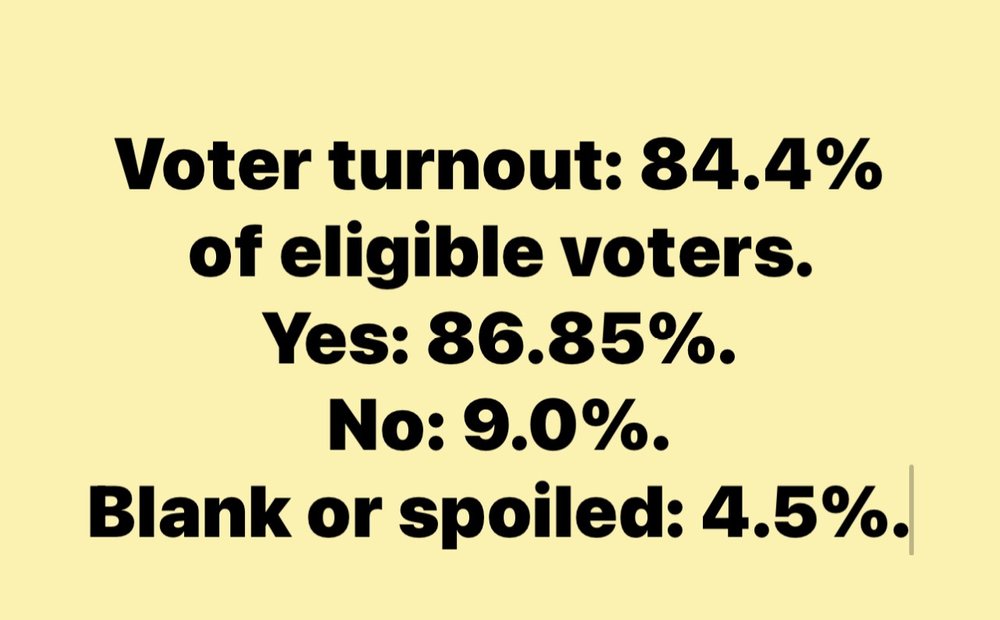
Thus, of those voting, over 86% voted in favour or their economic/political “communist” system. This ratio coincides with my own experience living in Cuba for extensive periods of time on and off since 1997: not all, but the vast majority of the population supports and works for their system. Even though the Archipiélago will not admit it, they must deal with this situation. Thus, at times, they must attack the system from the “left,” as Yunior does above and Cuesta Morúa also with his #DefundThePolice.
Is it an exaggeration to extrapolate from the Archipiélago pages and Yunior’s interview with the Miami Herald to claim that they use left rhetoric to cover up their goals of pro-US regime change? It does not seem to be a fabrication. However, readers can come to their own conclusions. On October 30 (appropriately the day before Halloween), in another attempt to explain his telephone conversation with the terrorist Ramón Saúl, Yunior dressed up as a virtual “firebrand leftist.”
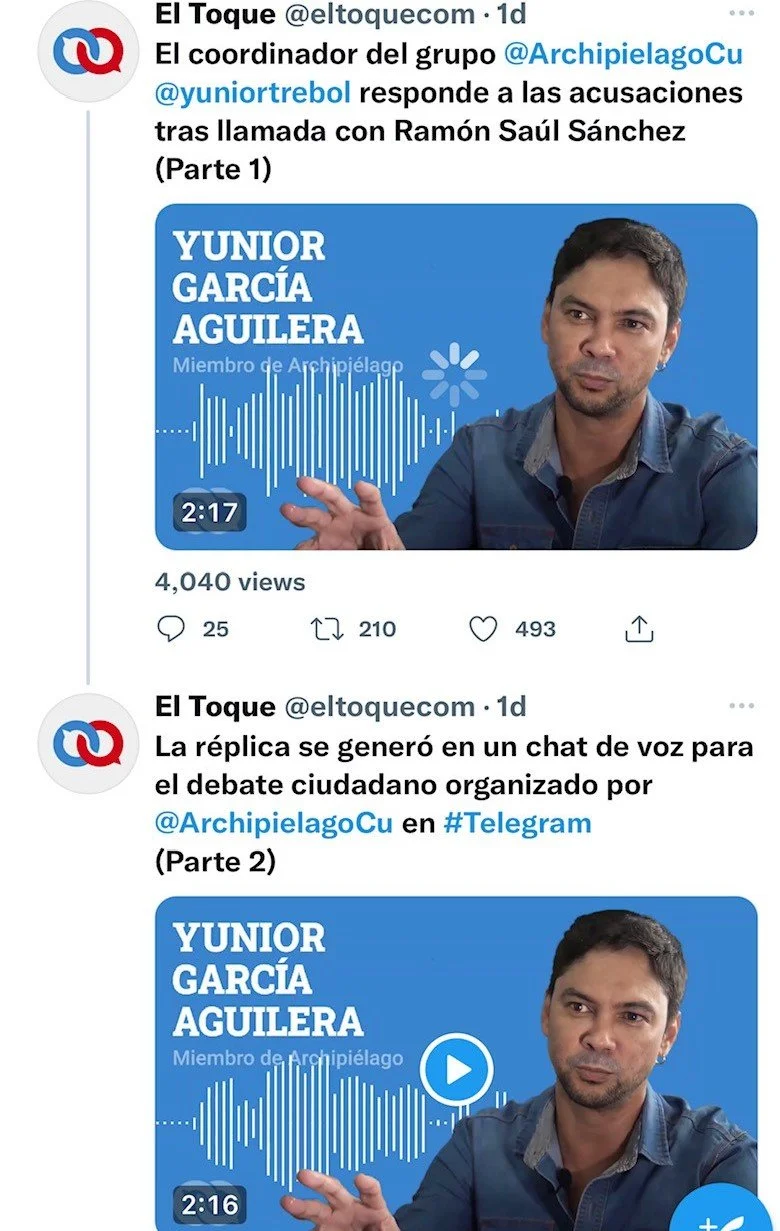
In chameleon-like fashion, he said in the above recording that he was against “savage capitalism” as an option for Cuba. At the same time, he asserted that there is “no socialism” in Cuba but rather a “primitive, ferocious state capitalism.” To make himself even more palatable to some of the left in Cuba and abroad, he stated that he had signed a petition to President Biden demanding the lifting of the blockade. (Notes taken by the author from the El Toque recording and translated into English.)
This latter revelation is not very impressive. First, in the interview with the Miami Herald cited above, he said that “they always complain about the ‘blockade, he said, referring to the U.S. embargo. ‘There is no worse blockade than the internal blockade on every Cuban citizen in this country.’” Second, as we have seen above, an Archipiélago post called on Biden to increase the blockade sanctions.
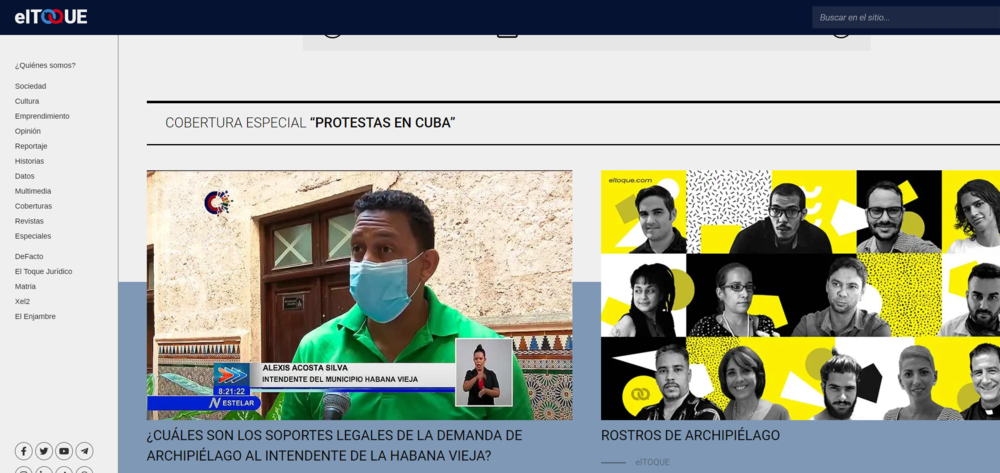
To add to his “left credentials,” Yunior said in the same recording that he is “against apartheid.” Okay, but where? In the US racist state, or in Israel, perhaps? No, in Cuba as he refers to its “ideological apartheid” that prohibits thinking outside the official ideology. (Notes taken by the author from the same audio interview with El Toque, one of the main subversive outlets and, of course, fully involved in 15N, as can be seen below, where it is promoting Archipiélago and its coordinators such as Yunior.)
El Toque is based in the Netherlands and its stated goal is to target countries where “freedom of expression is limited.”
However, while it is increasingly difficult to get people inside and outside of Cuba to swallow the “left” narrative, who comes to the rescue to provide Yunior with “left” credentials? The CNN Havana correspondent on November 4 provided him with the ultimate certification as a “left-leaning playwright.” This is not all. We see in the report based on an interview with Yunior in his home with his bookcase in the background, the two volumes by Fidel Castro, The Strategic Counter Offensive, detailing the epic struggle in the Sierra Maestra leading to the January 1 victory.
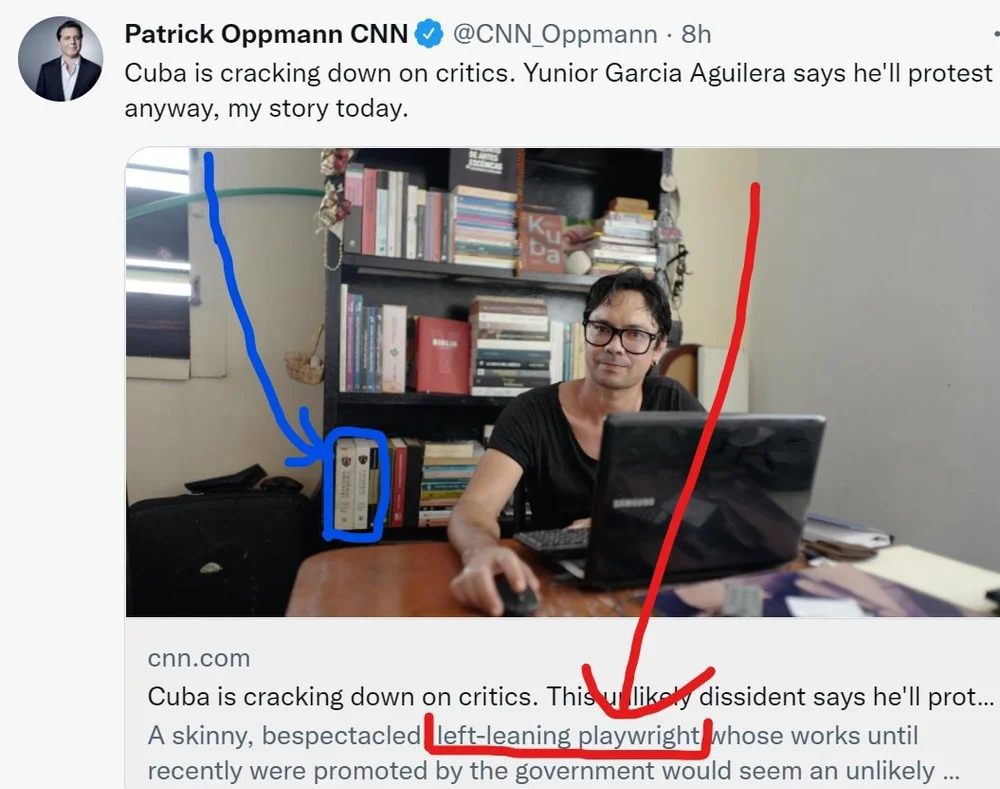
We do not know if the playwright, with a natural flare for drama, placed the Fidel volumes there to impress CNN in order to buttress the usual narrative of turn coats being former “supporters” of the Revolution but later “disaffected by the outcome.” One such example of betrayal is Samuel Farber, born in Cuba and having participated in the anti-Batista movement, emigrated to the US in 1958. For quite some time, from the “left,” he is supporting the US narrative against the Cuban leadership by writing among others for a “left alternative” pro colour revolution outlet in Cuba, La Joven Cuba.”
In any case, in the course of scouring Yunior’s Facebook group Archipiélago, one of the most important recurring features of the “left-leaning” Yunior is the utter disdain and hatred for Fidel accompanied with the most insulting cartoons and photos, surpassing anything that can be seen – even in the extremist hard-core anti-Castro Miami press.
The Yunior posture of being “neither left or right,” also known as the “end of ideology,” is a particular minority feature in Cuban political culture. It rears its head at every important turning point in Cuban history in recent decades. My 2017 article titled “The End of Ideology in Cuba?” on this controversy is more relevant than ever. I wrote, “Objectively, this so-called neutrality against extremes consists in throwing a life jacket in support of capitalism. The real defiance is against socialism.”
We have touched on the role of the “left face” of Cuban subversion. What about annexation to the US? Likewise, each country must be analyzed on its own, as we have briefly done above with regards to socialism and communism. Now, with regards to US projects to dominate countries in Latin America, for example, the US is threatening the sovereignty of Venezuela and Nicaragua, Bolivia and Peru.
However, for obvious geopolitical reasons, outright annexation is not part of their plans in these countries. The situation that Cuba faces is very different. Think of Puerto Rico. Given Cuban historical ties to the US since the 19th century, even when it was fighting Spanish colonialism, annexation to the US was a secondary part of the political culture on the island and it still exists today. Thus, while Archipiélago does not openly advocate annexation, the movement it is fostering does indeed lead to some kind of 21st-century Cuban “annexation” to the US.
In fact, among the Miami terrorist groups it solicits help from, annexation is still a goal, as they dream of another Playa Girón-like invasion, but one that succeeds in order to convert Cuba into another Puerto Rico. Furthermore, the Archipiélago trove contains innumerable photos comparing in a favourable light the situation that existed before the Revolution compared with today. What was the US–Cuba relationship before 1959, especially in the 1950s under Batista? Cuba’s neocolonialist status was as close as possible to actually being “annexed” to the US. In fact, while painfully navigating through Archipiélago, one cannot help but notice how it is so impregnated with sycophantic pro-US prejudices, that it reminded me of what José Martí said regarding his long exile in the US just before being killed in action in Cuba in 1895: “I have lived in the monster and I know its entrails.”
Controversy arose from my article cited above (“The End of Ideology in Cuba?”) around this statement:
“I have always maintained that the most dangerous opposition to the Cuban Revolution comes from the so-called left, and not from the openly right-wing annexationists.”
Most readers praised the article, while many others participated in the serious debate. Only a few strongly objected to it, mainly singling out that sentence about the “most dangerous opposition.” In responding to detractors, my second piece was penned in Spanish as a columnist for Cuba’s Prensa Latina (and published in English, titled Cuban “Left” Opposition and Annexationists: Two Wings of the Same Eagle).
This piece created more controversy, as well as complaints, and thus in the third installment of this trilogy, I wrote:
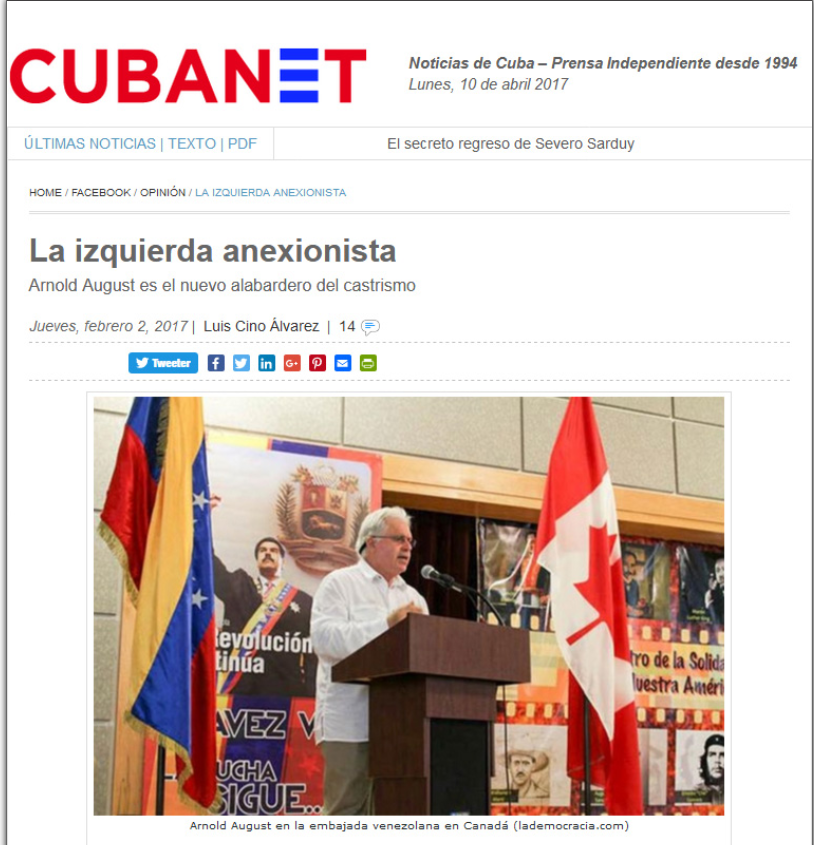
“Their common main complaint has been that my articles do not name individuals. Some of their social media accounts even try to dictate to me in referring to the dissidents’ posts. They ‘are asking for names’; ‘Name names!’ they demand. They are oblivious to the fact that by so doing they name themselves and that they do not, and cannot, in any way shame me into citing names. Perhaps the most remarkable proof that there is no need to name names, since worms will surface after rain, comes from Miami. On Feb. 2, 2017, the US-financed CUBA NET published a front-page article on the controversy provoked by my two columns.”
See the screenshot below, for my original Spanish version of the piece published in La Pupila Insomne, edited by Cuban blogger Iroel Sánchez. Perhaps the best example of the boomerang effect is the attack by the CIA-financed and extreme right-wing Miami-based CubaNet against my person and articles, while defending the Cuban “left,” titling their piece: “The Annexationist Left: Arnold August Is the New Agent of Castroism,”.
Thus they inadvertently prove my point that Cuba’s “Leftists” and Annexationists are two wings of the same eagle, and why, as can be read here: I do not name them.
The concern about the ideological/political annexationist war being waged against Cuba in the current period goes back to at least 2016, as my piece in Black Agenda Report points out:
“What does it mean when American flags appear on the streets of Havana? Is President Obama winning his war against Cuban socialism by non-military means? Obama confirmed once again that the US is dispensing with openly antagonistic tactics, in favor of diplomatic tactics that he hopes will attain the goal of snuffing out the Cuban Revolution. The Cuban people, themselves, are engaged in a great debate about their future – and ours.”
The Left in North America: Where Does It Stand?
Given the fully documented proof that, despite all the rhetoric, the 15N is not peaceful but is in fact US-driven – even to the point of threatening a military intervention – what can we do to defend Cuba?
The left in the US must be applauded. Virtually all the left alternative independent web-based media in the US has unconditionally opposed the US narrative on Cuba, including Black Alliance for Peace, Black Agenda Report, MintPress News, People’s Dispatch, The People’s Forum, Code Pink, Lee Camp – Redacted Tonight, The Socialist Program, BreakThrough News, The Grayzone, Popular Resistance, CounterPunch and others.
The only major holdout is the North American Congress on Latin America (NACLA), which serves as the virtual official organ of regime change in Cuba. A guide to the alternative left can be found here. NACLA is not listed, yet it is not clear if it is because of its right-wing swing toward Latin America. In any case, it is good thing it is not included.
Here in Canada, we are not blessed with this situation. In fact, the contrast with the US is startling. Only a very small number of outlets stand unconditionally against the US “colour revolution” narrative, while the vast majority either buy into the US agenda or are ominously silent on one of the most important issues for the left today: the Cuban Revolution. Is there a reason for this? Is it perhaps due to Liberal poster boy Justin Trudeau’s barely concealed support for colour revolution in Cuba, which was so appreciated by Archipiélago. Trudeau: “Cuba deserves democracy and freedom?”
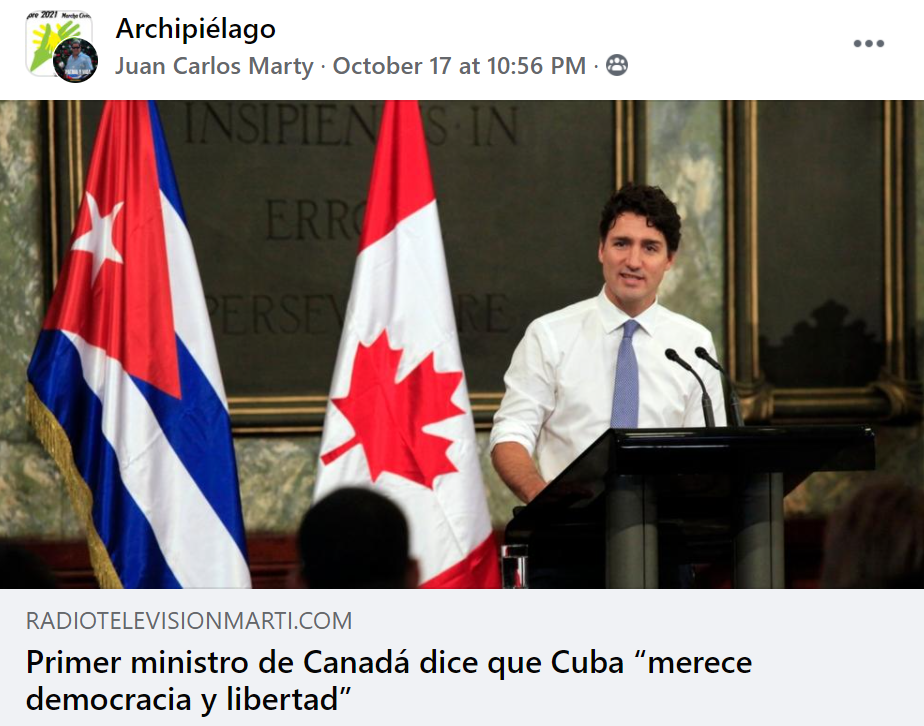
It proudly displays the latest feather in its cap, listing Canada among its supporters along with other countries such as Colombia, US, Sweden, Germany, Uruguay and Spain. The article was taken from “Radio and Television Martí,” the US-funded subversive media based in the US. This position by Justin Trudeau, given the current US-led subversive context, is perhaps one of the most right-wing reactionary statement taken by any Canadian government on Cuba since 1959.
It is far from being “ambiguous,” as some Trudeau apologists would have it. The US-trained Yunior and company have possibly been trained in capturing dog-whistle diplomacy, that is, hearing what music to their ears is, amplifying it while discarding the rest. Not one member of the Canadian Parliament – all the parties, including the social democratic New Democratic Party (NDP) – has yet to take a public stand against Trudeau encouraging colour revolution for Cuba.
After the July 11 event, the first out of the gates against the Cuban government was Canadian Dimension. The Canada Files produced an extended YouTube video based on my presentation at the August 29 panel on Cuba, organized by the Geopolitical Research Economy Group. We completely deconstructed the two Canadian Dimension articles written by Cuban dissidents and its related Trudeau position. Since then, Canadian Dimension has largely stayed clear of Cuba after publishing these two hit pieces. This is hardly a positive step in light of those dangerous precedents. A “left” publication that is neutral at a time that the Cuban Revolution is under attack, more than ever since 1959, is not encouraging. More on that below, as this Canadian disease of “neutrality” is rampant.
In any case, two other “Canadian left” media outlets picked up the baton from Canadian Dimension to try outracing each other, as to which one could cross the anti-Cuban Revolution finish line first.
First, there is Rabble. In a July 19, 2021 article, readers were confronted with several key pro-US regime change stereotypes:
“As a result of horrific conditions there and very likely [emphasis added] American provocation (the U.S. spends tens of millions annually on anti-government media and on-the-ground and social media campaigning), Cubans are demonstrating en masse against the government… They are blaming the Cuban government for the country’s state of affairs, claiming it is caused by Cuban leaders who are enriching themselves at the expense of the public… There are many things not to like about Cuba’s government. It isn’t democratic and there is widespread corruption, but other countries with un-democratic or corrupt governments are not bullied and starved by the U.S … I personally know people who can’t feed their families regularly, who stand in lines in the hot sun for hours every day to meet basic needs, who can’t rely on their excellent health care system anymore and who now fear absolute chaos. An orderly transition to some form of democratic government is impossible to imagine. Chaos is more likely, with widespread poverty, inequality and insecurity.”
Rabble may not realize it, but this “chaos and failed state” mantra was applied to Cuba by Biden, but ripped to shreds in The Canada Files YouTube mentioned above.
In another Rabble article, dated July 23, 2021, the litany of nonsense goes shamelessly beyond the pale by comparing Haiti to Cuba.
“Cuba, you might say, has in recent days had the same problem [as Haiti] – dissent – but in a very different setting [mild concession to Cuba]… Like its sheer longevity: despite a crippling US economic blockade, it has lasted as a one-party communist state, for only about a decade less than the Soviet Union did. Health care and education have been impressive, including a COVID-19 vaccine, though production is hampered by the blockade. Its flaws are many, among them repression of dissent – including the unprecedented current rallies and marches. The government says all economic trouble is due to the blockade, and protests are down to U.S. plots.
Now, one may be tempted to excuse Rabble for this, as this second one was reprinted from one of Canada’s flagship corporate media outlets, the Toronto Star. On the other hand, if Rabble can reprint from the Toronto Star, why did it not attend the two Geopolitical Economy Research Group (GERG) webinars on Cuba, on July 26 and August 29, to report on them and/or republish reports on them? The Rabble accusation above of Cuba as being guilty of “repression of dissent” rings somewhat hollow as our “dissenting voices” against the mainstream narrative on Cuba right here in Canada is repressed. Unless, of course, Rabble knuckles down in the future and reprints articles from The Canada Files on Cuba. Nothing yet.
Moreover, on November 1 it carried an article encouraging Canadian tourism to the island to be inaugurated on November 15. It did this without mentioning the US-led November 15th attempt to disrupt just that. Nor did it take a stand against the Canadian government’s treacherous stand lending credibility to the US-backed colour revolution narrative.
In addition to Rabble, The Breach outdid them all in an October 22 article:
“Well, I don’t think people like Blair and Clinton deserve any kind of left label. The people who understand themselves as being on the left, who are actively part of left campaigns, and who’ve really accepted an End of History narrative, are I think those people who don’t believe we can do any better than the defense of states like China, Syria, Cuba, and sometimes even North Korea, as building blocks in a feeble global antagonism against the overwhelming dominance of American power… When workers in Cuba are concerned about a year of economic brutality caused by both the imperialist American blockade and the collapse of tourism revenues – because of COVID and by mismanagement by a bureaucratic elite that lives a more luxurious life than ordinary Cubans – they can only be imperialist agents… So we oppose, for example, the American blockade on Cuba, but we don’t oppose it in the name of defending the state that these imperialists oppose. Instead, we oppose it in the name of supporting a politics of human freedom against imperialist power, above all, but also against those perverted and deflected forms of supposedly socialist politics that are bureaucratic states.”
However, the supposed rebuttal to this from what amounts to the “left” of Canadian Dimension, Rabble and The Breach is that it is wrong to lionize a leader simply because they are being attacked by the U.S. These words, paternalistically warning people in the North against glorifying Third World leaders, may fly under some of the left radar. It is very convenient for the middle-of-the-roaders.
Thus far, they refuse to purge themselves of the White Man’s Burden complex or US-centric notions that stop them from taking an unconditional stand in favour of leaders who are actually leading their peoples in fighting US imperialism, such as Miguel Díaz-Canel in Cuba.
Venezuela’s President Nicolás Maduro left me with this impression: “Ready to sacrifice his life.”
This “left” seems to be incapable of bringing itself to overcome the ingrained superiority of the “left” in the comfortable North, which cannot refrain from being “father knows best” for the leaders in the South. Thus, their difference with The Breach’s stark anti-communist, or anti-revolution stance, is just a matter of degree: how far can each of them go to avoid differentiating themselves from the leaders in the South who are vilified by the mainstream media, while maintaining the veneer of being “leftists”?
Is this exaggerated? Not so. How else can one explain that the current three most important Canadian left media – Canadian Dimension, Rabble and The Breach – have all taken stands in favour of a colour revolution in Cuba, while The Tyee and Ricochet have not yet carried any post-July 11 articles on Cuba at all.
On the other hand, The Georgia Straight, L’aut’journal in Quebec and The Canada Files (leading the way by a long shot) have carried favourable articles on Cuba. Aside from The Canada Files, not one of the independent “left” media outlets has taken a stand against Trudeau’s pro-colour revolution statement. Let that sink in: Cuba is being bled by the US now more than ever, and some “leftists” cannot take a stand? However, it is not too late. Now is the time, as the US and its allies are preparing a major offensive for November 15 against Cuba, as my recent article in The Canada Files points out. It is not too late. As Howard Zinn indicated, “You Can’t Be Neutral on a Moving Train.”
15N: What Are Cubans at the Grass-roots Level Presently Saying?
Even if we show without a shadow of doubt that 15N is being US-driven and supported, in recent telephone conversations with some of my Cuban colleagues, they all say that the situation is complicated. Let these Cubans speak for themselves on 15N:
Havana:
1) “Some think it is not US manipulation but rather coming from the base. Others are of the opinion that it is planning destabilization and change in government. I do not think that it will succeed. Last July was a surprise, not now, the government is prepared.”
2) “Many people ask questions, and they are not those who take to the streets to protest or shout offenses against revolutionaries but rather working men and women who see no future anywhere, and brother, they feel they are being let down.”
3) “All those who reside here (a two-generation household) say that regarding all those involved (in 15N), we have already accumulated enough ‘merits’ for them to be detained and accused of collaborating with a foreign power, punishable by our laws. I think we all agree on that here in the house. I really do not know ‘what card’ we will have up our sleeve to face these provocations if in the end they decide to take to the streets. And in these things, as Fidel always did, you have to be one step ahead, not act or riposte blindly. And I do not think that everything that we disseminate here on TV and others, the acts of reaffirmation, etc., have the repercussion that we need them to have outside of Cuba, because I think the propaganda outside is very strong, and people believe everything that the media says.”
4) “There must be a different preparation by the leadership of the country (for 15N) and I think that people were also a bit surprised about 11J. What worries me are the actions to face 15N.”
5) “One member of the family says that they should not be imprisoned now, because they would start a campaign against us, but I think that the campaign to bring them to court will take place at any time convenient for us; the measures should be taken that politically WE HAVE THE RIGHT TO TAKE THEM.”
6) “We were not prepared for 11J. However, for 15N we are. Let us see how it unfolds.”
7) “Hi Arnold, I haven’t heard anyone talk about 15N in my neighbourhood. It is not a matter of concern. Today I was in a queue to buy oil, and the neighbours commented on the length of the queue…Chicken is available, and that there is mincemeat for the month’s quota at the butcher shop. However, I saw everyone in their daily routine, as if there is an event to celebrate and that it’s the day (15N) that the students will resume face-to-face classes in the schools [in-person school attendance was suspended as a result of COVID-19]. And that is happiness for everyone.
8) Since the latest revelations on November 1 by agent Fernando proving without a shadow of doubt that Yunior and Archipiélago are a of creation of the U.S. to foment violent regime change, some Cubans are asking: “if it may be true that some people were confused and joined in the July 11 anti-government protests, will they be confused on 15N?
Just in from Santa Clara and elsewhere on the island:
9) “Taking into account the complaints that have been made public, including the uncovering of a Cuban security agent Fernando who was infiltrated in that group, I believe that if there was someone confused with the true objectives of the supposed ‘march’, it has already been clarified and I do not believe that they can manage to deceive many people to continue with their plans. If they continue, they will be accumulating crimes for which they can be prosecuted and convicted in Cuba according to the law.”
10) “Characters like these have no opportunity to carry out their subversion plans in Cuba, even if their trolls, influencers and bots on social networks want us to believe otherwise. The reality is that it is our revolutionary organizations can mobilize thousands of people in a short period to come out in defense of the Revolution.”
11) “These people are either paid, or they are fascists, or they are not really Cubans. I will never understand the hatred they have for us when we only want the best for all humanity.”
12) (It is no secret, in general terms, how the supporters of the Revolution act in a situation such as November 15.) Several sources across the island, especially in Havana, indicate for example that “the Cuban government is well informed about the activities of the counterrevolutionary media activists, the most known of whom is Yunior in Havana. The CDRs (Comités de Defensa de la Revolución- neighborhood committees) are organized with the intention of following them if they leave their houses, so that any action would immediately have revolutionaries on the streets to outnumber the counterrevolutionaries.” It confirms what other sources have stated as quoted above: “our revolutionary organizations can mobilize thousands of people in a short period to come out in defense of the Revolution.”
Featured image: Screenshot of Archipiélago Facebook Group.

Arnold August
Arnold August is a Canadian journalist and lecturer, the author of Democracy in Cuba and the 1997–98 Elections, Cuba and Its Neighbours: Democracy in Motion and Cuba–U.S. Relations: Obama and Beyond. As a journalist, he collaborates with many websites in Latin America, Europe, North America and the Middle East. He is a contributor to Orinoco Tribune. His website: www.arnoldaugust.com