By Francisco Dominguez1 – Dec 11, 2020
Before the 23 of January 2019, Juan Guaidó was an unknown entity. He acquired notoriety due to a series of coincidences … and decisions made in Washington. The practice of annually rotating the National Assembly’s presidency among the parties holding the majority meant that in 2019-2020 it was the turn of the extreme right-wing party, Voluntad Popular (VP); unfortunately, all VP’s key figures (Leopoldo López, Freddy Guevara) were under arrest or were fugitives of the law for their participation in seditious and violent acts against the Venezuelan state. Guaidó happened to be the next in line making him rightfully president of the National Assembly.2 In a bold move he (and Washington) decided he would proclaim himself “interim president” of Venezuela. His self-proclamation that was to catapult him into the world’s media limelight was part of Washington’s “regime change” strategy.
Mr. Guaidó’s “interim presidency” lacks constitutional or legal bases and his self-proclamation occurred in a public square in Caracas, in front of a small group of supporters. Guaidó has never been elected president of Venezuela nor has he ever stood as a presidential candidate for any election. His claim that his “interim presidency’ rests on the Venezuelan Constitution’s Art 233 is thoroughly false; the article reads: The President of the Republic shall become permanently unavailable to serve by reason of any of the following events: death; resignation; removal from office by decision of the Supreme Tribunal of Justice; permanent physical or mental disability certified by a medical board designated by the Supreme Tribunal of Justice with the approval of the National Assembly; abandonment of his position, duly declared by the National Assembly; and recall by popular vote.3 President Maduro is alive, has not resigned, has not been removed from office, is not physically or mentally incapacitated, has not abandoned the Presidency, and has not been recalled by popular vote. Additionally, the notion of ‘interim presidency’ does not exist in the Venezuelan Constitution. This ought to have been sufficient for European governments to never extend recognition, whatever they may think of President Maduro’s government.
The recognition of Juan Guaidó as “interim president” of Venezuela by European governments violates all basic principles informing political legitimacy, and should have never been awarded. The decision to award recognition is the result of political blackmail. Pedro Sánchez warned the Bolivarian government of Venezuela, on the EU’s behalf, that unless presidential elections, preferably without President Maduro as a candidate, were held within 8 days, the EU would have to recognise Guaidó. On this shaky, arrogant, and calculating basis EU governments proceeded to toe Trump’s line of elevating Mr Guaidó to the fictional position of “president” of Venezuela.
Ever since Jan-Feb 2019, Mr Guaidó has behaved abysmally.
In February 2019, Guaidó in complicity with the Colombian government, narco-paramilitaries, and the US government (Mike Pompeo), on the pretence of a concert at the Colombian border, tried to violently push ‘humanitarian aid’ into Venezuela by military means. The plan was sinister; it was naturally expected that Venezuela would oppose the illegal and violent action and it was intended to charge President Maduro with refusing to allow aid to his people, followed by serious military confrontation.
Guaidó made it to the concert through Colombian territory where he received military protection from the Los Rastrojos criminal narco-paramilitary gang, who Guaidó took several selfies with. The intensely anti-Chavista UK newspaper, The Guardian (14/09/2019) wrote: “Juan Guaidó, the Venezuelan politician fighting to topple Nicolás Maduro, is facing awkward questions about his relationship with organised crime after the publication of compromising photographs showing him with two Colombian paramilitaries.” It was revealed later that one truck was set on fire, by Guaidó supporters. The media had blamed President Maduro. The episode did not merit comment from European governments: was their silence forgiveness?
On 30th April 2019, Juan Guaidó led probably the most televised coup d’état in the history of Latin America. One wonders which features of this illegal, unconstitutional and armed action to violently overthrow President Maduro’s government—with incalculable consequences in human lives—are the European governments not prepared to condemn? The scandalously bland statement by the EU and European Parliament was inconsistent with the intense harshness and speed with which they are prepared to condemn the Maduro government. Euronews reported “Guaidó defiant after failed coup attempt.”
Mr Guaidó was complicit with the UK’s right-wing government in setting up a secret “Unit for the Reconstruction of Venezuela”. Records show that Guaidó and his entourage were prepared to offer oil and infrastructure contracts, and the restructuring of Venezuela’s debt, whilst his ‘ambassador’ to the UK, Vanessa Neumann, was reportedly prepared to surrender the Essequibo region in exchange for political support from the UK government. In short, Guaidó and his ‘team’ were ready to betray their nation on almost everything.
In May 2020 Guaidó contracted US-led mercenaries to launch an attack (Operatio Gideon) against his own nation and to assassinate President Maduro and high officials in the government, followed—as stated in the contract—by a Pinochet-style purge aimed at the thorough eradication of Chavismo from Venezuela. Here again, the European governments either pretended the event did not happen or they confined themselves to lame and soft generalities, a far cry from their unforgiving criticism of the Maduro government.
Guaidó has deliberately complicated the Venezuelan government’s access to 31 tons of gold in custody in the custody of the Bank of England on the ‘merits’ of his ‘interim presidency’. The gold is needed for the purchase of food, medicine and vital health inputs in order to fight the COVID-19 pandemic, through the UN Development Programme (UNDP). The Central Bank of Venezuela (BCV)’s appeal led the UK Appeals Court to annul a first verdict giving Guaidó access to the gold.
It is preposterous to imagine Guaidó having the capacity or the will to make good use of those resources. In Venezuela he has no control whatsoever, and given his obsession with imposing more sanctions on his own country, it is doubtful that he would spend money on the people of Venezuela. His lack of interest in paying the legal costs of the case (US$529,000) confirms he is not interested in complying with the law and is not desperate to obtain the gold to help the people of Venezuela.
Guaidó has made repeated calls to the military to wage a coup d’état to topple President Maduro, and has repeatedly (more then 20 times) organised a “final march” on Miraflores, Venezuela’s Presidential Palace, seeking to create a pretext for violent confrontations. In line with US and EU policy, he has repeatedly opposed the right of Venezuelans to vote in elections. The EU has at best commented on these flagrant undemocratic and seditious acts with deafening silence and at worst welcome them with enthusiastic approval.
Guaidó is not only a willing accomplice in aiding the US to illegally confiscate his own nation’s assets but he and his closest associates are also deeply involved in corruption. Through the protection of Trump, Guaidó and Co have been lining their pockets with hundreds of millions of US dollars resulting from the US illegal confiscation of Venezuelan assets ‘legalised’ by the ‘interim president’. On 24 January 2019 the US State Department gave US$20 million to the ‘new government’; a 2015 Citibank loan to Venezuela was unilaterally settled in advance and the saved difference (US$340 million) – with US government support – was given to Guaidó; in May 2020 OFAC gave Guaidó’s “government” US$80 million for the “liberation” of Venezuela; USAID gave Guaidó US$128 million to assist Venezuela migrants who have not seen one penny; and Guaidó was instrumental in Trump’s illegal confiscation of Venezuela state, US-based, gasoline distribution company CITGO, valued at about US$8,000 million. Venezuela has incurred US$11,000 in losses due to the freezing of assets. There is more but you get the picture. Europe has been the continent of colonial pillage so, is this ‘historic affinity’ maybe the reason they recognise Guaidó?4
In fact, European governments and the EU itself, de facto work with and recognise the Bolivarian government of President Maduro, by not only not recognising Guaidó’s appointees as “ambassadors” but by also sending ambassadors to Caracas who present their credentials to President Maduro in nationally televised public ceremonies. This sublime duplicity should end by the formalisation of a perspective of constructive engagement with the Bolivarian Government.
There is no justification whatsoever for European governments to continue their untenable policy of recognising Juan Guaidó as ‘interim president’ of Venezuela when in reality, he is totally bereft of any legal, political, or constitutional legitimacy for his self-proclamation, and especially since his thoroughly undemocratic and criminal credentials have been irrefutably proved. An unconditional withdrawal of his recognition is long overdue.
1 Francisco Domínguez, former refugee from Pinochet’s Chile, is an activist and an academic, and he is also National Secretary of the Venezuela Solidarity Campaign (UK)
2 Venezuela’s opposition won a majority to the National Assembly in 2015 for the period 2015-2020; Henry Ramos Allup representing the Acción Democrática party, became the Assembly’s president in 2016-17; Julio Borges of Primero Justicia during 2017-18; and Omar Barbosa from Un Nuevo Tiempo for 2018-19; all elected as president by a majority vote of the deputies.
3 Constitution of the Bolivarian Republic of Venezuela: https://www.constituteproject.org/constitution/Venezuela_2009.pdf?lang=en
4 Detailed information from article in Venezuelan pollster, Hinterlaces (in Spanish) about many of Guaidó corruption endeavours:https://www.hinterlaces.net/asalto-a-un-pais-el-prontuario-de-guaido-en-diez-casos-emblematicos/
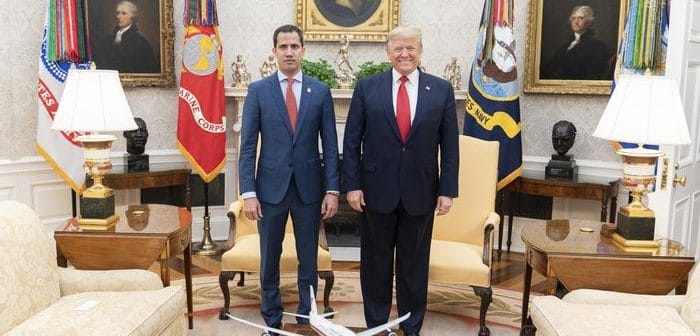
Featured image: File Photo.

Francisco Dominguez
Francisco Dominguez, a former refugee from Chile in the UK, is head of the Centre for Brazilian and Latin American Studies at Middlesex University, London, United Kingdom. He is also secretary of the Venezuela Solidarity Campaign in the UK.