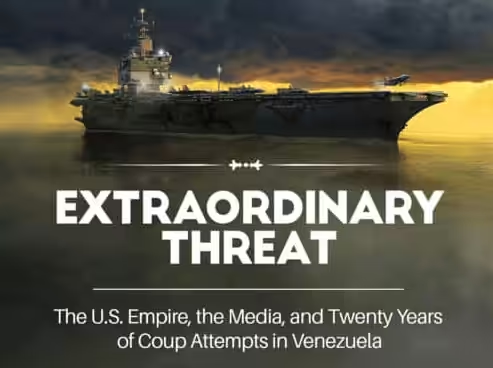
Monthly Review’s next up and coming book, Extraordinary Threat: The U.S. Empire, the Media, and Twenty Years of Coup Attempts in Venezuela, coauthored by Joe Emersberger and Justin Podur, is a primer on the mechanics of regime change. Their book draws our attention to Venezuela as a case study from which we must learn a core lesson: Never underestimate the power of U.S. propaganda.
Perhaps as a result of the power of the American propaganda machine, many North Americans may be inclined to focus solely on the following question: What might Chávez, Maduro, or for that matter, Morales, have done differently? Emersberger and Podur are here to remind North American viewers and readers (especially given their position relative to Latin America) to refocus their energies, asking instead: What could the U.S. have done differently, and what difference would it have made? As we study Extraordinary Threat, we quickly perceive the tricks and failures of a North American propaganda machine which sets up the convenient conditions for the appointment of successors outside any democratic process – that is, a combination of assassination attempts and rolling “opposition” protests, and a masquerade of “foreign aid” accompanied by horrific slap sanctions. Given that sanctions are the warfare of our time, what then can we learn from the way sanctions were imposed in the Venezuelan context, and their consequences? What are the lessons that Canadians, Americans, Europeans need to learn – especially about the nature of democracy, and the limitations of their own?
During a recent interview with the Orinoco Tribune, in advance of the book’s release, Joe Emersberger underscored: “What they can do, of course, in capitalism, is buy off a significant sector of the professional class, you know the people who actually have some useful skills, specialized knowledge…if you think back to what Chomsky said, in Manufacturing Consent, some interviewer asked him you know, whose consent is being manufactured, and he said, well it’s the 30% or so, the teachers, the professionals, their consent is crucial. So that’s a huge challenge, and I think it’s universal to any kind of social reform anywhere.”
RELATED CONTENT: Justin Podur & Joe Emersberger’s ‘Extraordinary Threat’ (Book Forum)
In turn, Orinoco Tribune contributor Gabriel Martínez took the opportunity to ask: “What could Venezuela’s experience share with the rest of Latin America, considering that we might be sort of seeing a veer towards more leftist and progressive modes of government?” Coauthor Justin Podur answered: “I think that it’s amazing that the more compromising (other leftist Latin American governments) were, the worse off they seems to be… every capitulation that Aristide made in Haiti, every sort of concession he made, got him that much closer to being overthrown, and you know, Chávez, Maduro, they had a lot of respect for the constitution, and that was the red line for them. They fought tooth and nail for the constitution, and… that to me is the lesson: The other side is not looking to sit in a room and come up with a power-sharing arrangement, the other side is looking to kill you, massacre you, get as many of you in jail as possible, and destroy everything that you’ve accomplished. That’s the difference between Castro, Chávez, and a lot of other leaders—I don’t want to blame anyone for getting overthrown…but what I’m saying here is that if you look at what they did right, it has to do with not underestimating the depravity of the opposition.”
Watch the full interview below or at Orinoco Tribune
Joe Emersberger is a writer with Ecuadorian roots based in Canada. His work has appeared in FAIR.org, Telesur English, ZNet, CounterPunch, Common Dreams. Joe is an engineer by profession and is a member of UNIFOR trade union of Canada. https://twitter.com/rosendo_joe.
Justin Podur is a Toronto-based writer and the author of “America’s Wars on Democracy in Rwanda and the DR Congo,” and “Haiti’s New Dictatorship,” in addition to three novels. He is an Associate Professor at York University’s Faculty of Environmental and Urban Change, and a fellow of the Independent Media Institute’s Globetrotter project. He has reported from India, Afghanistan, Palestine, Haiti, the Democratic Republic of Congo, Colombia, Venezuela and more for TeleSUR, rabble.ca, Ricochet, and other outlets. https://podur.org / https://twitter.com/justinpodur
Featured image: Poster of “Extraordinary Threat.” Courtesy of Monthly Review.
(Monthly Review)