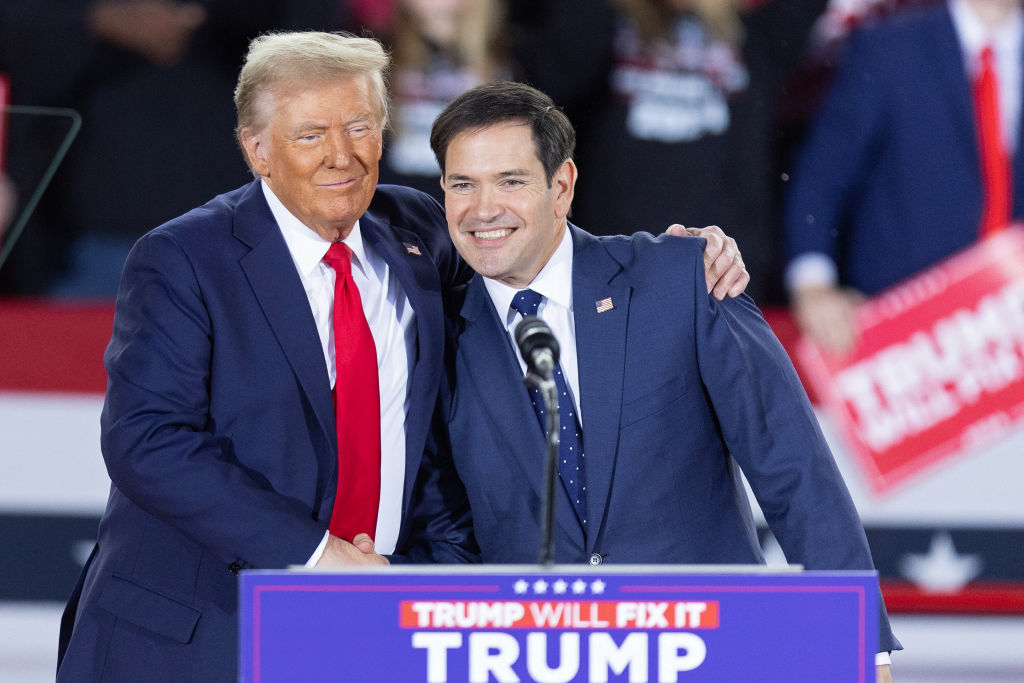
Former US President and Republican presidential candidate Donald Trump greets Senator Marco Rubio, Republican of Florida, during a campaign rally at the J.S. Dorton Arena in Raleigh, North Carolina, on November 4, 2024. Bitter rivals Kamala Harris and Donald Trump embark on a final frenzied campaign blitz Monday with both hitting must-win Pennsylvania on the last day of a tight and volatile US presidential election campaign. (Photo by Ryan M. Kelly / AFP) (Photo by RYAN M. KELLY/AFP via Getty Images)
Next year, the US political landscape will be characterized by control of all the levers of institutional power by the Republican Party, with Donald Trump and his party controlling the executive, the Congress, and the Senate.
In this context, it is likely that various projects to assault Venezuela will be resuscitated. Some already have, such as the “Bolivar Act,” which could be enacted before the close of the current 118th Congress.
Reviewing these initiatives allows us to glimpse what is being said in the halls of the Capitol building about the course the US will take towards Venezuela, as they did a decade ago under the clauses of the Venezuela Human Rights and Democracy Act of 2014, enacted at that time by Barack Obama.
Budget allocations Throughout the 118th Congress (2023-2024), 130 bills related to Venezuela have been introduced. The data show that, despite this number, the concrete results are limited: only 19 of these bills passed a single legislative chamber and only eight were approved in both chambers, thus becoming laws.
This low rate of legislative success—less than 7%—indicates both the complexities of the US legislative system and the politically charged nature of issues related to Venezuela.
All of these laws originate from the House of Representatives, which has specific prerogatives to address budgetary and financing issues, which are usually framed in what are known as “appropriations.”
Although the content of these eight laws are bureaucratic in their structure, they also maintain a clear strategic intention in two fundamental areas: the external financing of democracy programs, on the one hand, and security initiatives, which outline the specific interests of US foreign policy. Both aspects are framed within a broader plan for regime change promoted by Washington.
A representative example is the “Further Consolidated Appropriations Act, 2024,” which allocates US $50 million to the “Economic Support Fund” to finance what they call “democracy programs in Venezuela.” Although the text lacks details, it mentions that the resources will be directed to activities such as electoral observation and the promotion of the participation of opposition candidates. This type of external financing reflects a clear intervention against Venezuela’s sovereignty under the guise of promoting “democratic values.”
Another relevant law is the “National Defense Authorization Act for Fiscal Year 2024” which includes specific allocations on Venezuela but with a more security- and intelligence-oriented focus. This law requires the director of national intelligence to submit a report to Congress on the Venezuelan government’s actions to “detain US citizens.” However, regarding this segment, it should be noted that such detentions are due to activities that threaten the security and sovereignty of Venezuela, such as espionage, conspiracy, or direct interference in internal affairs. By requiring details such as the names and positions of Venezuelan officials, as well as an analysis of the motivations behind these actions, the law seeks to reinforce a hostile narrative that ignores Venezuela’s legitimate right to protect its internal order against external threats.
These clauses allow Congress to oversee and influence future negotiations linked to the exchanges of citizens detained in both countries.
These laws do not represent a significant change in the United States’ policy towards Venezuela but, rather, the continuation of a dynamic in which the country is considered a “foreign adversary” along with countries such as China, Russia, and Iran, a sufficient pretext to routinely include it in budget allocations and security guidelines in order to maintain the agenda of political and diplomatic pressure on the Venezuelan government.
Illegal extraterritorial projects According to this review of legislative initiatives oriented towards international political issues, a clear pattern of intervention through the use of extraterritorial legal instruments is revealed.
These projects, which represent 38% of the total identified in the thematic review, show a consistent approach in the design of regulatory frameworks that seek to consolidate the policy of sanctions and isolation against Venezuela, with implications that go beyond the national borders of the United States.
In contrast, the energy sector did not represent a significant percentage, with only eight related bills. This is because the legislative approach does not need to focus exclusively on the energy sphere when there is already a well-established system of financial coercion that meets Washington’s strategic needs to sanction other countries.
This system allows the United States to operate with flexibility in order to restrict key resources, such as Venezuela’s oil revenues, through broader financial mechanisms that affect the entire spectrum of economic operations, thus minimizing the need to legislate directly on energy.
However, the most notable initiatives within this segment of “international affairs,” still to be enacted, are those entitled “Verdad Reauthorization Act” (Law of Emergency Aid, Assistance to Democracy and Development of Venezuela), “Valor Act of 2024” (Law for the Advancement of Freedom, Opportunities, and Rights in Venezuela), and the “Bolivar Act” (Prohibition of Operations and Leases with the Illegitimate Venezuelan Authoritarian Regime). Their common denominator is to protect executive orders linked to illicit sanctions against Venezuela.
These regulations are not limited to sanctioning the Venezuelan State directly but also extend their scope to third countries that maintain commercial relations with Venezuela or that act as intermediaries to evade sanctions. This aspect introduces the extraterritorial dimension that seeks to dissuade international actors from collaborating with Venezuela under the threat of facing legal and economic consequences in the United States.
Essentially, these instruments seek to prevent such proclamations from being revoked unilaterally by the president in office. By converting their modification or elimination into an exclusively legislative procedure, these laws limit the flexibility of the executive branch and, at the same time, prolong the effects of illegal sanctions, even in scenarios of possible changes of administration or of political approach in Washington.
Legislative shielding represents a sophisticated use of economic asphyxiation measures as a foreign policy tool, consolidating an approach that combines economic pressure and diplomatic isolation.
Within this thematic framework, there is also the “Stop Maduro Act” (Law to Guarantee Timely Opportunities for Payment and Maximize Rewards for Detaining Officials of Illegal Regimes), which establishes raising the reward offered for information leading to the capture of President Nicolás Maduro to US $100 million.
Ultimately, this set of projects reflects a coordinated and phased approach that combines elements of economic pressure and judicial persecution, expanding the sphere of US intervention through extraterritorial measures.
Marco Rubio: the architect of illegal sanctions From the Senate, Marco Rubio, a Florida Republican and the next secretary of state in the Trump administration, has played a key role in legislative projects related to Venezuela during the 118th Congress.
Of the 21 projects he sponsored, several address measures that, albeit indirectly, include Venezuela within a broader narrative of confrontation with actors considered strategic adversaries of the United States, such as China, Russia, and Iran.
Known for his role in shaping the sanctions policy towards Venezuela, Rubio has highlighted three legislative initiatives that reflect his intention to expand the tools of financial coercion against the Venezuelan state.
Far from limiting themselves to reinforcing existing restrictions, these initiatives aim to provide them with a more solid legal framework, making it even more difficult to attempt to relax or advance bilateral negotiations.
The Venezuela Defense of Human Rights and Civil Society Reauthorization Act of 2023 represents a renewal of the 2014 Law and an expansion of the sanctions already in force. This sanctioning framework includes restrictions against military cooperation with Russia and against access to international financial systems and the ability to acquire weapons, perpetuating the siege that has characterized US policy towards Venezuela.
On the other hand, the proposal known as the “SEPAM Act” (Sanctions Evasion Prevention and Mitigation Act) expands the scope of pressure measures by including alternative financial systems developed by countries such as China, Russia, and Iran, which have sought to reduce their dependence on the financial infrastructure dominated by the United States.
This bill establishes severe measures against institutions that operate with platforms such as the Chinese Cross-Border Interbank Payment System, the Russian Financial Transfer Message System, and the Iranian Electronic Payment Messaging System.
By promoting illegal actions such as the freezing of assets, the prohibition of correspondent accounts, and the revocation of visas to executives of these institutions, the law seeks to block any effort by Venezuela and other sanctioned countries to find alternative financial channels.
Although there are limited exceptions for intelligence activities or international commitments, the central objective of this legislation is to ensure that illegal sanctions are globally unbreakable and effective.
This not only limits the president’s ability to use sanctions as a negotiating tool, but also makes any change in policy toward Venezuela require legislative approval, a process that is complex and unlikely in the short term.
Another project promoted by Rubio was the “Western Hemisphere Security Strategy Act of 2023” that reflects his geopolitical vision for Latin America and the Caribbean, structured under a hemispheric strategy that seeks to reaffirm the influence of the United States and counter the presence of powers such as China, Russia, and Iran.
Among its tools, it highlights the provision of financing, technical assistance, and military training to increase the capabilities of partner countries and, at the same time, restrict foreign investments from nations that are adversaries to the United States.
In short, this project reveals the approach that Rubio could adopt as a future US secretary of state. This project includes strengthening regional alliances through political and economic pressure while intensifying sanctions as a tool to try to isolate Venezuela and marginalize external actors that maintain strategic relations with the country. This position seeks not only to reinforce US hegemony in the region but also to weaken any attempt at multipolar integration that challenges its influence on the continent.
This balance not only reveals the priorities of US foreign policy towards Venezuela, which is framed in coercive measures, but also outlines a possible scenario for the incoming Congress in 2025.
The next US administration will face a regulatory environment designed to perpetuate these policies, limiting the options for any significant change in the bilateral relationship between the US and Venezuela.
This framework also represents an attempt to mitigate the growing influence of actors who have gathered against sanctions, as previously noted. However, the path to intensifying coercive measures is not without challenges. These movements seek to consolidate the hardline in foreign policy against Venezuela and to pressure Trump to adopt an agenda aligned with the most aggressive interests in terms of economic and financial siege, moving away from the negotiating nature that is typical of his experience and extensive career as a businessperson.